A story of my Cerebral
Palsied daughter, Rhonda Lou.
It was night in this
hospital room. A constant hollow sound of clatter prevailed. The
small ward held six beds with only three occupied. This building was
of a huge, heavy stone structure and was owned by Native Americans,
the Pawnee, to be specific even though it was named The Pawnee-Ponca
Hospital. Everything looked like a picture of institutions where
military men would go during war. These furnishings told of the
greater ownership by the Federal government of the United States of
America
The beds were white
of leggy small metal pipes and they were tall which brought a person
in them up to the edge of the span of windows. Lush green trees grew
in the low-lying land where a water table was close below.
Patients in the beds
during the day were given a view that was like looking down into a
manicured park where children and families of patients strolled
about while they waited on someone to be treated. Those were the
days when children were strictly forbidden to enter a hospital.
“Something in that
pill they gave me is making me so sleepy,” I told the patient in the
bed next to me.
She didn't answer and
only lowered her eyes. I expected no response. This young woman was
of my tribe and it was our teaching to be respectfully quiet. Her
half-smile and shaking of her head were enough to let me know she
understood.
“If no doctor shows
up here I will not be responsible for what happens.” One of the
nurses spoke into the telephone in a short, curt voice. The was
after nurse Bahayalle repeatedly tried to summon a doctor. My mind
mulled over what had happened to me while I was in labor.
I was well aware of
my sweet baby's difficult delivery. If a quick thinking nurse had
not been present, probably, neither my child nor I would have
survived.
Then there was a
bungled spinal block, blood spewing on all the nurses and doctor,
threshing, fighting, sitting up on the table after the failed spinal
block, these were all parts of my nightmare.
This blond, handsome
boy, who was my doctor, looked more like someone on a high school
basketball team and had probably not even completed his internship,
but he was steady and he did his best.
Rod, my husband, was
in and out of the nursery and my room watching both Rhonda, our
baby, and me after the delivery. He said the doctor held the tiny
newborn through the first night and gently tapped the bottoms of her
feet when she stopped breathing. I was thankful for that kindness.
Like a ghostly
apparition in white the young doctor now had suddenly appeared out
of the half light and was standing at the end of my bed. His size
was overwhelmed by the spaciousness of the room and he looked
forlorn, set away from all others. There was no malice for this man
who was little more than a boy. In this fight while in his youth he
had been quite alone in the decisions made during my child's
delivery. He bravely stepped up when no one else did and carried on.
The doctor came
around to the foot of my bed. It was as if he didn’t really want to
talk with me. There was no load of patients scheduled upon his time,
not at this far out place on the edge of vast prairie lands where
only ranches occasionally dotted the horizon. These doctors called,
"government doctors" by the Natives really did not have a heavy
load.
This hospital served
basically two tribes, the Pawnee and Ponca. Neither one of them had
much of a population. At the time the Native people maintained
strength and good health handed down from their ancestors.
There were serious
concerns with tuberculosis, diabetes and such diseases but the
tuberculosis cases were sent on to Shawnee, Oklahoma to a hospital
there called a sanitarium. The environment here at this place was
one of an unhurried and relaxed atmosphere.
“I must tell you,
because your delivery was very difficult your baby was quite
seriously injured. I feel she will be retarded in some way, either
physically or mentally.”
It was as if he,
rather than I, was showing anger. What thoughts must be going
through his mind? Was he angry with the doctor who fled to vacation
time then returned the next day to deliver a perfect baby by
caesarian for a woman my age who was dark skinned and visably Native
American? Maybe he believed because I, who was of fair skin, should
not have intruded upon the dedication he felt was to be made only to
those who looked to be Native.
So many times, this
happens to those of mixed Native American and Caucasian blood who
are using the facilities provided that were their inherited rights.
This was the curse and the silent persecution the “half-blood,”
often endures. If the issue had been voiced to the one who practiced
it they would have been loud in their denial. Only the person
experiencing the punishment knew. It has a name, though, and is
called, reverse-discrimination. Certainly, he did not know even a
whisper of the depth of possession a Native American feels for what
had been issued to them as payment for treasured home lands. The
ownership and inheritance is honored through cash payments from the
offices of the United States government, no matter what color the
person is. If the proof of bloodline is there so will be the money,
scant that it is.
He had no
understanding of that, not even a clue. No wonder the man felt
anger, he was caught between issues totally foreign to him as much
as if he had been in another country and was the intruder. He had no
proper back-up education and direction for a complex social web like
this. The youthful doctor did what he could with what he had.
It was the worst
place I could have been at that time, even though regular visits
were met along with all their requirements. In my naive reasoning
there was trust here on my part. Had we not used this hospital since
I was a chld? Another lapse in sanity on the part of that
institution was that there was actuality no kind of proper teaching
with Lamaze as is done today.
A kind, world of
blackness was waiting for me and I slipped away from all things mean
and harsh to sleep a dreamless sleep.
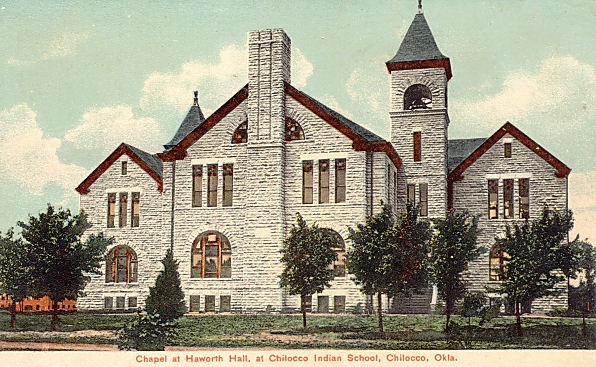
This is a picture of Chilocco Indian School but the architecture is very
similar to the hospital at Pawnee, Oklahoma.
 |



