|
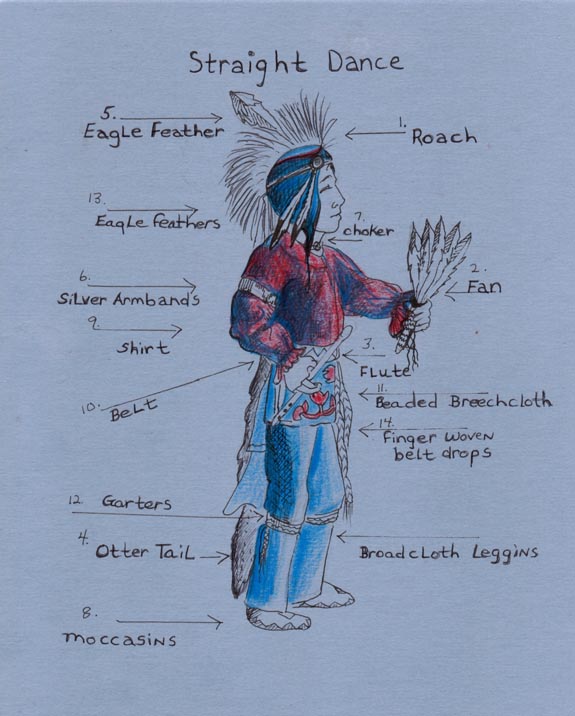
Today, these dances simply are called pow-wow.
Let it be made clear at one time they were not considered recreational
completely, although they were enjoyed. When a person went into the arena,
they were supposed to focus, looking straight ahead, having their dress in
order, shawls in place neatly, and not looking here and there, back and
forth at other dancers. Instead, they were to be respectfully and
sincerely involved, concentrating on the straightforward way of the dance,
thus the name "Straight Dance." The regalia is worn mostly by
the older Ponca men and the Osage. Most usually, the otter tail is with
the Osage. The following is a numbering of articles of the regalia. There
was a time when each piece of the regalia had a meaning and symbolism
which were just another way of teaching faith, and ethics done in the
easy-going way of the Gentle Leaders, Ponca. The straight dance is
performed with more decorum.
1. Roach
The roach is a thing of fine artwork and
unusual beauty. The spreader, or piece of porcupine or deer-hair is woven
through on the edges. The spreader is lovingly decorated with beadwork On
the spreader is a holder which holds the eagle feather erect at the top of
the head. A lot of the time the dancer makes his own costume but, there is
also those who specialize in one or the other parts of the costume. There
is a gentleman in Pawhuska, Oklahoma who makes these and it is my
understanding the cost is in the hundreds of dollars. Each feather, each
part of the costume must be well anchored because if any part is lost
during dance the person can be eliminated from competition.
Symbolism: Eagle feather at the top of the
head in learning from the eagle his vision, which scientists today tell is
telescopic, allowing him to see long distances away. Something, it would
be wise for anyone to cultivate.
Porcupine and deer hair roach, taking a
stand at the top of the head, foremost. It is good to be like the
porcupine, always ready with a practical defense which can come from our
mind, just as Chief Standing Bear fought through the white courts to claim
his right as an American citizen to be considered a human.
2. Fan
This illustration is just a sketch to show
the fan. There are really no words to describe the intricate beauty of
this part of the regalia. It is the most beautiful of artwork. Intricate
bead work covers the handle. The feathers themselves are set so carefully
together. Their own design is a part of the total piece bringing so much
fragility; yet, strong character to the object. It is a utilitarian object
for what it is, a fan, for after one the most active dance has heated the
dancer to a point he wants a bit of cool air. The way the dancers hold the
fan forward, as though making a statement seems to give proof something
else is being addressed.
3. Flute
The high-pitched notes of the flute during
a dance create moods for me. Sharp, staccato and brief, but for some
reason very expressive. Flute makers and those who teach the flute are a
part of the society our Oklahoma historical people are reviving, along
with other things like drum makers, ribbon work, and so on.
4. Otter Tail
The otter is an animal never to stop
playing, no matter how old it gets. This was symbolic for tribes and
represented life itself. I have heard one older dancer say, "The
otter tail can get it the way while I'm dancing. I have to kick it out of
the way, sometimes, to keep it from tripping me up."
5. Eagle Feather
Eagle feather at the top of the roach,
standing and held by the roach holder. When the dancer throws his head
back and forth the eagle feather moves almost as if it is alive again.
This is a lovely small part of the dance. Eagles are greatly admired and
as I've had a small opportunity to observe one brought to a lecture by an
ecologist I was very impressed with the bird. This one had damaged
eyesight so could not hunt and had to be kept in captivity. As the
gentleman spoke the bird was regal and apparently uninterested in the
video tape I made. However, when the man said, "We feed him
mice," the eagle turned his head quickly and was looking the man over
as if to say, "Mouse?" "Someone mention food?"
6. Silver Armbands
Useful decorative ornaments which hold up
shirt sleeves to the place the dancer wants them on his wrist.
7. Choker
With shell dish at the front, sometimes.
This is made with short bone beads, usually. It is an attractive piece as
well and some folks enjoy making just this one article. The cost is
governed by what beads the person uses as to their being authentic bone,
plastic, or even antique.
8. Moccasins
Here again the change in style is so varied
over the past few years. It seems to me anything hand made and attractive
seems to be the rule. Mother had my daughter a pair made and it was marked
with a star on the front which was strange to me, because my Osage blood
goes to Star Walker. I think Mother knows more than she tells me on that.
9. Shirt
Mother is a gifted seamstress on these
shirts. They can be so very beautiful out of fabric the dancers themselves
choose. Sometimes, brocade, other times a soft cotton fabric. She makes
them almost identically to the Scotsman's shirt, except there isn't as
much blousing at the arms. The difference is the ruffle around the wrist.
This is an added feature not always available to the man, depending on his
own taste or the willingness of his seamstress to add it for him.
10. Belt
The belt has a stiff leather backing. It is
wide and it is hand beaded. A fine work of art worth a great amount of
time and beadwork. It could be considered priceless because, genuinely, it
makes the regalia.
11. Beaded Breechcloth
Just as this regalia is kept by a most
conservative people this article has not changed over many years. There
are early photographs showing the woodland beadwork on this article of the
regalia. These parts are assembled at great expense to the dancer. This in
itself is a training in discipline. In days gone by, and now also, it was
common for the man to do the work himself. Jobs, limited time, now cause
the male to have help from whatever source he can find. Sometimes,
purchasing articles from crafts people, who specialize in one part of the
dress, or having them gifted to him, or handed down from other family
members.
12. Garters
These are lengths of yarn, finger woven
straps. This finger weaving is a most difficult craft to master. One of
the common designs is the chevron which is indicated here. These drops are
worn on the left side. These are also very expensive parts of the dress
since, it is so time consuming to do this. Twice now I have knitted a
quick replacement for the difficult part of the regalia to obtain until
the dancer could come to owning an authentic drops and garters. The
knitting is fine if one uses a small needle, giving the belts a flat close
weave. When the belt is pressed with a steam iron the yarn relaxes and
becomes a temporary replacement
Finger weaving was all but lost until a
group of women took many hours to teach and bring it back from
instructions they obtained out of the archives in Washington, D.C. One of
the ladies was Maudie Chesselwalla of the Osage tribe. Another was Delia
Castor, daughter of Dr. Franklin. Delia was non-Indian but, had a love for
the culture. She worked very hard for a life time to preserve many
beautiful things we would not have today without her dedication.
The Glass Negative owned by Mr. and Mrs.
Ray and Velma Falconer is a place where one can see many antique
photographs. The regalia on these will show the finger weaving.
13. Eagle feathers
Worn attached toward the front of the head.
Some books have called these plumes, and here again is the Ho! Ho! Ho! A
plume refers to what a woman wears. Just recently one of the elder women
was very put out with a hobbyist who had a plume in his hair. "Oh
my!" She said. So, you see, it is easy to make a mistake if one does
not know the proper etiquette.
14. Finger woven belt drops
These are wider than the leg garters, of
course, and longer. In a pinch I have knitted these also with a variegated
colored yarn. It isn't proper, but it serves.
15. Broadcloth leggins'
Broadcloth is a very expensive fabric woven
of wool. How far it goes back I do not know. The fur trading posts sold
it. It is usually dark blue but can be red. It holds it shape but can be
very warm during the summer months.
So there you have the Straight Dance
Regalia. If you are ever fortunate enough to enjoy a pow-wow in Oklahoma
you will surely see this gentlemanly regalia. I hope you enjoy being able
to identify the different items of dress. What makes it enjoyable is the
way each dancer adds his own personality to it. |



