|
The
prehistoric flint arrowheads so numerous in Scotland were long considered
by the peasantry to have fallen from the clouds, and to have been used as
weapons by the fairies to shoot at human beings, and especially at cattle.
A peculiarity of these elf-arrows or elf-bolts is
that they were never to be found when looked for, but turned up in the
most unexpected localities and circumstances. Thus Sir Robert Gordon of
Straloch, the Scottish geographer, who wrote over two centuries ago,
describes these elf-arrows, and states that a man, while riding, found one
in his boot, and that a woman found one in the breast of her dress, both
in an unexpected way. In 1590 occurred the remarkable trial of Katherine
Ross, Lady Fowlis, who was accused of witchcraft and sorcery in attempting
the destruction of some of her husband’s relatives by causing clay images
of them to be made, and shooting at these with elf-arrowheads. No mention
is made of the manner of discharging the arrowheads, but probably they
were shot in the manner described by Isobel Gowdie in her confession,
quoted further on. In the "Dittay against the Pannell," Lady Fowlis is
accused—
"In the fyrat, Thow art
accusit for the making of twa pictouris’ of clay, in cumpany with the said
Cristiane Roiss and Mariorie Neyne M’Allester, alias Laskie Loncart, in
the said Cristian Roisis westir chalmer in Canorth; the ane, maid for the
distructioune and consumptioune of the young baird of Fowlis, and the
vthir for the young Ladie Balnagoune; to the effect that the ane thairof
sould be Putt att the Brig-end of Fowles, and the vther att Ardrnoir, for
distruetioun of the saidis young Laird and Lady: And this sould hail bene
performit at Alhallowmes, in the year of God Im. ye. lxxvij zeiris:
Quhilkis twa pictouris, being sett on the north syd of the chalmer, the
said Loskie Loncart tuik twa elf arrow heides and delyuerit ane to ye
(you) Katherene, and the vther, the Mid Cristian Rois Malcumsone held in
her awin hand; and thow schott twa schottis with the said arrow heid, att
the Mid Lady Balnagowne, and Loskie Loncart schott thrie schottis at the
said young Laird of Fowlis. In the meane tyme, baith the pictouris brak,
and thow commandit Loskie Loncart to mak of new vthir twa pictouris
thaireftir, for the saidis persounes; quhilk the said Loskic Loncart tuik
vpoun hand to do."In the remarkable confession of
Isobel Gowdie, one of tho Auldearn witches, in 1662, there is the
following curious account of the manufacture and use of elf-arrows
:—
"As for Elf-arrow-heidis, the Divell shapes them with
his awin hand, [and syne delivers thame] to Elf-boyes, who whyttis and
dightis them with a sharp thing lyk a paking neidle; bot [quhen I wes in
Elf-land ?] I saw them whytting and dighting them. Quhen I wes in the
Elfes howssis, they will haw werie...... them whytting and dighting; and
the divell gives them to ws, each of ws so many, quhen...... Thes that
dightis thaim ar litle ones, hollow, and boss-baked. They speak gowstie
lyk. Quhen the divell gives them to ws, he sayes,
‘Shoot thes in my name
And they sall not goe heall hame !’
and quhan ve shoot these arrowes (we say)—
‘I shoot yon man in the Divellis name,
He sall nott win heall hame !
And this salbe alswa trw;
Thair sall not be an bitt of him on lieiw !’
We haw no bow to shoot with, but spang them from of the
naillis of our thowmbes. Som tymes we will misse: bot if they twitch, be
it beast, or man or woman, it will kill, tho’ they haid an jack wpon
them."
When a cow has been elf-shot it "refuses its food,
looks languid, and breathes hard. The old knowing women rub and search the
hide of the beast, where they pretend to find holes, not in the hide, but
in the membrane under it. These they rub well with their fingers, and
bathe them with salt and water. When all the holes are thus found out and
rubbed, two table-spoonfuls of salt are dissolved in half a Scotch pint of
cold water, a little of it poured in the ears, and the remainder poured
down its throat; and after some time is thus spent in going through this
process, the animal generally recovers. Some silver is put in the water
when the salt is dissolving in it." And the writer adds, "I do not pretend
to account for this distemper or cure, but I have felt what they termed
holes, and have seen all the ceremonies performed." Another cure recorded
by Pennant is to touch the cow with an elf-arrow, or make it drink the
water in which one has been dipped. In the united parishes of Sandsting
and Aithsting the cure was effected by folding a sewing-needle in a leaf
taken from a particular part of a psalm-book and securing it in the hair
of the cow. This was considered not only an infallible cure, but served
also as a charm against future attacks.
According to the late Dr John Hill Burton, cited by Sir
John Evans, it was an article of faith in Scotland, so late as 1872, "that
elf-bolts, after finding, should not be exposed to the sun, or they are
liable to be recovered by the fairies, who then work mischief with them."
In Sutherlandshire, it is stated by Mr Hew Morrison, a Fellow of the
Society, that in his younger days "arrowheads of
flint were religiously consigned to the nearest loch, or buried out of
sight, as instruments of evil;" and he adds, "Even so late as 1866 or 1867
I saw a cow which was said to have been killed by the fairies with these
weapons; and when I pointed out to the owner of the animal that her death
had been caused by rolling over, and her long horns penetrating the ground
and keeping her in a position from which she could not rise, I was told
that that was the common way in which the cows fall when struck by the
arrows of the shithich or elf-bolts."
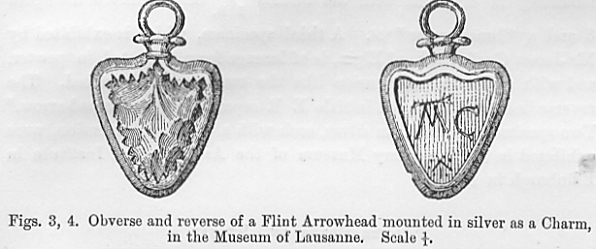
Of Scottish flint arrowheads which have been mounted in
silver for use as amulets, the following specimens are either in existence
or on record. Figs. 3, 4 represent the full size, the obverse and reverse,
of a specimen now in the Museum at Lausanne, Switzerland, but brought from
Edinburgh. The arrowhead is enclosed in a mounting of silver, which is
engraved on the back with the initials A. C. separated by a star. The
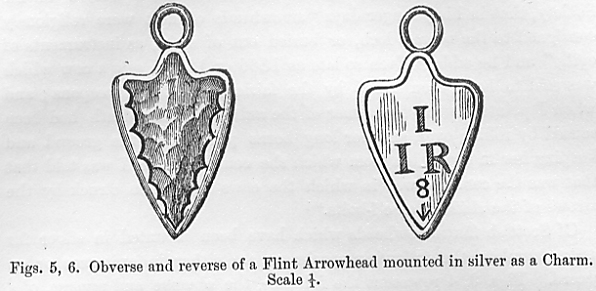
silver mounting is probably early 17th century work. Another which was
worn suspended from the neck by an old Scottish lady for half a century is
shown in figs. 5, 6. The reverse of the silver mounting is engraved with
the initials I I R below which is the figure 8 and a "broad-arrow."
A third specimen, which is exhibited by Mr James
Cruikshank, of Elgin, is of lozenge form, mounted in pewter, and with a
loop for suspension like the two already described. The reverse bears the
engraved initials E R separated by a "broad-arrow." Two specimens mounted
in silver, each with a loop for suspension, were exhibited in the
temporary Museum of the Archaeological Institute in Edinburgh in 1856. |



