|
A BRIEF HISTORY OF
THE COLLEGE
A question often asked of us (both in Spain
and in Scotland) is: Why is there a Scots College in Salamanca.. or even
in Spain? The answer begins in 1560 when the Scots Parliament outlawed the
practice of the Catholic religion in Scotland. To ensure a supply of
priests for the Scottish Mission, seminaries were founded at Tournay
(later moved to Douay), Rome, Paris and Madrid. Honourable mention should
also be made of the Benedictine monasteries of Regensburg and Würzburg
which also provided priests for Scotland in those difficult times.
 Colonel
William Semple of Lochwinnoch, after a life spent in the military and
diplomatic service of the Spanish crown, founded (with his wife, Doña
María de Ledesma) a college in Madrid in 1627, entrusting its running to
the Jesuits. Their deed of foundation stipulated that the college was for
students "Scottish by birth, preferably those of superior character and
virtue and those who promise more fruit in the welfare of souls, and they
have to spend whatever time may be necessary in studying Grammar and
Philosophy, Theology, Controversies and Sacred Scripture, so that when
they are well versed in all of these, they may proceed to the said Kingdom
of Scotland to preach the Gospel and convert heretics... when they leave
the said seminary for this purpose, others are to be received in their
place having the same end, and thus the matter will continue for as long
as the aforesaid conversion may require". Colonel
William Semple of Lochwinnoch, after a life spent in the military and
diplomatic service of the Spanish crown, founded (with his wife, Doña
María de Ledesma) a college in Madrid in 1627, entrusting its running to
the Jesuits. Their deed of foundation stipulated that the college was for
students "Scottish by birth, preferably those of superior character and
virtue and those who promise more fruit in the welfare of souls, and they
have to spend whatever time may be necessary in studying Grammar and
Philosophy, Theology, Controversies and Sacred Scripture, so that when
they are well versed in all of these, they may proceed to the said Kingdom
of Scotland to preach the Gospel and convert heretics... when they leave
the said seminary for this purpose, others are to be received in their
place having the same end, and thus the matter will continue for as long
as the aforesaid conversion may require".
 For
various reasons too complex to treat here, the College in Madrid did not
produce very many priests for the mission in Scotland and at times was
almost on the verge of extinction. Such was the case when in 1771 John
Geddes (later to be Vicar Apostolic of the Lowland District in Scotland)
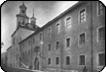
obtained from Carlos III the use of the former Jesuit Colegio de San
Ambrosio in Valladolid. Luckily, for us Scots at least, in 1767 the king
had suppressed the Society of Jesus in his realm and many of the former
Jesuit buildings lay empty. The original Cédula Real (Royal Charter) of
1771 granting us part of the building was followed in the same decade by
others which gave us the use of more of the building and granted us
similar constitutions and rights as had the English Colegio de San Albano,
founded in Valladolid in 1589. For
various reasons too complex to treat here, the College in Madrid did not
produce very many priests for the mission in Scotland and at times was
almost on the verge of extinction. Such was the case when in 1771 John
Geddes (later to be Vicar Apostolic of the Lowland District in Scotland)
obtained from Carlos III the use of the former Jesuit Colegio de San
Ambrosio in Valladolid. Luckily, for us Scots at least, in 1767 the king
had suppressed the Society of Jesus in his realm and many of the former
Jesuit buildings lay empty. The original Cédula Real (Royal Charter) of
1771 granting us part of the building was followed in the same decade by
others which gave us the use of more of the building and granted us
similar constitutions and rights as had the English Colegio de San Albano,
founded in Valladolid in 1589.
From its new base Valladolid, the Royal
Scots College sent a steady stream of priests to Scotland, achieving one
of our finest hours when by 1798 we remained the only Scots seminary on
the Continent functioning when the other colleges were suppressed in the
turmoil which followed the French Revolution and the rise of Napoleon,
although we too had to close our doors briefly from 1808-1816 due to the
Peninsular War. In 1812 our country house, built in the village of
Boecillo less than twenty years previously, twice played host to the Duke
of Wellington and his army in the course of his campaigns against the
French. It is also worth noting that in the early 19th century a number of
priests trained in Valladolid went as chaplains with the Scots who were
driven from their highland homes to seek refuge in Canada; some of these
priests became founding bishops of dioceses there.
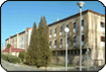
While the College had a long and fruitful
stay of more than two hundred years in Valladolid, occupied a
distinguished building in that city and had many friends and pastoral
contacts there, the decision was taken to move to the beautiful University
city of Salamanca in 1988: this was done principally to give our students
the possibility of attending the Pontifical University (established by
Pius XII in 1940, restoring the ancient Salmantino tradition of teaching
Theology and Canon Law to the highest level), thus allowing them access to
S.T.L. and J.C.L. degrees.
 For
some years after our arrival in the 'City by the Tormes' we rented a
building from the Marist Brothers and ended up buying it from them. This
building, while in a very pleasant site, bore all the hallmarks of a
Spanish 'rush job' of the mid 60's; these hallmarks were exacerbated in
1992 when we were linked up for the first time with the city mains water
supply... and the plumbing system could not cope. The virtually continuous
presence of plumbers and electricians convinced us that drastic measures
were needed... and we took them. For
some years after our arrival in the 'City by the Tormes' we rented a
building from the Marist Brothers and ended up buying it from them. This
building, while in a very pleasant site, bore all the hallmarks of a
Spanish 'rush job' of the mid 60's; these hallmarks were exacerbated in
1992 when we were linked up for the first time with the city mains water
supply... and the plumbing system could not cope. The virtually continuous
presence of plumbers and electricians convinced us that drastic measures
were needed... and we took them.
Having taken architectural advice from Scotland and from Spain, we
embarked on the great adventure of la reforma; a process which, painful
though it sometimes was, has given us the building we solemnly blessed in
October 1996 and now occupy with pride (and comfort). And why are we still
here? Read again the quote from the deed of foundation (making ecumenical
changes where necessary): that students trained here "may proceed to
Scotland and Preach the Gospel".
View their .pdf brochure here
| View the book about the college |




