|
Financial troubles in early
'Nineties-Some domestic disputes Theodore Napier and Bannockburn -
"Boisterous and insulting" conduct - Mayor of Melbourne walks out - New
secretaries - Ball shows profit of £1/19/3 - Ladies not admitted - Sir
John McIntyre, Sir Malcolm McEacharn, and Lord Brassey - Society's
remarkable record to 1898.
In spite of all the outings
enjoyed by members of Melbourne's Caledonian Society, and although
progress in general was sound, it is not to be supposed that all was plain
sailing with the organization in the late eighties and early nineties.
As a matter of fact, brisk
disputes developed at more that one meeting of the time. Members of the
Council, it is true, were a distinctly dignified collection-look, for
example, at a photograph of McBryde's team of 1893 for evidence on the
point-and they had their poise strengthened by the presence of the Rev.
Alex. Marshall, a Presbyterian parson who gave much sound service to the
Society. Nevertheless, various little troubles arose, and these were
charged against the Council by at least one trenchant critic.
Financial difficulties were
the main source of argument. Sports meetings, some of which had been
marred by bad weather, made a heavy drain on the Society's funds, and
there were frequent troubles in regard to the Choir, which was a somewhat
expensive enterprise. Within three years that body had three conductors:
Robert Kennedy, V. S. Dodds, and James Ure. Later (1890) Thomas Hammond
was appointed conductor, at a salary of £80 a year, upon which the Choir
broke new ground by giving a concert at Geelong.
Other demands upon the
Society's funds were made by the accommodation problem-meeting-places in
this period varied considerably-and by the determination of members to
maintain their charitable work. It is a striking fact that during the
first half-dozen years of the reconstructed Society, meetings of the
Council were largely taken up with the examining of charitable appeals.
Subsequently (1891) a
Charity Committee of the Council was established, as well as a Finance
Committee and a Musical and Social Committee.
In addition to financial
problems, the Society was troubled now and again by domestic disputes-the
"growing pains" that overtake pretty well every organization of the kind.
Theodore Napier (the
resolute fellow who objected to the over-free use of the word "England")
threw a spanner into the works in 1890 by trying to get the Society to
celebrate, on 24th June of each year, the anniversary of the Battle of
Bannockburn, that historic clash in which -away back in 1314 - the Scots
under Bruce routed the English. His motion was defeated, after
considerable argument, but he came again later with a proposal to donate
£20 to the Bannockburn Memorial Committee at Stirling, and this time he
succeeded.
Friction of a more serious
nature developed, in 1890, through the medium of I. C. Park, a newcomer to
the Society, who actually went into action before his nomination fee had
been lodged. In the course of an attack on the management of the Society
(so say the records) "his whole conduct was so boisterous and insulting"
that the meeting agreed that his membership would be most undesirable, and
therefore his subscription was not accepted.
Was Park subdued? Not at
all. After taking legal advice on the matter he threatened the Society
with a writ, upon which the Society in turn sought legal advice. Much
argument followed, but eventually the Council decided to make peace - it
not only agreed to admit its critic to membership but paid his legal
costs.
That "victory" gave Mr Park
new life, so that he bobbed up soon afterwards, at a quarterly meeting of
the Society, with two destructive motions. The first, which aimed at the
discontinuance of the Society's annual ball on the score of expense, was
rejected by a large majority; and the second, which declared that because
the Choir cost about £200 a year it ought to be disbanded, lapsed for lack
of a seconder.
But even then argument was
not ended.
At that stage (1891-92) the
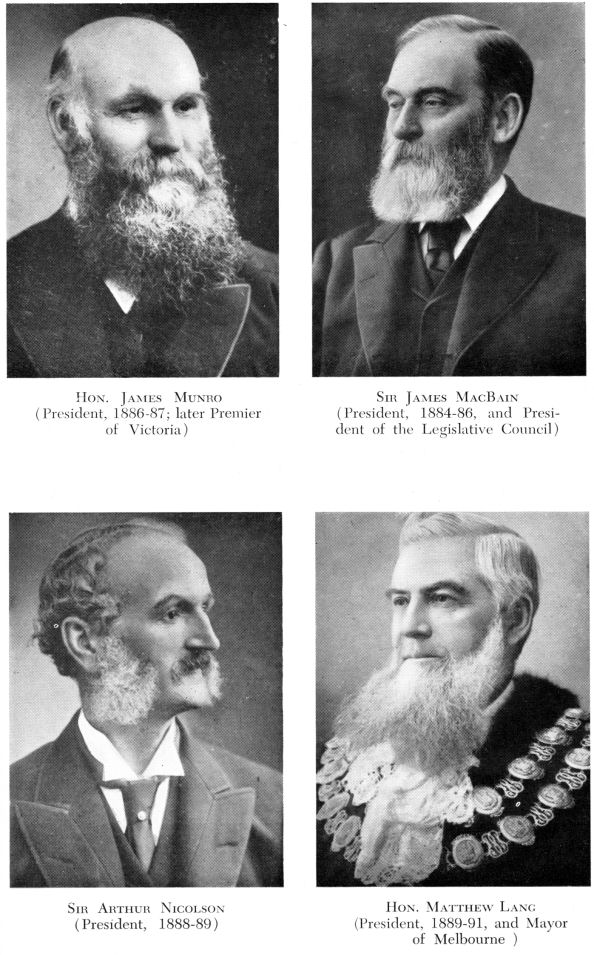
Society's President was Matthew Lang, Mayor of Melbourne and afterwards
M.L.C. He was succeeded by the Hon. Duncan McBryde, M.L.C., who later
became a Minister of the Crown. It was while Lang was handing over to
McBryde that Park provoked another storm-he did so by taking a point of
order when it was proposed to elect the retiring President to
life-membership of the Council.
Trouble arose at once. Sir
James MacBain tried to oil the turbulent waters, but someone else
supported the Park protest and "a scene of great disorder" developed. In
the midst of it all Mr Lang walked out of the room (which, by the way, was
in his own Town Hall), and when Mr Park tried to speak again members
refused to listen to him.
Oddly enough, Mr Park
succeeded with another restrictive motion when he took the floor again at
the next Annual Meeting-be persuaded members to agree to abolish the
entrance fee to the Society.
That abolition was rather
strange in view of the fact that many new members were still being
enrolled. Possibly, however, the healthy state of the membership was due
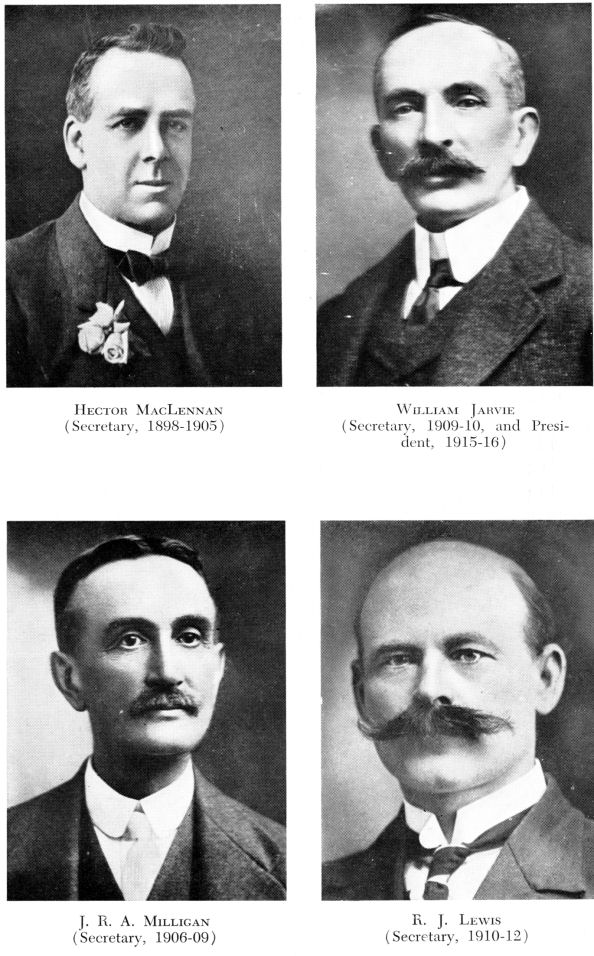
largely to the enterprise of the new Secretary, George B. Gordon, who had
succeeded Robert Gow (resigned to become a wine-grower) in May of '92.
Within his first few months of office Gordon not only collected lots of
subscriptions but turned the deficit on the annual ball into a profit of k
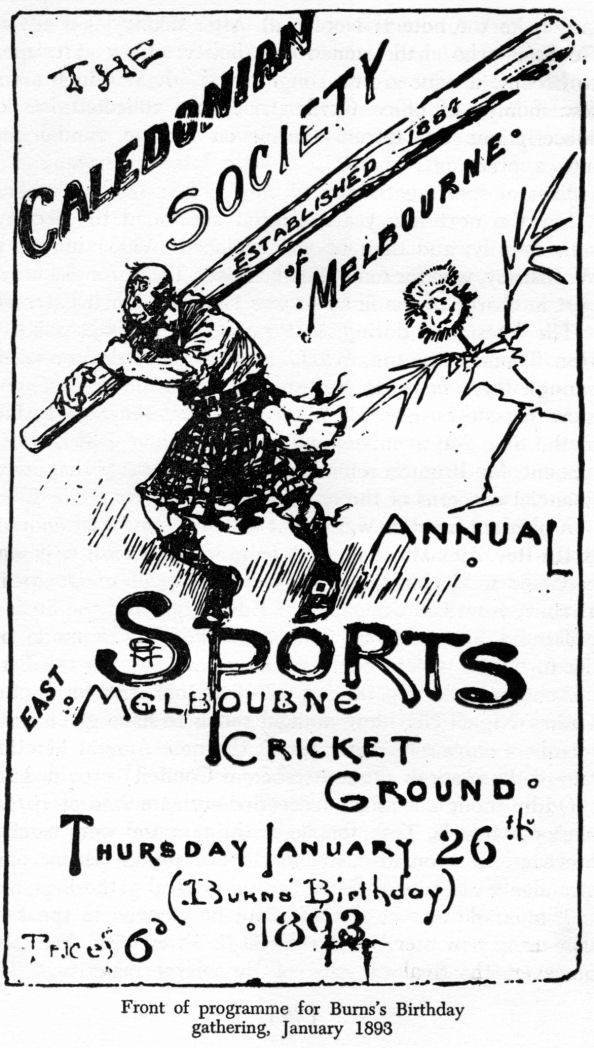
l/19/3! A little later he organised a successful sports gathering.
For the next few years
Gordon continued to carry on satisfactorily, and then he was replaced
(1896) by David W. Ramsay, who for some time had been Treasurer. Ramsay's
post in charge of the finances was taken by Hugh Paterson.
The President during that
period (1894-96) was the Hon. Thomas Brunton, M.L.C. Matters proceeded
smoothly enough then, concerts and smoke nights alternating with more
prosaic business. It is recorded that the Society had at the time 246
members and funds totalling P-200, which amount, Mr Brunton remarked, was
rather more than some financial concerns of the day could show.
A pleasant function was one
at which honour was rendered to the Rev. Alex Marshall, one of the
Society's most esteemed councillors. Mr Marshall received the degree of
Doctor of Divinity from the University of Edinburgh, and the Society
presented him with an illuminated address to mark the event.
Another cheery gathering of
1895 took the form of a Ladies' Night. That development seems to have
given some members chivalrous ideas, for at the next Annual Meeting one of
the motions (submitted from Council) provided for the admittance of ladies
to the Society at a rate of 10/6d. each per annum. The sponsors of the
proposal were careful, however, to stipulate that the 10/6d. would permit
only attendance at concerts, lectures, and general gatherings, and that
feminine members would "not be allowed to speak or vote at any meeting of
the Society". Even with that safeguard, the motion was rejected by a large
majority.
It is to be noted, by the
way, that one of the guests at the annual meeting then was the Hon. George
Reid, M.P., later Prime Minister. Had he been allowed a vote he would
certainly have been on the side of the ladies, for, according to Alfred
Deakin, he had a very keen bias in that direction.
As another aside, it may be
observed that Thomas Brunton, M.L.C., was lucky to be given a second term
of office in 1895, for of 12 Council meetings held during the previous
year he attended only one-a sharp contrast to the full 12 scored by Hugh
Paterson and the 11 each registered by Alex. Dick and Andrew Thompson.
In the years immediately
following, the Society continued to have distinguished citizens as
occupants of the Presidential office.
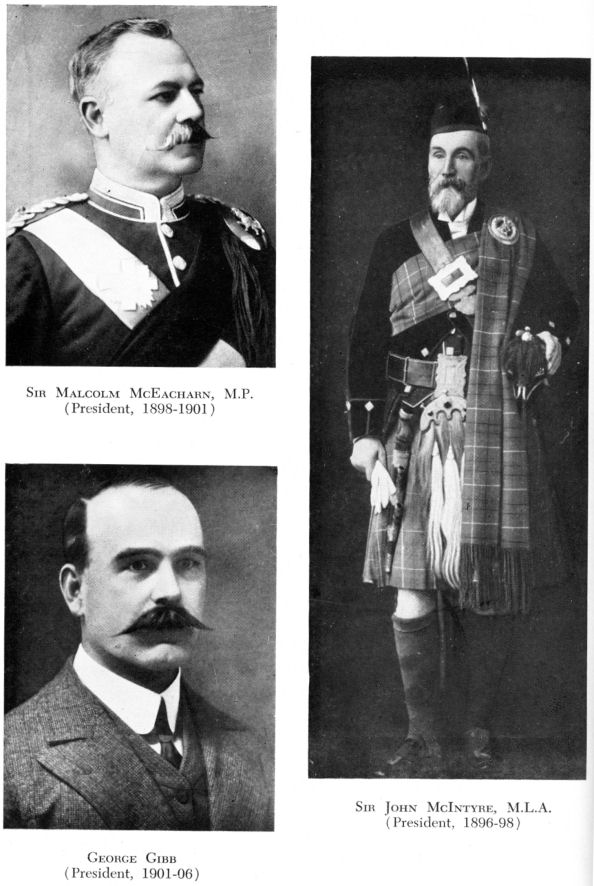
Sir John McIntyre (1896-98)
was a Glaswegian who came to Victoria in 1852 as a youth of 20 years,
joined in the rush to the Maryborough goldfields, and afterwards did much
towards the development of Bendigo. He was M.L.A. for Sandhurst in 1877-80
and also represented the Maldon electorate for 21 years. In 1893 he took
office as Minister for Lands, and later, as Leader of the Opposition, he
narrowly missed becoming Premier. He was knighted in 1895.
The next President of the
Society, Sir Malcolm McEacharn (1898-1901) was also an important figure in
public life. A product of Islay (one of Scotland's western isles), he
reached Australia as a young man in 1879 and in following years did well
as a pastoralist and cane-grower in Queensland. Later he founded the
shipping line of McIlwraith, McEacharn Ltd. He was Mayor of Melbourne in
1897-1900 -while occupying the position of President of the Society -and
was Lord Mayor in 1903-4. He was knighted in 1900 and in 1901 became
member for Melbourne in the first Commonwealth Parliament.
It was during Sir Malcolm
McEacharn's period as President that the Duke and Duchess of York (later
the King and Queen) arrived to inaugurate the Commonwealth, and he,
naturally, took a leading part in the activities organized by Australian
Scots as part of the celebrations. These included the presentation of an
Address of Welcome to the Royal visitors and the arranging of a most
spectacular display of Scottish dancing as a feature of the children's
demonstration.
Earlier-from 1896 to
1900-both Sir John McIntyre and Sir Malcolm McEacharn had received cordial
support in their Presidential work from the Governor of the period, Lord
Brassey, who made a point of attending pretty well every important
function of a Scottish nature organized in Victoria.
Consider now the remarkable
record of the Caledonian Society in regard to leadership:
In the early days
(beginning in 1858) its officers had included a Premier, two other
Ministers, nine additional members of Parliament, and numbers of other
eminent citizens. Within 15 years of activity of the reconstructed Society
(from 1884) the officers included at various times another Premier, the
President of the Legislative Council, two Ministers, two Mayors of
Melbourne, and a galaxy of other notable men. Furthermore, William
Alexander Watt, M.L.A., later to be Premier of Victoria for six years and
subsequently Treasurer, Acting Prime Minister, and Speaker of the
Commonwealth Parliament, had become a member of the Society's Council in
1898.
In addition to all that,
the Society had attracted to its ranks, as Patrons and active supporters,
two Governors and a future Prime Minister of Britain.
What better record of its
kind could any national body be expected to achieve? |



