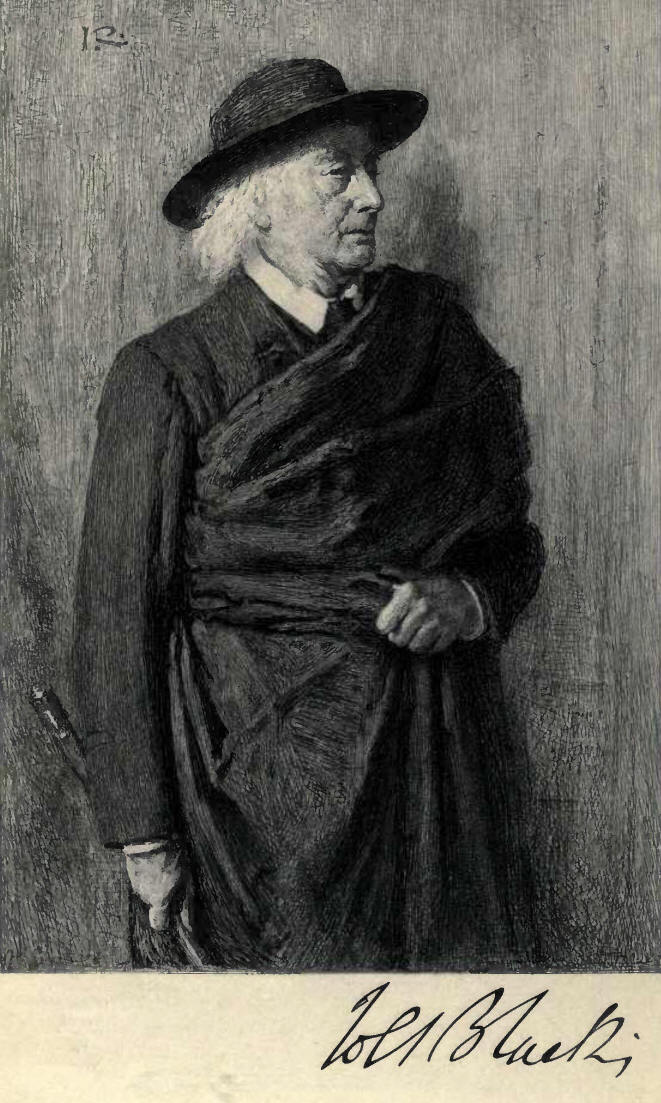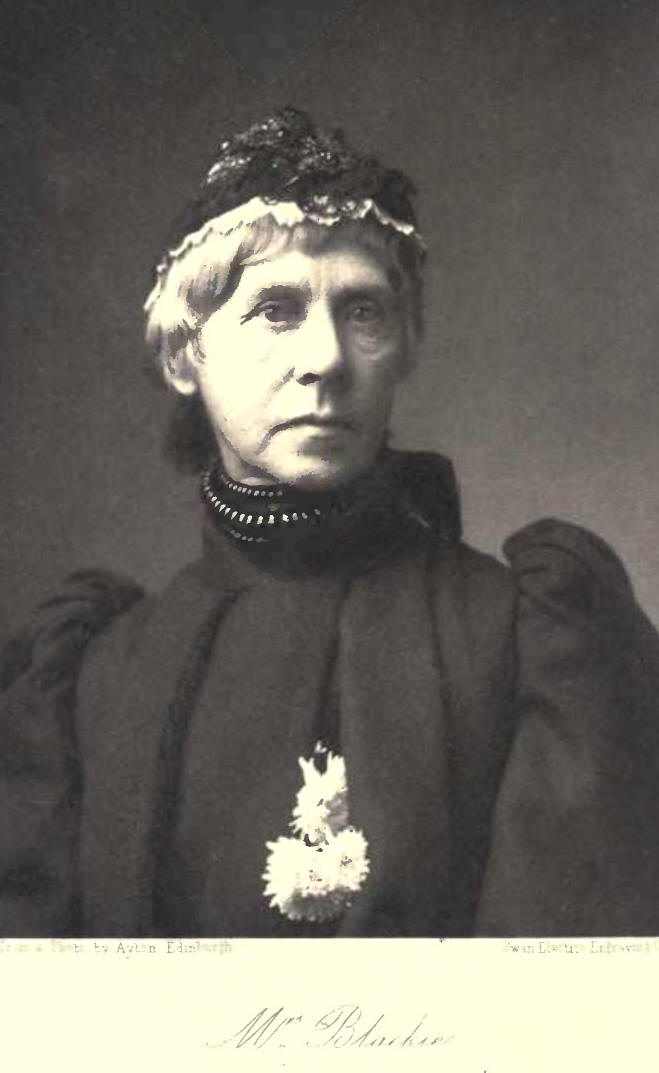
Preface
THE writer wishes to
acknowledge her great indebtedness to Mrs Blackie, who not only
intrusted her with the letters, MSS., and papers from which the
biography has been compiled, but has shown the most constant and
helpful interest in the work; to Dr Stodart Walker, who supplied her
with notes on the Professor's relations with the students of
Edinburgh University, and on the incidents of his last illness; to
Professor Mackinnon, for his important contribution to the history
of the Celtic Chair; to Professor Cowan, for his reminiscences of
the Greek Class, and for information referring to the Travelling
Greek Scholarship; to Dr Donaldson, Principal of the University of
St Andrews, for information with regard to University Reform; to Dr
Forbes White, Mr Burness, Dr Gardiner, Mr George Seton, Sir Arthur
Mitchell, and other friends of Professor Blackie's, for
reminiscences and anecdotes of importance to the presentation of his
individuality; to Sir Theodore Martin, K.C.B., for greatly esteemed
interest and suggestions; to the executors of the late Mr J. A.
Froude, and to many others, for their kind permission to quote from
letters written to Professor Blackie; to the executors of the late
Sheriff Nicolson, for their kind permission to make quotations from
his poems; to Mr David Douglas, for furnishing statistics of
publications; and, finally, to Mr Blackwood, for his unwearied
interest and encouragement during the progress of the biography.
END.
Blackie was one of the best-known
Scotsmen of his time. Born in Glasgow and educated in Aberdeen, he
received his first degree from Marischal College, Aberdeen. This was
followed by three 'Wanderjahre' spent at the Universities of
Göttingen and Berlin and in Rome. These gave him a life-long love,
first of the German language, German student life, songs and
culture, and secondly of the Greek language and antiquity. The first
were later to inform several of his own books, notably "Musa
burschicosa" (1869), "War songs of the Germans" (1870) and "Scottish
song" (1889) as well as the initial compilation of "The Scottish
Students' Song Book" (1891), of which his nephew Archibald Stoddart-Walker
was one of the first editors. Declining to enter the church he took
a law degree at the University of Edinburgh and joined the Scottish
bar.
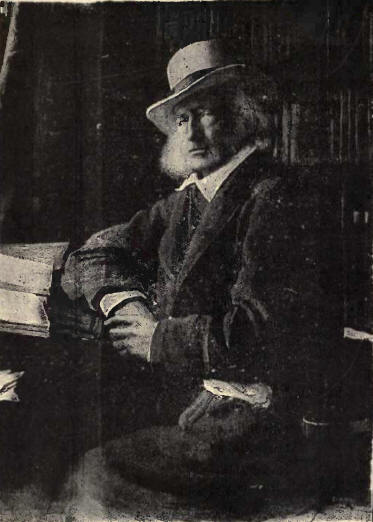
Professor Blackie in his Study
In 1839 he was appointed Professor
of Humanity at Marischal College, Aberdeen and in 1860 he achieved
his ambition when he was appointed to the Chair of Greek at the
University of Edinburgh. At Edinburgh he became a charismatic
teacher and a popular lecturer on many subjects. He espoused the
causes of educational reform and the Gaelic language, and almost
single-handed raised the £12,000 needed to endow the new Chair of
Celtic at Edinburgh. His death was the occasion for a national day
of mourning, and his funeral stopped the City of Edinburgh in its
tracks.
Contents
Volume I
-
Chapter I.
Parentage and Childhood 1809 - 1819
A Stuart race of doctors—An old Border family—A line of
Naismiths—Childish sports—His first school—A wilful boy—His
mother's death.
-
Chapter II. At
School and College 1820 - 1829
Early patriotic proclivities—At Marischal College—Apprenticeship
to the Law—A solemn period—Decision for the ministry—At
Edinburgh University—Amateur "slum" work—Record in Moral
Philosophy class—A young neophyte--Moderates and
Evangelicals—His renown as a Latinist—A leader of the
Moderates—A turning-point - Studies in nature.
-
Chapter III.
Student Life in Gottingen 1829
Mental difficulties—Womanly misgivings—A stormy voyage —Jolly
German students—Beer and tobacco—Professor Heeren--Professor
Saalfeld—A German Sunday—German socialities—A walking tour—Visit
to Luther's birthplace —Luther and Goethe.
-
Chapter IV.
Student Life in Berlin 1829 - 1830
Feelings of loneliness—Professor Neander—Professor Raumer
—Studies in English pronunciation—Widening views of life—The
mental transition—Growing distaste for the Church—A. proposed
presentation at Court—Projected journey to Italy—Results of
German residence.
-
Chapter V.
Rome 1830 - 1831
Leave-takings—Pickpockets in church—Interest in Italian
art—Outburst against Roman Catholicism—Desires for classical
study—A prisoner on parole—At Naples—Visit to Tivoli—More police
difficulties—Satire on Catholicism —A. religious
transition—Christmas Eve with the Bunsens —Study of modern
Greek—Longings for Greek travel— Letter from Chevalier Bunsen—An
archeological paper —Farewell to the Eternal City.
-
Chapter VI.
End of Wanderjahare 1831 - 1832
On tramp through Italy—Arrival at Bonn—In London—Out- come of
German residence—Decides for the Bar—Scotland's greatest Greek
scholar—Lord Brougham at Aberdeen.
-
Chapter VII.
Years of Struggle 1832 - 1837
Dislike for the Law—Merry supper-parties—Translation of
'Faust'—Carlyle's verdict on the translation—Reception of the
translation—Estimate of Wordsworth—The Speculative Society—The
Juridical Society—Literary contributions- Cultivating
philosophic calm- "Sociality and activity"—Scottish walking
tours.
-
Chapter VIII.
The Test Acts 1837 - 1840
A tender friendship—Greek metre and music—Doubts as to fitness
for Law—Appointment to Aberdeen Latin Chair— The Westminster
Confession—Making a declaration—A clerical hornet's nest—Letter
in explanation and defence— Presbyterial reception of the
letter—The case in Court— Again in Edinburgh—Correspondence with
Miss Wyld - A fantastic dress.
-
Chapter IX.
Installation and Marriage 1841 - 1842
A love episode—Disillusionment—The two loves—Parental
opposition—First lecture as professor—The new Humanity Chair -
Brightening prospects -Discipline in the classroom—First popular
lecture—A bridal song—The "Benedicite "—In summer quarters.
-
Chapter X.
Aberdeen and University Reform 1842 - 1850
Domestic administration—Fresh religious difficulties—Waiting for
the truth—At the Free Church Assembly—Education in
Scotland—Letter from Dr Chalmers—Marischal and King's
Colleges—University teaching of classics—A stirring appeal -
First Highland tour - An evening with Carlyle—At Oxford—Carlyle
on 'schylus '—Plan for publishing 'AEschylus '—Rhymed choruses.
-
Chapter XI. 'Æschylus'
and the Greek Chair 1850 - 1852
Aim of the Greek translation—Irregular and regular rhyme
—Students' reading-parties—The Hellenic Society—The British
Association in Edinburgh—Methods of learning languages - An
early educational reformer-Again in Germany—The Greek Chair at
Edinburgh--Professor Blackie's candidature- Disappearance of
prejudices- The Greek Chair won—Sectarian opposition— Notes of
gratitude.
-
Chapter XII.
Edinburgh 1852 - 1857
Parting gifts and regrets—Edinburgh in 1852—The pronunciation of
Greek—Departure for Greece—In Athens—Life in Athens—A drought of
rhyme—The Greek assistant lecturer - Work of the Greek classes -
Success of the Greek classes—Lectures at the Philosophical
Institution —Summer quarters at Bonn-Dr Guthrie's discourses—
The "Blackie Brotherhood".
-
Chapter XIII.
Lays, Lectures and Lyrics 1857 - 1860
The "Braemar Ballads "—Professor Gerhard—' On Beauty'- Visit to
Cambridge - Miss Janet Chambers - Sydney Dobehl on Garibaldi—The
British Association at Aberdeen —The 'Lyrical Poems'—First
meeting with Mr Gladstone —Lord John Russell—The home in Hill
Street—Social entertainments—Changes in family circle.
Volume II
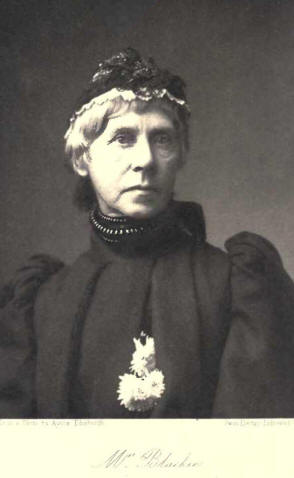
Mrs Blackie
-
Chapter XIV. Homer
1861 - 1866
Popular lectures—Beginning of interest in Gaelic—Inaugural
class-lectures-London celebrities - A Highland home— Publication of
'homer '—Last visit to Professor Aytoun - The Oban house—Translation
of Bunsen's poems—Plenishing of Aitnacraig—Aim of the translation of
'Homer'— Plan of the translation of 'Homer '—Specimen of the
translation of 'Homer'.
-
Chapter XV. The Highlands and Islands 1866 - 1870
A political encounter—Lectures on Plato—Visit to Browning —Summer
days at Altnacraig—Threatened prosecution for trespass—Tour in
Orkney and Shetland—The gospel of Utilitarianism—Reforms in
classical teaching—Greek Travelling Scholarship—An Oxford
reading-party—Royal Institution lectures—At Pembroke
Lodge—Appreciation of 'Lothair '—Dun Ee.
-
Chapter XVI. Pilgrim Years 1870 - 1872
The Franco-German war—En route for Berlin—At Gottingen —Bismark—At
Moscow—The 'Four Phases of Morals'- ,New edition of 'Faust'—Love for
the Highlands—Carivie on Spiritualism - A Highland itineracy-'Lays
of the Highlands and Islands'—An address done into Greek— Decadence
of Edinburgh society.
-
Chapter XVII. 'Self-Culture' 1873 - 1874
Death of Dr Guthrie—Lecture oil tour in Westphalia—Inception of the
Celtic Chair—Sitting for his portrait—An encounter with Bradlaugh—An
evening with Carlyle—At Dublin—Reading Irish history—St John's Eve
in Limerick—Excursion to Skye—At Inveraray Castle.
-
Chapter XVIII. The Celtic Chair 1875 - 1876
Gaelic in danger of extinction—Contributions to the fund—A charming
letter—At Oxford—Tour in the Hebrides— Flora Macdonald's
birthplace—'Songs of Religion and of Life'—The Ossianic
controversy—Hill Street hospitalities —Lectures on "Scottish
Song"—Scottish music—Scottish Universities Commission—At Loch
Baa—'Language and Literature of the Highlands'—Banquet to H. H. Wylldham —Sir Henry Irving on influence of the stage.
-
Chapter XIX. Egypt 1876 - 1879
Froude on the Gaelic language—A morning budget of letters —The
shrine of St Ninian—Heresy hunt of Dr William Robertson Smith - "Lay
of the Little Lady" - Lady Breadalbane—Leave of absence—Arrival in
Egypt—The Pyramid of Khufu—A visit to Tarsus—The Celtic Chair
endowment - The "Nile Litany" - Banquet of the "Blackie
Brotherhood"—In Rome—Death of Professor Kelland—The Splugen Pass -
Home again - A Skye school inspection.
-
Chapter XX. Retirement from the Greek Chair 1880 - 1882
Laleliam girls' school - A contemplated "flitting"-Excursion to
Iona—Mr Herbert Spencer's visit—Lecture on "The Sabbath"—The 'Lay
Sermons' - Exploration of Colonsay—Farewell to Altnacraig—A
consecration banquet—Failing strength—Lecture at Oxford—Sonnet on
Frederick Hallard—Preparing for the close—The retirement
confirmed—The new Professor of Greek—History of the Celtic Chair.
-
Chapter XXI. Class-Room and Platform 1841 - 1882
Mr Bob Melliss—The Professor and his "classes"—An Irish student—A
true Grecian—Tributes from old students— Services rendered to
education—Appearances in Oxford —A modern reformer - Embarrassing
civilities - The Hellenic. Society - Widespread fame - An
independent politician.
-
Chapter XXII. Recreations or an Emeritis Professor 1882 - 1887
The 'Wisdom of Goethe'—The Crofters' Commission—A visit to
Browning—A midnight banquet—A rectorial election —The 'Scottish
Highlanders'—A Crofter inquiry cruise —The Crofter question—A visit
to Knebworth—Church and State—Hospitality to Greek students—At
Lansdowne House—A "talking tour "—At Selkirk.
-
Chapter XXIII. "Living Greek" 1888 - 1891
'Life of Burns '—The Greek scholarship—Scottish Universities
Reform—" Praise of Kingussie "-'Scottish Song '—A verdict on 'Romola
'—At St Mary's Loch—" Tibbie Shiel's in Yarrow "- Modern Greek
literature - Presentation from Hellenic Society—Lecturing at
Oxford—The 'Greek Primer'—At Palermo—Sight-seeing in Constantinople—
Greek newspapers.
-
Chapter XXIV. Closing Years 1892 - 1895
The light of eventide - The Travelling Scholarship - The golden
wedding—Portrait by Sir George Reid—A birthday celebration—Looking
forward—A Hellenic meeting— Visits in England—At Pitlochry—Leeturing
at Aberdeen -'Self-Culture' in Italian—Two invalids—"The Happy
Warrior"—At Tom-na-monachan--Visit from Sir Henry Irving—A last
Christmas-party—The Blackie Scholarship —Nearing the end—His death
and funeral—At the grave.
On Self-Culture
Intellectual, Physical, and Moral by John
Stuart Blackie, 6th Edition, 1875
Contents
The Culture of the Intellect
On Physical Culture
On Moral Culture
See also in pdf format some of his
other publications...
The Life of
Robert Burns
Lays
of the Highlands and Islands
Scottish Song
What Does History Teach?
An Interview
with him by the Strand Magazine in the January to June 1892 edition
A Song of Heroes
Donald Carswell was born in Glasgow in
1882 to John and Flora Carswell. His father John was an eminent
physician in the city. Donald took an Arts degree at Glasgow
University and by 1911 was based in London where he became a
barrister, journalist and author. He authored some 37 books before
his death in 1940, including ’Brother Scots' in 1927.
Professor John Stuart Blackie features as a subject in 'Brother
Scots' (pdf)
The subject shall be
THE EDUCATION OF THE HIGHLANDER
and in doing so, I
shall first endeavour to set before you the ideal of what the
education of a genuine Caledonian Celt ought to have been, and, if
possible, ought yet to be; and, in the second place, take note of
how far you have fallen short of this ideal, and what means there
may yet be found in order to enable you to approximate in some
measure to the perfect stature, which it was in your destiny to have
achieved. Now, the fundamental postulate of all healthy education is
that it be native and national, that is, growing naturally out of a
firm local root, and under the influences of a healthy local
environment. Cosmopolitan views on educational subjects belong to
speculation, and are valuable only in so far as they tend to
correct, modify, or elevate some specially local culture.
Cosmopolitan thinkers, such as Plato and Aristotle, if rare, are
perfectly possible, and perfectly legitimate to the world of
thinking but in the world of action, and as a member of any existing
society, a cosmopolitan man, a man in the abstract or a man in
general, or however you may choose to phrase it, cannot exist; a man
exists either in Greece as a Greek, in Palestine as a Hebrew, in
Rome as a Roman, in England as an Englishman, in the Highlands as a
Highlander. And the peculiar type of character thus impressed upon a
man by the locality to 'which he belongs, and the social influences
under which he grows up is so natural and necessary, that not even
men of the highest reach of speculation, or the widest range of
universal human sympathies, can escape it. Hence even in Aristotle
and Plato—whose treatises on education are still equal in general
human value to the best that modern literature supplies —we
distinctly recognise the general Greek type, the Greek complexion,
the Greek atmosphere, and the Greek tendencies; and nothing could
have been further from the ideas of those great thinkers than to
write treatises to educate their countrymen not out of, but away
from their peculiar Greek nationality. In fact, nativeness to the
soil, if I may be allowed to coin the word, or nationality, as it is
more loosely expressed, is a condition of health, strength, and
beauty, through the whole living world.
You can
download the rest of this talk here
The Life of
John Stuart Blackie
Edited by the Rev. John G. Duncan
Other works by him...
The
Day-Book of John Stuart Blackie
Selected and Transcribed from the Manuscript by his Nephew Archibald
Stodart-Walker (1902) (pdf)
Greek and
English Dialogues
For use in Schools and Colleges by John Stuart Blackie, Professor of
Greek in the University of Edinburgh (1875) (pdf)
Horæe Hellenicae
Essays and discussions on some important points of Greek philology
and antiquity by John Stuart Blackie (1874) (pdf)
The Lyrical Dramas of
Aeschylus, from the Greek
Translated into English Verse by John Stuart Blackie (1906) (pdf)
The Pronunciation of Greek
Accent and quantity, a philological inquiry by John Stuart Blackie
(1852) (pdf)
The Selected Poems of John Stuart Blackie
Edited with an appreciation by Archibald Stodart Walker (1896) (pdf) |