|
Parish Church,
Bothkennar. Bothkennar, now a quoad sacra parish under
Grangemouth, was formerly independent, and its church stands in a
graveyard N. of the by-road leading from the Polmont-Stirling highway (A
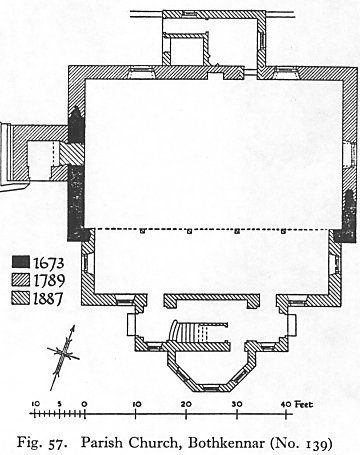
905), at Pinfoldbridge, to Carronshore. The church (Fig. 57) was
"rebuilt" in 1789 and
remodelled and enlarged in 1887, when an extension containing new
entrances was added on the S. and a vestry on the N.; the work of 1789 is no doubt commemorated by a stone bearing that
date which is built into the wall, high up, near the NE. corner. It is
clear, however, that this rebuilding was not total, and that remains of
an older structure survive; evidence for this is seen in the masonry of
the lowermost four feet or so of the walls, as under each of the
existing windows on the N. side, which have been placed to suit a higher
floor than that of the older structure, there appear the lower rybats
and sill of an original window, now built up, with dressed and backset
margins. Similarly, the bottom part of an original doorway survives
under the window in the E. gable, while a corresponding doorway, now
also built up, in the centre of the opposite gable provided the access
to the church until the new entrances were formed in 1887. The structure
to which these openings belonged, and the lower courses of masonry in
which they are found, may perhaps have originated in 1673, as this date
is incised high up on the W. gable near the SW. corner; this inscription
also suggests the retention at the southern ends of the gables of some
of the higher parts of the walling of this period, as well as of the
lower, during the rebuilding in 1789.
 Though the difference between old and new work is
hardly perceptible in the face of the E. gable, there is a decided
contrast between the character of the masonry in the southern and
northern halves of the W. gable, and this tends to confirm the idea that
earlier work was retained on the S.; it may
also be significant that the southern angles
of the church have slightly backset dressed
margins, similar to the old doors and windows,
in contrast with the plain quoins of the
angles on the N. Apparently the size of the
church remained unchanged until the
19th-century reconstruction, when most of its
southern wall was removed to allow for
increased accommodation in the new additions
on that side. The original church, rectangular
on plan, measured 57 ft. 9 in. by 35 ft.
externally, the walls being 2 ft. 9 in. thick
and built of random rubble. The present
windows are round-headed and have rounded
arrises. Though the difference between old and new work is
hardly perceptible in the face of the E. gable, there is a decided
contrast between the character of the masonry in the southern and
northern halves of the W. gable, and this tends to confirm the idea that
earlier work was retained on the S.; it may
also be significant that the southern angles
of the church have slightly backset dressed
margins, similar to the old doors and windows,
in contrast with the plain quoins of the
angles on the N. Apparently the size of the
church remained unchanged until the
19th-century reconstruction, when most of its
southern wall was removed to allow for
increased accommodation in the new additions
on that side. The original church, rectangular
on plan, measured 57 ft. 9 in. by 35 ft.
externally, the walls being 2 ft. 9 in. thick
and built of random rubble. The present
windows are round-headed and have rounded
arrises.
Abutting on the W. gable is a tower, erected either
during the alterations of 1789 or very shortly afterwards.
On plan it is 11 ft.
square over walls approximately 3 ft. thick; it rises to a height of
four storeys, the upper ones being reached by ladders and hatchways. A
door in the middle of its S. wall leads into a small chamber 5 ft.
square, which served as a vestibule before the W. door was built up. The
top storey is used as a belfry. In its ascent the tower is intaken at
two stages, the lower between the first and second storeys, at about the
level of the eaves of the church, and the higher between the upper two
floors. Below the lower intake the masonry is squared rubble roughly
brought to courses, but higher up it is ashlar to the apex of a
concave-sided pyramidal roof. This alteration may indicate a delay in
the completion of the upper portion. The
openings on the second floor are lintelled but
elsewhere they are round-headed. The church
bell dates only from 1911. An earlier bell, by
Robert Maxwell & Co., Edinburgh, has been
removed to Fallin; it is dated 1729 and is
similar in design and lettering to the Meikle
bell at Gargunnock.
The
internal arrangements of the church date only
from the reconstruction of 1887. The pulpit
now stands in front of a recess in the centre
of the N. wall, and E. of it a door has been
broken through into the vestry.
HERALDIC
CARVINGS. In addition to the two stones noted
above, bearing respectively the dates 1673 and
1789, and another bearing the initials W B and
the date 1654, two heraldic stones have been
reset in the walls of the church. One, on the
W. side, shows a shield dividing the date
1654, and the initials W B and charged: A
saltire and chief. The arms and initials are
those of William Bruce, 2nd of Newtoun (cf.
No. 306), who was retoured heir to his father
Patrick Bruce in 1655 and was still alive in
1709. In the E. wall there is a very badly
weathered stone bearing a shield charged:
Quarterly, 1st and 4th, a chevron; 2nd (and
presumably 3rd) a stag’s head erased. These
arms have not been identified.
TOMBSTONES.
The only tombstone in the churchyard on which
a date earlier than 1707 can be made out is a
small headstone inscribed in relief 1640 / I
A. Some of the later stones (Pl. 48 B, C, D)
show fine representations of ships, and no
doubt commemorate seamen of the former port of
Carronshore. |



