|
DAMASCUS is called the oldest city in the world. Its
history can be traced back to the days of Abraham, whose steward was
Eliezer of Damascus (Gen. xv. 2). The oldest inhabited house in England is
said to be what is locally known as the Jew’s House, at Wallingford, which
dates from the reign of Edward I. (1272-1307). It is curious to compare
England with the United States. In the latter the oldest inhabited house
is said to be that of William Van Rennselaer, opposite Albany, New York.
According to a plate set up by the Albany Memorial Society, it was erected
in 1642. The front walls still show the two portholes, through which the
early inhabitants used to shoot the Indians. In Scotland there are houses
that have a hoarier antiquity that even the Jew’s House. Dunvegan claims
to have been continuously inhabited since the 14th century; Dunrobin
(Sutherland) since the 13th; and Redcastle (Ross-shire) since 1179. From
war and siege, and the long result of time, these castles have undergone
great changes, the old is merged in the new, and the original plan cannot
be discovered. But it is otherwise with Castle Roy, which, though a ruin,
and uninhabited for hundreds of years, still retains its first form and
character. In M’Gibbon and Ross’s learned work on "The Castellated and
Domestic Architecture of Scotland," it is given as the earliest type of
castle, and it is on this ground that we claim it to be the "Oldest Castle
in Scotland’." But before describing Castle Roy it may be well, for the
sake of comparison, to refer to another so-called castle in our parish. On
the hill above Loch Pytoulish there is an outstanding Crag, called
Creag Chaisdeall. It faces the west, and commands a wide view both up
and down the Strath. The sides are steep and rugged, and the only access
is from the south-west. On this height there are the remains of an ancient
fort. It is now but a great heap of stones, the haunt of rabbits but on
examination the plan can be so far made out. The diameter is about 27
feet, and the thickness of the walls about 11 feet. The material is the
schist rock of the district. There are no marks of tools or mortar, and
the walls seem to have been built after the fashion of the pre-historic
cairns, such as those at Miltoun of Kincardine and Loch-nan-carragh, near
Aviemore. Probably the fort may have been used as a watch-tower or signal
post, but there are no indications of fire or vitrification. On the moor
below, as in other places near, there are the remains of cairns and
hut-circles, and on one massive slab there are four cup-marks. This fort
is allied to the Brochs. Castle Roy, on the other hand, seems to hold a
place between the Brochs and the Norman Castles. The time of Norman
settlement and colonisation in Scotland was about 180 years, from the
accession of David I. as Prince of Cumbria in 1107, to the death of
Alexander III. in 1286. During this period numerous castles were built in
the north. The first were probably of the Castle Roy type, the Broch being
enlarged and modified somewhat after the fashion of a Roman Castrum, of
which there is a fine specimen at Richborough; afterwards they were
developed into more elaborate structures. "The general idea of the 13th
century Castles (in Scotland) is that of a large fortified enclosure. The
plan is usually quadrilateral—but more or less irregular, so as to suit
the site. . . . The curtain walls are about 7 to 9 feet in thickness by 20
to 30 feet high. The angles are frequently provided with round or square
towers, and no doubt these and the curtains had parapets with embrasures
for defence, and rampart walks all round the walls. The entrance gateway
was always wide, and seems to have been generally provided with a
portcullis. There is sometimes also a postern door." Castle Roy (Ruadh,
red) belongs to the simplest type of these old fortresses. It stands
on a height, from 10 to 15 feet above the level of the surrounding fields,
about 200 yards north of the present Parish Church. There is a trend in
the ground to the east, separating it from the rocks of the Craggans, and
below, towards the Spey, are wide meadows, still sometimes flooded, and in
old times probably an impassable morass.
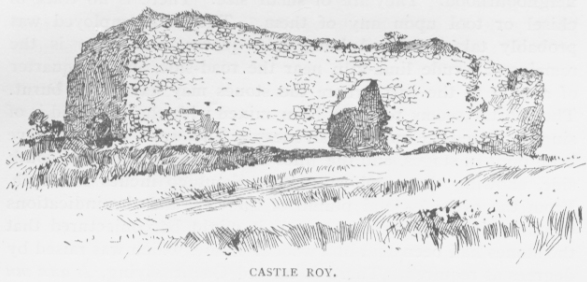
"The walls are 7 feet thick, built
with strong rubble work, and are still from
20 to 25
feet high. The enclosed space measures 80 feet from
North to South by 53 feet from East to West within the walls. The entrance
is by a door-way, 8 feet wide, in the north wall, the inner pointed arch
of which still remains. There is a square tower, at the North West angle,
and the remains of a large window near it, which has also a pointed arch
in the reveal; but it seems doubtful whether these are not later
additions. The East angle of the enclosure is complete! without any
appearance of a tower having ever existed there. At the South-East angle
the wall is broken away, as if for the purpose of adding a tower similar
to that at the North-West angle, but apparently no tower has ever been
built there. The recess in the wall at the South-West angle, which is on
the ground level, seems to have been used as latrines. There is a
projecting garde-robe over this in the upper part of the wall, but no
appearance of any tower at this angle either. The building seems to have
been simply a large enclosing wall of great height, and was no doubt well
defended from the parapet, for the purpose of sheltering the vassals and
their property. There were probably wooden or other buildings within the
enclosure, with roofs supported against the curtains, but no trace of
these now exists" (M’Gibbon and Ross, Vol. I., p. 66). It may be mentioned
that Lochindorb Castle has towers at the four corners, and is altogether
of a more advanced type than Castle Roy. The stones of which Castle Roy
was built must have been got from the neighbourhood. They are of small
size. There is no trace of chisel or tool upon any of them. The lime
employed was probably taken from Achnagonaln quarry, and there is the
remains of a rude lime-kiln near the road-side, about a quarter of a mile
to the east, where the stones may have been burnt. The mortar seems to
have been mixed with charcoal, and is of singular strength and
cohesiveness. The walls seem to have been built in stages, and the lines
are well marked on the south side, showing that each stage was about 20
inches in depth. From the evenness and plumb of the wall, and the
indications of its having been built by stages, it might be conjectured
that the stones had been laid in a wooden frame, which was raised by
degrees as required. There is an old Gaelic saying, Is ann mu ‘n
seach, or, uidh air uidh, thogar an Dun, "It is turn by turn
the fort is built," which favours this opinion. Tradition says that there
was a crypt or vault in the central court; and there were old people alive
60 years ago who alleged that they had seen the opening and steps leading
to this underground apartment. They said it was the cause of accidents to
cattle, and that, therefore, it had been filled up. There are other
traditions of the kind common to old castles, as that a treasure or
Ullaidh is hidden within the walls, but as the plague is hidden there
also, it would be unsafe to search for it. Another legend is that there
was a secret underground passage leading from the castle to the church. A
strange old world story is told connected with the Mote-hill. It is said
that one of the Baron Bailies, at Balliemore, had taken earth from the
churchyard to put upon his fields. This gave great offence, and the Bailie
had to discontinue the practice. Some time after, when sitting on the
Mote-hill, he was stricken with apoplexy and died. The people said it was
a judgment of God; that though he had given up taking the earth with his
hand, he had gone on doing it in his heart.
Castle Roy is believed to have been
built by the Comyns, and may have been their residence in the Lordship of
Abernethy. It seems to have been still in use in the sixteenth century, as
it is named, along with the castles of Tarnua and Hall Hill, in the
Charter of the Earldom of Moray obtained by George, Lord Chancellor, 13th
February, 1548. |



