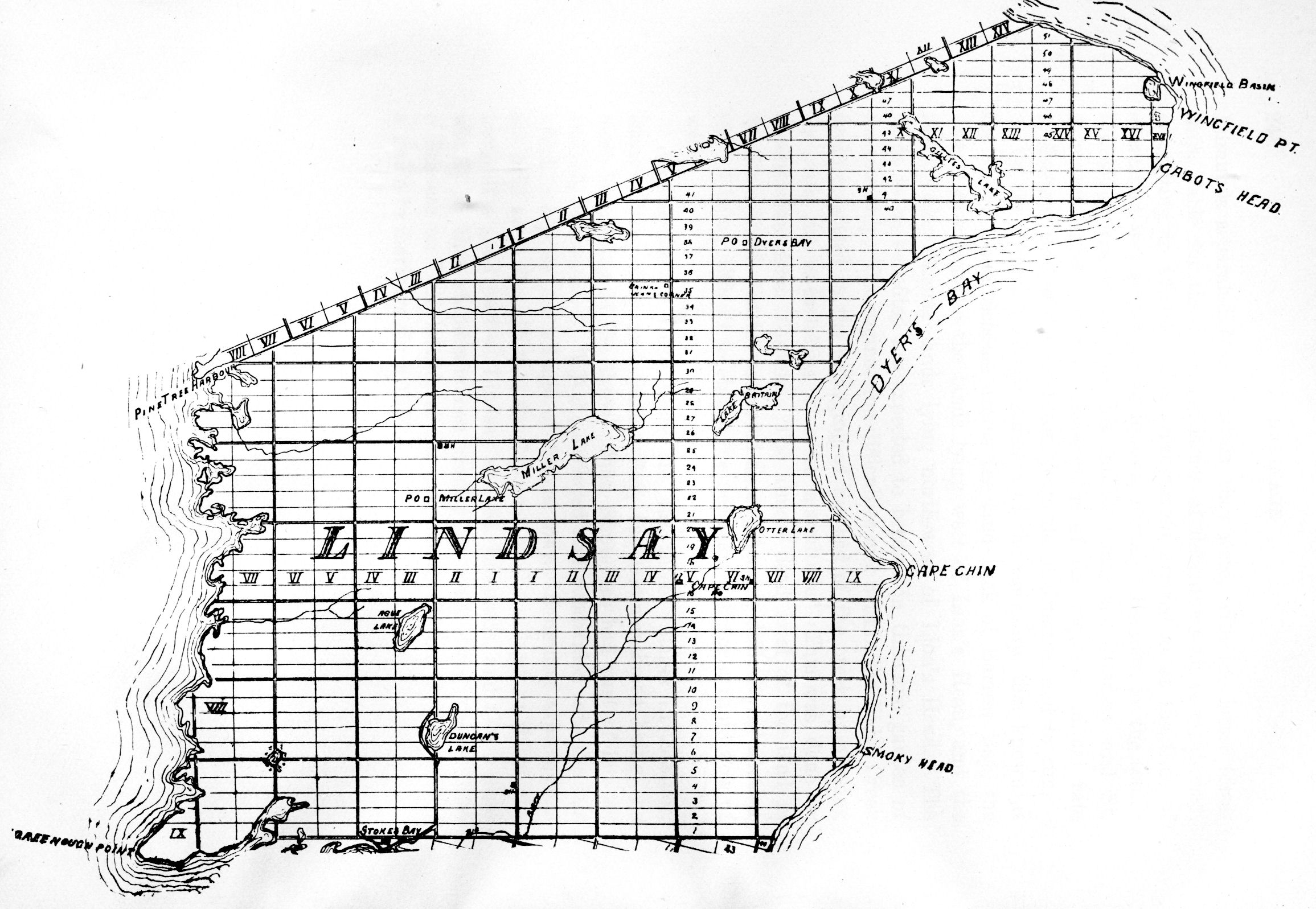
|

The name this township
bears is said to have been given in honor of Earl Lindsay.
Extract from the Report of
County Valuators, 1879.
"Lindsay and St. Edmunds.
It would be difficult to place any value on these townships, as we have
not seen any land fit for cultivation, and not more than a dozen settlers,
and one saw-mill in the whole of the two townships. The greater part of
the land that was purchased in these townships was bought for the timber,
and when that was taken off the land was abandoned. We set it down at
$1.50 per acre."
Extract from the Report of
County Valuators, 1901.
"Owing to the limited time
at our disposal, we are unable to give complete reports of the townships
of Lindsay and St. Edmunds. These townships possess very little good land.
St. Edmunds is largely a waste. The inhabitants of Dyer's Bay and
Tobermory sections are at a great disadvantage, being so far removed from
a line of railroad, and the roads leading to those places are in an almost
impassable condition. Land is so sparsely settled that it is utterly out
of the power of the people of these townships to maintain the roads. Their
lines have not fallen to them in pleasant places, certainly not their
concession lines.''
The first sale of lands in
the township of Lindsay was made in the year 1870. Previous, however, to
any sales of land the pioneer settler of Lindsay, Abraham West, had come
into the township and located. The land he selected was lot o, concession
2, W.B.R., and on that lot the first clearing in the township was made.
The first neighbor Mr. West had was William Clark, who settled on land but
four lots south. The little settlement progressed but slowly in numbers;
the census of 1871 gives the number of the inhabitants of the whole
township as twenty. By 1879, however, the population had so grown as to
warrant the establishing of a school section and the building of a
school-house. The first Board of Trustees consisted of John Kelly, George
Ceasor and Alexander McDonald. The school-house, built of logs, was at
"McDonald's" (lot 4, con. 1, W.B.R.), and the first teacher who therein
imparted instruction was a Miss Hurst, who was succeeded by Miss Christie
Stringer.
The roads in Lindsay could
not at any time, by any stretch of the imagination, be called good; in
fact, it has only been in very late years that it has been possible to
drive safely a buggy on either of the two main roads which lead through
the township. The west side main road of the Peninsula was opened through
to Lindsay in the year 1870, and that from Lion's Head to Dyer's Bay in
1880. The following anecdote, related of one of the pioneers, will
illustrate the hardships they endured from lack of roads passable by a
team: One of the settlers went to Owen Sound, and bought six bushels of
potatoes, which he had taken to Lion's Head by boat, and then had to carry
them on his back the rest of the way home, a distance of some nine miles.
Another undertook to carry home a barrel of flour. He was not an
especially strong man, so had the flour placed in two bags. One of these
he would carry for a bit, and "while resting," as he called it, would go
back for the other bag and carry that up to or beyond the first. This was
repeated again and again until a number of miles were covered and home
reached at last.
A number of Lindsay's early
settlers were young men of Highland origin who came from the township of
Huron. Prominent among them was Alexander McDonald, referred to more fully
in a footnote. [Alexander McDonald settled in Lindsay in 1877. He was for
many years reeve of the township and also county commissioner, which
position he filled at the time of his death, which occurred in June, 1903.
Mr. McDonald was an active Christian man and at the schoolhouse above
mentioned he started a Sunday-school, of which he was superintendent until
his death; he also, in the absence of a settled minister, conducted
regularly a weekly prayer-meeting; through his efforts a church building
was also erected. When Mr. McDonald first became reeve the township was
largely in debt; under his judicious, cautious and economical guidance
this debt was much reduced.]
It was some ten years or
more after the first settlers had located in Lindsay before they had the
luxury of a post-office in their own township. Previous to 1881 they were
dependent upon the post-office at Mar, Lion's Head or Spry for their
supply of mail matter. In the year just mentioned a post-office was
established, known as "Stokes Bay," [Wm. Lyons was first postmaster; he
was succeeded by John Gibson, and he by John Shute, who held the office
for twenty-three years.] but at first located on lot 5, concession 2,
W.B.R., Lindsay. In the same year "Dyer's Bay" [Thomas Tindall was first
postmaster.] post-office was established. This proved a great convenience
to those settled in the eastern part of the township.

The municipal history of
Lindsay is as follows: On the 1st January, 1873, it became one of the
townships in the municipality of the united townships of Albemarle,
Eastnor, Lindsay and St. Edmunds. On the 1st January, 1878, the three
northern townships were separated from Albemarle. On the 1st of January,
1883, Lindsay and St. Edmunds were erected into a separate municipality,
which union continued to exist until the 1st January, 1903, when each of
these two townships became separate municipalities. In a footnote [The
following are the names of the reeves of the township of Lindsay and St.
Edmunds : Peter McVicar, 1883; J. Weatherhead, 1884, '86; James Shute,
1885; Alex. McDonald, 1887, '88, '89, 1890, '91, '92, '93, '94, '95, '96,
'97, '98, '99, 1900; John Shute, 1901, '02. As reeve of Lindsay, Peter
Alderson, 1903, '04, '05, '06.] are given the names of the various parties
who have filled the position of reeve for the united townships of Lindsay
and St. Edmunds, and since the separation as reeve of Lindsay. The
debenture debt of the three united townships at the date of the
dissolution of the union amounted to $7,600. The two united townships of
Lindsay and St. Edmunds, in settlement of the proportion of this
indebtedness due by them, agreed to pay to Eastnor an annual payment of
$257.22 until the debentures matured, some seventeen years later. The
first Council of the united townships of Lindsay and St. Edmunds consisted
of Donald McDonald, Alex. Patch, John Shute, councillors, and Peter
McVicar, reeve. The joint office of clerk and treasurer was held by James
Weatherhead, and Alex. Currie was the first collector.
The following are the names
of some of the pioneers of Lindsay, in addition to those who are already
mentioned: Kenneth Smith, Roderick McLennan, John Kelly, John Ceasor,
Donald McLean, Andrew Clarke, James Finch, James Nixon, John McArthur, Sam
Bestward, John Holmes, John Steip, John Witherspoon (postmaster at Miller
Lake for many years), John Smith, James, William and Alex. Weatherhead,
Alex. Currie (township treasurer for several years), Thomas Tyndall,
William Matheson, James Watson, John Jackman, William McNair, John
McDonald, John and James Shute and Norman Smith.
Prom the very first
lumbering has been the main industry in Lindsay. Probably the first mill
was that of Hiram Lymburner, at Gillies Lake, erected in 1880, and which
he and his sons operated until 1905. Power was derived by widening and
deepening the little creek flowing from the lake; this enlargement was
increased from time to time as the demand for power made it necessary. The
Messrs. Lymburner showed a good deal of enterprise in launching a small
tug on Gillies Lake named the Gertie, used to tow rafts of logs to the
mill, this little boat being the second steamer ever used on the inland
waters of the county.
Lindsay is the only
township in the county of Bruce in which mining for precious metals has
been carried on. In the early nineties a Mr. E. Clendening sank a shaft
over 300 feet deep on lots 9 and 10, concession 4, E.B.R. The work was
continued for two summers and one winter. Ore is said to have been found
which showed some silver, but not in sufficient quantities to pay for
working it. Mr. Clendening later on did some prospecting on lot 5,
concession 2, W.B.R., but with similar results. Those who were engaged in
this prospecting supplied but little information to outsiders, so what is
here given is but from hearsay.
The amount of land in
Lindsay that might be classed as good farming land is not very large. A
visitor to the township finds the principal settlement therein between the
fourth concession west of the Bury Road and the fifth concession east of
it, with a limit of about four miles in width north from the Eastnor
boundary.
The following incident, the
facts of which are given in the Wiarton Canadian, although not strictly
speaking an historical item, yet deserves to be recorded as an instance of
motherly love and devotion as manifested by one of the good wives of
Lindsay. "Though rattlesnakes are reported to be fairly plentiful in
Lindsay and St. Edmunds, fortunately accidents of a serious nature such as
follow the bite of these reptiles have not been numerous, and settlers
have become rather careless. On a warm day in August, 1902, a six-year-old
son of Mr. Robt. Bartley, residing north of Dyer's Bay, playing about his
home bare-footed and bare-legged to his knees, was so unfortunate as to
step on a three-foot snake, which was lying basking in the sun. The rude
awakening aroused the temper of the reptile, and in a twinkling its fangs
were buried in the child's leg. An angry snake strikes very quickly, and
before the child got beyond reach the beast struck him in five different
places. His screams brought his mother to the scene, and realizing the
trouble and danger, instead of fainting or going into hysterics, she
bravely sucked the wounds, tied a ligature tightly round the limb to stop
the circulation of the blood, then hitched a horse and started on a
fifteen-mile drive to Lion's Head with the boy. Before reaching medical
aid at that village the child was nearly crazy from the pain caused by the
ligature stopping the circulation in the limb, and his cries could be
heard for a long distance. But the heroic woman held on and fortunately
found Dr. Sloan at home. The wounds were cauterized and dressed, and
fortunately little or no ill effects resulted from this exciting
experience."
The origin of the following
names in Lindsay are here given by the author on what he considers good
authority: Lake Miller bears the name of B. B. Miller, first Indian Land
Agent at Wiarton; Gillies Lake is called after John Gillies, M.P. for
North Bruce in the seventies; Cabot Head is said to have been named by
Governor Simcoe in honor of Cabot, the discoverer of Canada. The
lighthouse at this point was established in 1896. |