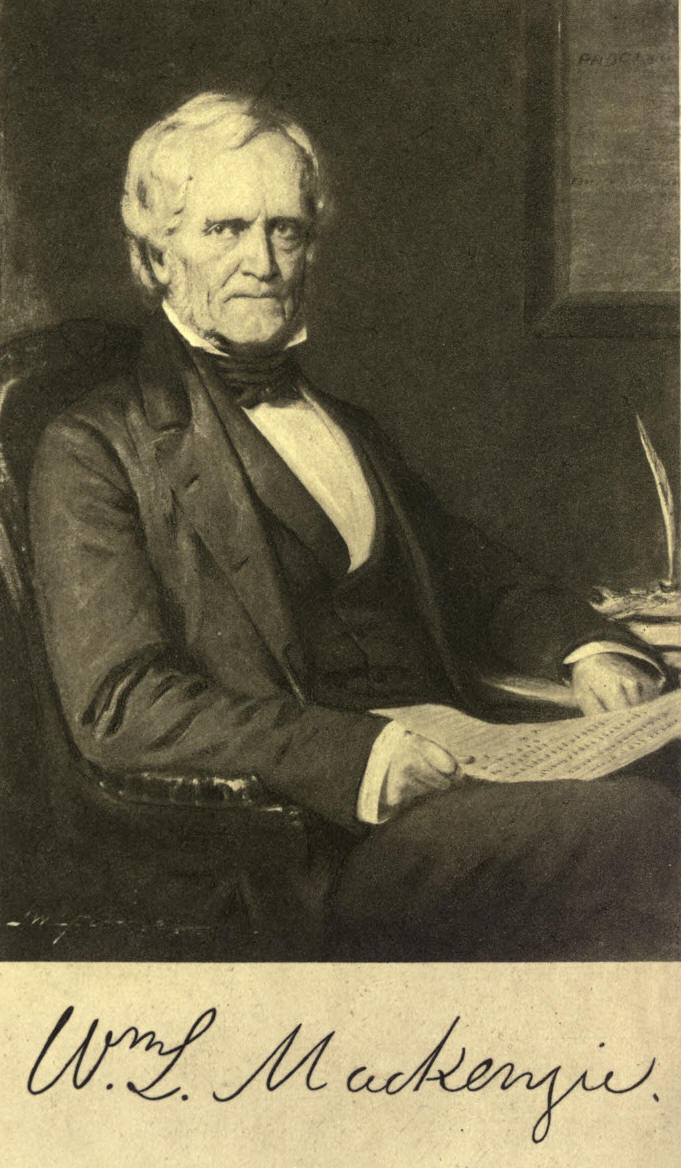
|
 The staunch and impulsive Reformer, was born
in Springfield, Dundee, Scotland, on the 12th of March, 1795, and came to
Canada in 1820. He was descended from a peasant parentage, and when a mere
infant was thrown for support on his brother. He obtained a meagre
business education in Dundee, and at seventeen started for England, where
he obtained employment as a clerk with Lord Lonsdale. On the 18th of May,
1824, appeared in Niagra the first number of his paper, The Colonial
Advocate. It was roughly written, and dry, and declamatory, but it was
on the right side, and made the oligarchists twist uneasily in their
chairs. "Every effort", says Mr. Morgan, "except such as
reason and the law might have sanctioned, was made to suppress the paper.
A bitter personal quarrel, carried on by means of the press, between Mr.
Mackenzie and some prominent members of the official party, led, in 1826,
to the violent destruction of the printing office by a mob of irritated
friends of the ruling party. The office was forcibly entered and the types
cast into the bay of Toronto. At this time, the paper was printed at that
city. A most inopportune time was chosen for the work of destruction. It
was probably not known to the rioters that the last number of the paper
which it was intended to destroy had already been published; for if it had
the act would have been stupid and illegal. As the act was done in the
face of day, the perpetrators of it were known, and damages were recovered
against them, on the case being brought into a court of justice. We must
suppose that the object of scattering the types into the bay was to put an
end to the existence of an obnoxious newspaper; but the effect was
precisely the contrary of what had been intended. The paper, of which the
last number had already been issued, received from the violence used to
put it down a new lease of existence. The Colonial Advocate,
instead of expiring in 1826, as it would, if left to itself, continued to
be published till 1833, when the press and types were sold to Dr. O'Grady.
In 1828, Mr. Mackenzie was elected to the Canadian Parliament, for the
County of York. The violence of the official party was not confined to the
destruction of a printing office. Mr. Mackenzie had, in his newspaper,
used language towards the majority in the Assembly, which that majority
chose to regard as libellous, and they resolved to punish the
representative for the act of the journalist. The alleged libel consisted
of describing the majority as sycophants fit only to register the decrees
of arbitrary power. Language quite as strong as this has frequently been
used in the House of Commons. For instance, Henry, now Lord Brougham, when
in the House of Commons, said of the Minister Peel, 'I do not arraign him
as much as I do you, his flatterers, his vile parasites,' for which
language, so far from being expelled, he was not even called to order. But
admitting the language used by Mr. Mackenzie to be libellous, the proper
remedy would have been to bring the case before a jury. But that remedy
was hopeless; it was notorious that no verdict could have been obtained
against the publisher of the alleged libel. It was treated as a breach of
privilege; on that ground the expulsion proceeded, and an attempt was made
to render Mr. Mackenzie incapable of sitting in the Assembly. His
re-election could not, however, be prevented, for no member of the
official party would have had the least chance against him; and as often
as he was expelled - five times - he was re-elected; once when he was
absent in England". He was chosen first Mayor of Toronto in 1836, and
with all his faults, seemed to have been the darling of those who were
doing battle for popular rights. His visit to Downing Street when the
dominion of the Family Compact was most galling, was productive of several
minor results; but it seemed to be our fortune to have gentlemen governing
us then, who were conspicuous only for their utter unfitness for the
position. Sir Francis Bond Head, with several trunks full of blank poems,
plays and unfinished essays, made a great sensation on first appearing
here, but he had a soft head, and the Tories promptly brought him into
line. He was in Canada in 1837-38, the season of William Lyon Mackenzie's
wild uprising near Toronto. Mackenzie did not succeed with his motley band
of well-meaning followers, but with a price upon his head, fled the
country through the wintry woods. He eventually obtained a pardon through
the influence of his friend, Mr. Hume, and returned to Canada. The
Reformers gave him the cold shoulder, and the Tories raised their eyes in
horror when they looked upon him. In 1850, he opposed George Brown for
Haldimand, and defeated him. He held his seat in the Assembly till 1858,
when he resigned. He died in comparative poverty, at Toronto, in August
1861. In 1822, he married Isabel Baxter, a sister of Mr. George Baxter,
teacher of the Royal Grammar School at Kingston, and the same from whom so
many of our prominent Canadians received their early tuition. He left
seven children. The staunch and impulsive Reformer, was born
in Springfield, Dundee, Scotland, on the 12th of March, 1795, and came to
Canada in 1820. He was descended from a peasant parentage, and when a mere
infant was thrown for support on his brother. He obtained a meagre
business education in Dundee, and at seventeen started for England, where
he obtained employment as a clerk with Lord Lonsdale. On the 18th of May,
1824, appeared in Niagra the first number of his paper, The Colonial
Advocate. It was roughly written, and dry, and declamatory, but it was
on the right side, and made the oligarchists twist uneasily in their
chairs. "Every effort", says Mr. Morgan, "except such as
reason and the law might have sanctioned, was made to suppress the paper.
A bitter personal quarrel, carried on by means of the press, between Mr.
Mackenzie and some prominent members of the official party, led, in 1826,
to the violent destruction of the printing office by a mob of irritated
friends of the ruling party. The office was forcibly entered and the types
cast into the bay of Toronto. At this time, the paper was printed at that
city. A most inopportune time was chosen for the work of destruction. It
was probably not known to the rioters that the last number of the paper
which it was intended to destroy had already been published; for if it had
the act would have been stupid and illegal. As the act was done in the
face of day, the perpetrators of it were known, and damages were recovered
against them, on the case being brought into a court of justice. We must
suppose that the object of scattering the types into the bay was to put an
end to the existence of an obnoxious newspaper; but the effect was
precisely the contrary of what had been intended. The paper, of which the
last number had already been issued, received from the violence used to
put it down a new lease of existence. The Colonial Advocate,
instead of expiring in 1826, as it would, if left to itself, continued to
be published till 1833, when the press and types were sold to Dr. O'Grady.
In 1828, Mr. Mackenzie was elected to the Canadian Parliament, for the
County of York. The violence of the official party was not confined to the
destruction of a printing office. Mr. Mackenzie had, in his newspaper,
used language towards the majority in the Assembly, which that majority
chose to regard as libellous, and they resolved to punish the
representative for the act of the journalist. The alleged libel consisted
of describing the majority as sycophants fit only to register the decrees
of arbitrary power. Language quite as strong as this has frequently been
used in the House of Commons. For instance, Henry, now Lord Brougham, when
in the House of Commons, said of the Minister Peel, 'I do not arraign him
as much as I do you, his flatterers, his vile parasites,' for which
language, so far from being expelled, he was not even called to order. But
admitting the language used by Mr. Mackenzie to be libellous, the proper
remedy would have been to bring the case before a jury. But that remedy
was hopeless; it was notorious that no verdict could have been obtained
against the publisher of the alleged libel. It was treated as a breach of
privilege; on that ground the expulsion proceeded, and an attempt was made
to render Mr. Mackenzie incapable of sitting in the Assembly. His
re-election could not, however, be prevented, for no member of the
official party would have had the least chance against him; and as often
as he was expelled - five times - he was re-elected; once when he was
absent in England". He was chosen first Mayor of Toronto in 1836, and
with all his faults, seemed to have been the darling of those who were
doing battle for popular rights. His visit to Downing Street when the
dominion of the Family Compact was most galling, was productive of several
minor results; but it seemed to be our fortune to have gentlemen governing
us then, who were conspicuous only for their utter unfitness for the
position. Sir Francis Bond Head, with several trunks full of blank poems,
plays and unfinished essays, made a great sensation on first appearing
here, but he had a soft head, and the Tories promptly brought him into
line. He was in Canada in 1837-38, the season of William Lyon Mackenzie's
wild uprising near Toronto. Mackenzie did not succeed with his motley band
of well-meaning followers, but with a price upon his head, fled the
country through the wintry woods. He eventually obtained a pardon through
the influence of his friend, Mr. Hume, and returned to Canada. The
Reformers gave him the cold shoulder, and the Tories raised their eyes in
horror when they looked upon him. In 1850, he opposed George Brown for
Haldimand, and defeated him. He held his seat in the Assembly till 1858,
when he resigned. He died in comparative poverty, at Toronto, in August
1861. In 1822, he married Isabel Baxter, a sister of Mr. George Baxter,
teacher of the Royal Grammar School at Kingston, and the same from whom so
many of our prominent Canadians received their early tuition. He left
seven children.
Taken from "William Lyon MacKenzie", by
Charles Lindsey, 1909. Chapter I - The Period and the Man.
THERE are many circumstances
which give to the life, character and career of William Lyon Mackenzie a
peculiar and almost pathetic interest, and which render them well worthy of
a permanent record in the memoirs of the "Makers of Canada." They not only
represent the strong mental and moral equipment of an individual—one of a
race which has been identified with constitutional liberty and reform in all
the overseas states of the Empire—but they also represent an important epoch
in British colonial history. It was an epoch of political transition, and
Mackenzie stands out in it conspicuously, a commanding and picturesque
personality who did much to create, as well as to inspire and promote, the
movement which made the transition one from an evil to a better state of
things. He was a representative man of the period —a man of thought and
resource who had a genius for successful political agitation—a man of action
who, as a distinguished publicist has said, "embodied the sentiment of his
time" in working towards political ideals in the State. If it be true that
11the types of men living at particular periods afford the best studies of
history," Mackenzie cannot be ignored by the historian.
The great interest which
attaches to his life, especially in his years of strength and vigour, is
derived from the fact that it extended over a period of political and
critical unrest with the spirit and action of which he was completely
identified. Mackenzie in those years had to be reckoned with, at every turn
in the arena, by the men who governed; and he must be given a place by
himself, but none the less a distinguished place, amidst the conflicting
influences, and the strifes and antagonisms which, culminating in a civil
war, wrought a revolution in the system of government in Canada, and
thereafter in British colonial government everywhere. That was an issue
which, it has been well said, "evolved out of the discord of conflicting
ideals, the foundations of a permanent and worthy settlement of the
relations of the Crown to the colonies," and "broadened, once for all, the
lines of constructive statesmanship in all that relates to the colonial
policy of England." There probably never was a period in the history of this
country when the two political parties were more sharply divided, and more
clearly distinguished, upon a great public question. It was a comparatively
small forum for such a debate; the cause was worthy of a greater tribunal
than that to which the argument was addressed. But the final judgment in the
matter was momentous and far-reaching in its consequences. The principles
which were laid down by the Reformers in that controversy, under the
leadership of Mackenzie and his coadjutors, were those which were embodied
by Lord Durham in his famous Report, and were subsequently crystallized into
legislation by the parliament of Great Britain. They are the principles upon
which the Australian commonwealth and the states of South Africa, as well as
Canada, are governed to-day, and by which, in fact, in all the outlying
dominions of the Crown, imperial unity is reconciled, and may continue to be
reconciled, with complete self- government.
Mackenzie has been described
as "a reformer ahead of his time," as "the stormy petrel" of the
ante-rebellion era in Upper Canada, and in other terms, less equivocal and
less deserved, by the calumny which pursued him to his grave. Mr. Goldwin
Smith's portraiture of him is that of "a wiry and peppery little Scotchman,
hearty in his love of public right, still more in his hatred of public
wrong-doers, clever, brave, and energetic, but, as tribunes of the people
are apt to be, far from cool-headed, sure-footed in his conduct, temperate
in his language, or steadfast in his personal connections."
These references to
Mackenzie's personal qualities and character as a public man might easily be
multiplied. He had at all times, even when political feeling ran high in the
constituencies, friends and admirers amongst men of all parties. Speaking of
his election for Haldimand, the first open constituency after his return
from exile, when he defeated the late Hon. George Brown, the most formidable
opponent he could have encountered, a prominent resident of that county
stated, in a published interview, that "Mackenzie had support from
Conservatives as well as Reformers; in fact, as I happen to know, be always
had a great many warm Conservative friends, who admired his pluck as well as
his independence and honesty." Arid referring to his election as first mayor
of Toronto, a Conservative historian has written that "the combined
suffrages of his party supporters and of the moderate Tories placed him in
the office of chief magistrate of the city. It has never been doubted that
the choice then made was a good one. It is but fair to the memory of Mr.
Mackenzie to say that, in all his political conduct and extravagances, he
was not actuated by personal resentment. He was a determined advocate of
reform, and in his political course made himself many enemies, but they were
not personal, but political enemies."
"Mackenzie died, as he had
lived, a poor man," said one of the most brilliant writers on the Canadian
press. "Throughout his second political career, he was an ultra-Reformer,
one might almost say an irreconcilable. Although he had seen enough of
republicanism to dislike it, he remained a Radical to the last. Had he been
so disposed, he might have taken office in the short-lived Brown-Dorion
administration; but he loved the freedom of his independent position, and
would have proved restive in official harness. Whatever his faults of
judgment and temper may have been, he was, beyond question, an honest,
warm-hearted and generous man. That he should be a free lance in politics
was to be expected from his antecedents and his temperament; but there was
always a bonhomie about him which made even those he opposed most
strenuously his warmest personal friends. ....In looking back upon a career
so unfruitful on the surface, and so unprofitable to himself, the natural
verdict will be that it was a failure. Still, when it is considered that he
was the pioneer of reform, the first who formulated distinctly the principle
of responsible government, among the first to advocate a confederation of
the provinces, and, above all others, the man who infused political vitality
into the electorate, we cannot say that he lived in vain. Like other
harbingers of a freer time, he suffered that the community might enjoy the
fruits of his labour, the recompense for his misfortunes. When responsible
government was at length established, he was chafing as an exile in a
foreign land. When he re-entered politics, the battle had been won, and
others had reaped the reward. With all his faults, and he had many, no man
has figured upon the political stage in Canada whose memory should be held
in warmer esteem than William Lyon Mackenzie."
There is a measure of truth
in all these descriptions, and in others of a similar character which might
be recited. Reformers who are earnest and sincere are seldom other than
"ahead of their time," and one of the sacrifices which they have to make, if
they are true to their ideals, is the sacrifice of "personal connections,"
and sometimes also of political friendships. History is full of examples of
this species of independence and passion for an idea. Lord Durham, whose
services to Canada can never be forgotten, and whose memory will ever, be
revered by the Canadian people, was, as a commoner, his biographer tells us,
"far in advance of his times. The Whigs of that generation, his own
political allies, did not share his desire for "sweeping reforms," and
especially his early endeavours to destroy the "rotten boroughs" of England.
He was often regarded by them
with petulant impatience, and even as a thorn in their side, but he never
wavered in his allegiance to what he regarded as the first conditions of
progress, and he stood, all through the reign of George IV, like an
incarnate conscience in the path of the official leaders of his party. . . .
They were convinced that parliamentary reform had not yet come within the
range of practical politics. "But all this did not deter him from breaking
away from his personal and political alliances, and proposing a bill for the
reform of parliament eleven years before it was carried, and before "the new
era of government by public opinion began"
To say that Mackenzie was "a
reformer ahead of his time," is only to say, as the fact was, that he
typified opinions in favour of a system of government, lines of policy, and
methods of administration, which were in sharp and hostile contrast to those
which were stubbornly, and at times oppressively, adhered to by his
adversaries, and of which he was the uncompromising and implacable foe.
Mackenzie's ideas of civil government and administration were entirely
opposed to those of the military and semi-military rulers who represented
the Crown in Upper Canada, and to those who, firmly entrenched in their
offices and privileges and having the whole power and patronage of the
executive at their command, were set about those men, during the most
strenuous years of his career. But they were ideas which, although since
carried out to the fullest extent, were all but dormant when he appeared on
the scene. Mackenzie inspired them with life and vigour. His propaganda gave
them a powerful hold on the public mind, and a momentum that was
irresistible. It was his long, unselfish and self-sacrificing struggle,
amidst enormous difficulties and against tremendous odds, which first
aroused the people to a true sense of their citizenship, and to the real
value of those free institutions which were their just heritage. And it was
he who, though aided by other able men, unquestionably bore the brunt of the
battle for constitutional reform.
In his course of action in
regard to these things, Mackenzie did not always wait to see whether the
principles which he espoused were practicable. He had the courage to
advocate an opinion long before it was ripe for realization. What he
believed to be good for the commonwealth he did not hesitate to say was
good, and he supported it with all his might as a journalist, on the
platform, and in parliament—brooking no opposition from friend or
foe—whether public opinion was prepared for it or not. To this extent he was
not what might be called a "practical man"—a charge which he sometimes had
to meet—in politics. To this extent, also, he was "ahead of his time" and
inconstant in his "personal connections." He was not of those who would
support or oppose any proposal or measure on the principle of mere political
expediency. He had in fact a scorn of expediency and a hatred of
half-measures in the presence of justice. Neither did he oppose a measure at
a particular time because it was impracticable, and support it only when it
could be carried;1but whatever his attitude, he could give, and almost
invariably did give, practical reasons for his support or opposition In all
questions, great or small, involving honesty, purity and uprightness in
public life, economy in the public expenditure, prudence and thrift in the
preservation of the public domain, and a full recognition of the
constitutional rights of the people, his voice and pen and action were never
uncertain. These things lay close to his heart, and their opposites had his
relentless hostility.
Mackenzie is also one of the
"old Liberals" against whom party in its madness was wont to hurl
relentlessly the taunt of disloyalty. How far the taunt was really deserved,
the readers of this volume must be left to judge. Many of them may remember
that the chiefs of the insurrection, and the great body of their friends and
supporters, were still living when the famous apothegm of Junius was adopted
as its motto by the leading Reform journal of Canada. Mackenzie believed in
the truth which it enunciated and acted on it. It was one of the articles of
his creed that "the subject who is truly loyal to the chief magistrate will
neither advise nor submit to arbitrary measures." He carried the doctrine to
extremes; but, as was said by the reviewer in dealing with the fact, one
should not "fail to see the group of events as it stands in its historic
surroundings, and to judge the acts and actors with a fair and comprehensive
reference to the circumstances of the period." "Loyalty" in those days, if
we may judge by some occurrences, was an equivocal and easily convertible
virtue. The despatch of a colonial minister to the lieutenant-governor of
Upper Canada, making some concessions to the long-enduring people of the
province, and dismissing two law-officers of the Family Compact for their
tyrannical conduct treatment which was mildness itself compared to the
unremitting and, at times, brutal persecution to which Mackenzie was
subjected—was sufficient to sap the "loyalty" of the Compact, and to call
forth threats of alienation from 1the glorious Empire of their sires," and
of "casting about for a new state of political existence."
Mackenzie never went further
than this sort of "veiled treason" in his peaceable demands for colonial
self-government. He never was an annexationist as that term is now popularly
understood; he had no desire for union with the United States. Until hope of
redress was crushed by absolute despair,* no public man of his time gave
stronger proofs of his attachment to the British Crown and British
institutions, or laboured more earnestly to preserve imperial authority over
the Canadian provinces. That, prior to the outbreak, he lost faith in the
remedial justice of the government as then administered; and that he aimed
to deprive the Crown and its colonial representatives and ministers of the
authority which they debased and abused, and to hand it over, with proper
restrictions, to the representatives of the people, goes without saying.
That for this purpose he joined in a temporary appeal for aid to some of the
American people, is equally true; but there is. no evidence worthy of the
name that annexation of the provinces to the neighbouring states was his
immediate or ultimate goal. His last message to the emissaries of Sir
Francis Bond Head, while standing in armed resistance to the oligarchy, was
"independence and a convention to arrange details." "Mr. Mackenzie," said a
Conservative writer, the author of several historical works dealing with
that early period, "was not an admirer of the American constitution. On the
contrary, he preferred the British constitution, and would have been
satisfied with that constitution enforced in its entirety, including
responsibility to the elective House and so to the people, instead of its
responsibility to the Crown, as it prevailed in Canada."' "He was a
constitutional Reformer; yet his programme was certainly moderate enough. He
was a staunch friend to British connection, opposed to the abortive Union
Bill of 1818, and one of the first to propose a British North American
confederation."'
The question of loyalty
involved in the rebellion itself is no longer the debatable question it once
was. There is a great deal, as we shall see, in connection with the
circumstances leading up to that event, to palliate and excuse it, if not to
justify it absolutely. And, judging by the later literature on the subject,
controversial though some of it may be, this is the view which is now all
but universally entertained. In any case the responsibility for the
insurrection, deplorable as it was, should not be made to rest on Reformers,
who, after long years of heroic but fruitless effort to effect a change in
the system of government by constitutional means, were at last goaded by
their rulers into asserting the justness of their cause by physical force.
The history of political agitations which have culminated in great political
reforms, or in revolutions which have compelled reforms, proves that, in
nearly every instance, the dominant power or party against whom the
agitation has been directed has refused to believe in the popular demand
until revolution either actually came, or was no longer capable of being
resisted.
"History proves that the
rights of constitutional liberty, which British subjects enjoy to-day, have
only been obtained by agitation, and, in some cases, by the exercise of
force. Magna Charta, the greatest bulwark of British liberty, was forced by
the barons from an unwilling monarch. Other incidents in history show that
grievances have only been remedied when the oppressed, despairing of
obtaining success by lawful agitation in the face of opposition by
entrenched officialism, have been compelled to fly to arms in defence of
their rights. Few will deny to-day, in the light of history, that the cause
of constitutional government in Canada was materially advanced by the action
of William Lyon Mackenzie, and that results have justified the rising of
1837." "It was one of a series of revulsions of popular feeling, recorded in
British history, which has extended and broadened incalculably the liberties
of the British race and nation." "It may be that Mackenzie was impetuous and
turbulent, but the rebellion of 1837 was at best a pitiful expression of the
discontent which the greed and the oppression of the Family Compact had
developed. Too much has been said of the rash counsels and unhappy
adventures of Mackenzie, and too little of the crying grievances which an
insolent and autocratic executive would not redress, and of the privileges
they were resolved to maintain. It is in such fashion that the decisive blow
has been dealt to tyranny and privilege all down the splendid centuries of
British history; and if in the story of Liberalism in all countries there
are wild and sanguinary chapters, it is because only in that way could
popular government be established and perpetuated."
"Did the pages of history,"
said Lord Durham in one of his great speeches on the Reform Bill, "not teem
with instances of the folly and uselessness of resistance to popular rights?
The Revolution of 1741, the French Revolution of 1789, the separation of the
North American colonies, might all have been averted by timely and wise
concession. Can any man with the slightest knowledge of history attempt to
persuade me that if Charles I, after the Petition of Right, had kept his
faith with his people, he would not have saved his crown and his life?
Again, with reference to the French Revolution, I say that if Louis XVI had
adopted the advice given by his ministers, the people would have been
satisfied, the ancient institutions of the country ameliorated, the altar,
the throne, and the aristocracy preserved from the horrible fate which
afterwards befell them. Twice had Louis XVI opportunities—first, under
Turgot's ministry, secondly, under Necker's—of conciliating the country, and
averting that fatal catastrophe by limited concessions. The nobility
resisted and the Revolution followed. I need only add my conviction that, if
after the repeal of the Stamp Act, England had not destroyed all the benefit
of that concession by the Declaratory Act, and the re-imposition of the tea
duties, North America would at this hour have been a portion of the British
Empire. The course of events has always been the same. First, unreasoning
opposition to popular demands; next, bloody and protracted struggles;
finally, but invariably, unlimited and ignominious concessions." Durham
might also have referred to the other French Revolution of 1830, when
Charles X was deposed for his persistent endeavours to maintain an unpopular
ministry in power, or he might have cited the revolt of Belgium against
Holland, leading to its creation as an independent kingdom events, we are
told, "which were hailed with outbursts of enthusiasm in England, and
perceptibly quickened the demand for reform."
In Great Britain itself,
Catholic Emancipation and the Parliamentary Reform of 1832 were only
conceded when the country was on the brink of revolution. "Agitation had
evidently obtained for Ireland what loyalty and forbearance had never
procured; and though the fear to which our statesmen had yielded might be
what Lord Palmerston asserted, 'the provident mother of safety,' a
concession to it, however wise or timely, gave a very redoubtable force to
the menacing spirit by which concession had been gained. "Sir Robert Peel
"was proud of having made a great sacrifice for a great cause [namely,
Catholic Emancipation]. There can be little doubt that he had prevented a
civil war in which many of the most eminent statesmen of foreign countries
would have considered that the Irish Catholics were in the right."' And,
speaking of the Reform Bill, the same writer says that "some plan of
Parliamentary Reform had of necessity to be proposed. The true Conservative
policy would have been to propose a moderate plan before increased
disquietude suggested a violent one." "He [Peel] was converted with respect
to the Catholic question, and was converted to Liberal views, but when he
professed this conversion, it was to save the country from civil war. He was
converted with respect to the Corn Laws, and was converted to Liberal
convictions; but when he professed this conversion, it was to save the
country from famine. "
Referring to the Duke of
Wellington, Durham's biographer says, that It his solitary claim to
political regard is that he eventually extorted a reluctant consent from the
king for Catholic Emancipation—a concession which lost all its grace because
it was the outcome of panic, and could no longer be refused without peril .
. . . . . It became law only after a protracted and bitter struggle, which
brought Ireland to the brink of rebellion." And, referring to the rejection
by the Lords of the second Reform Bill, he says, "Lord Grey at once moved
the adjournment of the House, and the country stood on the brink of
revolution ......The king seemed to have forfeited his popularity as if by
magic, and the people, in their bitter disillusionment, were prepared to go
almost any lengths— even to that of armed resistance—rather than submit to
the contemptuous refusal of their just demands. . . Riots occurred in many
towns, and whispers of a plot for seizing the wives and children of the
aristocracy led the authorities to order the swords of the Scots Greys to be
rough sharpened. It will probably never be known how near the country came
at that moment to the brink of a catastrophe which would have overturned
both law and order . . . . . . The Reform Act was a safety valve at a moment
when political excitement had assumed a menacing aspect, and the nation
seemed on the verge of anarchy."
"The chiefest authors of
revolutions have been, not the chimerical and intemperate friends of
progress, but the blind obstructors of progress; those who, in defiance of
nature, struggle to avert the inevitable future, to recall the irrevocable
past; who chafe to fury by damming of its course the river which would
otherwise flow calmly between its banks, which has ever flowed, and which,
do what they will, must flow forever."
It is not necessary to
institute any comparison with these great political and revolutionary
movements, in other countries, in order to excuse or justify the
revolutionary movement for constitutional reform which lay at the root of
every other reform in government and administration in Canada. The evidence
is overwhelming as to the grievances suffered by the people, their
endeavours to remove them by legitimate means, and the absolute refusal of
their reasonable demands by the advisers and representatives of the Crown.
These latter, as was truly said, were living in "an atmosphere of
constitutional fiction."
Lord John Russell, a
representative Whig, and the member of a Whig administration, speaking in
his place in the House of Commons of the demands of Lower Canada, said "The
House of Assembly of Lower Canada have asked for an elective legislative
council, and an executive council which shall be responsible to them and not
to the government and Crown of Great Britain. We consider that these demands
are inconsistent with the relations between a colony and the mother country,
and that it would be better to say at once, 'Let the two countries
separate,' than for us to pretend to govern the colony afterwards." And,
speaking in the same place, only nine months before the actual outbreak in
1837, he said that "cabinet government in the colonies was incompatible with
the relations which ought to exist between the mother country and the
colony. Those relations required that His Majesty should be represented in
the colony not by ministers, but by a governor sent out by the king, and
responsible to the parliament of Great Britain. Otherwise Great Britain
would have in the Canadas all the inconveniences of colonies without any of
their advantages."
These opinions of the
colonial minister were endorsed by the imperial parliament in resolutions of
both Houses passed on April 28th and May 9th, in the same year (1837). The
resolution refusing the concession of responsible government declared "that
while it is expedient to improve the composition of the executive council in
Lower Canada, it is unadvisable to subject it to the reponsibility demanded
by the House of Assembly of that province." Amendments favouring the
recognition of responsible government were moved in the House of Commons,
but were rejected; and Lord Brougham entered his dissent, with reasons, on
the journals of the House of Lords. In a despatch to Lord Sydenham, as late
as October 14th, 1839, which deals with the great "difficulty" Sydenham may
encounter "in subduing the excitement which prevails on the question of what
is called responsible government," Lord John Russell lays special stress on
the action of the imperial authorities more than two years before. "The
Assembly of Lower Canada," he says, "having repeatedly pressed this point,
Her Majesty's confidential advisers at that period thought it necessary not
only to explain their views in the communications of the secretary of state,
but expressly called for the opinion of parliament on the subject. The Crown
and the Houses of Lords and Commons having thus decisively pronounced a
judgment upon the question, you will consider yourself precluded from
entertaining any proposition on the subject. It does not appear, indeed,
that any very definite meaning is generally agreed upon by those who call
themselves the advocates of this principle, but its very vagueness is a
source of delusion, and, if at all encouraged, would prove the cause of
embarrassment and danger."
The despatch shows clearly
enough that the home government saw difficulties, under certain
circumstances,— theoretical and imaginary they really were,—in the
application of the principle of executive responsibility to a colony, but
none, as the minister states further on in his despatch, "to the practical
views of colonial government recommended by Lord Durham," as he understood
them.' What is important, however, to notice is, that the attitude and
policy of the home government, above indicated, with respect to Lower
Canada, prior to the outbreak, were just the same with respect to Upper
Canada. The true remedy that was sought for the grievances complained of was
distinctly refused to both provinces. It made no difference who was at the
head of the colonial office, Tory or Whig, the answer to the petitions for
redress was, in effect, the same. Glenelg was of opinion that, "in the
administration of Canadian affairs, a sufficient practical responsibility
already existed without the introduction of any hazardous schemes "which
"schemes," be it added, were what really brought "peace with honour," by the
men who advocated them, to this country. In Upper Canada the answer was
sufficiently galling. Sir Francis Bond Head's reply to the protests of his
executive council on one occasion was, that he was the sole responsible
minister, and that he was only bound to consult his council when he felt the
need of their advice. "The lieutenant-governor maintains," said he "that
responsibility to the people, who are already represented in the House of
Assembly, is unconstitutional ; that it is the duty of the council to serve
him, not them." The message exemplified the man, and was a mild epitome of
the arbitrary theory and practice of executive responsibility which
prevailed during his own and the previous regimes, but which was effectually
shattered by the insurrection.
All these things were known
to the Reformers in both Upper and Lower Canada. It is scarcely to be
wondered at that, under these circumstances, coupled with the actual
situation at their own doors in every town and hamlet in the province, the
prospects of redress seemed infinitely distant, and that hope died within
the people's hearts. In Upper Canada, only three mouths following the
decisive action of the imperial parliament, Sir Francis Bond Head must have
read a manifesto, published in the public prints, from the Reformers of
Toronto to their fellow-Reformers throughout the province, which was plainly
a declaration for independence; and this meant a political revolution. He
could not but know that this final and portentous remonstrance was being
approved by considerable sections of the people in all parts of the country;
that the arrogant and autocratic exercise of the authority of the Crown, and
the abuses of the vicious system of administration, had alienated popular
sympathy and support from the government; that the seeds of disaffection
were sown broadcast; and that, as in Ireland and England, during the last
days of the fierce agitation for Catholic Emancipation and Parliamentary
Reform, the country was on the brink of civil war. And yet, servant and
representative of the Crown as he was, he, at that very time, according to
his own admission, subsequently published, was encouraging armed resistance
to the government in order to exhibit his power in suppressing the revolt!'
How far the insurrection of
1837 can be excused or justified, is a question upon which every thoughtful
person must form his own conclusions from a perusal and consideration of the
history of the time. The question is a practical and not an academic one,
for no one admits that rebellion against a regularly organized government is
never justifiable. The data for an impartial judgment are largely supplied
by the narrative of events and the commentaries thereon, which are contained
in the pages of this volume. For a considerable period following the
outbreak, public opinion in Canada and in England, for reasons which need
not be discussed here, was condemnatory of the appeal to physical force, but
it was far from unanimous; it was impossible that it should be unanimous.
The movement failed in the field through no lack, as the historian has told
us, of capacity and courage on Mackenzie's part; still it failed, and there
was a natural reaction of sympathy and opinion, stimulated by the aftermath
of the frontier disturbances, against the movement and those who were
concerned in it personally and politically, as well as against the party
with which they were identified. Greater patience, renewed petitions and
protests, firmer faith in the disposition and willingness of the imperial
authorities to accede to the constitutional changes so earnestly and
unavailingly demanded, would, in due time, it has been said, have ensured a
responsible executive and the full and complete benefits of parliamentary
government as it was in Great Britain. The political tendency of the times
was favourable to Liberal doctrines and constitutional reform, and the home
government had already been moving, and would continue to move, in that
direction. Such is the argument, in brief, usually made against the
movement.
The reply is interrogatory.
How long must a free people, entitled to freedom and all the other benefits
of British institutions, and fit for self-government, endure the tyranny,
oppression, and general viciousness of such a system as prevailed prior to
1837? What is the time limit in such a case, for history has set such a
limit in some other cases? Determined as was the attitude of the people of
Upper Canada, startling and significant as was the warning conveyed by the
insurrection, and intensely dissatisfied and alienated, according to Lord
Durham and Lord Sydenham, as large numbers of the most law-abiding persons
in the province were, even after the rebellion was crushed, —the old system
was long in dying. Under circumstances and influences that one would have
supposed had greatly hastened its demise, it died hard; for not until the
régime of Lord Elgin, more than ten years after the first angry shot was
fired in the Canadian provinces, were the long-looked-for measures of
remedial justice and reform fairly and fully in force.1 If, said the
Reformer, under such adventitious aids backed by a rebellion de facto
(strong or weak, it matters not), the people had so long to wait, how long
must the waiting have been —how long the practice of the virtues of patience
and forbearance, had Upper Canada never beheld a "rebel" in arms?
Questions like these have
occasionally provoked an answer. Mr. W. J. Rattray, a thoughtful pub- heist
and writer on historical and political subjects, has given it as his opinion
that, were it not for the rebellion, many years must have elapsed before the
British government would have consented to carry out the reforms advocated
in Mackenzie's "Seventh Report on Grievances," and subsequently recommended
by Lord Durham. "Had these concessions," he says, "been only made three
years before, there would have been no rebellion; and it may safely be
affirmed likewise that, but for the rebellion, responsible government would
not even now have been granted." Other answers have been given at different
times, either in the columns of the newspaper press, or in public speeches
and addresses. But, in whatever form they have appeared, they show that
public opinion with respect to the rebellion, aided as it has been by
historical research and a calmer and more deliberate consideration of the
causes and outcome of the whole movement, has been greatly modified in the
intervening years.
In a speech delivered by the
Hon. Edward Blake, M.P., to his Irish constituents in the summer of 1898,
with respect to the Irish rebellion of 1798, Mr. Blake said: "Rebellion is
morally justified upon two conditions: first, that there are grievances that
are serious, overwhelming and long endured, and that peaceable redress has
turned out to be impossible; and, secondly, that there is some reasonable
chance of success at any rate in the rising." These conditions were not
wanting in 1837. An eminent historian has declared that "Toronto all but
fell into the hands of the rebels. Mackenzie, who showed no lack either of
courage or capacity as a leader, brought before it a force sufficient for
its capture, aided as he would have been by his partisans in the city
itself, and he was foiled only by a series of accidents, and by the
rejection of his bold counsels at the last." "The rebellion in both
provinces, though vanquished in the field of war, was victorious in the
political field, and ended in the complete surrender of imperial power." The
same authority has also expressed the opinion, which is all but universally
accepted, that in both Canadas it was, in fact, not a rebellion against the
British government, but a petty civil war, in Upper Canada between parties,
in Lower Canada between races, though in Lower Canada the British race had
the forces of the home government on its side. "We rebelled neither against
Her Majesty's person nor government, but against colonial misgovernment,"
were the words of one of the rebel leaders in Lower Canada. "The two
movements were perfectly distinct in their origin and their course, though
there was a sympathy between them, and both were stimulated by the general
ascendency of Liberal opinions since 1830 in France, in England, and in the
world at large. The rebellion was the end of Sir Francis Bond Head. Then
came Lord Durham, the son-in-law of Grey, . . . to inquire into the sources
of the disturbance, pronounce judgment, and restore order to the twofold
chaos."'
The origin and history of the
insurrection in Canada have also, within very recent years, occupied public
attention in Great Britain and South Africa, in connection with the
rebellion and the terribly destructive war which followed in that part of
the king's dominions. Comparisons were not unnaturally made between the
condition of affairs at the seats of rebellion in each country prior to the
outbreak, and the justification in each case for the revolt. It is worthy of
notice that the historic parallel, on the score at least of provocation and
justification, is favourable to Canada and to those who took part in the
insurrection in these provinces; and such evidently was the opinion of the
British government, and of public opinion in Great Britain, so far at any
rate as it was represented in parliament. The revolt in Canada was
officially stated to be "founded on grievances under constitutional
conditions which were recognized as unsatisfactory by the government of the
day and altered by subsequent legislation. In the Cape there has been
adhesion to the Queen's enemies, during war, of those who have not even the
pretext of any grievance, and who have for a generation enjoyed full
constitutional liberty." It was "unnecessary," wrote the ministers at Cape
Town to Sir Alfred Milner, "for the purpose of tracing the mode of dealing
with those guilty of the crime of rebellion or high treason in Canada, to
give any history of the causes which led up to the rebellion in Upper and
Lower Canada. In both cases the disturbance had its origin in a conspiracy
for the redress of grievances which were more or less well grounded, and
recognized as being so by the reforms which followed the outbreak."' And
speaking on the same point, in his place in the House of Commons, in a
debate on the address (January 20th, 1902), when the policy and conduct of
the government were under criticism, the colonial secretary, Mr.
Chamberlain, said: "Just let me for a moment, in two or three words, remind
the House what took place in Canada. The Canadians had great grievances,
which the Cape rebels had not. The Cape rebels had every liberty, every
right, every privilege which the Canadians desired, or which they have since
acquired. There was justification—or an excuse—for the conduct of the
Canadian rebels. There was no justification of any kind for the conduct of
the Cape rebels. In the case of Canada there was justification which was
admitted by subsequent legislation. The wrongs of the Canadians were
subsequently redressed, but they were redressed on the initiation of this
country, and not as terms or conditions of surrender."
Sir Wilfrid Laurier, since he
became first minister of Canada, has referred to the rebellion on two
notable occasions. Speaking in the House of Commons, on his motion of
condolence with respect to the death of the late Queen, he said: "Let us
remember that, in the first year of the Queen's reign, there was a rebellion
in this very country; there was a rebellion iii the then foremost colony of
Great Britain, rebellion in Lower Canada, rebellion in Upper Canada;
rebellion—let me say it at once, because it is only the truth to say
it—rebellion, not against the authority of the young Queen, but rebellion
against the pernicious system of government which then prevailed."
The second occasion was the
banquet of the Canadian Club in London, England, on July 16th, 1902, when,
in responding to the toast of "The Dominion of Canada," he said: "The
loyalty of Canada has been enhanced by the free institutions given to her.
If it had not been for the charter of liberty which she had received,
perhaps the condition of things would have been different. In 1837 Canada
was in a state of turmoil and excitement. There was rebellion not only in
the province of Quebec, but in the British province of Ontario. The
rebellion, in his mind; was quite justified by the unworthy system which
then obtained, and by attempting to rule what ought to have been a free
people by methods which were unsuited to them. But in 1899, when they had
been given a free regime and had a parliament to which the government of the
country was responsible, when they had the blessings of responsible
government in the same measure that they had in England, when the dominion
of her late Majesty was threatened in a distant part of her domain, the very
sons of the rebels of 1837 were the first to come to the rescue and to
maintain the dominion of Her Majesty in South Africa. That was the result of
the wise policy that had been followed with regard to Canada and the other
colonies of Great Britain."
These various expressions of
opinion touching the question of 1837, whence imputations of disloyalty
against Mackenzie and the Reformers of his time have been drawn, and which
are supplemented elsewhere in these pages, are not unworthy of
consideration. The lapse of years, and a clearer and truer perception and
understanding of the events in which he figured, of the system of government
and abuses which he assailed, of the forces, political and personal, which
beset him, and of the man himself, have manifestly wrought a more rational
judgment with respect to those old and exasperating matters of controversy.
Their true significance is understood as it never was before by statesmen
and publicists, and by those who inspire and mould the thought of the
nation. "The tumult and the shouting" of crimination and recrimination,
which they once provoked, have passed with the passing of the men of the old
dispensation; and loyalty to the Crown not being, as in fact it never has
been, the exclusive possession of any particular party in the State, these
old charges of disloyalty, whencesoever they come, must be regarded as a
spent force in the politics and government of Canada. |