|
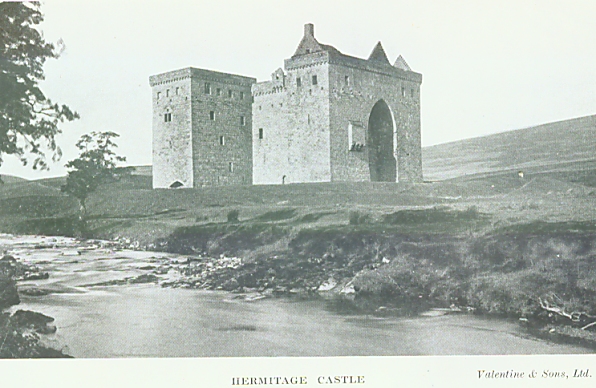
THE Castle of Hermitage,
now a ruined structure, stands in the southern part of Roxburghshire, a
few miles froth Riccarton Junction, near Hermitage Water, which is formed
by Twistlehope Burn and Braidley Burn, and becomes a tributary of Liddel
River. It flows, therefore, through Liddesdale, and is not far from the
Border between Scotland and England in the olden time. It seems probable
that the site of the Castle was chosen because it lies between the two
streams named, and these would not only form a protection from attack, but
also furnish an ample supply of water for the ditches by which the Castle
was surrounded. The whole district of Liddesdale was, in early times, in
the possession of the De Soulis family; and it is said that Randolph de
Soulis built a Castle in this district, but not on the site of the later
Hermitage Castle, about the time of David I., who reigned from 1124 till
1153, and was the ninth and youngest son of Malcolm Caenmor and St
Margaret, daughter of Eadward Atheling. It is possible that King David had
met one of the De Soulis family at the Court of Henry I. of England, and
may have brought him to Scotland when he succeeded his brother Alexander
I. as ruler of that Kingdom. There is little doubt that the most of the
Liddesdale country was in the possession of the De Soulis family about the
13th century.
The Castle of Hermitage was
built on its present site by Nicohlas de Soulis, about 1240, and was made
the excuse by Henry III. of England for an invasion of Scotland, on the
plea that this stronghold was too near the Scottish Boundary, which was
then formed by the Liddel River. So late as 1300, the Castle of Hermitage
was regarded as one of the principal fortresses in the southeastern part
of Scotland. Very soon it came into the possession of William de Douglas,
Knight of Liddesdale, who also held Roxburgh Castle, and was Keeper of
Lochmaben Castle, and in 1332 was Warden of the Marches. Ten years
afterwards (1342) he was specially favoured by David II., who sent him on
an embassy to France. In 1346 he was taken prisoner by the English at
Durham, and only released on the condition of becoming a vassal of Edward
III. of England. But in 1353 the Lord of Hermitage Castle was murdered by
his kinsman, and godson, William, Lord of Douglas, afterwards Earl. It has
been stated, but without documentary proof, that the Castle of Hermitage
was erected by Walter Comyn, fourth Earl of Menteith; but there is little
doubt that this was the main seat of the De Soulis family at a much
earlier period.
Sir William de Douglas, the
Knight of Liddesdale, was born about 1300, and was so brave and successful
in war that he was styled by his contemporaries "the Flower of Chivalry."
He was present at the disastrous battle of Halidon Hill, in 1333, and was
taken prisoner by the English, and remained captive for two years. He
became, after his liberation, one of the most strenuous supporters of the
Scottish national party, and was active at the Siege of Perth in 1339,
where he was wounded. His purpose was then to win back Teviotdale from the
English, which he accomplished in 1342, when King David II. granted to him
the Earldom of Atholl, winch had been forfeited, and bestowed upon him
many lands near Hermitage Castle, by which he became known as "the Knight
of Liddesdale." He resigned the title of Earl of Atholl to the High
Steward of Scotland in exchange for some of the lands in Liddesdale. He
was then the largest proprietor of lands in the district; but his ambition
and jealousy led to his downfall, and brought on the tragedy of Hermitage
Castle.
At this time he was
Custodian of Roxburgh Castle, though it was then in the possession of the
English. Sir Alexander de Ramsay of Dalwolsy, ancestor of the present Earl
of Dalhousie, was one of the most valorous Knights in the brilliant galaxy
of warriors at the Court of David II. He had distinguished himself by
bringing about the raising of the Siege of Dunbar; and in 1338 he captured
the Castle of Roxburgh, and expelled the enemy. So pleased was the King
with this exploit that he conferred at once upon Ramsay the office of
Sheriff of Teviotdale, forgetting that the office was already held by the
Knight of Liddesdale, and was thus deprived of it that it might be given
to his rival. So he captured Ramsay while that unsuspecting Sheriff was
presiding at a Court at Hawick; carried him off to Hermitage Castle, and
imprisoned him in one of the deepest dungeons. There he was confined
without sustenance until he died of starvation; his life having been
prolonged by some grains of corn that fell from an upper chamber in the
place where he was incarcerated. It is certain that Ramsay died at
Hermitage Castle, and Andrew Wynton, the Chronicler, carefully remarks:—"
Of his dethe wes grete pete. To tell you thare-off the manere it is bot
sorow to tell here."
The Earl of Angus in 1470
appointed David Scott of Buccleuch to the office of Custodian of Hermitage
Castle, and for many years the Scotts fulfilled this duty. In 1492,
Archibald Douglas, fifth Earl of Angus, exchanged Liddesdale and Hermitage
with Patrick Hepburn, third Lord Hales, who was created first Earl of
Bothwell, for Bothwell Castle on the Clyde. Angus had married Mary
Hepburn, daughter of the Earl of Bothwell, who thus became a son-in-law to
Bothwell. The second Earl of Bothwell fell on the Field of Flodden, and
the third Earl, his successor, died in 1556, leaving a son, afterwards the
notorious James Hepburn, fourth Earl of Bothwell, whose marriage to Mary,
Queen of Scots, led to his downfall. The sister of this Earl was married
to John Stewart, Prior of Coldingham, a natural son of James V., and
became the mother of Francis Stewart, another turbulent nobleman, who was
created by James VI. the Earl of Bothwell of a new creation, but retaining
the designation of fifth Earl though he retained his mother’s name of
Hepburn.
The story of the fourth
Earl of Bothwell forms a prominent feature in the history of the reign of
Queen Mary. While he lay wounded at Hermitage Castle in 1566, the Queen
went from Jedburgh to see him, a distance of about 40 miles, and returned
the same day, thus bringing on a severe attack of fever. This indiscreet
action upon her part told against her when her marriage to Bothwell took
place in May 1567, as it was supposed that she had consented to this
unfortunate wedding. Bothwell escaped the vengeance of the Scottish
nobles, fled to Kirkwall, and became a pirate. He landed in Norway, was
sent to Denmark, and the King refused to surrender, but kept him in close
confinement, first at Copenhagen, and afterwards at Malmo, and thence to
Drangholm, where he died insane in 1578, having been imprisoned for over
ten years.
The story of Francis
Stewart or Hepburn, fifth and last Earl of Bothwell, was hardly less
eventful and exciting than that of his predecessor. He has been described
as "one of the most treacherous men of his time," always plotting and
counterplotting against his relative James VI. After a very stormy career
he went to France, was pursued thither, and forced to fly to Spain and
Italy. He died at Naples in poverty and disgrace, in 1624, his title and
possessions having been forfeited in 1592, after a daring attempt to carry
off the King from Falkland Palace. His possessions in Liddesdale,
including Hermitage Castle, were conferred upon Sir Walter Scott of
Buccleuch, who was created, in 1606, as first Lord Scott of Buccleuch,
from whom descended the Dukes of Buccleuch, holders of the title. The
present Duke is the proprietor of Hermitage Castle. |



