IN the Naval History of the United
States, we find among the many notable men of Scottish birth or descent
the following: John Paul Jones, Samuel Nicholson, Richard Dale, Alexander
Murray, Charles Stewart, James Barron, John Rodgers, Sr., John Rodgers,
Jr., Thomas McDonough,. Matthew Gaibraith Perry, Oliver Hazard Perry,
Franklin Buchanan.
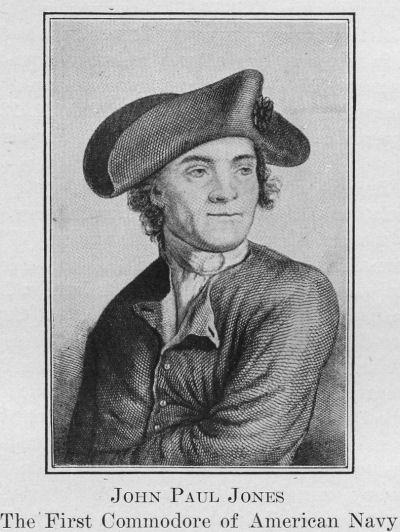
John Paul Jones was born at
Arbigland, Scotland, July 6, 1747, and died in Paris in the Spring of 1792
at the age of forty-five. He was the son of John and Jennie MacDuff Paul,
and the fifth of seven children. He served seven years on a British
warship, and after leaving the British Navy was mate on a slave-trader and
later captain. At the outbreak of the Revolutionary War he became a
lieutenant in the American Navy, and was soon promoted to captain. During
his four years of service he gave brilliant examples of the kind of navy
necessary for the Colonies. His exploits and adventures in France and
Scotland are well known. He was a rover from his thirteenth year until his
departure, never living five years of his life in any one part of the
world excepting America.
Samuel Nicholson (1743-1813), who
was with Paul Jones and later became the first commander of the United
States frigate Constitution, was the son of a Scot from
Berwick-on-Tweed, who received a grant of land and gave name to
Nicholson’s Gap, in the Blue Ridge, Virginia. Samuel’s brothers, James
Nicholson (1737-1804) and John Nicholson, also distinguished themselves in
the early American naval service. Samuel's grandson, James William
Augustus Nicholson (1821-1887), maintained the family honours in the Civil
War.
Richard Dale, of Virginia
(1756-1826), who was also with Paul Jones and afterward served in the
Mediterranean against Tripoli, was of Scottish descent on his mother’s
side and also in part on his father’s.
• Alexander Murray (1755-1821), was
the son of a Scottish physician, of Chestertown, Maryland, and the
grandson of a Jacobite who fled to Barbadoes. Young Murray was in command
of a vessel at eighteen. In 1776 he was made a lieutenant in the navy, but
fought on shore. Upon the re-organization of the navy in 1798, he was
placed in command successively of the frigates Insurgent and
Constellation in the Mediterranean. In 1820 he fought a flotilla of
seventeen Tripolitan gun-boats and chased them into their harbour. His
son, also named Alexander (1816-1884), served with distinction in the
American navy in the Mexican and Civil Wars, and retired a rear-admiral in
1876.
Charles Stewart (1778-1869), born of
Scottish parentage in Philadelphia, entered the merchant service at the
age of thirteen and quickly rose to the command of an Indiaman. In the War
of 1812 he commanded the Constellation and the Constitution.
His daughter, Delia Tudor Stewart, was the mother of Charles Stewart
Parnell, the Irish Home Rule leader.
Commodore James Barron (1769-1851)
commanded the Chesapeake in the fight with the British frigate
Leopard. It was he who killed Commodore Decatur in a duel, in which he
himself was seriously wounded.
Thomas McDonough (1783-1825),
another Scot, was the victor of the battle of Lake Champlain (or
Plattsburg) September 11, 1814, which ranked only second in importance to
Commodore Perry’s famous victory on Lake Erie.
Oliver Hazard Perry was born in the
little village of South Kingston, R. I., in 1785. His father was
Christopher Raymond Perry, of old Devonshire Quaker stock; his mother,
Sarah Wallace Alexander (1768-1830), born in Neury, County Down, Ireland,
the granddaughter of an officer in the Scottish army, a Covenanter, who
had fled from Ayr to Ireland in 1660. Commodore Perry won his famous
battle off Put-in-Bay, Lake Erie, September 10, 1813, when he was
twenty-eight years old, building his own ships in the wilderness on the
bank of the lake. His opponent was a Scot, Captain Robert H. Barclay, one
of Nelson’s veterans. The fight was fiercely contested, but at three o
‘clock in the afternoon the British flag was hauled down. For the first
time since she had created a navy, Great Britain lost an entire squadron.
Perry announced his victory to General William Henry Harrison in the
well-known line, "We have met the enemy and they are ours." How important
a part the Scottish element played in the makeup of this family of five
famous sailor sons is indicated by the fact that the victory of Lake Erie
was known, for years afterward as "Mrs. Perry’s victory" among her
neighbors in Rhode Island.
Matthew Galbraith Perry (1794-1858),
a younger brother of Commodore Perry, organized and commanded the
expedition that broke down the walls of Japan and let in the light of
western civilization in 1853, and in 1854 had the honour of signing with
that country the first treaty opening her ports to the commerce of the
world. He also served with distinction in the War of 1812 and in the war
with Mexico.
Franklin Buchanan (1800-1874), born
in Baltimore of Scottish descent, organized the Naval Academy at Annapolis
in 1845, and was its first superintendent. He entered the Confederate navy
in 1861 and was in command of the ironclad Merrimac at Hampton
Roads. He was wounded, however, the day before and could not participate
in her battle with the Monitor. But Ericsson, the builder of the
Monitor, had a Scottish mother, and on the Monitor itself, in
charge of her engines and turrets, was Isaac Newton, a Scot; so Scotland
was not without representation in the strange sea-battle that opened a new
chapter in the naval history of the world.



