I HAVE sometimes dared to say that
the two principal gifts which Scotland has made to the life of this
country are Presbyterianism and Golf. At first sight they may seem very
far apart, and yet a very interesting parallel might be drawn between
them. It remains to be seen what place Golf will have in the development
of the real character of the people of this country, but there can be
little doubt that the contribution made by Presbyterianism is not only of
a much older date but of wider and more penetrating influence.
Presbyterianism was established in
this country in the seventeenth century mainly as the result of
immigration from Ulster, where many of the Scottish settlers had speedily
found themselves in an uncongenial atmosphere. They preferred the risks of
the voyage and the opening up of the new world to the hardships and the
continual struggle for freedom which they were compelled to endure in
Ireland. Presbyterianism was only gradually established, and found its
earliest centers in Pennsylvania, New Jersey and New York, from which
states it has spread over the whole country. It should be noted that many
Scottish people who settled in New England were absorbed naturally into
the Puritan system established there, a system which long hovered between
Presbyterianism and that kindred form of Congregationalism which they
ultimately adopted. In fact, in the State of Connecticut the earliest
church organization of a strictly formal kind, was Presbyterian, and well
down in the eighteenth century many churches in the towns of that state
were known as Presbyterian churches. The earliest records, for example, of
the Center Church of Hartford, now one of the most powerful Congregational
Churches in New England, show that it was commonly spoken of as the
Presbyterian Church.
The genius of Presbyterianism is to
be found in its singular union of democracy with organized authority. Its
Church Courts regulate the life and establish the inter-relation and
organization of all the different congregations within their jurisdiction.
But these Church Courts are representative courts, and, therefore,
stimulate the sense of responsibility as well as the lively inter est of
private members in the affairs of the Church as a whole.
In other directions, it is curious
to notice that Scotland made some important gifts to the church life of
this country. George Keith, for instance, who was born in Aberdeen and
began life as a Presbyterian minister, became a Quaker and in Pennsylvania
founded a branch of the Quaker movement which was known as the Keithians,
or Baptist Quakers. While a learned and powerful man, there was apparently
something changeable in his form of enthusiasm, for having fought a stormy
warfare in this country, he retired to England and died there a rector in
the Episcopal Church.
Episcopacy in this country was for
long treated as simply a mission field of the Church of England, and the
congregations in the colonies were under episcopal jurisdiction from the
mother land. It was not until 1784 that Bishop Seabury, of Connecticut,
was consecrated as a Bishop by the Episcopal Church of Scotland. This fact
has to this day always awakened in the mind of the Protestant Episcopal
Church a sense of peculiar relationship with the Scottish branch of that
church, from which it received the establishment of its orders on this
side of the ocean.
It is in the field of philosophy,
theology, and religious literature in general that one must look for
another very deep relationship between Scotland and America. The Scottish
Philosophy, so-called, was much more congenial to the theological position
of the theologians on this side of the water than was the more
materialistic and sceptical development of English Philosophy. Men who saw
the connection between John Locke and David Hume, even though they were
attracted by Bishop Berkeley, recoiled from the influence of the typical
English method of approach to the problems of philosophy. The Scottish
method, known as the "Philosophy of Common Sense," appealed much more
sympathetically to their minds. Throughout the latter part of the
eighteenth and the whole of the nineteenth century it was Scottish thought
that most influenced New England. The works of James Reid, Thomas Brown,
Dugald Stewart, Sir William Hamilton and David Calderwood became textbooks
in the colleges of this country, and saturated the minds of the better
educated sections of the ministry with the characteristic methods of
Scottish thought.
On the other hand, it is to be
remembered that this kinship between the two countries made it natural
that Arnerican theology should be warmly welcomed and better understood in
Scotland than in England. The works of Edwards, Dwight, Porter, Hodge, and
Bushnell were among the text-books used in Scottish theological education,
and were to be found on the shelves of many of the ministers in that land.
It is along many and varied lines
that one might trace the action and reaction between the two countries in
respect of their religious life and thought. The predominence of
Episcopacy in England and the comparative weakness of the Free Churches in
that country helped to direct the thought and sympathy of the ministry of
powerful American denominations towards Scotland, its philosophers,
theologians and preachers.
When one reviews the connection
between the Scottish Church and American religious life, three names stand
out as among the most distinguished and influential in past generations.
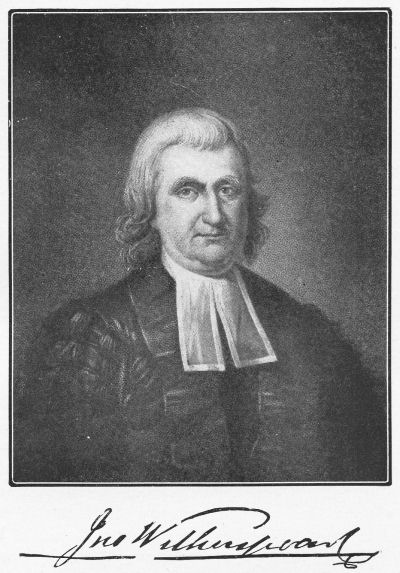
Few personal histories are in a sense more romantic than that of John
Witherspoon, who was born in West Lothian in 1722, graduated from the
University of Edinburgh, became a Jacobite, and was captured at the Battle
of Falkirk. After his release, he came to this country in 1768 to become
President of the College of New Jersey, now Princeton University. From
that time on he exercised a powerful influence over the life of
Pennsylvania, New Jersey and New York. For six years he was a delegate to
the Continental Congress, and was one of the signers of the Declaration of
Independence. He lived to see the triumph of the revolution and died in
1794.
Another Princeton President was the
late Rev. Dr. James McCosh, who after exercising his ministry in Scotland
and in the North of Ireland, became President of the College at Princeton.
Alike by his writings, his teaching power, and his powerful administrative
gifts, McCosh made a great contribution to the educational history of this
country. A man of rugged personality, of determined will, full of the
"pawkiness" of the Scotehman, he ruled in Princeton like a giant. It is
always confessed that it was he who more than any other made that
university what it is to-day. The air of Princeton still reeks with all
kinds of stories of his witty sayings, his abrupt actions, his passionate
outbursts of indignation, his keen handling of affairs.
Among the great preachers of
America, the late Rev. Dr. William Taylor, of the Tabernacle Church of New
York, ranks high. Dr. Taylor was born in Ayrshire, but was called to the
Tabernacle Church from Liverpool, and for many years stood out as one of
the great preachers on this continent. Volume after volume proceeded from
his pen, and all found their way to the libraries of ministers as
representing models of skill in the presentation of the Bible story and
the exposition and application of Christian truth.
Worthy to stand beside Taylor is the
name of the late Rev. Dr. John Hall, of the Fifth Avenue Presbyterian
Church. Dr. Hall was greater as a pastor than he was as a preacher, but in
the pulpit he, nevertheless, displayed great power. His organizing ability
amounted almost to genius, and he it was who made that church one of the
most powerful centers of re1igious influence in this country, and made
this pulpit a seat of power for all his successors.
This brief outline of the main forms
in which Scotland has influenced church life in America is suggestive of
the many directions in which the subject might be pursued to an almost
limitless extent. To-day the influence is by no means less. Perhaps it is
greater than it has ever been. No new denominations have been created, no
great new movements of thought have been awakened, during the last
generation to illustrate the inter-relation of Scottish and American life;
but that inter-relation continues through a hundred channels. In the
writings of her scholars, in the visits of her preachers, the old country
north of the Tweed is still recognized as one of the sources from which
some of the best contributions are still being made to the higher life and
thought of the United States of America.
WILLIAM DOUGLAS MACKENZIE.
Hartford, Conn.



