|
| |
|
Scots and
Scots Descendant in America
Part V - Biographies
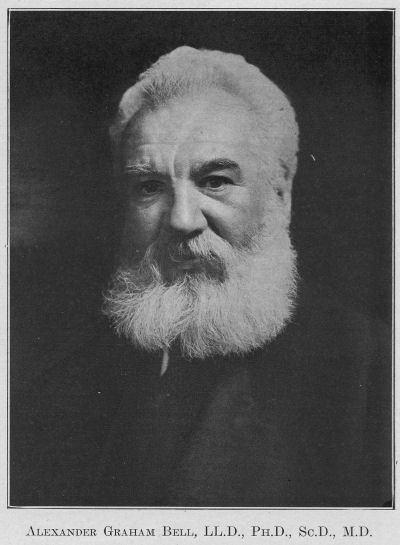
Alexander Graham Bell, LL.D. Ph.d.,
Se.D., M.D. |
|
ALEXANDER GRAHAM BELL was born March
3, 1847, in Edinburgh, Scotland, the second son of Alexander Melville Bell
(born 1819—died 1905), an eminent phonetician and lecturer on elocution
and inventor of "Visible Speech" symbols, and Eliza Grace (Symonds) Bell
(born 1809— died 1897), a daughter of Dr. Samuel Symonds, surgeon in the
British Royal Navy.
Dr. Bell was taught at home
by
his parents, more especially by his mother, whose
musical talent he inherited, and by August Benoit Bertini, a musical
authority and composer. He afterwards entered MacLauren's Academy,
Edinburgh, and a year later the Royal High. School, and was graduated
shortly after his thirteenth birthday. He then went to London and received
instruction in elocution and the mechanism of speech from his grandfather,
Alexander Bell (born 1790—died 1865), a recognized authority on these
sub-. jects. Returning home, he was further trained along the same lines
by his father, with a view to following the family profession. He was
employed for a year as a teacher at Weston-House Academy, Elgin, Scotland,
after which he entered the University of Edinburgh and attended lectures
upon Latin under Dr. Sellers, and upon Greek under Professor Blackie. He
then returned to Elgin as a teacher of elocution and music and resident
master, and remained two years; was instructor in Somersetshire College,
Bath, England, for a year; then became assistant to his father, in London,
who had removed there and received the appointment of lecturer on
elocution in University College. In 1868, he taught several deaf-born
children to speak, and from July to December had entire charge of his
father's professional affairs, including the giving of lessons and
lectures at the different schools, while the father was delivering
lectures in America. Early the next year, he was taken into partnership
with his father. During 1868 to 1870, he attended courses on anatomy and
physiology at University College, joined the college medical society and
matriculated, as an under-graduate at the London University.
The death of two of his sons from
tuberculosis, and the threatened infection of his remaining son caused the
father, in 1870, hurriedly to resign his lectureships and to abandon his
practice in London and remove with his family to a country place at Tutelo
Heights, near Brantford, Ontario, Canada. He continued his work
successfully in Canada and the United States, and the son, Alexander
Graham Bell, by living mostly out-of-doors, regained his health; one of
his recreations at the time being the teaching of his father’s "Visible
Speech" to a neighbouring tribe of Mohawk Indians.
April 1, 1871, Alexander Graham
Bell, at the request of the Boston Board of Education, began the
instruction of teachers of deaf children in the use of the physiological
symbols. His success was immediate and the work extended to Northampton,
Mass., Hartford, Conn., and other cities. In 1872, he opened in Boston a
normal training school, known as the School of Vocal Physiology for
teachers of the deaf, and for instruction in the mechanism of speech,
faults of speech, etc. In 1873, he was appointed professor of vocal
physiology in the School of Oratory of the Boston University. He remained
in Boston until 1877, when he went to Britain and the Continent to lecture
on the telephone.
While a young man, in Scotland and
England, Alexander Graham Bell had shown an aptitude for invention and had
experimented with speaking automatons and the telegraph. Shortly after
arriving in Massachusetts, he was again able to take up, first in Salem
and later in a little workshop at 109 Court Street, Boston, the work that
led eventually to his invention of the telephone. He was a
third-generation specialist in the nature of speech, ‘‘a teacher of
acoustics and a student of electricity, possibly the only man in his
generation who was able to focus a knowledge of both subjects upon the
subject of the telephone." The experiments covered a period of five years
and Gardiner G. Hubbard and Thomas Sanders helped to pay his expenses.
Though for many months he had been certain of the underlying principle, it
was not until June, 1875, that he succeeded in passing the first complete
sound over a wire, and not until nearly forty weeks afterward, March 10,
1876, that he was able to talk complete words and sentences. His patent is
dated March 3, 1876— "the most valuable single patent ever issued."
Then came the hurried trip to the
Centennial Exposition in Philadelphia, where in the presence of the
Emperor of Brazil, Sir William Thomson, afterward Lord Kelvin, Professor
Henry, and other savants, the value of the Bell speaking-telephone was
made known to the world.
The long commercial and legal
battles that followed in sustaining the legality of the patents also
brought many hardships; but in these he and his little band of loyal
suppoters were sustained by the strong men that had rallied around him,
and did not demand the same sacrifice, determination, dogged perseverance
and devotion to an ideal, which make the life of Alexander Graham Bell
such a wonderful lesson to all.
Before he was seventeen years of
age, Dr. Bell devised a method for removing the husks from wheat. His more
important inventions are: the harmonic multiple telegraph (1874) ; the
fundamental method that underlies the electric transmission of speech in
any form in any part of the world (summer of 1874) ; the magneto-electric
speaking-telephone (1876) ; the photo-phone, for transmitting speech and
other sounds to a distance by means of a beam of light (1880) ; an
induction balance with magneto-electric telephone for painlessly locating
bullets or other metallic masses lodged in the human body (1881) ; the
telephone to determine the position and depth of metallic masses in the
human body (1881) ; joint invention, with C. A. Bell and Sumner Taintor of
the graphophone-phonograph and flat disc records for recording and
reproducing speech, music and other sounds, "the commercial origin of the
sound-recording art" (1884-1886) ; tetrahedral kites and kite structures
(1903); joint inventor in a number of improvements designed to promote
aerial locomotion in connection with the Aerial Experiment Association
(1903-1908) ; and the spectrophone for determining the range of audibility
of different substances in the spectrum (1881).
Dr. Bell has been the recipient of
many honours, and is a member and has held important offices in many
learned societies in the United States and abroad. Among the honorary
degrees conferred upon him are: LL.D., Illinois College (1881), Harvard
(1896), Amherst (1901), St. Andrew’s University (1902), Edinburgh
University (1906), Queen’s University, Canada (1908), George Washington
University (1913), Dartmouth (1914) ; Ph.D., National Deaf-Mute College,
now Gallaudet College (1880) ,~ Wurzburg University (1882); D.Sc., Oxford
University (1906); and M.D., Heidelburg Germany), on the 500th anniversary
of that University in 1886. He was awarded by the government of France, in
1880, the Volta Prize of 50,000 francs, for the electrical transmission of
speech. He was also decorated and created an officer of the Legion of
Honour of France (1881). Among the medals he has received are the
following: Centennial Exposition, Philadelphia—gold medal for
speaking-telephone, gold medal for Visible Speech (1876) ; Royal Cornwall
Polytechnic Society—the James Watt silver medal for the telephone (1877) ;
Massachusetts Charitable Mechanics Association— gold medal for the
telephone, gold medal for Visible Speech (1878) ; Society of Arts,
London—Royal Albert silver medal, for his paper on the telephone (1878) ;
Republique Francaise Exposition Universelle Internationale, Paris— gold
medal for the telephone, and a silver medal (1878) ; Society of Arts,
London—Royal Albert silver medal for his paper on the photophone (1881);
the Karl Koenig von Wuerttenberg gold medal, Dem Verdienste; Society of
Arts, London—Royal Albert gold medal, for his invention of the telephone
(1902); John Fritz gold medal (1907); Franklin Institute of Philadelphia—
Elliott Cresson gold medal for the electrical transmission of speech
(1912) David Edward Hughes gold medal, and a silver medal (1913) ;
American Institute of Electrical Engineers—Thomas Alva Edison gold medal
(1914).
In 1887, Dr. Bell founded and
endowed the Volta Bureau for the Increase and Diffusion of Knowledge
Relating to the Deaf, Washington, D. C. In 1900, he assisted in the
formation of the American Association to Promote the Teaching of Speech to
the Deaf, and gave $25,000 to endow the association, and later gave large
additional sums. As special agent of the Bureau of the Census he
determined the scope of that part of the Twelfth Census relating to the
deaf of the United States living on June 1, 1900, initiated the inquiry,
specified the tabulations to be made from the data secured, conducted the
correspondence and prepared the text of the special report of 200 pages
that is valued highly by all who are investigating any phase of deafness.
He was appointed by Congress a Regent of the Smithsonian Institution in
1898, and has been regularly reappointed since. In January, 1904, he
brought the remains of James Smithson, founder of the Smithsonian
Institution, from Genoa, Italy, to New York, where they were received with
national honours and conveyed to Washington.
Dr. Bell married, July, 1877, Mabel
Gardiner Hubbard, daughter of Gardiner Greene Hubbard. Their summer home
is "Beinn Breagh," near Baddeck, Nova Scotia, Canada; their city
residence, 1331 Connecticut Avenue, Washington, D. C. |
|



