|
These years were chiefly marked by
the struggles of the more zealous clergy to replace the church upon a
purely Presbyterian basis, and to maintain their assumed independence of
the civil power. The king found his power encroached on, upon the one
hand, by nobles richer, and having a greater command of followers, than
himself; on the other, by divines who repudiated all subjection to civil
authority in matters ecclesiastical, and yet arrogated powers which
greatly concerned the secular rights and liberties of the people. While
the reaction in his youthful mind against these besetting troubles
inspired him with visionary ideas - of the true rights of a monarch, the
dissimulation practised at his court by the astute emissaries of
Elizabeth, the restraints imposed on his liberty and natural sentiments by
the more zealous Protestant party while he was under their rule, and the
tricks he was tempted to have recourse to in order to recover his freedom,
and obtain some share of real power, gave him, before he was twenty, such
a tutoring in craft, as marked his character during the remainder of life.
A more manly and resolute person would have either broken bravely through
such a complication of troubles or perished in the attempt. With the help
of a good-natured pliancy, James floated on. He was of a timid
disposition, greatly disrelishing the sight of weapons, and along with
this temper he exhibited much good-nature. Trembling at the outrageous
dispositions of his nobles, and constitutionally a lover of peace, he
exerted himself to conciliate offenders, and by persuasion to make them
cease to break the laws, when a vigorous procedure against them in courts
of justice would have been required. For the sake of his hopes of the
English succession, if not from his own convictions—which, however, are
not to be doubted—he maintained the Protestant cause. At the same time,
seeing that the Catholics were friends of monarchy, and might have
something to say in the English succession, he desired, if possible, to
avoid offending them past forgiveness. Even the ultra-zealous Presbyterian
clergy, who came to remonstrate with him, in his own palace, on his public
acts or his private foibles, he could treat with such pleasantry as often
disarmed them, when a more strenuous policy might have failed.
In February 1586—7, the unfortunate
Mary was beheaded in Fotheringay Castle, a victim to the necessities of
the Protestant cause.
In 1588, when this cause was
threatened with destruction by the Spanish Armada, King James and his
people manifested the greatest zeal in preparing for the defence of their
part of the island. They entered into a Covenant or bond, in which they
made solemn profession of the Protestant faith, and avowed their
resolution to oppose Popery by every means in their power. After this
danger had blown over, a new alarm was excited by the discovery of a
conspiracy amongst the three leading Catholic nobles of Scotland, Huntly,
Errol, and Crawford, to aid in introducing a Spanish army, through
Scotland, for the conquest of the British island. These nobles having
broken out in rebellion, in concert with a Protestant noble of irregular
character, Stuart, Earl of Bothwell, the king led an army against them,
and succeeded in reducing them to obedience (April 1589). Huntly,
Crawford, Errol, and Bothwell were all convicted of treason; but the king
shrank from inflicting a punishment which was certain to damage his
prospects with a large party in England. They were liberated after only a
few months’ imprisonment.
In the latter part of 1589, James
effected his marriage with the Princess Anne of Denmark. His young bride
being detained in Norway for the winter, in consequence of a storm, he
sailed for that country (October 22), and solemnised his nuptials at Upslo
(now Christiania). In May 1590, the royal pair arrived amidst great
rejoicings at Leith. The first year of the king’s married life was
strangely disturbed by a series of trials for the imaginary crime of
witchcraft, in which the character of the age is strongly marked.
1586, Apr 18
The Earl of Eglintoun, ‘a young nobleman of a fair and large stature’ (Moy.),
was murdered by Cunningham of Robertland.
Montgomery and Cunningham were the
Montague and Capulet of Ayrshire in the sixteenth century. The feud had
sprung up nearly a hundred years before the above date, in consequence of
the Earl of Glencairn disputing the title of the Earl of Eglintoun to the
bailiery of the district of Cunningham. There had been attempts at a
stanching of the feud, and even a marriage had been proposed by way of
fixing the parties in amity; but at a time when peace had nearly been
effected, enmity was renewed in consequence of a Montgomery killing a
Cunningham in self defence.
‘The Cunninghams, being grieved
hereat, made presently a vow that they should be avenged upon the fattest
of the Montgomeries (for these were their words) for that fact. This vow
was sae acceptable to them all, that a band was concludit, subscrivit with
the chiefest of their hands, to slay the young Earl [of Eglintoun] by
whatsoever mean could be devisit, and that whasoever wald take the turn in
hand, and perform it, he sould not only be sustenit upon the common
expenses of the rest, but sould also be maintenit and defendit by them all
from danger and skaith. At last ane Cunningham of Robertland took the
enterprise in hand, whilk he accomplished in this manner:
‘Twa year before his treasonable
attempt, he insinuate himself in familiarity and all dutiful service to
the said young earl, whereby he movit him to take pleasure without ony
suspicion, till he conqueist [acquired] sic favour at his hand, that
neither the gold, money, horses, armour, clothes, counsel, or voyage was
hid from him, that this same Robertland was made sae participant of them
all, even as though they had been his awn; and besides all this, the
confidence and favour that the earl shew unto him was sae great, that he
preferrit him to be his awn bed-fellow. Hereat Lord Hugo, auld Earl of
Eglintoun, took great suspicion, and therefore admonist his son in a
fatherly manner to beware of sic society, whilk, without all doubt, wald
turn to his skaith; for he knew weel the nature of these Cunninghams to be
subtle and false, and therefore willit him to give them nae traist, but to
avoid their company altogether, even as he lovit his awn life or wald
deserve his fatherly blessing. To this counsel the son gave little regard;
but that was to his pains; and the domestic enemy was sae crafty indeed,
that he wald attempt naething during the life of the father for many
respects. But within short time thereafter [the father died June 1585], as
the noble earl was passing a short way in pastime, accompanied with a very
few of his household servants, and evil horsit himself, Robertland,
accompanied with sixty armed men, came running furiously against him on
borseback; and the earl, fearing the thing that followit, spurrit his
horse to have fled away. His servants all fled another way, and he was
left alone. The horsemen ran all upon him, and unmercifully killed him
with shots of guns and strokes of swords.
‘The complaint of this odious murder
being made to the king, he causit the malefactors to be chargit to a
trial. But they all fled beyond sea. Robertland, wha was the first to make
the invasion, passed to Denmark, where he remainit at court till the king
came to Queen Anne. And because nane of the rest could be apprehendit, the
king ordainit their houses to be renderit to the earl’s brother, to be
usit at his arbitrament, either to be demolishit or otherwise; and he
swore the great aith, that be sould never pardon any of them that had
committit that odious murder. Yet, how soon his majesty was arrivit in
Denmark, his pardon was demandit of the queen for the first petition, and
the same was obtenit, and he was receivit in grace there in presence of
them all. Thereafter he came hame in the queen’s company, and remains as
ane of her majesty’s master stablers ‘—H. K.
J.
May
The persecution of the Protestants in France at this time drove a vast
number to England, where great sacrifices were made for their due
entertainment. Scotland, with comparatively limited means, but perhaps
warmer feeling, also made collections of money for the distressed people.
According to James Melville, ‘all the Protestants in France were chargit
off France within sic a day, under pain of life, lands, gudes, and gear;
sae that the number of banished in England were sae great, and the poor of
them sae many, that they were compelled to seek relief of us for the same
. . . . in the poor bounds I had under charge at the first beginning of my
ministry, we gathered about five hunder merks for that effect. . . . . The
sum of the haul collection whilk the French kirks gat, extended but till
about ten thousand merks.’ A considerable number of the exiles, including
Pierre du Moulin, the minister of Paris, came to Edinburgh, where the
magistrates gave them the common hall of the university for their worship,
along with a stated allowance of money for support of their clergy. It
cannot be doubted that the sight of these poor French exiles would deepen
the feeling of dread and antipathy towards popery and papists, which was
already strongly rooted in Scotland.
May 26
A singular collusive trial took place this day, for the purpose of
clearing Mr Archibald Douglas, parson of Glasgow, of his concern in the
murder of Darnley. He had been in exile or in hiding ever since, except
during the regency of Morton, whose cousin he was. But now it was thought
he might prove useful in advancing the king’s prospects in England; so,
with the most barefaced contempt for the very forms of justice, he was
tried by a packed jury, and acquitted.
It is difficult to say to what
extent the king was personally concerned in absolving one of his father’s
murderers. Perhaps he was not over-squeamish about murders of old date. On
this point an anecdote may be quoted, though it stands somewhat under
question on the score of authority. ‘When Bothwell-haugh returned from
France, whither he had fled upon the murder of the Regent, it is reported
that he fell down at the king’s feet, told who he was, and implored
pardon. On which the king said, raising him up: "Pardon you, man; pardon
you, man! Blest be he that got you! for had you not shot that fellow, I
had never been king."’
June 3
Sundry persons of the name of Burne, dwelling in the middle march of
Scotland, had appointed a day of combat with several persons residing in
the opposite country within England, ‘upon some light purpose unknown to
his majesty, and without licence cravit of his majesty or of his dearest
sister [Elizabeth] or of her officers, as aucht to be in sic case.’ It was
much to be feared that amongst the many persons assembled, a very small
accident might be sufficient to rekindle old feuds, and that thus serious
evils would arise. The Council, therefore, forbade all assembling at the
place and day appointed, under pain of treason.—P.
C. R.
July
While the southern and more populous parts of Scotland were, as we see,
sufficiently barbarous, the Highland districts were as the comparative,
and the Hebrides as the superlative degree in the same quality. The king,
in the first edition of his Basilicon Doron, tells his son to think
no more of the Islanders than as ‘wolves and wild boars.’ Probably, when
the reader has perused the following narrative, he will think the epithet
not unjustly applied, although his majesty afterwards dropped it in
reprinting his book. The tale is of a commotion betwixt Angus M’Connel,
Lord of Kintyre, and Maclean, Lord of Islay. ‘This Angus had to his wife
the sister of Maclean, and although they were brother-in-law, yet the ane
was always in sic suspicion with the other, that of either side there was
sae little traist, that almaist sendle [seldom] or never did they meet in
amity, like unto the common sort of people, but rather as barbares upon
their awn guard, or by their messengers. True it is that thir Islandish
men are of nature very proud, suspicious, avaritious, full of deceit and
evil intention [each] against his neighbour, by what way so ever he may
circumvent him. Besides all this, they are sae cruel in taking of revenge,
that neither have they regard to person, age, time, or cause; sae are they
generally all sae far addicted to their awn tyrannical opinions, that in
all respects they exceed in cruelty the maist barbarous people that ever
has been sin’ the beginning of the warld; ane example whereof ye saIl hear
in this history following:
‘Angus M’Connel, understanding, by
divers reports, the gude behaviour of Maclean to be sae famous, that
almaist he was recommended and praised by the haill neutral people of
these parts above himself; whilk engendered sic rancour in his heart that
he pretermitted nae invention how he might destroy the said Maclean. At
last he devised to draw on a familiarity amang them, and inveited himself
to be banqueted by Maclean; and that the rather, that Maclean should be
the readier to come over to his isle with him the mair gladly, either
being required, or upon set purpose, as best should please him. And when
Angus had sent advertisement to Maclean, that he was to come and make gude
cheer, and to be merry with him certain days, Maclean was very glad
thereof, and answered to the messenger: "My brother shall be welcome,"
said he, "come when he list." The messenger answered, it wald be
to-morrow. So when Angus arrived in effect, he was richt cheerfully
welcomed by his brother-in-law, wha remained there by the space of five or
sax days. And when it was perceived that Maclean’s provision was almaist
spent, Angus thought it then time to remove. Indeed, the custom of that
people is sae given to gluttony and drinking without all measure, that as
ane is inveited to another, they never sinder sae lang as the vivers do
last. In end, Angus says: "Because I have made the first obedience unto
you, it will please you come over to my isle, that ye may receive as gude
treatment with me as I have done with yon." Maclean answered that he durst
not adventure to come to him for mistrust; and Angus said: "God forbid
that ever I should intend or pretend any evil against you; but yet, to
remove all doubt and suspicion frae your mind, I will give you twa
pledges, whilk shall be sent unto you with diligence; to wit, my eldest
son and my awn only brother-german: these twa may be keepit here by your
friends till ye come safely back again." Maclean, hearing this offer,
whilk appeared unto him void of all suspicion, and so decreeted to pass
with him to Kintyre; and further to testify that baith he simply believed
all to be true, and that upon hope of gude friendship to continue, he
thought expedient to retein ae only pledge, and that was Angus’s brother,
and wald carry with him his awn nevoy, the son of Angus. Whether he did
this to save himself frae suspicion of danger, as apparently of the event
he did it, or gif he brought him back again upon liberal favour, I will
not dispute; because I have tauld you afore the perfect nature and
qualities of these islands people; yet, because Maclean’s education was
civil, and brought up in the gude lawis and manners of Scotland from his
youth, it may be that he has had double consideration, ane by kind, and
another by art of honest dissimulation.
To conclude, to Kintyre he came,
accompanied with forty-five men of his kinsfolk and stout servants, in the
month of July 1586; where, at the first arrival, they were made welcome
with all humanity, and were sumptuously banqueted all that day. But Angus
in that meantime had premonished all his friends and weelwillers within
his isle of Kintyre to be at his house that same night at nine of the
clock, and neither to come sooner nor later; for he had concluded with
himself to kill them all the very first night of their arrival, fearing
that gif he should delay any langer time, it might be that either he sould
alter his malicious intention, or else that Maclean wald send for some
greater forces of men for his awn defence. Thus he concealed his intent
still, till baith he fand the time commodious and the very place proper;
and Maclean being lodged with all his men within a lang house, that was
something distant frae other housing, took to bed with him that night his
nevoy, the pledge afore-spoken. But within ane hour thereafter, when Angus
had assembled his men to the number of twa hundred, he placed them all in
order about the house where Maclean then lay. Thereafter he came himself
and called at the door upon Maclean, offering to him his reposing drink,
whilk was forgotten to be given to him before he went to bed. Maclean
answered, that he desired nae drink for that time. "Although so be," said
the other, "it is my will that thou arise and come forth to receive it."
Then began Maclean to suspect the falset, and so arase with his nevoy
betwixt his shoulders, thinking that gif present killing was intended
against him, he should save himself sae lang as he could by the boy; and
the boy, perceiving his father with a naked sword, and a number of his men
in like manlier about, cried with a loud voice, mercy to his uncle for
God’s sake; whilk was granted, and immediately Maclean was removed to a
secret chalmer till the morrow. Then cried Angus to the remanent that were
within; sae mony as wald have their lives to be safe, they should come
forth, twa only excepted, whilk he nominate; sae that obedience was wade
by all the rest, and these twa only, fearing the danger, refused to come
forth. Angus, seeing that, commanded incontinent to put fire to the house,
whilk was immediately performed; and thus were the twa men cruelly and
unmercifully burnt to the death. These twa were very near kinsmen to
Maclean, and of the eldest of his clan, renowned baith for counsel and
manheid. The rest that were prisoners of the haill number afore-tauld,
were ilk ane beheaded the days following, ane for ilk day, till the haul
is number was ended; yea, and that in Maclean’s awn sight, being
constrained thereunto, with a dolorous advertisement to prepare himself
for the like tragical end howsoon they should all be killed. And when the
day came that Maclean should have been brought forth, miserably to have
made his tragical end, like unto the rest, it pleased Angus to lowp upon
his horse, and to come forth for joy and contentment of mind, even to see
and behald the tyrannical fact with his awn eyes. But it pleased God, wha
mercifully deals with all men, and disappoints the decrees of the wicked,
to disappoint his intent for that day also, for he was not sae soon on
horseback, but the horse stumbled, and Angus fell off him, and brake his
leg, and so was carried hame.’—H. K. J.
The personages of this well-told
tale were properly designated Angus Macdonald of Islay, and Lachlan
Maclean of Dowart; the latter is described by Mr Tytler as ‘an island
Amadis of colossal strength and stature,’ ‘by no means illiterate,’ ‘and
possessing, by the vigour of his natural talents, a commanding influence
over the rude and fierce islesmen.’ Angus of Islay was step-son to the
Irish Earl of Tyrone, and much mixed up with the troubled politics of the
north of Ireland in that age. There was an old feud regarding land between
Angus and his brother-in-law Maclean. In 1585, it received fresh
excitement from an outrage on the laws of hospitality committed by
Maclean’s people upon the retinue of Donald Mor of Sleat, when that chief
chanced to take shelter from a storm in the isle of Jura. Angus of Islay,
having gone to visit Maclean soon after, was seized and imprisoned along
with his followers; and he was not liberated till he had agreed to
renounce the disputed lands. Such, in reality, was the nature of the visit
which the annalist has described as prompted by deceit on the part of
Angus. With one of the two hostages exacted from Angus on this occasion,
Maclean soon after went to Islay to see after the recovered lands; with
strange simplicity, he complied with an invitation of Angus to visit him
at his house of Mullintrea, though not till he had received repeated
protestations that no harm was intended to him. Here it was that the
barbarous circumstances related by our annalist took place.’
By the intervention of a royal
message, and the interference of the acting head of the clan Campbell,
Angus rendered up Maclean, ‘on receiving a promise of pardon for his
crimes, and on eight hostages of rank being placed in his hands by Maclean,
for the performance of certain conditions which the latter was forced to
subscribe. To complete this singular picture of barbarism, Lachlan was no
sooner free, than he ravaged Islay with fire and sword; in requital of
which, Angus ravaged the isles of Mull and Tiree, killing every human
inhabitant and every beast that fell into his hands.
The various clans siding with their
respective friends in this contest, it became the cause of a general war
throughout the islands and West Highlands, which lasted some time,
notwithstanding every effort of the government to put it down.
Oct 8
The Master of Yester, whom we have just seen as a peace-breaker, comes
once more before the Council as a turbulent and wicked person. Sir John
Stewart of Traquair, and his brother James Stewart of Shillinglaw,
lieutenant of his majesty’s guard, appear as complainers, setting forth,
in the first place, how it is well known of Sir John Stewart, that ‘having
his dwelling-place on the south side of Tweed, in a room subject to the
invasions and thieves of the broken men of the Borders, and lying betwixt
them and sundry his majesty’s true lieges, whom commonly they herry and
oppress, how at all times himself, his brother, his friends and neighbours
assisting him, dwelling betwixt the burgh of Peebles and Gaithopeburn,
resistit the stouthreif and oppressions of the said thieves and broken
men, to the comfort and relief of mony true men, in whilk course they
intend, God willing, to continue to their lives end.’ Of late, however, so
proceeds the complaint, ‘they have been, and is greatumly hindered
therein, by reason that William, Master of Yester, by the causing,
direction, at least owersicht and tolerance, of William Lord Hay of
Yester, his father, sheriff of Peebles and provost of the burgh of Peebles
(wha, by the laws of this realm . . . . aucht to mak his said son
answerable,’ but had ‘placit him in the principal house and strength of
Neidpath,’ though he has been a denounced rebel for nearly the space of a
year ‘for his inobedience to underlie the laws,’ till within the last few
days that he obtained relaxation) . . . . had in the meantime ‘not only
usurpit and taken upon him the charge of the sheriffship of Peebles, and
provostry of the burgh thereof, but ane absolute command to proclaim and
hald wappinshawings at times nawise appointit by his hieness’ direction,
to banish and give up kindness to all persons in burgh or land where
he pleases, to tak up men’s gear under pretence of unlaws fra
wappinshawings or other unnecessar causes, never being lawfully callit nor
convenit; . . . . and forder, it is weel knawn to sundry of the lords of
Secret Council, that the said Master socht the life of the said James
Stewart, and dayly shores and boasts to slay him, and all others of his
kin, friends, allies, assisters, and partakers.’ On the petition of’ the
complainers, the Council heard parties, the peccant Master appearing for
himself, and in excuse for his father, who was sick and unable to travel.
And the end of the matter was, that the case was remitted to the judgment
of the Court of Session, to be decided by them as they might think proper.
Meanwhile, the Master was enjoined to cease molesting the Stewarts and
their friends and dependents between this and the 8th of January next.—P.
C. R.
On the 29th April 1587, it is stated
that the king had dealt between these hostile parties, and arranged
letters of affirmance between them, in order to secure peace for the
future; but the Master of Yester had refused to subscribe. For this he is
threatened with being denounced rebel, or, as the ordinary phrase was,
being put to the horn. On the 12th May, the king ordered him to enter in
ward north of the Tay, and there remain till liberated; and a few weeks
later, on this order not being complied with, the Master was denounced
rebel, and all forbidden to assist or receive him.—P. C. K
In a memoir of the Hays of
Tweeddale, composed by a member of the family a century later, the
character and objects of the parties in this dispute are precisely
reversed. The Master of Yester—whose nickname, it seems, was
Wood-sword—is described as a great upholder of the laws against
thieves, while the Stewarts of Traquair were the reverse. The passage is
worth transcribing, as an example of the favourable views of which a man’s
actions are always more or less susceptible in the eyes of friends,
especially after the lapse of a few years.
‘In his time, the Borders being much
infested with broken men and thieving, this lord, who always rode
accompanied with twenty-four horsemen and as many footmen armed, did take
and hanged a great [many] of them. He was at feud with the house of
Traquair for seconding the thieves, in pursuit of whom he received a wound
in the face. King James the Sixth being desirous to have this feud taken
away, as all others of the country, and he refusing, was committed to the
Castle of Edinburgh, out of which he made his escape, and immediately made
ane new inroad against the thieves, of whom he killed a great many, in a
place called from thence the Bloody Haugh, near Riskin-hope, in
Rodonna; whereupon King James was pleased to make a hunting journey, and
came to the house of Neidpath, whither the king called Traquair, with his
two sons, who made to Lord Yester acknowledgment for the wrong they had
done him, and then peace was made by the king. This was witnessed by one
William Geddes, who was my lord’s butler, and lived till the year 1632.’—Genealogy
of the Hays of Tweeddale, by Father R. A. Hay.
1586-7, Feb
A few days before the death of Queen Mary in Fotheringay Castle, the king,
her son, ‘to manifest his natural affection towards his dearest mother,
whose preservation he always earnestly wished, required the ministers to
pray for her, at all preachings and common prayers, after the following
form: "The Lord illuuminate and enlighten her spirit, that she may attain
to the knowledge of his truth, for the safety of soul and body, and
preserve her from the present peril."
‘Some of the ministry agreed to that
form of prayer, thinking it very lawful, since it was his majesty’s
pleasure; but some of them, especially the ministers of Edinburgh, refused
to pray but as they were moved by the spirit.’
‘On the 3d. of February [five days
before Mary’s execution], the king appointed Patrick, Archbishop of St
Andrews, a man evil thought of by the ministry and others, to preach in
the kirk of Edinburgh, and resolved to attend the preaching himself. When
the day came, Mr John Coupar, one of the ministers of Edinburgh,
accompanied with the rest of the brethren, came in and prevented the
bishop, by taking place in the pulpit before his coming into the kirk; and
as the said John was beginning the prayer, the king’s majesty commanded
him to stop: whereupon he gave a knock on the pulpit, using an exclamation
in these terms: "This day shall bear witness against you in the day of the
Lord. Wo be to thee, O Edinburgh! for the last of thy plagues shall be
worse than the first!" After having uttered these words, he passed down
from the pulpit, and, together with the whole wives in the kirk, removed
out of the same.’—Moy. R.
Another account says: ‘The Bishop of
St Andrews went up, and, after the English form, began to beck in a low
courtesy to the king; whereas the custom of this kirk was first to salute
God, to do God’s work, and then, after sermon and divine worship, to give
reverence and make courtesy particularly to the king. But soon after the
bishop was entered into the pulpit, all the people in the kirk gave a
shout and loud cry, so as nothing could be heard, and almost all ran out
of the kirk, especially the women. This carriage of the people made the
king rise up and cry: "What devil ails the people, that they may not tarry
to hear a man preach!" ‘—Row.
The archbishop ‘preached a sermon
concerning prayer for princes, whereby he convinced the whole people who
remained in the kirk, that the desire of the king’s majesty to pray for
his mother was most honourable and reasonable.’—Moy. R.
It gives a striking idea of the
difficulty attending the transmission of intelligence in those days—in
connection, it must be owned, in this instance, with the deceitful and
stealthy conduct of Elizabeth—that Mary had been upwards of a fortnight
dead before her son King James was fully apprised of the fact in
Edinburgh. On the 15th, he received a message from Kerr of Cessford, the
warden of the Borders, informing him that the English warden had just
communicated to him this sad intelligence. Not believing it on this
authority, the king went to hunt at Calder, but at the same time sent his
secretary to Berwick to make inquiry. This gentleman returned on the 23d,
with certain information of Mary’s death. ‘This put his majesty into a
very great displeasure and grief, so that he went to bed that night
without supper; and on the morrow, by seven o’clock, went to Dalkeith,
there to remain solitary.’ —Moy. R.
‘Certain it is that King James, her
only son, was not a little moved to hear such unparalleled and uncouth
news, who loved his dearest mother with the greatest piety that could be
seen in a son. [He] took exceeding grief to heart, not without deep
displeasure for the same; and much lamented and mourned for her many
days.’ —Pa. And.
Many years after, when he had
mounted the English throne, King James told Sir James Harrington, that his
mother’s death had been foreseen in Scotland, ‘being, as he said, "spoken
of in secret by those whose power of [second] sight presented to them a
bloody head dancing in the air." He did remark much on this gift, and said
he had sought out of certain books a sure way to attain knowledge of
future chances.’
Attention was strongly fixed at this
time on the confidence manifested by such as were of the Catholic
religion, chiefly gentry, in entertaining Jesuits and seminary priests,
who performed mass in their houses, and even took possession of some of
the ruinous parish churches, doing what in them lay to seduce the people
back to the old faith We are told, for instance, that Lord Maxwell openly
caused mass to be sung in the abbey-church of Lincluden, near Dumfries, on
three successive days at Christmas 1586. Pasch and Yule began again to be
kept by the common sort of people, and saints’ wells were much resorted to
for the cure of diseases. The General Assembly declared it to be ‘ane
exceeding great grief to all such as have any spunk of the love of God and
his kirk,’ to see the land thus polluted with ‘idolatry’ and ‘pusionable
doctrine.’ They considered the evil as chiefly owing to the laxity of the
state in the repression of papistry, and the positive encouragement which
it rendered in some instances to papists. At the same time, the reformed
religion was in miserable condition, many of the parish kirks being
ruinous and destitute of pastors, while the pastors that did anywhere
exist were defrauded of their revenues, starved, and sometimes greatly
abused in their very persons by the papist gentle-folks. A great defection
was seriously apprehended as now imminent, unless some change should take
place in the king’s counsels and conduct. He was pathetically exhorted to
execute the laws against both the priests and their entertainers. It was
demanded, in particular, that all papist noblemen should be ‘presently
exiled the country,’ while certain of the priests should be sent away by
the first ships, with certification that on their daring to return they
should be hanged without further process.
According to the same General
Assembly, the moral condition of the country was awful, ‘ugly heaps of all
kinds of sin lying in every nook and part’ of it—no spot but what was
overwhelmed as by ‘a spate’ [inundation], ‘with abusing of the blessed
name of God, with swearing, perjury, and lies, with profaning of the
Sabbath-day with mercats, gluttony, drunkenness, fighting, playing,
dancing, &c., with rebelling against magistrates and the laws of the
country, with blood touching blood, with incest, fornication, adulteries,
and sacrilege, theft and oppression, with false witness[ing], and finally
with all kinds of impiety and wrong.’ The poor at the same time ‘vaiging
[wandering] in great troops and companies through the country, without
either law or religion.’—B. U. K.
1587, May
The French poet, Guillaume Sallust, Sieur du Bartas, paid a visit to
Scotland. For any eminent literary man of either England or France to
travel north of the Tweed, was as yet a rarity and a marvel. The king,
however, had contracted an admiration of Du Bartas, and translated some of
his poetry; and now a royal invitation had brought him to Holyrood. It
would be curious to learn what were the sentiments of the polite Frenchman
on coming in contact with James’s circle at the palace, or seeing the rude
state of the people generally throughout the country.
We learn that ‘he was received
according to his worthiness, entertained honourably, and liberally
propined ‘—that is, favoured with presents. At the end of June, the king
made an excursion to St Andrews, taking the French poet along with him,
that he might see the principal seat of learning in Scotland. We have some
curious particulars of the visit from the Dutch pencil of James Melville.
St Mary’s College, the principal theological seminary of the country, was
now presided over by the faithful Presbyterian Andrew Melville, the man of
most marked talent and energy in the Scotch church after the days of Knox.
In the Castle lived, in much reduced state, the nominal archbishop,
Patrick Adamson, a man of fine literary talents, but weak in character,
and, upon the whole, not a credit to Scottish Episcopacy. James admired
and patronised Adamson; but he had a trembling faith in the powerful wit
and inflexible courage and integrity of Melville. The king, ‘coming first
without any warning to the new college [St Mary’s], he calls for Mr
Andrew, saying he was come with that gentleman to have a lesson. Mr Andrew
answers, "that he had teached his ordinar that day in the forenoon." "That
is all ane," says the king; "I maun have a lesson, and be here within an
hour for that effect." And indeed, within less than an hour, his majesty
was in the school, and the haill university convenit with him, before whom
Mr Andrew extempore entreated maist clearly and mightily of the right
government of Christ, and in effect refuted the haill acts of parliament
made against the discipline thereof, to the great instruction and comfort
of his auditory, except the king alane, wha was very angry all that
night.’
On the morrow, ‘the bishop had baith
a prepared lesson and feast made for the king. His lesson was a tighted-up
abridgment of all he had teached the year bypast—.namely, anent the
corrupt grounds whilk he had put in the king’s head contrary to the true
discipline. To the whilk lesson Mr Andrew went contrair to his custom, and
with his awn pen marked all his false grounds and reasons; and without
further [preparation] causit ring his bell at twa afternoon the same day,
whereof the king hearing, he sent to Mr Andrew, desiring him to be
moderate and have regard to his presence, otherwise he wald discharge him.
He answerit courageously, that his majesty’s ear and tender breast was
piteously and dangerously filled with errors and untruths by that wicked
man, the whilk he could not suffer to pass, and brook a life [and yet
remain alive]; otherwise, except the stopping of the breath of God’s mouth
and prejudging of his truth, he should behave himself maist moderately and
reverently to his majesty in all respects. The king sent again to him and
me, desiring it should be sae, and shawing that he wald have his four
hours [a light meal at four o’clock] in the college, and drink with Mr
Andrew. Sae, coming to that lesson with the bishop, wha requested the king
for leave to make answer instantly in case anything were spoken against
his doctrine. But there Mr Andrew, making him [affecting] as though he had
naething to do but with the papist, brings ont their warks, and reads out
of them all the bishop’s grounds and reasons. The whilk, when he had at
length and maist clearly shawn to be plain papistry, then he sets against
the same with all his mean [power], and with immutable force of reasoning,
from clear grounds of Scripture, with a mighty parrhesie and flood of
eloquence, he dings them sae down, that the bishop was dashed and strucken
as dumb as the stock he sat upon. After the lesson, the king, in his
mother-tongue, made some distingoes, and discoursit a while thereon, and
gave certain injunctions to the university for reverencing and obeying of
his bishop; wha fra that day furth began to tire of his teaching, and to
fall mair and mair in disgrace and confusion. The king, with Monsieur du
Bartas, came to the college-hall, where I causit prepare and have in
readiness a banquet of wet and dry confections, with all sorts of wine,
whereat his majesty campit very merrily a gude while, and thereafter went
to his horse. But Monsieur du Bartas tarried behind, and conferrit with my
uncle and me a whole hour, and syne followed after the king; wha inquiring
of him that night, as ane tauld me, "What was his judgment of the twa he
had heard in St Andrews?" he answerit the king, "that they were baith
learned men, but the bishop’s were cunned [conned] and prepared matters,
and Mr Andrew had a great ready store of all kind of learning within him;
and, by [besides] that, Mr Andrew’s spreit and courage was far above the
other." The whilk judgment the king approved.’
The Sicur du Bartas was ‘dismissed
in the harvest, to his majesty’s great praise, sae lang as the French
tongue is used and understood in the world.’—Ja.
Mel.
The small merchant-craft of Scotland
was much troubled with pirates, chiefly of the English nation. James
Melville gives a lively account of an affair with an English piratical
vessel, which took place in connection with the Fife port where he served
as pastor.
‘At my first coming to Anstruther
there fell out a heavy accident, whilk vexit my mind mickle at first, but
drew me mickle nearer my God, and teached me what it was to have a care of
a flock. Ane of our crears, returning from England, was beset by an
English pirate, pill[ag]ed, and a very guid honest man of Anstruther slain
therein. The whilk loon coming pertly to the very road of Pittenweem,
spulyied a ship lying therein, and misused the men thereof. This wrang
could not be suffered by our men, lest they should be made a common prey
to sic limmers. Therefore, purchasing a commission, they riggit out a
proper fly-boat, and every man encouraging another, made almaist the haill
honest and best men in all the town to go in her to the sea. This was a
great vexation and grief to my heart, to see at my first entry the best
part of my flock ventured upon a pack of pirates, whereof the smallest
member of the meanest was mair in valour than a shipful of them. And yet I
durst not stay some [un]less nor I stayed all, and all I durst not, baith
for the dangerous preparative, and the friends of the honest man wha was
slain, and of them that were abusit, wha were many, in sic sort as the
matter concerned the haill. But my God knaws what a sair heart they left
behind when they parted out of my sight, or rather what a heart they
carried with them, leaving a bouk behind. I neither ate, drank, nor
sleepit, but by constraint of nature, my thought and care always being
upon them, and commending them to God, till aucht or ten days were endit,
and they in sight returning, with all guid tokens of joy, flags,
streamers, and ensignie displayed, whom with great joy we receivit, and
went together to the kirk, and praised God.
‘The captain, for the time, a godly,
wise, and stout man, recounted to me truly their haill proceeding. That
they, meeting with their admiral, a great ship of St Andrews, weel riggit
out by the burghs, being fine of sail, went before her all the way, and
made every ship they forgathered with, of whatsomever nation, to strike
and do homage to the king of Scotland, shawing them for what cause they
were riggit forth, and inquiring of knaves and pirates. At last, they meet
with a proud stiff Englishman, wha refuses to do reverence; therefore the
captain, thinking it was a loon, commands to give them his nose-piece:
the whilk delashit lights on the tie of the Englishman’s mainsail, and
down it comes; then he yields, being but a merchant. But there was the
merciful providence of God, in staying a great piece of the Englishman,
lying out her stern in readiness to be shot, whilk, if it had lighted
amang our folks, being many in little room, without fence, wald have
cruelly demeaned them all. But God, directing that first shot, preserved
them. From them they approached to the shore at Suffolk, and finds by
Providence the loon [rogue], wha had newlins taken a crear of our awn
town, and was spulying her. Howsoon they spy ane coming warlike, the loons
leave their prize, and run their ship on land, our fly-boat after, and
almaist was on land with them; yet, staying bard by, they delash their
ordnance at the loons, and a number going a-land, pursues and takes a
half-dozen of them, and puts them aboard in their boat. The gentlemen of
the country and towns beside, hearing the noise of shooting, gathers with
haste, supposing the Spanyard had landed, and apprehending a number of the
bone in our men’s hands, desirit to knaw the matter. The whilk when the
justices of peace understood, and saw the king of Scotland’s arms, with
twa gallant ships in warlike manner, yielded and gave reverence thereto,
suffering our folks to take with them their prisoners and pirate’s ship,
whilk they brought with them, with half-a-dozen of the loons; whereof twa
were hangit on our pier-end, the rest in St Andrews; with nae hurt at all
to any of our folks, wha ever since syne have been free from English
pirates. All praise to God for ever. Amen.’
King James at this time attempted
what Dr Robertson, with somewhat too much complaisance, calls a work
worthy of a king. Many of his nobility were at feud with each other on
account of past grievances. For example, Glammis bore deadly hatred
against the Earl of Crawford, in consequence of the killing of his father
by some of Crawford’s people at Stirling in 1578. With the Earl of Angus,
whose piety and love of the clergy induced James to call him the
Ministers’ King, it was sufficient ground of hostility against the
Earl of Montrose that he had sat as chancellor on the jury which adjudged
Morton to the Maiden. The Earls of Huntly and Marischal had some mutual
grudge of their own, perhaps little intelligible to southern men. So it
was with others. The nobility being now assembled at a convention, James,
who never could check outrages amongst them by the sword of justice, did
what a good-natured weak man could to induce them to be reconciled to each
other, and call it peace when there was no peace. Assembling them all at a
banquet in Holyrood on a Sunday, he drank to them thrice, and solemnly
called on them to maintain concord, threatening to be an enemy to him who
should first disobey the injunction. Next day, [May 11] after supper, then
an early meal, and after ‘many scolls’ had been drunk to each other, he
made them all march in procession ‘in their doublets’ up the Canongate,
two and two, holding by each other’s hands, and each pair being a couple
of reconciled enemies. He himself went in front, with Lord Hamilton on his
right hand, and the Lord Chancellor Maitland on the left; next after, the
Duke of Lennox and Lord Claud Hamilton; then Angus and Montrose, Huntly
and Marischal, Crawford and the Master of Glammis. Coming to the Tolbooth,
his majesty ordered all the prisoners for debt to be released. Thence he
advanced to the picturesque old market-cross, covered with tapestry for
the occasion, and where the magistrates had set out a long table well
furnished with bread, wine, and sweetmeats. Amidst the blare of trumpets
and the boom of cannon, the young monarch publicly drank to his nobles,
wishing them peace and happiness, and made them all drink to each other.
The people, long accustomed to sights of bloody contention, looked on with
unspeakable joy, danced, broke into songs of mirth, and brought out all
imaginable musical instruments to give additional, albeit discordant
expression, to their happiness. All acknowledged that no such sight had
ever been seen in Edinburgh. In the general transport, the gloomy gibbet,
usually kept standing there in readiness, was cast down, as if it could
never again be needed. Sweetmeats, and glasses from which toasts had been
drunk, flew about both from the table of the feast and from the responsive
parties on the fore-stairs. When all was done, the king and nobles
returned in the same form as they had come.—
Moy. Bir. Cal. H K J.
Healing measures like these were not
nearly so good as they seemed. In less than two months, we find six or
seven of the nobles quarrelling about priority of voting, and Lord Home
passing a challenge to Lord Fleming—’ wha were not sufferit to fecht,
albeit they were baith weel willing.’
King James had a sincere antipathy
to deadly feuds and quarrels, because he loved peace and good humour; but
timidity, want of strong will, and partly, perhaps, his very bonhomie,
prevented him from taking those severe measures with offenders which
alone could effectually repress such practices. He desired to correct men
by proclamations or at the most ‘hornings;’ and when one gentleman had
literally killed his neighbour in a casual rencontre, the king was
satisfied if he could induce the son or other relations of the deceased to
meet the guilty person, make up matters for a sum of money, shake hands,
and agree there should be no more of it. He liked to be personally busy in
effecting reconciliations, and at length came to use what he considered as
cornpulsory measures for bringing the parties to his presence, that he
might see to their renewing friendship. Thus, on the 22d November 1599, an
edict of council was sent to James Hoppringle of Galashiels, and George
Hoppringle of Blindlee, commanding them to come and submit the quarrel
standing between them to the arbitrament of friends, on pain of being
charged with rebellion. On the 12th of January ensuing, James Tweedie of
Drumelzier and William Veitch of Dawick were charged, under like pains, to
come and subscribe letters of assurance, for ‘the feid and inimitie
standing betwixt them.’—P. C. R.
In consequence of a bad crop in
1586, there was ‘great scant and dearth’ this year, ‘and great death of
people for hunger.’—H.K.J.
Elizabeth issued a proclamation
regarding scarcity, 2d January 1586—7. She speaks of ‘foreseeing the
general dearth of corn and other victuals, partly through the
unseasonableness of the year past, whereby want bath grown more in some
countries than in others, but most of all, generally, through the
uncharitable greediness of great corn-masters, &c.’ This was the
invariable cry on all occasions of dearth. All would be well if only those
possessing grain would not reserve it in hope of higher prices. No one
ever dreamed of that benefit which the modern political economist sees in
the reservings of the corn-mercbant—namely’, an equalising of consumption
over the whole period of the scarcity, as contrasted with the over-free
use of the victual at first, and increased scarcity afterwards. Perhaps
there was, after all, some grounds for the wrath at forestallers, for in
former days, as we well know, there was less means of obtaining
information regarding the extent of the failure of a crop than there is
now, and those gentlemen, accordingly, were rather speculators on a
possible, than on an ascertained case. They would hence appear as men
aiming at the making of a scarcity where there was perhaps no great
occasion for it. What offence greater, the poor public would naturally
say, than that of deliberately trying to starve us!
King James had lately sent Vans of
Barnbarroch, and his own ex-preceptor, Peter Young, as ambassadors to
Denmark, to negotiate a match with the daughter of Frederick II. He now
(June 14, 1587) wrote to those gentlemen, ordering them to see to certain
Scotch ships which had gone to Dantzie for grain, designing to carry it to
other foreign ports for a profit: he demands that they shall not be passed
by the tollena!er at Elsinore, till the skippers enter into an
obligation to bring the grain to Scotland, ‘for the relief of the puir and
supply of the dearth and scarcity.' How would a modem con-merchant feel if
his Vessels were now stopped at the Sound with such a demand as this!
1587, Sep
Patrick Hamilton, brother of the Laird of Preston, and captain of Brodick
Castle in Arran, was denounced rebel for not appearing before the king and
Council, to answer a complaint of Abacuck Bisset, writer to the Signet in
Edinburgh. It appears that Patrick, accompanied by two nephews, had
attacked Mr Bisset in St Giles’s Kirk in Edinburgh, during the sitting of
parliament, with a sword, and cut off the haul fingers of his left hand.’
This Abacuck Bisset was clerk to Sir
John Skene, Lord Clerk Register. He compiled a treatise entitled
The Rolment of Courtis, contenand the Auldest Lawis,
Actis, Statutis, Constitutionis, and Antiquities of His Majesties Native
and maist Ancient Realme of Scotland, as ane Frie Kingdome, &c.
We have hitherto heard the name of
Queen Mary chiefly in connection with tragic matters: verily a name of
tears. For once we find her connected with a piece of pleasantry, and it
was in association with the author of the Rolment of Courtis. The
father of this worthy writer was caterer to the queen. One day, as she was
passing to mass, he acquainted her with his having a child to be baptised,
and desired her to assign the infant its name. She said she would open the
Bible in the chapel, and whatever name she cast up, that should be given
to the child. The name cast up was that of the prophet Habakkuk, which, in
the form of Abacuck, was accordingly conferred on the future writer.
Abacuck Bisset’s Rolment of
Courtis exists in manuscript in the Advocates’ Library, only a portion
of it, containing A Short Form of Process for civil cases, having
been printed. It was composed in the old age of the author, after the
commencement of the reign of Charles I., and seems to have been designed
for immediate publication, as it is prefaced with sundry of those
complimentary verses with which authors used to gratify each other in days
while as yet reviews were not. One set of these, by Mr Alexander Craig of
Rose Craig, and which appears in his Poetical Exercises (Raban,
Aberdeen, 1623), is not without some feeling:
‘Twixt was and is how
various are the odds!
What one man doth another doth undo;
One consecrates religions works to
gods,
Another leaves sad wrecks and ruins new.
This book doth shew that such and such things were,
But would to God that it could say, They are!
‘When I perceive the south, north,
east, and west,
And mark, alas! each monument amiss,
Then I confer times present with the past,
I read what was, but cannot tell what is:
I praise thy book with wonder, but am sorry
To read old ruins in a recent story.’
Abacuck himself appears to have had
a turn for verse, and in this form he gives his poetical friends notice of
the contents of his book, that they may address him regarding it. After a
great deal of very dry prose matters about decreets, suspensions,
exceptions, &c., he either makes or quotes the following:
CERTAIN AULD RULES CONTENTED IN THE
ANCIENT REGISTER OF
SCOTLAND ANENT THE MEITHIS AND MERCHES OF LAND.
All landis, wherever they be
In Scotland partis, has merches three,
Headroom, water, and montis borde,
As eldren men has made record.
Your headroom to the hill direct,
Frae your haugh tilled in effect.
Betwixt twa glenis ane montis borde,
Divides thae glenis, I sall stand for ‘t.
Water comand frae ane glen head,
Divides that glen, and stanches feid.
Thortrom burnis in montis hie
Sall stop nae headroom, though they be.
The meaning of all this is, that
ancient custom in Scotland recognised three natural divisions or
boundaries for land—1. Headroom, the termination of a piece of territory
on the summit of the slope of the adjacent hill; 2. The line of hills
between two glens; 3. The river passing through a glen. A water crossing
the headroom on the summit of the mountains made no difference.
[It
is to be feared that Abacuck was a person of a litigious and troublesome
temper. A complaint was made against him before the Privy Council by
Kenneth M’Kenzie of Kintail, to the effect that Bisset had purchased
letters to force Kenneth to produce a clansman named Rory M’Allister
M’Kenzie, alleged to be at the horn for default in a civil cause. It was
alleged that, knowing that on the case being called, he (Kenneth) could
shew many good arguments for exonerating himself of this responsibility,
Bisset had delayed the calling, in hopes of being able to do it when
Kenneth should not be at hand to make his own defence. The matter being
brought fully before the Lords in the presence of parties, it was decreed
that Kenneth should be absolved from the duty implied in Bisset’s
letters.—P. C. R.
In July 1608, Abacuck was involved in a still
worse-looking affair. He was charged before the Privy Council with having
prosecuted Mr William Raid, of Aberdeen, in a malicious manner at law,
from no cause but that of ‘some little eleist’ fallen out between him and
Andrew Reid, brother of William, in which the said William had no interes.-
He had also traduced William Hay in
regard to the propriety of his marriage, though it was well known to be
‘an honest and famous marriage.’ The Council found the charge just, and
commanded Abacuck’s proceedings to be stopped.]
‘The pest brake up in harvest in
Leith, by opening up of some old kists, and in Edinburgh about the 4th of
November. It continued in these two towns this winter till Candlemass.’—Cal.
This pest ‘strake a great terror in
Edinburgh and all the coast-side,’ says James Melville. He adds: ‘By
occasion thereof, we began the exercise of daily doctrine and prayers in
our kirk, whilk continues to this day with great profit and comfort, baith
of the teachers and hearers.’ The kirk-session of Perth appointed a fast
‘with great humiliation’ for eight days. In those days, there was scarcely
any other recognised method of averting pestilence. The same simple
diarist tells us: ‘This winter the king was occupied in commenting of the
Apocalypse, and in setting out of sermons thereupon against the Papists
and Spaniards: and yet, by a piece of great oversight, the Papists
practised never more busily in this land, and made greater preparation for
receiving the Spaniards nor [than] that year.’
In October 1588, the town-council of
Glasgow was in great apprehension of a visit of the pest, as it was then
in Paisley. They made arrangements for guarding the ports to prevent the
entrance of people from the infected district.—M.
of G.
1587-8, Feb
Mr James Gordon, a Jesuit, uncle to the Earl of Huntly, being now in
Edinburgh, ‘his majesty took purpose to convene some of the ministry of
Edinburgh within his own chamber in Holyroodhouse, and to send for the
said Mr James; who coming before his majesty, his highness declared the
cause for which he had sent for him, which was, that as he understood him
to be a learned man, come into this country on purpose to persuade the
people to embrace the popish religion, he would therefore shew him that
his majesty was himself disposed to use some reasoning with him on
religion. Whereunto Mr James objected, and said that he desired not to
reason with his majesty, but would reason with any other. [James was now
only twenty-one.] The king’s majesty, answering, offered and promised to
lay his crown and royalty aside, and to reason with him as if he were a
private man. And so his majesty began and laid down some grounds of
religion, which he still observed and reasoned upon for the space of four
or five hours. Some things were yielded to by Mr James, and others denied.
The said Mr James was kept in a
chamber in Holyrood
house five or six days, and then appointed to pass to Seaton, till he was
ready to depart off the country.’—Moy. R.
1588, May 28
Alison Peirson, in Byrehill, was tried for witchcraft. The verdict recites
a number of strange and incoherent charges which had been proved against
her, but whose entire tenor only shews that she was a sickly nervous
woman, who took her own dreams and fancies for realities. According to her
own account, she had learned unlawful arts from her cousin, Mr William
Simpson, son of one who had been the king’s smith at Stirling, and who had
acquired his skill from a big Egyptian, by whom he had been carried away
in his childhood and kept for twelve years. Being in her own youth
afflicted with loss of power in one of her sides, she had applied to Mr
William in Lothian, and he had not only cured her, but taught her by
charms to be a healer of disease herself. Since then, she had haunted the
company of the queen of Elfame, but had not seen her for the last seven
years. At one time she had many good friends in Elfame; but they were all
dead now. Sometimes she would be in her bed quite well, but could not tell
where or in what state she might be next day. Lying down sick in
Grangemuir, near Anstruther, she had seen a man in green clothes, whom she
asked to help her: he went away at that time, but appeared afterwards with
a multitude of people, when ‘she sanit her [blessed herself] and prayit,
and passed with them further nor she could tell; and saw with them piping,
and merriness, and gude cheer, and was carried to Lothian, and saw
wine-puncheons with tasses [cups] with them.’ ‘Ofttimes they wald come and
sit beside her, and promised that she should never want gif she wald be
faithful and keep promises, but, gif she wald speak and tell of them and
their doings, they sould martyr her.’ For the last sixteen years, Alison
had been frequenting St Andrews as a practitioner in unlawful methods of
healing; and where among her patients had been no less a person than the
titular Archbishop Adamson—a fact of which his enemies did not fail to
take advantage in pasquinading him. For the healing of his grace, Simpson
had bidden her ‘make ane saw [salve] and rub it on his cheeks, his craig,
his breast, stomach, and sides, and siclike gave her directions to use the
ewe-milk, or waidrave [probably woodroof], with the herbs, claret wine;
and with some other things she gave him ane sodden fowl; and that she made
ane quart at ance, whilk he drank at twa draughts, twa sundry diets.’ Poor
Alison was convicted and burnt. —Pit.
1588, July 21
At the very time when the Spanish Armada was at sea on its way to England,
a Catholic pair of high rank, much though secretly interested in favour of
that enterprise, were wedded at Holyrood. The bridegroom was the young
Earl of Huntly, and the bride Henrietta Stuart, eldest daughter of the
late Duke of Lennox. The affair was conducted with ‘great triumph, mirth,
and pastime;’ but some of the other circumstances were of a more
remarkable nature. The Presbyterian clergy, in a paroxysm of apprehension
about the Armada, took up the strange position of refusing to allow the
marriage to be performed by any clergyman capable of shewing his face in
the country, unless the earl should first sign the Confession of
Faith—that is, abjure his religion. Huntly was induced to profess an
inclination to comply, but professed to stickle at some of the Protestant
doctrines. The king, on the other hand, who felt as the father of the
bride, and knew that Huntly was in reality his friend, favoured and
facilitated the match. To the great chagrin of the Presbyterian clergy,
the ceremony was at length performed by Patrick Adamson, archbishop of St
Andrews—who, however, was afterwards brought to their feet as an abject
penitent, declaring, among other things, ‘I married the Earl of Huntly
contrair the kirk’s command, without the confession of his faith, and
profession of the sincere doctrine of the Word; I repent, and craves God
pardon.' The writer of Adamson’s life in the Biographia Britannica
has characterised this as ‘one of the completest instances of
ecclesiastical folly and bigotry recorded in. history.’ Perhaps if this
biographer had been a Scottish Protestant of 1588, he would not have
thought so; but the affair may at least somewhat abate our surprise that
the Earl of Huntly was found next year in arms against the Protestant
interest.
July 20
Sir William Stuart of Monkton, a younger brother of the ill-famed
ex-chancellor, ‘Captain James,’ and said to be ‘in qualities and behaviour
naething different’ from that personage, had for some years had place at
the king’s court, serving the government in various capacities. Only a few
weeks before this date, he had conducted an expedition by which the Castle
of Lochmaben was taken from the rebellious Maxwells. The captain and five
of the garrison had been hung up on the green before the gate,
notwithstanding a promise of their lives, alleged to have been
given. Stuart was rewarded with large
spoil; and on his return to Edinburgh, with Lord Maxwell as a prisoner, he
was allowed to have the custody of that nobleman.
Doubtless the blood of the upstart
was somewhat heated by so rich a triumph. Meeting the unruly Earl of
Bothwell a few days after in the king’s chamber, he fell into a dispute
with him—the lie was given, and the altercation closed with a ribald
exclamation on his part, followed by a threat on the other. Nothing more
occurred till nearly three weeks after, when Sir William Stuart, coming
down the High Street with a party of his minions, met Bothwell,
accompanied by a younger brother of the Master of Gray, whom Stuart had
lately delated for his betrayal of the king’s interest in his ambassage
for the saving of Queen Mary’s life. A collision between two such parties
was unavoidable. In the general fight, Stuart killed a servant of.
Bothwell, but thereby lost his sword. He fled into the Blackfriars’ Wynd,
pursued by the vengeful Bothwell who, as Stuart stood defenceless against
a wall, ‘strake him in at the back and out at the belly, and killed him.’—
Bir. Cal. H. K. J.
We are assured by a contemporary
writer, that the slaughter of Sir William Stuart was ‘to the comfort of
mony of the people, wha allegit that God did the same for his betraying of
Mr David Maxwell and his company in Lochmaben, but specially the Lord
Maxwell, wha was his prisoner in John Gourlay’s house.’—C. K.
Sc. Bothwell only deemed it necessary for a few days to keep out of
the way. By and by, on the king’s return from a visit to Fife, he
reappeared in court as usual, uncallit, unpursuit, unpunist for this
fact.’
It is curious to find the General
Assembly sitting down exactly a week after this street-conflict, and
proceeding quietly with its usual work of choosing a moderator, arranging
about provision for the ministers, and denouncing the papists, just as it
would have dime at any time nearer our own gentler day.
Aug
Great excitement prevailed throughout all Scotland, in apprehension of
invasion by the Spanish Armada. There was not wanting a party prepared to
co-operate with the Spaniards, if they had landed in Scotland. In this
exigency, the king was compelled to forget his anger at Elizabeth on
account of the recent death of his mother; he made all possible
preparation for resistance, and when Sir Robert Sidney, the English
ambassador, told him that if the Spaniard took England, the king might
expect no greater kindness at his hand, James ‘merrily answered: "That he
looked for no other benefit of the Spaniard in that case, than that which
Polyphemus promised to Ulysses—namely, to devour him after all his fellows
were devoured." ‘—Spot.
‘Terrible was the fear,’ says James
Melville, ‘piercing were the preachings, earnest, zealous, and fervent
were the prayers, sounding were the sighs and sobs, and abounding was the
tears at that fast and General Assembly keepit at Edinburgh, when the news
were credibly tauld, sometimes of their landing at Dunbar, sometimes at St
Andrews, and in Tay, and now and then at Aberdeen and Cromarty Firth. And
in very deed, as we knew certainly soon after, the Lord of armies, wha
rides upon the wings of the winds, the keeper of his awn Israel, was in
the meantime convoying that monstrous navy about our coasts, and directing
their hulks and galiots to the islands, rocks, and sands, whereupon he had
destinat their wrack and destruction. For within twa or three month
thereafter, early in the morning, ane of our bailies came to my bedside,
saying (hut not with fray): "I have to tell you news, sir. There is
arrivit within our harbour [Anstruther, on the coast of Fife] this morning
a ship full of Spaniards, but not to give mercy but to ask." And sae shaws
me that the commanders had landed, and he had commandit them to their ship
again, till the magistrates of the town had advisit, and the Spaniards had
humbly obeyit; therefore desirit me to rise and hear their petition with
them.. Up I got with diligence, and assembling the honest men of the town,
came to the tolbooth; and after consultation taken to hear them, and what
answer to make, there presents us a very reverend man of big stature, and
grave and stout countenance, gray-haired, and very humble-like, wha, after
meikle and very low courtesy, bowing down with his face near the ground,
and touching my shoe with his hand, began his harangue in the Spanish
tongue, whereof I understood the substance, and being about to answer in
Latin, he having only a young man with him to be his interpreter, began
and tauld ower again to us in gude English. The sum was, that King Philip,
his master, had riggit out a navy and army to land in England for just
causes to be avengit of many intolerable wrangs whilk he had receivit of
that nation; but God for their sins had been against them, and, by storm
of weather, had driven the navy by the coast of England, and him, with a
certain [number] of captains, being the general of twenty hulks, upon an
isle in Scotland, callit the Fair Isle, where they made shipwreck, and
where sae mony as had escapit the merciless sea, had mair nor sax or seven
weeks sufferit great hunger and cauld, till, conducting that bark out of
Orkney, they were come hither as to their special friends and confederates
to kiss the king’s majesty’s hand of Scotland (and therewith becket
[bowed] even to the yird), and to find relief and comfort thereby to
himself, these gentlemen captains, and the poor souldiers, whase condition
was for the present maist miserable and pitiful.
‘I answerit this meikle in sum:
"That, howbeit neither oar friendship, whilk could not be great, seeing
their king and they were friends to the greatest enemy of Christ, the pope
of Rome, and our king and we defied him, nor yet their cause against our
neighbours and special friends of England could procure any benefit at our
hands for their relief and comfort; nevertheless, they should know by
experience that we were men, and sae moved by humane compassion, and
Christians of better religion nor they, whilk should kythe in the fruits
and effect plain contrair to theirs. For, whereas our people, resorting
amang them in peaceable and lawful affairs of merchandise, were violently
taken and cast in prison, their gudes and gear confiscat, and their bodies
committit to the cruel flaming fire for the cause of religion, they should
find naething amang us but Christian pity and warks of mercy and alms,
leaving to God to work in their hearts concerning religion as it pleasit
him." This being truly reported again to him by his trunshman, with great
reverence he gave thanks, and said he could not make answer for their kirk
and the laws and order thereof, only for himself that there were divers
Scotsmen wha knew him, and to whom he had shewn courtesy and favour at
Calais, and, as he supposit, some of this same town of Anstruther. Sae [I]
shew him that the bailes granted him licence with the captains to go to
their lodging for their refreshment, but to nane of their men to land till
the ower-lord of their town was advertised, and understand the king’s
majesty’s mind anent them. Thus, with great courtesy, he departed.
‘That night, the lord being
advertised, came, and on the morn, accompanied with a gude number of the
gentlemen of the country round about, gave the said general and the
captains presence, and after the same speeches, in effect as before,
receivit them in his house, and entertained them humanely, and sufferit
the sooldiers to come a-laud, and lie all together, to the number of
thretteen score, for the maist part young beardless men, silly [weak],
trauchled [worn-out], and hungred, to the whilk a day or two kail,
pottage, and fish was given. The names of the commanders were Jan Gomez de
Medina, general of twenty hulks, Capitan Patricio, Capitan de Legoretto,
Capitan de Luffera, Capitan Mauritio, and Signor Serrano.
‘Verily, all the while my heart
melted within me for desire of thankfulness to God, when I remembered the
prideful and cruel nature of thae people, and how they wald have usit us
in case they had landit with their forces amang us; and als, the wonderful
work of God’s mercy and justice in making us see them, the chief
commanders of them, make sic courtesy to poor seamen, and their souldiers
so abjectly to beg alms at our doom and in our streets.
‘In the meantime they knew not of
the wrack of the rest, but supposed that the rest of the army was safely
returned, till ae day I gat in St Andrews in print the wrack of the
galiots in particular, with the names of the principal men, and how they
were usit in Ireland and our Highlands, in Wales, and other parts of
England; the whilk when I recordit to Jan Gomez, by particular and special
names, O then he cried out for grief, bursted and grat. This Jan Gomez
shewed great kindness to a ship of our town, whilk he fand arrestit in
Calais at his hamecoming, rade to court for her, and made great roose
[praise] of Scotland to his king, took the honest men to his house, and
enquirit for the laird of Anstruther, for the minister, and his host; and
sent hame many commendations. But we thanked God in our hearts, that we
had seen them amang us in that form.’
This is on the whole a pleasing
anecdote. One cannot, however, but wish that the worthy James had not
commenced his speech with a taunt at the religion of the Spaniards, and
that he had had the magnanimity on such an occasion to forget any injuries
formerly inflicted by that nation upon his.
The shipwrecked Spaniards were not
everywhere so well treated. The kirk-session of Perth, May 18, 1589,
ordered the keepers of the town-gates to exclude Spaniards and other
idle vagabonds and beggars, and commanded that all such persons now in
the town should immediately leave it.
‘In the beginning of October [1588],
one of these great ships was drove in at the Mull of Kintyre, in which
there were five hundred men or thereby; she carried threescore brass
cannon in her, besides others, and great store of gold and silver. She was
soon after suddenly blown up by powder, and two or three hundred men in
her, which happened by some of their own
people.’ —Moy. R.
Another of the vessels, having found
its way into the Firth of’ Clyde, sank in ten fathom water on a sandy
bottom, near Portincross Castle in Ayrshire. Tradition affirms that some
of the crew in this case reached the land. A local newspaper, in
October 1855, recorded the recent death of Archibald Revie, at Lower
Boydstone, Ardrossan, at an advanced age—a descendant of one of the
Spanish sailors saved from the Spanish ship at Portincross in 1588, and
who ‘retained many of the peculiarities of his race.’ In 1740, a number of
pieces of brass and iron ordnance were recovered from this wreck by means
of a diving-machine; and one of the latter still lies on the beach beside
the old castle, bearing faint traces of the Spanish crown and arms near
the breech.
Sep
The Earl of Bothwell having been drawn into the designs of the popish
lords—though led only by a common hatred of the Chancellor Maitland—raised
a company of men, under pretence of an expedition for the pacification of
the remote isle of Lewis. Under favour of a royal warrant, he demanded a
subsidy of five thousand merks from the city of Edinburgh. Meeting a
refusal, he said he should ‘cause the carles disgorge him a thousand
crowns in spite of their hearts! There was some resolution in these gentle
burghers. When Bothwell impudently carried off one of their number, named
James Nicol, to Crichton Castle, as a means of extorting money from him,
they ‘threatened to pull Bothwell out of Crichton by the ears, and make
his house equal with the ground.’ On their complaint to the king,
‘Bothwell, fearing the king and the town of Edinburgh, set James Nicol at
liberty, and so gained nothing but shame and discredit to himself.’—Cal.
Sep 4
Though Eustachius Roche is still described as tacksman-general of the
mines, it is to be suspected that that adventure was seen to be
unproductive, as we find him now entering upon a new contract with the
king for a wholly different object. He proposed to make a superior kind of
salt by a cheap process, assigning the profits to the king, excepting only
a tenth for himself and his heirs, ‘unsubject to confiscation for ony
offence or crime.’ He assured the king that this project would add a
hundred thousand merks yearly to his revenue. The king on his part gave
him the exclusive right to make salt in the proposed new way, with certain
other privileges.—P. C. R.
1589, June 3
A Bond of Association was entered into by Sir Walter Scott of Branxholm
and fifty of the most important men of his kin and clan, which throws an
important light on the customs of the age. A later and more notable Sir
Walter Scott says of this bond— which he had seen in the possession of his
cousin, William Scott, Esq. of Raeburn—that ‘it is calculated to secure
against any clansman taking any "room" or possession over the head of
another of the name. Any one who was accused of having done so, bound
himself to stand by the award of five men, to be mutually chosen, bearing
the name of Scott. Even if the chief should encroach upon the possessions
of any inferior person of the name, he declares he will submit the cause,
in like manner, to four persons of the name of Scott; which shews an
independence on the part of the clansmen which I was not prepared for. The
bond seems to have been calculated to prevent kinsmen from going to law
with each other, and to secure a species of justice within the clan, to
the advancement of the "guid and godlie purposes" of their chief.’—Pit.
June
‘In this time, [the Laird of] Easter Wernyss took up 1500 waged men for
the king of Navarre, now allegit king of France.’—Moy.
July
A sad accident befell in the family of Lord Somerville, at Drum, near
Edinburgh.
‘The Lord Somerville having come
from Cowthally early in the morning, in regard the weather was hot, he had
ridden hard to be at the Drum by ten o’clock, which having done, he laid
him down to rest. The servant, with his two sons, William, Master of
Somerville, and John his brother, went with the horses to ane shot of
land, called the Pretty Shot, directly opposite to the front of the house,
where there was some meadow-ground for grazing the horses, and willows to
shadow themselves from the heat. They had not long continued in this
place, when the Master of Somerville, after some little rest, awaking from
his sleep, and finding his pistols that lay hard by him wet with dew, he
began to rub and dry them, when unhappily one of them went off the ratch
[lock], being lying on his knee and the muzzle turned sideways. The ball
struck his brother John directly in the head, and killed him outright, so
that his sorrowful brother never had one word from him, albeit he begged
it with many tears. A lamentable case, and much to be pitied, two brave
young gentlemen so nearly related, and dearly loving one another, who
besides their being brethren by birth, were entirely so in affection,
communicating all their affairs and designs one to the other, wherein they
were never known to differ in the least.
‘The father, hearing the shot, leapt
from his [bed] (being then in the chamber of dais), to the south light,
and seeing his son and servants all in a cluster, called aloud to know the
matter; but receiving no answer, he suspected some mischief, and thereupon
flew hastily down the stair, and went directly to the place where they
were, which the gentlemen observing, they advised the Master to take him
to his horse, until his father’s passion and fury should be over, which at
length, upon their earnest entreaty, he did, taking his direct way for
Smeaton, where his lady-mother then lived by Smeaton Ford. The father,
being come upon the place, first hears the lamentation of the servants,
and then sees the sad spectacle of his son all bloody and breathless, with
his head laid upon a cloak, whereon he falls himself, and cries aloud: "My
son, my son, dead or alive? dead or alive?" embracing him all the time,
which he continued for some space, and thereby giving opportunity for his
eldest son to escape. At length, finding no motion in his dear son, all in
a fury he arises and cries aloud: "Where is that murderer? who has done
the deed?" Staring wildly about, missing the Master, he cries out: "Oh,
heavens, and is it he? Must I be bereft of two sons in one day? Yes, it
must be so, and he shall have no other judge nor executioner but myself
and these hands." And with that immediately mounts his horse, commanding
two of his servants to attend him, making protestation in the meantime
that they should both go to the grave together. But God was more merciful,
for by this time the Master was past Smeaton Ford, and before his father
came that length, he was at Fallside House, out of all danger. . . .
Coming now a little to himself he [the father] began much to condemn this
unwarrantable attempt of his, upon second thoughts. Before he came back,
the sad object of his sorrow was removed to the place of Drum, and the
corpse decently handled by the ladies of Edmonston, Woolmet, and
Sheriff-hall, near neighbours, for in less than the hour the report went
over all the country. Yea, before the king rose from dinner he had notice
of it, being then in Holyroodhouse, with the circumstance of the father’s
following the other son with intention to kill him; for which the king,
within three days thereafter (the Lord Somerville coming to wait upon his
majesty), reproved him by saying "he was a madman; that having lost one
son by so sudden an accident, should needs wilfully destroy another
himself, in whom, as he was certainly informed, there was neither malice
nor design, but a great misfortune, occasioned by unwary handling of the
pistol, which should have rather been a matter of regret and sorrow to him
that the like had happened in his family, than that he should have sought
after revenge. Therefore he commanded him to send for his eldest son, and
be reconciled to him, for he knew he was a sober youth, and the very
thoughts of his misfortune would afflict him enough, albeit he were not
discountenanced by him."’
The unhappy principal in this
tragedy was in reality an amiable young man, insomuch as to be called the
Good Master of Somerville. ‘I have heard it reported that Sir James
Bannatyne of Newhall, one of the senators of the College of Justice,
asserted there was not a properer youth trod the streets of Edinburgh, nor
one of whom there was greater expectation, than William, Master of
Somerville; but when God designs the ruin of a family, all supports are
removed, that the fall may be the more sudden, as happened in this young
nobleman’s case, who after he had contracted in the latter end of
February, and should have been married in April 1591, that very month he
took a fever, which kept him long, and so weakened his body that he never
recovered, but continued under a languishing sickness for more than ten
months. It was supposed the thoughts of his own great misfortune in
killing of his brother, the disagreement of his parents . . . . hastened
his death. He died at Cowthally in the month of January 1592.
A devote gentleman, William Inglis
of East Shiel, as the corpse passed the outer gate, struck upon his
breast, and cried out to the hearing of many: "This day the head is as
clean taken off the house of Cowthally, as you would strike off the head
of a syboe!" And indeed it proved so.’
Aug 30
The king, now hourly expecting the arrival of his
Danish bride, is found writing pressing letters to all persons of
substance who bore him any good will, for contributions of means towards
the proper outset of the court on the occasion. From the Laird of
Barnbarroch, he entreated ‘sic quantity of fat beef and mutton on foot,
wild-fowls and venison, or other stuff meet for this purpose, as possibly
ye may provide and furnish of your awn or by your moyen.’
On the 2d of September, he wrote to
Boswell of Balmouto a pressing, pleading letter for the loan of a thousand
merks, stating that he had been disappointed of money by any more regular
course, on account of its ‘scarcity in thir quarters,’ and expressing his
assurance that he, the laird, would ‘rather hurt yourself very far than
see the dishonour of your prince and native country.’’
Sep
The storm which impeded the Princess Anne’s voyage from Denmark to
Scotland was also felt very severely in our country, and a passage-boat
between Burntisland and Leith was lost, with an interesting person on
board. This was Lady Melville of Garvock, born Jane Kennedy, who had been
one of the maids of Queen Mary, had attended her on the scaffold at
Fotheringay, and bound the embroidered handkerchief upon her eyes. Jane
had subsequently married Sir Andrew Melville, master of household to King
James, who, desiring her presence at the reception of his queen, because
she was ‘discreet and grave,’ caused her to take this fatal voyage. ‘She,
being willing to mak diligence, wald not stay for the storm, to sail the
ferry; when the vehement storm drave a ship upon the said boat, and
drownit the gentlewoman, and all the persons except twa.’—Mel.
Oct 22
The king, hearing of the detention of his bride by stormy weather,
resolved to go to Denmark to bring her home. He sent, ‘directing Robert
Jameson, burgess of Air, to bring his ship whilk was callit the JAMES, to
the road of Leith, she being ane gallant ship, weel appointit with
ordnance, her sails being covent with red taffeta, and her claiths red
scarlet.’ On the day noted, he set sail in this vessel, with other five
ships in company, and after outriding a gale or some time in the Firth of
Forth, proceeded on his course with fair winds. Landing on the 28th at
Flaikray, in Norway, he, after some days’ rest, commenced a difficult
land-journey to Upslo— now Christiania—where the princess had taken up her
residence for the winter. ‘Immediately at his coming (November 19), [he]
passed quietly with buits and all, to her hieness . . . . he minded to
give her a kiss after the Scots fashion, whilk she refusit, as not being
the fashion of her country. Marry, after a few words spoken privily
betwixt his majesty and her, there passed familiarity and kisses. They
were married four days after at Upslo, and spent the remainder of the
winter in Denmark.
1589-90, Feb 4
Hitherto, many of the articles of domestic use now largely manufactured in
our country, had been introduced by merchants from abroad. Paper, glass,
tanned leather, and soap were of this number. The present reign is the era
of the first attempts at a native manufacture of all these articles, as
will be fully seen in the following pages.
It was while James was absent on his
matrimonial visit to Denmark, that a native manufacture of paper was first
spoken of. Peter Groot Heres, a German, and sundry unnamed persons
associated with him, proposed to set up this art in Scotland, under favour
of certain encouragements which they demanded from the government. On what
river they meant to plant their work, does not appear. We only find that
the Lords of Council were willing to promote the object, calculating that
thus would paper be made cheaper than hitherto, and also that by and by
the natives would be enabled to become paper-makers themselves.
They granted to Peter and his
co-partners liberty to carry on the manufacture of paper in Scotland for
nine years, without competition, personally free from the duties of
watching, warding, and tax-paying, and ‘under his majesty’s special
protection, maintenance, defence, and sure safeguard.’ The only condition
imposed was, that they should begin their work before the ensuing 1st of
August, and carry it on constantly during the time for which the privilege
was granted; otherwise the licence should be of none effect.—P. C.
R.
Feb 8
It is with unexpected pleasure that we find another matter betokening the
progress of literature and intelligence only four days after the licence
for paper-making. Andro Hart then carried on the business of a bookseller
in Edinburgh, and his name appears on so many interesting title-pages,
that he is really a notable man of the time. He and John Norton,
Englishman, now send a petition to the Privy Council, setting forth ‘what
hurt the lieges of this realm susteint through the scarcity of buiks and
volumes of all sorts,’ and to what exorbitant prices those had risen which
were brought from England. They, ‘upon an earnest zeal to the propagation
and incress of vertue and letters within this realm, had, two years ago,
enterprisit the hame-bringing of volumes and buiks furth of Almane and
Germanie, fra the whilk parts the main part of the best volumes in England
are brought, and in this trade have sae behavit themselves that this town
is furnist with better buiks and volumes nor it was at ony time
heretofore, and the said volumes sauld by them in this country are als
guid cheap as they are to be sauld in London or ony other part of England,
to the great ease and commodity of all estates of persons within this
realm.’ Behold, however, John Gourlay, the customer (that is, farmer of
customs), had laid hands upon the books which Hart and Norton were
importing, and demanded that they should pay a duty—a demand altogether
unprecedented. ‘Upon the like complaint made by Thomas Vautrollier,
printer, he obteint ane decreet discharging the provost and bailies of
this burgh and their customer fra all asking of ony customs for ony bulks
sauld or to be sauld by him.’ The present petitioners only demanded to be
so treated likewise. It is gratifying to find that the lords
unhesitatingly granted the prayer of the two booksellers, so that the
books they imported from Germany would thenceforth be duty-free.—P. C.
R.
1590
In the early part of this year, ‘the wicked clan Gregor, so lang
continuing in blood, slaughters, herships, manifest reifs, and stouths,’
fell under notice for a frightful outrage. The king had his forest of
Glenartney, in Perthshire, under the care of one Drummond, usually called
Drummond-ernoch, on account of his having spent part of his life in
Ireland. His neighbours, the Macgregors, taking mortal offence at this
man, for some cause probably connected with their own misdeeds, fell upon
him one day, while he was collecting venison against the return of the
king from Denmark with his new-wed spouse. They barbarously cut off the
forester’s head, which they carried off with them, wrapped in the corner
of a plaid. Soon after, passing the house of Ardvorlich, the lady of which
was sister of the murdered man, they entered in peaceful fashion, and were
regaled with bread and cheese. While the lady was absent, looking after
better entertainment, they placed Drummond-ernoch’s ghastly head on the
table, and put a piece of bread and cheese in the mouth, telling him in
mockery to eat it, as many a similar morsel he had formerly eaten in that
house. The lady, returning, and seeing the frightful object, in which she
recognised her brother’s features, fled from the house in a state of
distraction, and was recovered to her home and sanity with great
difficulty.
This part of the story rests on
tradition; but the subsequent procedure of the murderers comes to us on
historical authority. The bloody head being brought to the chief of
Macgregor in Balquhidder, he and the whole clan assembled in the parish
kirk, and the head being then presented, all present laid their hands upon
it in succession, avowing that the homicide had been done under their
counsel and with their sanction, and swearing to defend the actual
committers of the fact with all their power!’
These proceedings being reported to
the Privy Council, a commission was granted (February 4, 1590) to the Earl
of Huntly, and certain other nobles and gentlemen, to search for the
culprits, and, if they should flee, to pursue them with fire and sword.
What success attended this edict does not appear.
In spring, while the king was absent
in Norway, a General Assembly was held in Edinburgh, and it being found
that the country was surprisingly free of all
steerage from
either papists or evil-doers, the brethren praised God for the same, and
agreed that there should be fasting and moderate diet observed every day
till the king’s return. ‘The whilk custom, being found very meet for the
exercise of the Sabbath, was keepit in Edinburgh, in the houses of the
godly, continually thereafter. Sae that, sparing their gross and sumptuous
dinners, they usit nocht but a dish of broth, or some little recreation,
till night; and that whilk was spared was bestowed on the poor.' Such
seems to have been the origin of a custom which many travellers remark in
Scotland in the seventeenth century, of having only a lunch instead of
dinner on Sunday. Our diarist makes, however, only a faint allusion in the
phrase ‘till night,’ to what the same travellers remark, that there was
always a hearty supper in the evenings, amply making up for the half-fast
of the day, and at which human nature found vent occasionally in a little
good-humour and merriment.
May 1
‘The king and queen, with sundry of the nobility and blood-royal of
Denmark, accompanied with sixty gentlemen—being seven great ships—convoyed
by the grace of God through ane great mist by the navy of England—arrivit
in the firth of Leith at two afternoon, and came by boats to Leith, to the
great comfort of this nation, being on the shore of na little number.’ The
royal party was ‘receivit by the Duke of Lennox, Earls Bothwell and Mar,
with great din, and ordnance from Edinburgh Castle, and on the south and
east ferries, as by the ships. The king took the queen by the hand, and
led her up ane trance, whilk was made for that effect, covered with
tapestry and claith of gold, whereon they passed, that their feet should
not touch the bare earth: where Mr James Elphinston, ane of the Lords of
Session, made ane orison in French, to the praise of God for their
prosperous voyage.
‘The queen being placed in her
lodging in Thomas Lindsay’s, the king [there] took all the noblemen of
Denmark by the hand, every ane after ane other. And thereafter the king
passed to the kirk, where the Lord Hamilton and Lord Fleming met her grace
and convoyit them. Mr Patrick Galloway made the sermon. His majesty passed
to the lodging, where they all remained while [till] the sixth day of the
same month, [when] they passed, afternoon, at four hours or thereby, to
the Abbey of Holyroodhouse, the king’s grace and noblemen on horse, and
the queen’s grace in ane dame’s coach, drawn with aught great
cussers of her awn, richly reparrit with claith of gold, silver, and
purpour velvet; [and] the town of Edinburgh, Canongate, and Leith, in feir
of weir, to the number of 1600 footmen. At the inner yett of the said
abbey, the horsemen lichtit, [and] the king took the queen by the hand,
and passed through the inner close to the great hall, and through the rest
of the chalmers, which were richly hung with claith of gold and silver,
and tapestry of silk: the said palace was newly repaired.’—Jo.
Hist.
May
‘There came with the king and queen’s majesty, Callipier, the admiral of
Denmark, Peter Monk, the captain of Elsinburgh, Stephen Brahe, Braid
Ransome Maugaret, Nicolaus Theophilus, doctor of laws, and Henry
Goodlister, captain of Bocastle, as principal and of the council of
Denmark; William Vanderwant, who was appointed to wait upon her majesty,
with sundry other gentlemen to the number of thirty or thereby, all in
gold chains of good fashion. The number of the haul train was two hundred
and twenty-three persons, who were all entertained by the king and
noblemen of Scotland, and banquetted daily. They were twelve hundred merks
every day for their furnishing, during the time of their remaining.’—Moy.’
May 19
The young queen, who had been crowned on the 16th, made her ceremonial
entry into Edinburgh by the West Port, sitting in her chariot, which was
drawn by eight splendidly caparisoned horses. She was attended by
thirty-six Danes on horseback, each accompanied by some Scottish lord or
knight. The citizens gave her welcome ‘with great triumph and joy,
pageants being erected in every place, adorned with all things befitting.
Young boys with artificial wings did fly towards her, and presented two
silver keys of the city'—’as use is, under a veil.’ The Castle fired
repeatedly in honour of the day, and forty-two young men of the town,
dressed in white taffeta and cloth of silver, with gold chains, and
disguised as Moon, danced before her along the streets. When she came to
the Over Bow: ‘Mr Hercules Rollock, master of the Grammar School, made his
orison. Thereafter [she] came to a scaffold at the Butter Tron. whilk
was plenished with the fairest young women of the town, fifty apparelled,
with organs playing and musicians singing; where ane bairn made ane Latin
orison. At the Tolbooth was younkers on ane scaffold, in women’s claithing,
representing Peace, Plenty, Policy, Justice, Liberality, and Temperance
[who likewise made her an oration]. ‘Thereafter, [they] passed to the kirk,
where Mr Robert Bruce, minister, made the sermon." At the Cross, to which
the party next came, there was ‘a covered table, whereon stood cups of
gold and silver full of wine, with the goddess of corn and wine sitting
thereat, and the corn in heaps by her, who, in Latin, cried that there
should be plenty thereof in her time; and upon the side of the Cross sat
the god Bacchus upon a puncheon of wine, winking, and casting it by cups
full upon the people, besides other of the townsmen, that cast apples and
nuts. Among them; and the Cross itself ran claret wine upon the causey for
the loyalty of that day.’
‘All curious pastimes and conceits
Could be imaginat by man,
Was to be seen on Edinburgh gaits,
Frae time that bravity began:
Ye micht have heard on every street
Trim melody and music sweet.
* * * *
‘Organs and regals there did carp
With their gay glittering golden strings;
There was the hautboy and the
harp,
Flaying maist sweet and pleasant springs:
And some on lutes did play and sing,
Of instruments the only king.
‘Viols and virginals were here,
With gitterns maist jucundious;
Trumpets and timbrels made great beir,
With instruments melodious:
The seistar and the sumphion,
With clarche, pipe, and darion."
The variety of instruments here
specified as in use in Edinburgh in 1590, will probably excite surprise.
From the Cross the queen proceeded
to the Salt Tron, ‘where was represented the king’s grace’ genealogy in
the form of a tree, from the Bruce till
himself . . . .
ane bairn at the root of the tree made the orison in
Latin describing the haul bairns and branches. And syne [they] come to the
Nether Bow, where the seven planets were, and gave the weird [fortune] in
Latin. All their reasons was to the thanking of God and loving of the king
and queen’s grace, and spoken in Latin because the queen understood na
Scots.’
May 23
This evening, being a Sunday, the Danish nobles and gentlemen who had
convoyed the queen to Scotland, received a formal entertainment from the
magistrates of Edinburgh. A handsome alcoved room, which still exists, in
the house of the Master of the Mint, in the Cowgate, was appropriated for
the purpose. The style of the banquet seems to have been more remarkable
for abundance than for elegance. There was simply bread and meat, with
four boins of beer, four gang of ale, and four puncheons of wine. The
house, however, was hung with tapestry; and the tables were decorated with
chandlers and flowers. We hear, too, of napery, of ‘twa dozen great
vessels,’ and of ‘cupbuirds, and men to keep them.’ The furnishing of all
these articles was distributed among the city dignitaries, apparently with
some reference to their respective professions.’
June 3
It forms an amusing commentary on the late grand proceedings of King
James, when we find him now trying to squeeze voluntary contributions out
of his courtiers and richer subjects generally, for the purpose of getting
the expenses paid. Under the date marginally noted, he entreats the Laird
of Barnbarroch to send immediately the remaining half of his subscription
of two hundred pounds to Alexander Lawson, ‘for the relief of him and sic
others as had the charge and oversicht of their houses, that, in default
thereof, they be not troubled by the furnishers, wha, being for the maist
part puir folks, shores [threatens] daily to use the rigour and extremity
of the law against them.’ There is a similar letter written in October to
the Laird of Caldwell, to quicken him in sending, what had formerly been
asked, ‘according to the custom observit of auld by our maist noble
progenitors;’ namely, ‘ane hackney for transporting of the lathes
accompanying the queen our bedfellow.’ ‘In doing whereof,’ he goes on to
say, ‘ye will do us richt acceptable pleasure, to be rememberit in any
your adoes, where we may give you proof of our remembrance of your guid
will accordingly. Otherwise, upon the information we have receivit of sic
as ye have, we will cause the readiest ye have to be ta’en by our
authority and brought in till us.’
After reading these curious
missives, it is not difficult to believe in the existence of a third,
which unfortunately has escaped print, in which James addresses his cousin
the Earl of Mar, beseeching the loan of ‘the pair of silken hose,’ in
order to grace his royal person at the reception of the Spanish
ambassador!
June
In this month commenced a feud which for many years disturbed the peace of
the upper part of the valley of the Tweed. The fact in which it took its
rise was the slaughter of Patrick Veitch, son of William Veitch of Dawick
(now New Posso), by or through James Tweedie of Drunielzier, Adam Tweedie
of Dreva, William Tweedie of the Wrae, John Crichton of Quarter, Andrew
Crichton in Cardon, and Thomas Porteous of Glenkirk. These persons were in
prison in Edinburgh for the fact in July of this year; but the case was
deferred to the aire of Peebles. Meanwhile, on the 20th of the
month just mentioned, two relatives of the slain youth— James Veitch,
younger, of North Synton, and Andrew Veitch, brother of the Laird of
Tourhope—set upon John Tweedie, tutor of Drumelzier and burgess of
Edinburgh, as he walked the streets of the capital, and killed him. Thus
were the alleged murderers punished through a near relative, probably
uncle, of the principal party. Six days after, the two Veitches were
delated for the fact, and we find Veitch of Dawick taking their part in
true Scottish style, by joining in surety for their appearance at trial to
the extent of ten thousand merks. After some further procedure, the king
was pleased to interfere with an order for the liberation of the Veitches;
whereupon a Presbyterian historian cuttingly remarks: ‘He had soon forgot
his promises made in the Great Kirk."
It would appear that, within a short
space of time, the Tweedies of Drumelzier took revenge to a considerable
extent on the Veitches: in particular they effected the slaughter of James
Geddes of Glenhegden, who seems to have been brother-in-law to a principal
gentleman of that family. The recital of James Geddes’s death in the Privy
Council Record, affords by its minuteness a curious insight into the
manner of a daylight street-murder of that time. ‘James,’ it is stated,
‘being in Edinburgh the space of aught days together, haunting and
repairing to and fra openly and publicly, met almaist daily with the Laird
[of Drumelzier] upon the Hie Street. The said laird, fearing to set upon
him, albeit James was ever single and alane, had espies and moyeners
[retainers] lying await for him about his lodging and other parts where he
repairit. Upon the 29th day of December [1592], James being in the Cowgate,
at David Lindsay’s buith, shoeing his horse, being altogether careless of
his awn surety, seeing there was naething intendit again him by the said
laird divers times of before when they met upon the Hie Gait; the said
laird, being advertised by his espies and moyeners, divided his haill
friends and servants in twa companies, and directit John and Robert
Tweedie, his brothers-german, Patrick Porteous of Hawkshaw, John Crichton
of Quarter, Charles Tweedie, household servant to the said James, and Hob
Jardine, to Cow’s Close, being directly opposite to David Lindsay’s buith,
and he himself; being accompanied with John and Adam Tweedie, sons to the
Guidman of Dreva, passed to the Kirk Wynd, a little bewest the said buith,
to await that the said James sould not have escaped; and baith the
companies, being convenit at the foot of the said close, finding the said
James standing at the buith door with his back to them, they rushit out of
the said close, and with shots of pistolets slew him behind his back.’
The guilty parties were summoned,
and, not appearing, were denounced as rebels.
In June 1593, we find James Tweedie
of Drumeizier released from Edinburgh Castle, under surety that he should
presently enter himself in ward in the sheriffdom of Fife. We next hear of
the two belligerent parties in January 1600, when they were commanded to
come and subscribe letters of assurance ‘for the feid and inimitie
standing betwixt them.’ The king seems to have been content with the
consideration that they had now done pretty full justice upon each other,
and it was therefore unnecessary for him to trouble himself any further in
the matter. It was probably with some surprise that, many years after,
while residing in England, he heard that these two Tweeddale clans
continued to keep up their feud. (See under March 1611.)
July 22
Two extraordinary trials took place, affording the most striking
illustrations of the vices and superstitions of the time.
The family of Monro of Foulis, in
Ross-shire, which still flourishes, was even then one of great antiquity,
being represented by the seventeenth baron in succession. Holding
possessions on the borders of the Highlands, it hovered between the
characters of the Celtic chief and the Lowland gentleman. Ross of
Balnagowan was a rich neighbour of similar character. The Lady Foulis
of the year 1576—to use her common appellation—was Catherine Ross of
the latter family, the second wife of her husband. She had a son named
George; but the succession was barred to him by two sons of the previous
marriage of her husband, Robert and Hector.
Her husband and his eldest son were
dead when, at the above date, she and Hector, then representative of the
family, were tried separately for sundry offences, Hector being, strange
to say, the private pursuer against his step-mother, although he had
immediately after to take his own place at the bar as a criminal. The
dittay against the lady set forth a series of attempts at serious crime,
partly prosecuted by natural means, and partly by superstitious practices.
It appeared that she desired to put her eldest step-son out of the way,
not, as might have been supposed, to favour the succession of her own
offspring, but that her brother, George Ross of Balnagowan, might be free
to marry Robert Mouro’s wife; to which end she also took steps for the
removal of the wife of George Ross. It appears that she was not only
prompted to, but assisted in her attempts by George Ross himself, although
no judicial notice was taken of his criminality. Catherine Ross, described
as daughter of Sir David Ross of Balnagowan, was also concerned. Having
formed her design some time in the year 1576, Lady Foulis opened
negotiations with various wretched persons in her neighbourhood, who
practised witchcraft; and first with one named William M’Gilivray, whom
she feed with a present of linen cloth, and afterwards with sums of money.
One Agnes Roy, a notorious witch, was sent by her to secure the services
of a particularly potent sorceress, named Marion M’Kean M’Alister, or more
commonly Lasky Loncart, who was brought to Foulis, and lodged with
Christian Ross Malcomson, that she might assist with her diabolic arts.
Christian, too, was sent to Dingwall, to bring John M’Nillan, who appears
to have been a wizard of note. Another, named Thomas M’Kean M’Allan
M’Endrick, was taken into counsel; besides whom there were a few
subordinate instruments. Some of the horrible crew being assembled at
Canorth, images of the young Laird of Foulis and the young Lady Balnagowan
were formed of butter, set up and shot at by Lasky Loncart with an
elf-arrow; that is, one of those flint arrow-heads which are
occasionally found, and believed by the ignorant to be fairy weapons,
while in reality they are relics of our savage ancestors. The shot was
repeated eight times, but without hitting the images; so this was regarded
as a failure. On another day, images of clay were set up, and shot at
twelve times, yet equally without effect. Linen cloth had been provided,
wherewith to have swathed the images in the event of their being hit;
after which they would have been interred under the bridge-end of the
stank of Foulis. The object of all these proceedings was of course to
produce the destruction of the persons represented by the images. This
plan being ineffectual, Lady Foulis and her brother are described as soon
after holding a meeting in a kiln at Drimnin, to arrange about further
procedure. The result was a resolution to try the more direct means of
poison with both the obnoxious persons. A stoup of poisoned ale was
prepared and set aside, but was nearly all lost by a leak in the vessel.
Lady Foulis then procured from Lasky Loncart a pipkin of ranker poison,
which she sent to young Monro by her nurse on purpose to have deitroyed
him. It fell by the way and broke, when the nurse tasting the liquor, was
immediately killed by it. It was said that ‘the place where the pig [pipkin]
brake, the gerse that grew upon the samen was so heich bye [beyond] the
nature of other gerse, that neither cow nor sheep ever previt [tasted]
thereof yet; whilk is manifest and notorious to the haill country of
Ross.’ Lady Foulis is accused of afterwards making renewed attempts, not
merely to poison young Monro, but many of his relations, particularly
those who stood in the way of her own son’s succession. There seems,
however, to have been no success in this quarter. Matters turned out
better with the innocent young Lady Balnagowan. Regarding her, Lady Foulis
is represented as thus expressing herself, that ‘she would do, by all kind
of means, wherever it might be had, of God in heaven or the devil in hell,
for the destruction and down-putting of Marjory Campbell.’ By corrupting a
cook, Lady Foulis contrived that some rat-poison should be administered to
her victim in a dish of kid’s kidneys. Catherine Niven, who had brought
this poison, ‘scunnerit [revolted] with it sae meikle, that she said it
was the sairest and maist cruel sight that ever she saw, seeing the vomit
and vexation that was on the young Lady Balnagowan and her company.’ By
vomiting, death seems to have been evaded, but the lady contracted in
consequence what is described at the trial as an incurable illness.
Not long after these events, they
became the subject of judicial investigation, and Christian Ross and
Thomas M’Kean were apprehended, brought to trial, convicted, and burnt,
November 1577. It is alleged that, a few days before they suffered, Lady
Foulis came into their presence, and referring to the common reports
against her, accusing her of sorcery and poisoning, declared herself ready
to abide a trial; when, there being no one present to accuse her, she
asked instruments to that effect; after which, mounting a horse which had
been kept ready, she rode away to Caithness, and remained there
three-quarters of a year. By the iunercession of the Earl of Caithness,
she was then taken back by her husband; and there seems to have been no
further notice taken of her case for several years. At length, in 1589,
her husband being dead, his successor, Robert Monro, purchased a
commission for the trial of certain witches and sorcerers, aiming
evidently at retribution upon his wicked step-mother. According to the
dittay: ‘Before any publication thereof, and ere he might have convenient
time to put the same in execution, in respect of the troubles that
occurred in the north, thou, knawing thyself guilty, and fearing to bide
the trial of ane assize, faud the moyen [found the means] to purchase ane
suspension of the said commission; and causit insert in the said
suspension, not only thy awn name, and sic others as was specified in the
said commission, but also certain others who were not spoken of hilk, gif
thou had been ane honest woman, and willing to abide trial, thou wald
never have causit suspension of ony sic commission, but wald rather have
fortherit the same.’ In the same year, Robert Monro died, under what
circumstances does not appear, leaving the succession to his brother
Hector, who now appeared as nominal prosecutor of his mother-in-law.
In the circumstances under which the
trial took place, the jury being a packed one of humble dependents on the
Foulis family, a conviction was not to be expected. Lady Foulis was
‘pronounced to be innocent and quit of the haill points of the dittay;
whereupon she asked instruments.’
The dittay against Hector Monro of
Foulis sets forth sundry affairs of necromancy, in which he was alleged to
have been concerned along with reputed sorcerers. He had, in August 1588,
communed with three notorious witches for the recovery of his elder
brother, the then young laird. For this purpose, they ‘poffit the hair of
Robert Monro, and plet the nails of his fingers and taes;’ seeking by
these devilish means to have cured him of his sickness. Meeting no
success, they told him he had been too late in sending for them. He, for
fear of his father, conveyed them away under silence of night.
Having himself taken sickness in the
ensuing January, while lying at a house in Alness, he had Marion
M’Ingarroch, a notorious witch, brought to him for the purpose of
obtaining the benefit of her skill ‘She, after her coming to you,’ says
the dittay, ‘gave you three drinks of water forth of three stanes, whilk
she had; and, after lang consultation had with her, she declarit that
there was inc remede for you to recover your health, without the principal
man of your blude should suffer death for you.’ Having pitched upon his
half-brother George, he sent for him from the hunting, and, as a means of
working his destruction, gave his left hand into George’s right hand,
taking care at the same time not to be the first to speak. ‘That night, at
ane after midnight, the said witch, with certain of her complices, passed
forth of the house where ye lay, and took with them spades, and passed to
ane piece of earth, lying betwixt twa sundry superiors’ lands . . . . and
made ane grave of your length, and took up the ower [upper] part thereof,
and laid it aside; the said earth being near the sea-flood. And, this
being done, she came hame, and convenit certain of your familiars, that
knew thir secrets, and informit them what should be every ane’s part, in
taking of you forth to be eardit in the foresaid grave, for your relief
and to the death of your brother George. Whase [that is, the accused’s]
answer was, that gif George should depart suddenly, the bruit [report]
wald rise, and all thir lives wald be in danger; and therefore willit her
to delay the said George’s death ane space; and she took in hand to
warrant him unto the 17th day of April next thereafter. And after thir
plats, laid by the said witch, she and certain of your servants . . . .
pat you in ane pair of blankets, and carried you forth to the said grava.
And they were all commanded to be dumb and never to speak ane word, unto
the time that she and your foster-mother should first speak with her
master, the devil. And being brought forth, [you] was laid in the said
grave; and the green earth which was cuttit, was laid aboon, and halden
down with staves, the said witch being beside you. . . . . Christian Neil,
your foster-mother, was commanded to run the breadth of nine rigs, and in
her hand Neill younger, Hector Leith’s son. And, how soon Christian had
run the breadth of the nine rigs, she came again to the grave, and
inquirit at the said witch, "Whilk was her choice?" Wha answered and said,
that Mr Hector was her choice to live, and your brother George to die for
you. And this form was used thrice that night; and thereafter ye was
carried hame, all the company being dumb, and was put in your bed.’
Contrary to what one would expect of
an invalid exposed in this manner on a January night, Hector Monro
recovered. His brother George took ill in April 1590, and lingered to the
beginning of July, when he died. No doubt being entertained that his
mortal illness was caused by witchcraft, his mother, the subject of the
preceding trial, appears to have immediately commenced a prosecution
against Hector, now laird; and the result was a trial following
immediately that in which he had appeared as prosecutor against her. This
trial had the same issue as the other, the jury being composed in a
similar manner.—Pit.
Aug 18
Bessie Roy, nurse in the family of Lesly of Balquhain, was tried for
sundry points of witchcraft, leading to the death of several persons. One
minor offence, particularly insisted on in this woman’s case, was her
being ‘a common away-taker of women’s milk.’ It was alleged that, while
living in the family of William King at Barra, she had bewitched away the
milk of a poor woman named Bessie Steel, who came seeking alms. ‘Sitting
down by the fire,’ says the dittay, ‘to give her bairn souk [suck], thou
being ane nourice thyself, and perceiving the poor woman to have mair
abundance of milk than thou had; and seeing that the goodwife, thy hussie
[housewife], should have deteinit the poor woman and given her the bairn
to foster; thou, by thy devilish incantations and witchcraft, abstracted
and took away her milk. And immediately after the poor woman was past out
of the house, she perceived her milk to be taken away, came again to the
said house, and compleinit to the goodwife, that the nurse had taken away
her milk, and said: "Gif she were not restorit to her milk, she should
divulgate the same through the country, and shaw how ye had used her." And
thou, fearing thy devilish craft to be revealed, said to the poor woman:
"Gif I have thy milk, come sic a night to me to this house, and ask it for
God’s sake, and thou sall have it." Likeas the poor woman, being glad to
receive her milk again, came that same night as thou appointed her, and
lay in the house beside ye all night; and about the mids of the night,
thou cried upon her and ‘wakened her, and bade her receive her milk; and
incontinent she wakened, and her paps sprang out full of milk, and
remained with her thereafter.’ Bessie was pronounced innocent by the
jury.—Pit.
The great Highland family now
represented by the Marquis of Breadalbane had at this time for its head
Sir Duncan Campbell of Glenurchy, ordinarily called Donacha Dhu nan
Curich (Black Duncan of the Cowl), a man of considerable force of
character, and, for his time, large means, who died at an advanced age in
1631. He was distinguished for building, planting, and improving;
had the taste to hire artists to decorate his house; and, some years after
this time, was one of the most prominent patrons of the Scottish Vandyke,
George Jameson.
The household books of this great
Celtic chief exhibit his style of life about the time here noted. His
rents were principally paid in kind, and the corn, cattle, and poultry
thus supplied by the tenantry went directly to the support of the laird
and his household. ‘In 1590, the family spent their time between Balloch
and Finlarig. The oatmeal consumed was 364 bolls; the malt, 207 bolls
(deducting a small quantity of struck barley used in the kitchen).
They used 90 beeves ("neats," "stirks," or "fed oxen"), more than
two-thirds consumed fresh; 20 swine; 200 sheep; 424 salmon, far the
greater portion being from the western rivers; 15,000 herrings; 30 dozen
of hard fish; 1805 "heads" of cheese, new and old, weighing 325 stone; 49
stones of butter; 26 dozen loaves of wheaten bread; of wheat flour, 3¼
bolls. The wine brought from Dundee was claret and white wine, old and
new, in no very large
quantities. [The malt furnished abundance of-ale of three kinds—ostler
ale, household ale, and best ale, serving, doubtless, for the different
grades of persons in the family] Of spices and sweet-meats, we find only
notice on one occasion of small quantities of saffron, mace, ginger,
pepper, "raises of cure," plumdamas, and one
sugar-loaf.’
While the Laird of Glenurchy thus kept house in
Strathtay, Lord Lovat supported a ménaqe not greatly different in
Inverness-shire. The weekly expenditure of provisions in his house
included seven bolls of malt, seven bolls of meal, and one of flour. Each
year seventy beeves were consumed, besides venison, fish, poultry, kid,
lamb, veal, and all sorts of feathered game in profusion. His lordship
imported wines, sugars, and spices from France, in return for the salmon
produced by his rivers. He was celebrated for a liberal hospitality; and
when he died in 1631, five thousand armed followers and friends attended
his funeral, for all of whom there would be entertainment provided.
The rude abundance shewn in these
two establishments, taken in connection with the account presently to be
given of the outward state of the Marquis of Huntly, the reports afforded
by the Water Poet of the hospitalities he experienced in the braes of
Aberdeenshire and Morayshire, and other particulars involved in our
chronicle, ought somewhat to modify the prevalent notions as to the
poverty of the Celtic part of Scotland in this age. There was, indeed, no
manufacturing industry worth speaking of; but the natural wealth of the
country, the cattle, the wild animals, and the rain, seem to have
furnished the people with no inconsiderable share of the comforts of life.
It will be found, too, that the mansions of Glenurchy and Huntly, a few
years after this date, exhibited elegant architecture and decoration.
Oct
The rich temporalities of the Abbey of Deir, in Aberdeenshire, had been
held since the Reformation by one who was no friend to the Reformed
clergy—Robert Keith, second son of William, fourth Earl Marischal. In
1587, they had been erected into a temporal lordship, under the name of
the Lordship of Altrie, in their possessor’s favour, to descend, after his
death, to his nephew, George Earl Marischal. There was one malcontent with
this arrangement—Robert Keith of Benholm, brother of the earl— probably
because he had concluded in his own mind that the abbey-lands formed a
more appropriate estate for a cadet than for the chief of the family, the
latter being already a rich man. It would appear, however, that the earl
was understood to have requited the king for the gift by the splendid
style in which he conducted his ambassage to Denmark, when negotiating the
royal marriage.
At the present date, Robert Keith
made an attempt to take forcible possession of the abbey—an act which
would have been rash and dangerous at any ordinary time, but might look
feasible enough in an age so full of violences of all kinds as the
present. We learn that he kept the abbey for six weeks, at the end of
which he was driven out by an armed company brought against him by the
Earl Marischal. Then retiring to the castle of Fedderat, he stood a siege
of three days, which ended in his coming to a truce with his brother, upon
what terms does not appear.
The abbacy was well worthy of a
struggle, as in 1565 it comprehended a rental of £572, 8s. 6d., with
thirteen and a half bolls of wheat, fourteen chalders and ten bolls of
beir, and sixty-three chalders nine bolls of meal. The revenue of the
earldom to which this became an addition on the death of Lord Altrie in
1593, has been stated at an amount for which there may be some difficulty
in obtaining credence—namely, 270,000 merks. Lord Marisehal could enter
Scotland at Berwick, and travel in the leisurely style of those days
through the country to John o’ Groat’s House, and never need to take a
meal or a night’s rest off his own lands. That he used his wealth
generously, no one can deny, when it is remembered that he bestowed part
of it in founding the Marischal College in Aberdeen. Yet, in the eyes of
the common people, a weird hung over him. It was thought he did ill to
stain his hands
with the plunder of the old Cistercian
monastery on the banks of the Ugie.
‘This Earl George, his first wife,
daughter to the Lord Home, being a woman of a high spirit and of a tender
conscience, forbids her husband to have such a consuming moth in his house
as was the sacrilegious meddling with the abbacy of Deft. But fourteen
score chalders of meal and beir was a sore tentation; and he could not
weel endure the rendering back of such a morsel. Upon his absolute refusal
of her demand, she had this vision
. . . . she saw a great number of religious
men, in their habit, come forth of that abbey to the strong craig of
Dunnottar, which is the principal residence of that family. She also saw
them set themselves round about the rock, to get it down and demolish it,
having no instruments but only
penknives; wherewith they foolishly (as it seemed to her) began to pick at
the craig. She smiled to see them intend so fruitless an enterprise, and
went to call her husband, to scoff and jeer them out of it. When she had
(and him, and brought him to see these silly monks at their foolish work,
behold! the whole craig, with all his strong and stately buildings, was by
their penknives undermined and fallen in the sea, so as there remained
nothing but the rack of their rich furniture and stuff floating on the
waves of a raging and tempestuous sea."
The earl is believed to have mocked
the popular notions and his wife’s foreboding dream, by inscribing on a
tower he built at Deir, and likewise on the wall of his new college, the
defying legend:
THAY. HAlF. SAID: QUHAT. SAY. THAY:
LAT. THAME. SAY.
The greatness of the Keith Marischal
family probably seemed to him as firmly set as the old Castle of Dunnottar
itself on its conglomerate basis beside the sea. When the above story was
put down in writing, sixty years had elapsed, and the narrator could not
but remark the reduction which the civil war and usurpation of Cromwell
had by that time wrought upon the once enormous wealth of the house of
Keith Marischal What would he have felt, could he have known that in sixty
years from his time, the family would be out of lands and titles, exiles
from their native country; or that in sixty more, there would not be a
male descendant of the Earls Marischal in existence, of cadency later than
the fifteenth century, while the ancient fortress of Dunnottar would stand
roofless and grass-grown, and, except for the melancholy interest of the
passing visitor, might as well be crumbled beneath the waves that beat
upon the subjacent cliffs!
Dec 26
A series of extraordinary trials for witchcraft and other crimes commenced
at this date. One David Seaton, dwelling in Tranent, suspected his
servant-maid, Geilie Duncan, of a supernatural power of curing sickness,
and, having subjected her to the torture of the pilniewinks (a screw for
the fingers), soon extorted from her, not only a confession that the devil
had given her the power of a witch, but information inculpating a number
of persons in the like criminality. Among these were John Fian (alias
Cunningham), schoolmaster at Prestonpans; Agnes Sampson, a midwife at
Keith; Barbara Napier, the wife of a citizen of Edinburgh; and Eupham
M’Calyean, a lady of rank, daughter of a deceased judge of the Court of
Session. The confessions of these persons, for the most part wrung from
them by torture, form a strange jumble of possible and impossible, of
horrible and ludicrous things; nor are they even devoid of historical
importance, seeing that they involved the honour of the Earl of Bothwell,
who was thus apparently led into those troubles from which he never got
free, and by which the peace of the king and his kingdom was for some
years seriously compromised.
Fian, who was a young man, confessed
to some wicked arts which he had practised for obtaining the love of a
young woman of his neighbourhood. There was nothing in them or their
effects but what is easily reconcilable with natural fact, even to the
striking of a rival with a sort of madness, under which, when brought into
the king’s chamber, where Fian was under examination, he fell a-bounding
and capering with an energy which it required many persons to restrain,
and this for an hour together, at the end of which he declared that he had
been in a sound sleep. But Fian also admitted, though only under torture,
his having had conferences with the devil; he had attended various
meetings of witches with the Enemy of Man, some of which took place in
North Berwick Kirk, and on these occasions he had acted as registrar or
clerk of proceedings. He had also been one of a party of witches which
went off from Prestonpans one night to a ship at sea, which they sunk by
their incantations. He had chased a cat at Tranent, with the design of
throwing it into the sea, in order to raise storms for the destruction of
shipping; and in this chase it was alleged that he was borne above the
ground, and had leaped a wall, the head of which he could not, but for
witchcraft, have touched with his hand. Out of many facts laid to his
charge at his trial, there is one which modem science has no difficulty in
explaining upon natural principles—’ Passing to Tranent on horseback, and
ane man with him, [he] by his devilish craft, raisit up four candles upon
the horse’s twa lugs [ears], and ane other candle upon the staff whilk the
man had in his hand, and gave sic licht as gif it had been daylicht; like
as the said candles returnit with the said man at his hame-coming, and
causit him fall dead at the entry within the house.’
After his first examination and
confession, Fian was put into a separate room, where he quickly came to a
state of penitence, renounced the devil and his works, and professed to
have returned to God. Next day he told his keepers that he had had a
Vision of the devil, who,
finding him a determined rebel against his authority, said: ‘Once ere thou
die thou shalt be mine;’ after
which he broke a white wand which he held in his hand, and vanished. Fian
soon after contrived to escape from prison, but was retaken and brought
back, when, being found to deny his former confession, the king expressed
his belief that he must have entered into a new compact with the Prince of
Darkness. His person was searched for marks, but in vain; and he was then
subjected to tortures of the direst kind, with a view to bringing him back
to his confession. The nails of the poor wretch were torn away with
pincers; needles were thrust up to the heads in his fingers, and his legs
were crushed in the boots till ‘the blood and marrow spouted forth.’ He
resisted all, and thus only impressed the king and others with the
conviction that the devil had entered into his heart. He was then
arraigned, condemned, and burned.
The trials of three of the women
inculpated took place in the course of a few ensuing months—that of Agnes
Sampson on the 27th of January 1591. At the previous examinations, the
king presided, manifesting a deep interest in the declarations of the
prisoners, as if he read therein the materials of a new branch of science;
and, indeed, there can be little doubt that what he now learned formed the
groundwork of his subsequent work on
Demonology.
The cases were the more remarkable
on account of the apparent character and station of the culprits. Sampson
was a grave, matron-like woman, who gave composed, pertinent answers to
all that was put to her; while Napier and M’Calyean belonged to the upper
class of society. Sampson’s dittay consists of no fewer than fifty-three
articles, each charging some distinct form or act of sorcery, most of them
cures or attempts to cure, or else prophecies of events which actually
came to pass, all being done with the assistance of her familiar, the
devil. The various articles, numerous as they are, must have been founded
on the confessions previously drawn from the accused by means of the
inhuman torture of a rope twisted round the head, which she is said to
have endured for an hour unmoved. It was alleged that for her cures she
uttered incantations in rhyme; but these appear to have had nothing
devilish in them, one being merely a rough version of the Apostles’ Creed,
while another runs as follows:
‘All kinds of ills that ever
may be,
In Christ’s name I conjure ye;
I conjure ye baith mair and less,
With all the vertues of the Mess;
And richt sae, by the nailis sae,
That nailit Jesus and nae mae;
And richt sae, by the samen blude,
That reekit o’er the ruthful rood:
Furth of the flesh and of the bane,
And in the erd and in the stane,
I conjure ye in God’s name!’
In two or three cases, one is
reminded of the doctrines of modern mesmerism. Being called to see a sick
boy at Prestonpans, she only graipit him—that is, felt him over—and
he was healed. Some cattle she had cured by going up between them in their
stalls, ‘straking their backs and wames [stroking their backs and
bellies], and saying Ave
Maria oft ower.’
The thirty-fifth count charges her with ‘curing Robert Kerse in Dalkeith,
wha was heavily tormented with witchcraft and disease laid on him by ane
westland warlock, when he was in Dumfries; whilk sickness she took upon
herself, and keepit with great groaning and torment till the morn; on
whilk time there was ane great din heard in the house; whilk sickness she
cast off herself in the close, to the effect ane cat or dog might have
gotten the same; and, notwithstanding, the same was laid upon Alexander
Douglas in Dalkeith, wha dwined and departed therewith, and the said
Robert Kerse was made hale.’
A curious affair is related as
taking place at a gentleman’s house near Edinburgh. ‘When she was sent for
to heal the auld Lady Edmestone, when she lay sick, before the said Agnes
departit she tauld to the gentlewomen that she should tell them that night
whether the lady wald heal or nocht; and appointit them to be in the
garden after supper, betwix five and sax at even. She passit to the garden
to devise upon her prayer, on what time she chargit the devil, calling him
Elva, to come and speak to her; wha came in ower the dyke, in
likeness of ane dog, and came sae near her, that she was afraid, and
chargit him "on the law that he lived on," to come nae nearer, but to
answer her; and she demandit "whether the lady wald live or not." He said:
"Her days were gane." When he demandit: "Gif the gentlewomen her dochters,
where they were?" And she said: "That the gentlewomen said, that they were
to be there." He answerit: "Ane of them sould be in peril, and that he
sould have ane of them." She answerit: "It sould not be sae;" and sae [he]
departit frae her yowling. Frae this time till after supper, he remainit
in the wall [well]. When the gentlewomen came in, the dog came out of the
wall, and appearit to them; whereat they were affrayit. In the meantime,
ane of the said gentlewomen, the Lady Torsonce, ran to the wall, being
forcit and drawn by the devil, wha wald have drownit her, were not the
said Agnes and the rest of the gentlewomen gat ane grip of her, and with
all their forces drew her back again, whilk made them all affrayit. The
dog passit away thereafter with ane yowl. Then she said to the gentlewomen
that she could not help the lady, in respect that her prayer stoppit, and
that she was sorry for it.....
On Sampson’s trial, some of the
transactions first revealed in Fian’s case came out in greater detail,
particularly the night-meeting of the sorcerers of the district with their
grisly master at North Berwick Kirk. What follows was the woman’s own
confession before the king: ‘The devil, in man’s likeness, met her going
out in the fields from her awn house in Keith, betwix five and sax at
even, being her alane, and commandit her to be at North Berwick Kirk the
next nicht. She passit there on horseback, convoyit by her good-son,
called John Couper, and lichtit at the kirk-yard: a little before she came
to it, about eleven hours at even, they dancit alangs the kirk-yard.
Geilie Duncan playit to them on ane trump. John Fian, missalit [masked],
led all the rest; the said Agnes and her daughter followit next; besides
thir, wee [little] Kate Gray, George Mowat’s wife, Robert Grierson,
Catherine Duncan, Bessie Wright, Isobel Gylour, John Ramsay’s wife, Annie
Richardson, Jonet Gaw, Nicol Murray’s wife tailor, Christian Carrington
alias Lukit, Maisie Aitchison, Marion Paterson, Alexander Whitelaw,
Marion Nicholson, Marion Bailie, Jonet Nicholson, John Graymeal, Isobel
Lauder, Helen White, Margaret Thomson, Marion Shiel, Helen Lauder, Archy
Hennel’s wife, Duncan Buchanan, Marion Congleton, Bessie Gullan, Bessie
Brown the smith’s wife, Thomas Burnhill and his wife, Gilbert M’Gill, John
M’Gill, Catherine M’Gill, with the rest of their complices, above ane
hundred persons, whereof there was sax men, and all the rest women. The
women first made their homage, and next the men. The men were turned nine
times withershins about [contrary to the direction of the sun], and the
women sax times.’ Another account, from Sampson’s confessions, states that
the witches took hands and danced a reel to Geilie Duncan’s music, singing
in one voice:
'Cummer, go ye before; cummer, go ye;
Gif ye will not go before, cummer, let me.’
Geilie Duncan, being sent for, came
and played the very tune over again, upon a Jew’s harp, before the king.
To proceed with the narrative as
given in the dittay: ‘John Fian blew up the doors, and blew in the lichts,
whilk were like meikle black candles sticking round about the pulpit. The
devil start up himself in the pulpit, like ane meikle black man, and
callit every man by his name, and every ane answerit: "Here, Master."
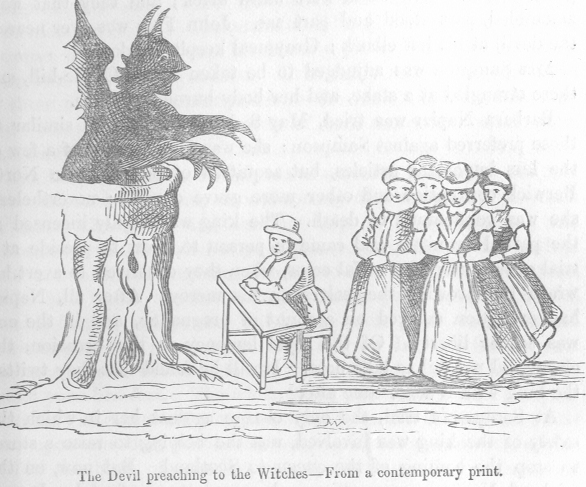
Robert Grierson being namit, they
ran all hirdy-girdy, and were angry; for it was promisit, that he should
be callit "Robert the Comptroller, alias Rob the Rower," for
expreming of his name. The first thing he demandit was, "Gif they [had]
keepit all promise and been guid servants?" and "What they had done since
the last time they had convenit?" On his command, they openit up the
graves, twa within and ane without the kirk, and took off the joints of
their fingers, tacs, and knees, and partit them amang them; and the said
Agnes Sampson gat for her part ane winding-sheet and twa joints, whilk she
tint negligently. The devil commandit them to keep the joints upon them,
while [fill] they were dry, and then to make ane powder of them, to do
evil withal. Then he commandit them to keep his commandments, whilk were
to do all the evil they could.’ The devil then ordered them to perform an
act of homage towards himself, which does not admit of description, but
which may be said to have been at least one degree more humiliating than
the kissing of the papal great toes. In the account of the confessions, it
is stated that he inveighed against the king, and, being asked why he had
such a hatred to him, answered: ‘By reason the king is the greatest enemy
he hath in the world.’ According to the dittay, the devil ‘had on him ane
gown and ane hat, whilk were baith black; and they that were assembled,
part stood and part sat. John Fian was ever nearest the devil, at his left
elbock; Graymeal keepit the door.’
Mrs Sampson was adjudged to be taken
to the Castle-hill, and there strangled at a stake, and her body burned to
ashes.
Barbara Napier was tried, May 8,
1591, on charges similar to those preferred against Sampson: she was found
guilty of a few of the less important articles, but acquitted of being at
the North Berwick convention and other more grave charges; nevertheless,
she was condemned to death. The king was highly incensed at the partial
acquittal, and came in person to court to preside at a trial of the jurors
for wilful error, when they contrived to avert his wrath by throwing
themselves on his mercy. After all, Napier had execution delayed on
account of pregnancy, and in the end was set at liberty. Of the royal
leniency on this occasion, the clergy did not fail to take note. It will
be found that they twitted the king with it some time after.
At Sampson’s trial, the only charge
against her in which the safety of the king was involved, was the helping
to raise a storm to stop the coming of the queen to Scotland. But now, on
the trial of Napier, more serious charges were preferred. It was alleged
that at Lammas last there had been a witch-meeting at Aitchison’s Haven,
and in the midst of it was the devil, ‘in likeness of ane black man.’
‘Agnes Sampson proponit the destruction of his hieness’ person, saying to
the devil: "We have ane turn to do, and we wald be at it if we could, and
therefore help us to it." The devil answerit, "he sould do what he could,
but it wald be lang to; because it wald be thorterit [thwarted];" and he
promisit to her and them ane picture of wax, and ordenit her and them to
hing, roast, and drop ane taid [toad], and to lay the drops of the taid,
mixed with strong wash, ane adder-skin, and the thing in the forehead of
ane new foalit foal, in his hieness’ way, where it micht drop upon his
hieness’ head or his body, for his hieness’ destruction. . . . Agnes
Sampson was appointit to mak the picture [of the king], and to give it to
the devil to be enchantit, whilk she made indeed, and gave it to him; and
he promisit to give it to the said Barbara [Napier] and to Effie M’Calycan,
at the next meeting, to be roastit... There was ane appointit to seek some
of his hieness’ linen claiths, to do the turn with.’ At the North Berwick
meeting on All-hallow even, ‘Robert Grierson said thir words: "Where is
the thing ye promisit?" meaning the picture of wax devisit for roasting
and undoing his hieness’ person, whilk Agnes Sampson gave him. . . . . He
answerit: "It sould be gotten at next meeting.". . . . Barbara and Effie
M’Calyean gat then ane promise of the devil, that his hieness’ picture
sould be gotten to them twa, and that right soon’ It is highly noteworthy
that none of these particulars appear either in the indictments against
Fian and Sampson, or in the accounts of their confessions which came out
about the time of their trials.
The trial of Eupham M’Calyean
commenced on the 9th of June. She was taxed with many acts of sorcery of a
common kind—such as this: ‘Consulting and seeking help at Anny Sampson,
ane notorious witch, for relief of your pain in the time of the birth of
your twa sons, and receiving frae her to that effect ane bored stane, to
be laid under the bowster, put under your head, enchanted moulds [earth]
and powder put in ane piece paper, to be usit and rowit in your hair; and
at the time of your drowis [throes], your guidman’s sark to be presently
ta’en off him aud laid wimplit round your bed feet. The whilk being
practisit by you . . . . your sickness was casten off you, unnaturally, in
the birth of your first son, upon ane dog, whilk ran away and never was
seen again: and in the birth of your last son, the same practice was usit,
and your natural and kindly pain unnaturally casten off you upon the
wanton cat in the house; whilk likewise was never seen thereafter.’ It was
also alleged of Eupham, that, eighteen years before, she had ‘consulted
with Jonet Cunningham in the Canongate-head, alias callit Lady
Bothwell, ane auld indytit witch of the finest champ, for poisoning of
Joseph Douglas of Pumfrastown, and that by ane potion of composit water
whilk she send her servant John Tweedale for, to be brought up to Barbara
Towers’s house in ane chopin stoup.’ What was more to the purpose, she was
accused of her concern in the affair of the waxen picture, and of having
conspired to raise a storm for stopping or drowning the queen on her way
from Denmark. After a trial of three days, a verdict was returned against
her on the chief points, and this unfortunate lady was condemned to be
burned alive at a stake on the Castle-hill.
Throughout all the proceedings
connected with these trials, as far as they have been preserved, there is
no appearance of any imputation against the Earl of Bothwell; but
Spottiswoode affirms that Sampson, in her confessions, had attributed to
him the guilt of suggesting the picture device, adding that the devil,
finding his plans of no avail against the king, said: ‘Il est ua homme de
Dieu.’ It also appears that James discovered further matter against
Bothwell, in the course of examining the wizard Richard Graham. The
turbulent lord was therefore committed to ward, from which he broke out
only three days before the death of M’Calyean, June 22d. He was now
forfaulted on a former sentence, and henceforth became a broken man,
though one still able to create no small trouble to his sovereign.
A review of these circumstances
leaves a strange feeling on the mind, as if we were reading that which was
deficient in some of the most necessary elements of human action. It is
difficult to see to what extent the so-called wizards and witches were
deluders and deluded. Was there any basis in fact for the affair at North
Berwick Kirk, confessed to by two or three of the culprits, though, it may
be remarked, with varying circumstances? Was Geilie Duncan’s dance-tune
truly repeated before the king? Or were these matters of mere
hallucination? Did these women really aim at doing harm to any one, or
were they only lunatics? The story reads the more inexplicably when we see
so many names as of simple villagers involved in it, and find a king and
all his court and clergy viewing it in a serious light.
This year was marked by ‘a plague
amang the bestial’—.-Chron. Perth. |



