|
The conquest of England by
the Romans [I think should mean the Normans] in 1066 brought a host of adventurers into the country, who
were often rewarded for their part in the battle of Hastings by the
sequestrated estates of the Saxon lords. Among these were Robert de Bruis,
Jardine, Comyn, Pierre de Bailleul, Seigneur de Fescamps, and Le Seigneur
de Jeanville, all mentioned by the Norman chronicler; and the three first
were transferred to lands in the north of England. Cumberland and Lothian
were claimed by both the English and the Scots at that time. Bruis or
Bruce and Cumyn through marriages, and the others probably in a similar
way, obtained a footing in Dumfriesshire, where the warlike character of
the natives is still shown by the traces of Roman fortresses and
encampments built along the Borders in early ages to oppose their advance
upon South Britain. Here the Norman settlers intermarried with the
Maxwells, Murrays, Carlyles, Kirkpatricks, Crichtons, Carrutherses,
Irvings, Grahames, Griersons, Fergussons, and other families in Annandale,
who, after Cumberland finally became English, formed an effectual barrier
against any further encroachments from the south.
The rivers Esk and Sark,
and a morass called Solway Moss, make a natural boundary between
Cumberland and Dumfriesshire, added to the bleak tract of country
extending for about seven miles from the mouth of the Annan to the Sark.
The deep valley of the Annan and the banks of the Milk, with their
isolated towns and villages, occasionally recall Switzerland to the modern
tourist, and before the union of the two crowns were favourite hiding
places for outlaws and bandits, as the arm of the law had difficulty in
penetrating to these remote regions, except through the chiefs of the
clans. The English borderers were as rude and nearly as aggressive as
their Scottish neighbours, so that peace never existed long between North
Cumberland and South Dumfriesshire, whatever treaties were signed by their
respective kings. Gretna or Graitney, Annan, Newbie, Sark or Morton,
Caerlaverock, Holmains, Dunskellie (now Cove), Lochwood, Hoddam, Johnstone,
Closeburn or Killosburn, Amisfield, and Comlongan all possessed fortified
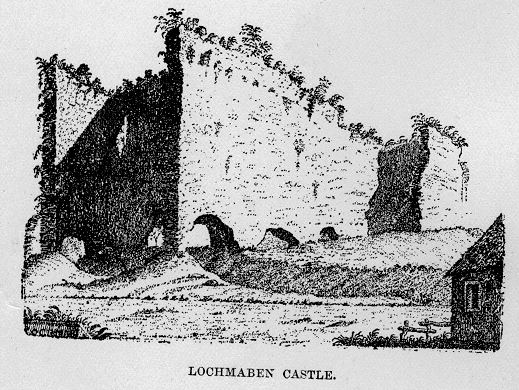
towers, where the owners occasionally withstood a siege. The Castle of
Lochmaben, which the King retained in his own hands, had walls eight feet
in thickness, and the sovereigns occasionally made it their temporary
residence.
Early in the 12th century,
Robert de Bruis or Bruce held the title of Lord of the Valley of Annan or
Annandale, besides large estates in Yorkshire, where he founded the
monastery of Gysburn. He gave to this house the patronage of all the
churches in Annandale, and his son and grandson, William and Robert,
confirmed the gift. The original deeds, preserved at York, are signed,
among others, by Humphrey de Gardine (Jardine) and Adam Carlile, both
well-known border names, and the churches, described are Lochmaben,
Kirkpatrick, Cumbertrees, Rein Patrik (now Redkirk), Gretenhow (or
Gretna), and Annan. In the subsequent wars between England and Scotland
these churches were made over to the See of Glasgow, and long before the
Reformation were generally sold to lay patrons. Between 1170 and 1180
William de Bruce, Lord of Annandale, granted lands to Adam Carlyle, a
native of the soil who held property in Cumberland, and the lands of
Newbie in Dumfriesshire; and in a charter of Henry de Graeme, ancestor of
the Duke of Montrose, the district of Dumfriesshire from Wamphray,
inclusive, to Greistna Grene is granted to David Carlyle, Lord of
Torthorwald. These early charters have no dates, which can only be
ascertained by the reign of the King of Scotland under whom they were
conferred. "Twa score Carvels (Carlyles) frae Cockpool" are mentioned in
an ancient ballad called "The Bedesman of Nithsdale" as having followed
Richard I. of England to the Crusades.
The pedigree of the Bruces
goes back into the regions of fable. As Princes of Orkney and Caithness,
they had a connection with Scotland in the 9th century, and their chief
married the daughter of Malcolm II. of Scotland. His son, Regenwald, a sea
king, roved through Europe for a bride, and found one in the daughter of
Vladimir the Great, the first Christian Czar of Russia. Regenwald finally
settled in Normandy, and his grandson Robert followed the fortunes of the
Conqueror. His descendant Robert Bruce, Lord of Annandale, married the
natural daughter of the Scottish King, William, who, following the example
of his son-in-law (up to that time Scotland was without a coat of arms),
assumed a heraldic distinction, and bore a lion on his shield. The son of
this Bruce espoused King William’s niece, and was the father of the Lord
of Annandale, known as the competitor for the throne of Scotland in 1286.
Another branch of the family remained in England, where it still exists;
while the house of Robert the First became extinct in the male line with
his only son David II., for his four brothers, all slaughtered during the
long war with England, had died childless. His daughter Marjory died
before her father, but she had married Walter, son of James, High Steward
of Scotland, and was the ancestress of the Stuarts or Stewards, and of her
gracious Majesty.
Robert Bruce, the son of
the competitor and father of the great Bruce, seems to have been English
in his sympathies, and had formed a second marriage with the daughter of
Edward’s ally, the Earl of Ulster. It was not till he died that his son
(who had received a pardon from Edward I. for killing a stag in the
King’s English forests) took an ostensible part on the side of Scotland.
The elder Bruce had fought with Edward I. and with Louis IX. in the
Holy Land, and it is probable that one of the family, like the Carliles,
also accompanied Richard I. to the Crusades, for the Jardines, Johnstones,
and Kirkpatricks carry the same saltire and chief as the Bruces on their
shields, and it is believed that they adopted them when fighting with the
Lord of Annandale against the Saracens..
With the Bruces and Baliols,
the Graemes or Grahames, Carliles, and Corries, seem at this date to have
been the chief landowners in Dumfriesshire. The Grahames and Carliles
claimed direct descent—the first from King Grime, and the last from
Malcolm II. of Scotland; and with their kindred, the Kirkpatricks, were on
good terms apparently with the Norman immigrants, as their names are
frequently found together on inquisitions, or as witnesses to the same
deeds. Two of the sisters of the great Bruce married Annandale men, Sir
Christopher Seton and Sir William de Carlile, and the wife of Carlile left
numerous descendants. But the Carlile property, which once comprised half
of Annandale, was reduced in 1700 to a few isolated estates; and no
Carlile appears as a Member of Parliament for any part of Dumfriesshire
after 1357. The Lord Carlile who supped with Bothwell in 1567, on the eve
of the murder of King Henry, could not sign his own name.
The second son of Sir
William de Carlile and Margaret Bruce was killed at the battle of Durham
in 1346, leaving one child, Susanna, who was afterwards married to Robert
Corrie. A charter in favour of his brother William de Carlile from Robert
Bruce styles him the King’s sister’s son; and another dated at Melrose,
1363, from David II. in favour of Susanna Carlile and of her husband,
Robert Corrie, calls the deceased Thomas Carlile the King’s blood
relation, and grants to his daughter and her spouse the lands along the
southern coast of Dumfriesshire, which had belonged to her grandfather.
The Corries (the name is Celtic for hollow) were the hereditary keepers of
the castle of Loch Doon in 1306, and a little later, owing to the marriage
above-named, added greatly to their possessions in Dumfriesshire. Besides
the Barony of Corrie, comprising the modern parishes of Hutton and Corrie,
they owned Keldwood in the modern Cumberland parish of
Kirkandrews-upon-Esk, Comlongan, Ruthwell, the Barony of Newbie, the
Barony of Stapleton, Robgill, and part of the parish of St. Patrick, now
divided into Kirkpatrick-Fleming; and Gretna, which includes the ruins of
the ancient Redkirk or Rampatrick, and the celebrated Lochmaben Stone,
where treaties were signed with the English. But during the 15th century
the rebellion of the Douglases involved Dumfriesshire in a civil war. In
1484 George Corrie took the side of the insurgents against the King, and
when they were defeated he was outlawed, and part of his estates
transferred to Thomas Carruthers, a loyal freeman in Annandale. His
brothers, Thomas and William Corrie, for some time retained a portion of
the family lands, but subject to constant forays on the part of their
neighbours, and in spite of numerous lawsuits, they could get no redress.
Yet Thomas Corrie of Kelwood and Newbie was of sufficient importance to be
appointed in 1529, with the King’s treasurer and two Scottish knights, an
arbiter in a family matter between the Earls of Eglintoun and Glencairn.
He married a daughter of Lord Herries.
Dumfriesshire supplied many
soldiers for the service of Sir William Wallace, who called himself
guardian of the kingdom for King John; and as Lord of Annan, Baliol [Baliol’s
father was buried in 1269 at Sweetheart Abbey near Dumfries, which had
been founded by his wife Devongilla, daughter of Allan, Lord of Galloway.
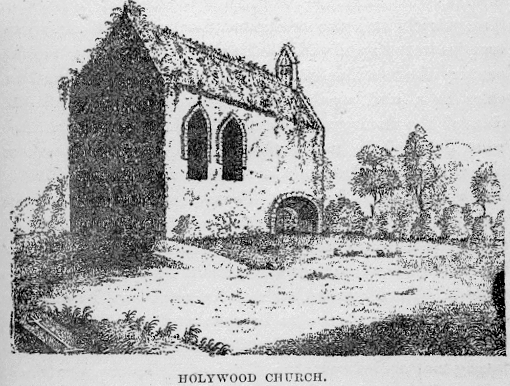
She also founded Holywood, and built the Old Bridge at Dumfries.] seems to
have had his strongest support in Annandale. Lochmaben, Sanquhar,
Caerlaverock, Graitney, and Annan changed hands very frequently between
1296 and 1370, and in the middle of the present century an inscription was
still legible on a tomb in Graitney Churchyard showing that it belonged to
a near relative of Wallace.
N0TE.—Hostages for the Ransom of
David II., 1357.—"John Steward (Robt.
III.); Humphrey Kirkpatrick; Reynald, son and heir of Sir J. More;
Gilbert, ditto of John Kennedy; John, ditto of John Berkeley; John
Fleming, son of the Earl of Wigton; John, son of Andrea de Valence;
Patrick, son of Sir David Graham; Robt., son of Sir Wm. Cunningham; Robt.,
son of Sir John Steward of Darnley; Robt., son and heir of Sir Robt.
Darzel; Thos., son to Robt. Esk; Wm., son of Thos. Somerville; David, son
of David de Wemyss; Thos., son of Wm. de la Haye of Loughewode; John, son
and heir to John Gray; John, son and heir of the Earl of
Sutherland, is sent to London with his father to appear before the
Chancellor; Wm., son and heir to the Earl of Rosse, is sick, and King
David and the Bishops of St. Andrew, Brechin, and the Earl of March have
undertaken that he shall be delivered if he is alive to the Keeper of
Berwick before Easter, and if he be dead, that the next heir of the said
Earl shall come in his place."
—(Original MS. in London Record
Office.) |



