Old Photographs Of Gypsies In
Scotland
Tour Scotland video of old photographs of gypsies. Highland Travellers also
known as Tinkers are closely tied to the native Highlands, and many
traveller families carry clan names like Macfie, Stewart, MacDonald,
Cameron, Williamson and Macmillan. They followed a nomadic or settled
lifestyle; passing from village to village and are strongly identified with
the native Gaelic speaking population. Continuing their nomadic life, they
would often pitch their tents on rough ground on the edge of the village and
earn money there as tinsmiths, hawkers, horse dealers or pearl fishermen.
Many found seasonal employment on farms, e.g. at the berry picking or during
harvest time
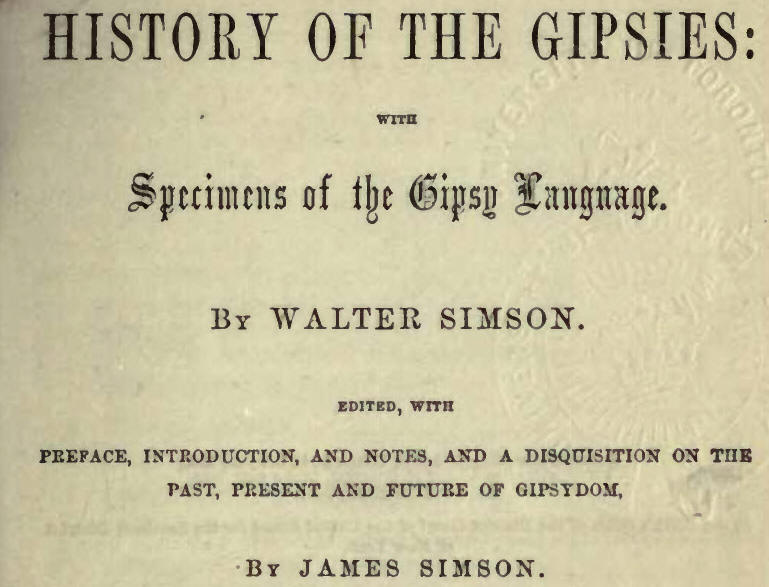
EVER since entering Great
Britain, about the year 1506, the Gipsies have been drawing into their body
the blood of the ordinary inhabitants and conforming to their ways; and so
prolific has the race been, that there cannot be less than 250,000 Gipsies
of all castes, colours, characters, occupations, degrees of education,
culture, and position in life, in the British Isles alone, and possibly
double that number. There are many of the same race in the United States of
America. Indeed, there have been Gipsies in America from nearly the first
day of its settlement; for many of the race were banished to the
plantations, often for very trifling offences, and sometimes merely for
being by "habit and repute Egyptians." But as the Gipsy race leaves the
tent, and rises to civilization, it hides its nationality from the rest of
the world, so great is the prejudice against the name of Gipsy. In Europe
and America together, there cannot be less than 4,000,000 Gipsies in
existence. John Bunyan, the author of the celebrated Pilgrim's Progress, was
one of this singular people, as will be conclusively shown in the present
work. The philosophy of the existence of the Jews, since the dispersion,
will also be discussed and established in it.
When the "wonderful story" of
the Gipsies is told, as it ought to be told, it constitutes a work of
interest to many classes of readers, being a subject unique, distinct from,
and unknown to, the rest of the human family. In the present work, the race
has been treated of so fully and elaborately, in all its aspects, as in a
great measure to fill and satisfy the mind, instead of being, as heretofore,
little better than a myth to the understanding of the most intelligent
person.
The history of the Gipsies,
when thus comprehensively treated, forms a study for the most advanced and
cultivated mind, as well as for the youth whose intellectual and literary
character is still to be formed; and furnishes, among other things, a
system of science not too abstract in its nature, and having for its
subject-matter the strongest of human feelings and sympathies. The work also
seeks to raise the name of Gipsy out of the dust, where it now lies while it
has a very important bearing on the conversion of the Jews, the advancement
of Christianity generally, and the development of historical and moral
science.
NEW YORK, May 1st, 1866.
At the Gypsy Heart in Scotland
From Roseanna McPhee we learn all about traditional Scottish Gypsy Traveller
wedding customs & the Heart that remains & needs to be looked after.
Life on the edge of society
A New study details the grim reality of overcrowded housing and squalid
living conditions endured by Scotland's Roma community.
By Judith Duffy and published in the Herald Newspaper.27th October 2013
UP to 5000 Roma are living in
Scotland following a significant influx from eastern Europe in the past 10
years, according to the first comprehensive study of the community north of
the Border.
However, many are facing a vicious cycle of poverty, unacceptable living
conditions and a lack of access to public services, education and employment
opportunities, the report has warned. Some turn to crime, including begging,
as can be seen on the streets of Scottish towns.
Roma representatives in Glasgow are planning to petition the Scottish
Parliament to call for an inquiry into the barriers and discrimination
facing their community, the Sunday Herald can also reveal.
The report comes as global attention has been focused on the ethnic group
following the case of a four-year-old girl, known as Maria, found living
with a couple who were not her parents at a Roma settlement in Greece. The
couple said the girl was given to them by her mother as she was too poor to
look after her, but were charged with abducting a minor and detained.
On Friday, DNA tests confirmed a Bulgarian Roma couple were her biological
parents, with authorities investigating whether the mother had sold her
child, a claim which she denies. In the wake of that case, two blond,
blue-eyed children were removed from Roma families in the Republic of
Ireland amid claims they could not prove their parentage. A seven-year-old
girl was taken from her south Dublin home for 48 hours and a two-year-old
boy from his home in Athlone overnight.
The cases have raised fears about anti-Roma hysteria, with Ireland's police
watchdog reviewing the controversial action by Gardai and health officials.
Allegations of casual racism were levelled against the Irish police.
The Roma people have suffered persecution in Europe for hundreds of years
and faced genocide under the Nazi regime.
The new study of Roma in Scotland, carried out by the Social Marketing
Gateway for Glasgow City Council, found the largest proportion of the
population has settled in Glasgow, with the city home to up to 3500 Roma,
mainly from Slovakia.
Up to 150 Roma are thought to be living in Edinburgh, with 60 in Fife, 45 in
North Lanarkshire, around 50 in Aberdeen City and 20 in Falkirk. Around 550
are estimated to be living in other council areas across the country. Many
arrived from Eastern Europe as economic migrants following the enlargement
of the European Union in 2004 - when Slovakia, Hungary and the Czech
Republic became members - and from 2007, when Romania and Bulgaria joined.
But Roma are often living in unacceptable conditions in Scotland, the report
warns.
It finds: "Mostly, Roma live in large family groups in overcrowded housing,
often without adequate sanitation and with only limited capacity and
connections to access local health, education and other services.
"Although less than perfect, these conditions are tolerated because they are
an improvement on the living conditions that many Roma people left behind in
Bulgaria, Czech Republic, Hungary, Romania and Slovakia." The report says
Roma can find themselves living in a vicious circle of poverty, with
challenges in accessing education, employment, housing and healthcare.
"Some Roma individuals may be forced to turn to off-the-record or even
criminal behaviour to provide for their families," the report notes. "This
creates a negative stereotype of the whole community."
The most stereotypical image of a Roma in Scotland is often of a beggar on
the street. On Friday afternoon, the Sunday Herald spoke to three beggars
within the space of an hour on the rain-lashed streets in the centre of
Glasgow, all of whom said they were from Romania. At least one Roma child -
a girl thought to be about 12 - has also been seen begging in central
Glasgow.
Concerns have previously been raised that Roma beggars may be victims of
exploitation and forced to beg by gangmasters involved in organised begging
gangs.
One 17-year-old sheltering in a doorway, who declined to give her name, said
in broken English: "It is very hard. I need the money for food." Immigration
rules mean that so-called "A2" nationals from Bulgaria and Romania can enter
the UK and remain here if they can prove they are self-supporting. However,
they cannot take up employment and have no entitlement to welfare benefits,
which some see as a recipe for begging.
The report notes the current rules mean many Roma from these countries are
surviving at a subsistence level. However, Roma people from other EU
countries, including the Czech Republic and Slovakia, can claim benefits and
work as they are so-called "A8 nationals" as their countries joined the EU
earlier.
More than 50% of Big Issue vendors in Scotland are from Romania and are also
Roma, it found. They are usually "vulnerable, homeless or living in multiple
occupancy property with several generations of one family".
It is also estimated around 100 people from Romania - most likely Roma - are
regularly begging, mainly in Glasgow and Edinburgh, with most begging
organised within families rather than through force or organised crime. The
report added: "Contrary to what is probably widespread public perception,
this activity [begging] is not widely accepted by other Roma people."
The image of Roma as beggars is a stereotype that wearies Marcela Adamova,
founder of Romano Lav ("Roma Voice"), a community group based in Govanhill,
Glasgow, an area which is home to a large Roma population.
She said: "It is not only Roma people who are begging outside. But some
people are begging because they have nothing to eat. For example in the case
of the Romanians, they are not entitled to benefits and they can't work in
this country."
Adamova pointed to recent anti-Roma marches in the Czech Republic as an
example of the widespread discrimination the community still suffered. She
said: "The same attitudes are everywhere. I just think that here [in
Scotland] people wouldn't dare to go in the streets and protest openly."
She also believes the recent cases in Greece and Ireland have thrown up
worrying attitudes and negative stereotypes, while ignoring the bigger
picture of the many Roma children who are living in poverty across Europe.
And she added: "They should not connect ethnicity with criminality, because
ethnicity has nothing to do with criminality."
Romano Lav, which is supported by Oxfam Scotland, is planning to submit a
petition to the Scottish Parliament calling for an investigation into the
barriers faced by people from Roma backgrounds who wish to gain access to
public services in Scotland.
A report by Govanhill Law Centre last year found administrative delays and
inefficiencies were endemic within public authorities dealing with welfare
claims from Roma citizens entitled to claim benefits in Glasgow.
Just over half of cases were refused based on an erroneous decision, it
found. Examples where benefit payments had taken four months to be paid,
when it had already taken two years for a favourable decision to be made,
were also highlighted.
Rachel Moon, a solicitor at Govanhill Law Centre, said the situation was
still largely the same today.
She said: "They still face the same discrimination issues when they make any
sort of applications.
"Applications go directly to [the benefits office] investigations unit and
they ask for huge amounts of information, more so than they would for any
other client."
Colin Clark, professor of sociology and social policy at the University of
the West of Scotland, believes Scotland needs a Roma integration strategy,
as exists in some other European countries.
He pointed out that in some countries, such as rural areas of Slovakia,
unemployment rates in Roma communities were as high as 90%-95%. Some have
speculated whether such high levels of poverty are driven by discrimination
and effectively force Roma people into low-level criminal behaviour.
Clark said: "That situation is just not tolerable - both morally, but also
from a social justice and social inclusion equation.
"I would hate to think that situation could happen within Govanhill … I
don't think that is likely to happen, but unless there are some actions
taken, it has that potential."
Clark also pointed out that austere times often led to a "search for a
scapegoat", adding: "I can't help but think that has some bearing on what
has been happening recently in terms of the Greek and the Irish cases."
Campaigners have also raised concerns. Judith Robertson, head of Oxfam
Scotland, said poverty and discrimination meant around 90 per cent of Roma
in Europe live below national poverty lines.
"If it's found the case in Ireland was based on discriminatory perceptions
of the Roma community, Oxfam would have serious concerns," she said.
"We know that these kinds of stereotypes aren't just held in Ireland or
Greece, they are here in Scotland.
"In addition, research by the Govanhill Law Centre and others shows that
discrimination is having a serious impact on the ability of Roma people to
simply get on with their lives."
A spokeswoman for Amnesty International Scotland said: "The story of the
little girl known as Maria comes at a time when Roma are being pushed even
further to the margins of society as a result of forced evictions, are
attacked on an ethnic basis, and denied access to education and basic human
rights.
"Her situation should be considered as an individual case and not as an
excuse to attack an entire community."
A spokesman for Glasgow City Council said the authority had worked extremely
hard in recent years to minimise the social exclusion of the Roma in
Glasgow.
He said: "Specialist teams, which include members of the Roma community,
have been established to address particular issues in employment and social
care and there also has been a significant focus on improving educational
outcomes.
"Assisting members of the community to improve their qualifications and
skills will give them access to better opportunities and ultimately help
lift them out of poverty. We are taking a long term view, but progress is
definitely being made."
A spokeswoman for the Scottish Government said £435,000 had been allocated
over the next three years to provide additional support for the Roma
community in Govanhill.
She said: "The Scottish Government is fully committed to eradicating racial
discrimination against our most vulnerable communities."
The Truth About Life As A
Young Scottish Traveller
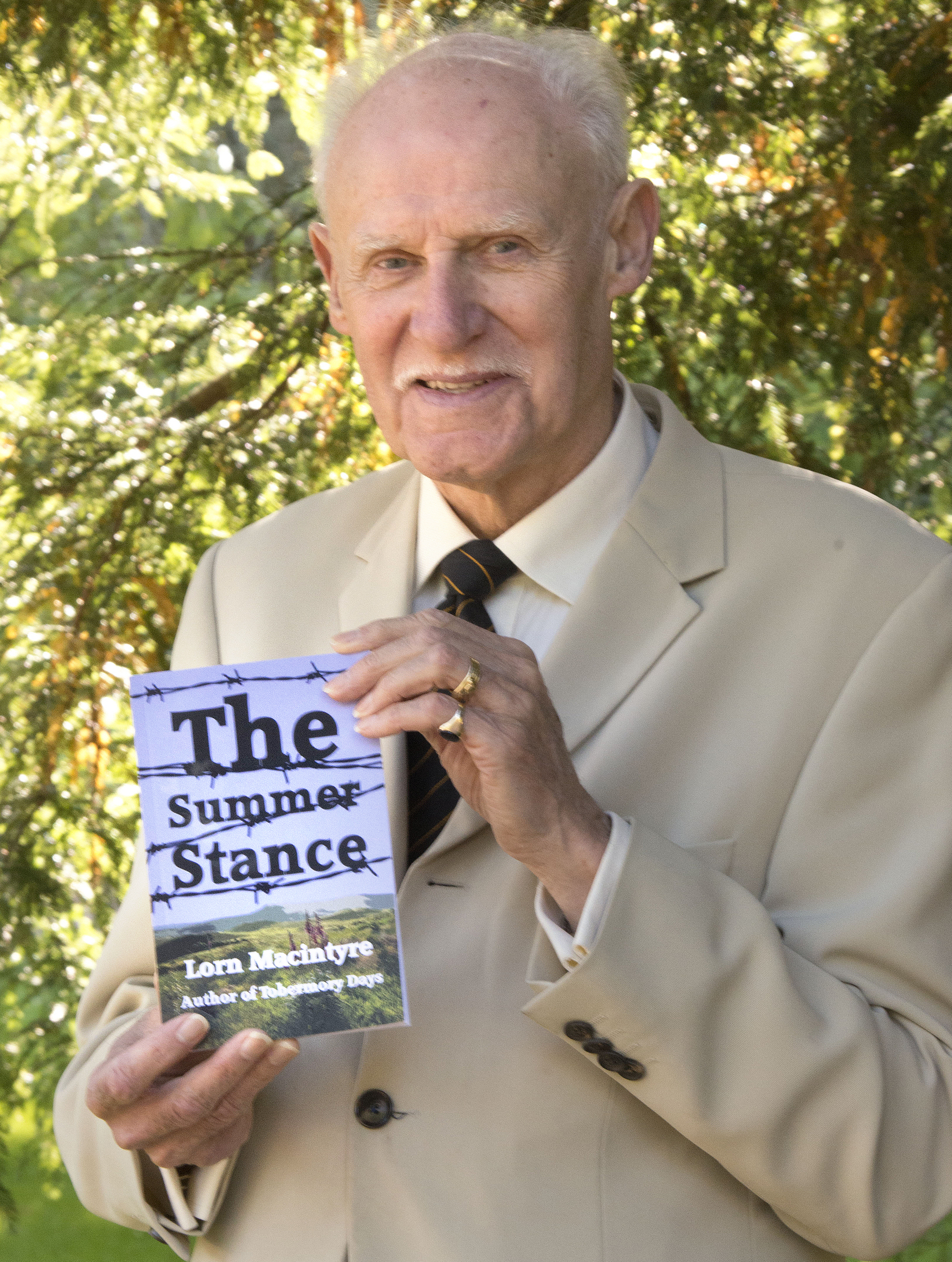
Lorn MacIntyre with his book "The
Summer Stance"
The author of "Tobermory Days"
This comment system
requires you to be logged in through either a Disqus account
or an account you already have with Google, X, Facebook or
Yahoo. In the event you don't have an account with any of
these companies then you can create an account with Disqus.
All comments are moderated so they won't display until the
moderator has approved your comment.