|
THE Acts of Parliament
mentioned in the foregoing chapter effected a vital change in the work
and functions of all merchant and craft guilds. Bereft of their trading
privileges, the members turned their attention almost exclusively to
provident and educational objects; and in this respect the Aberdeen
Trades have been remarkably successful. The individual incorporations
have not only added to their capital, but the additional funds, in which
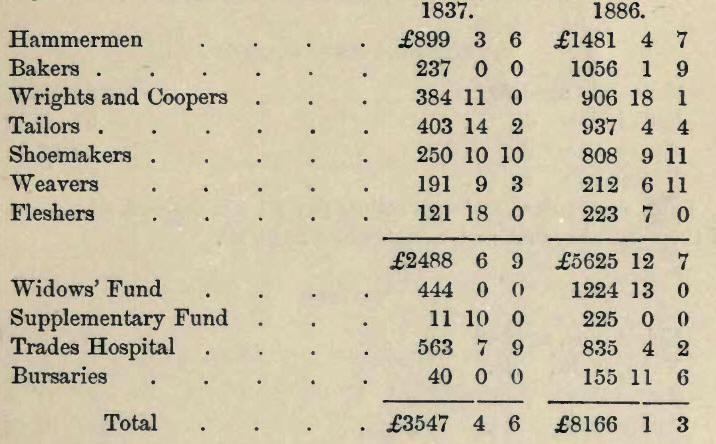
all have a common interest, have also been considerably augmented. The
following comparative table, showing the amount of the allowances paid
to widows, annuitants, orphans, &c., for the years 1837 and 1886, will
give an indication of their financial prosperity during the last fifty
years:—
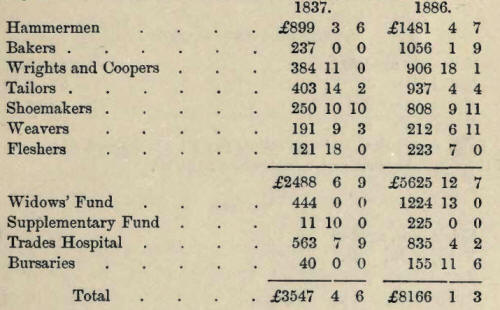
In addition to these sums
the Trades pay about £400 per annum of corporation duty; and when
salaries, management, and other expenses are taken into account, it will
be seen that their present revenue represents a capital of close upon
£250,000.
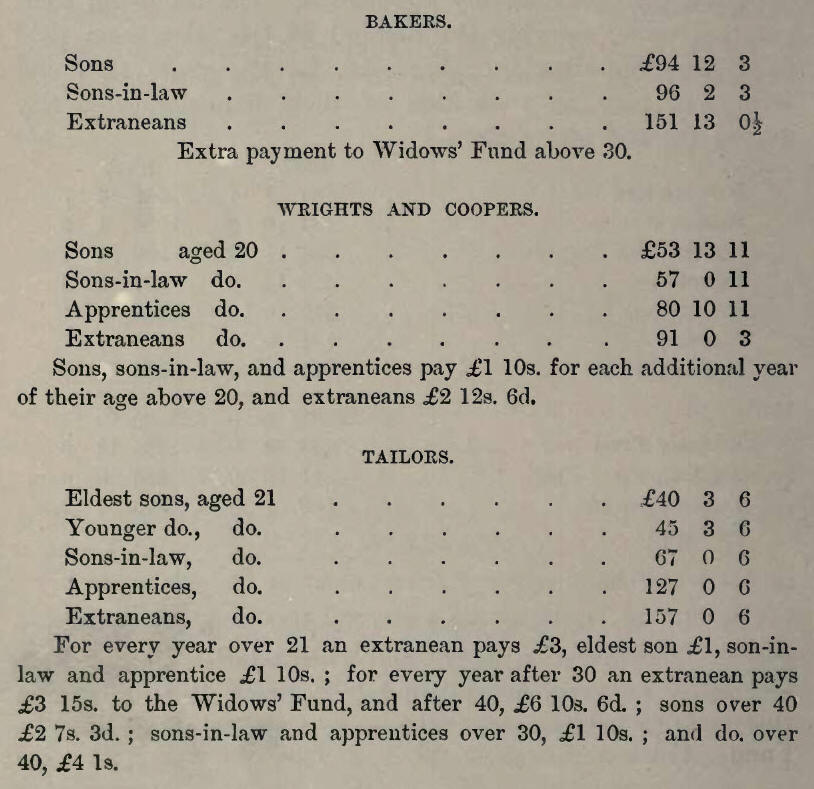
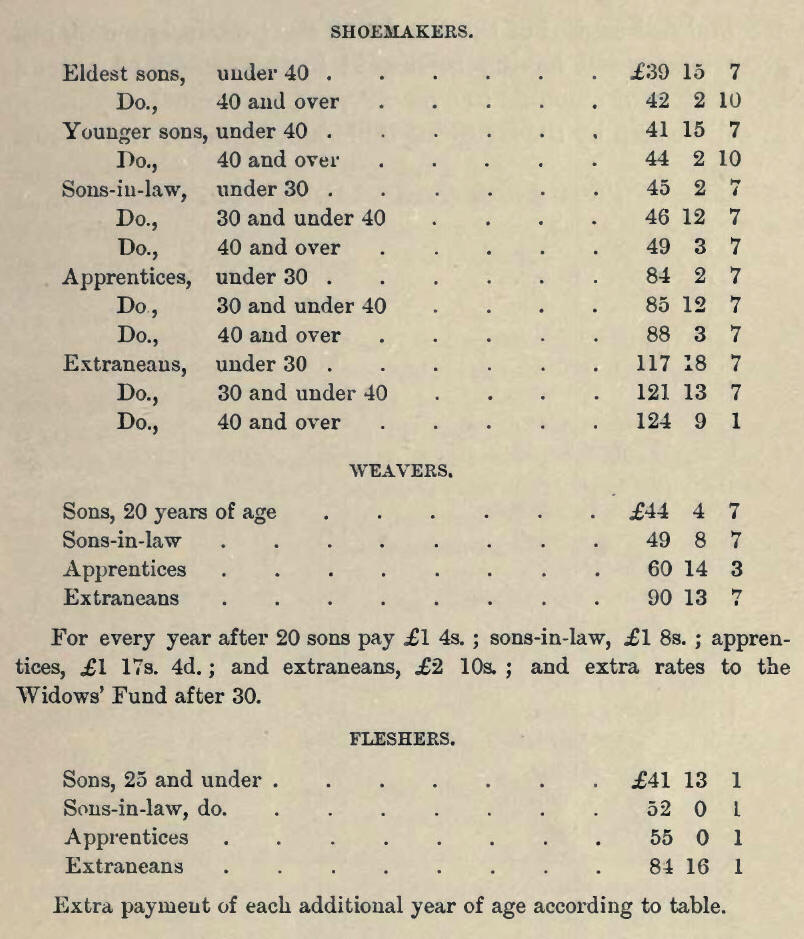
The following is a
statement of the present entry monies to the different Trades, extracted
from the Tables of Dues :—
HAMMERMEN.
Entry money at 21 years
of age, £120. After the age of 21 entrants pay, in addition to the
foregoing sum, £5 for every year or part of a year up to 33 years of
age, at which age the payment will amount to one hundred and eighty
pounds, which sum is the highest payment for an entrant of any age to
the Trade. Widows' Fund payment extra, according to age, &c. Sons of
members who have joined the Incorporation previous to the adoption of
the present rules (November, 1886), are admitted at 21 years of age for
the sum of £54, with an entra payment of 20s. for every year or part of
a year over that age; and to the Widows' Fund, when above 40 years of
age, £2 7s. 3d. Sons-in-law of members who have joined the Incorporation
previous to the adoption of the present rules are admitted at 21 years
of age for the sum of £60 6s. 3d., with an extra payment of 20s. for
every year or part of a year over that age ; and to the Widows' Fund,
when above 40 years of age, £4 1s.
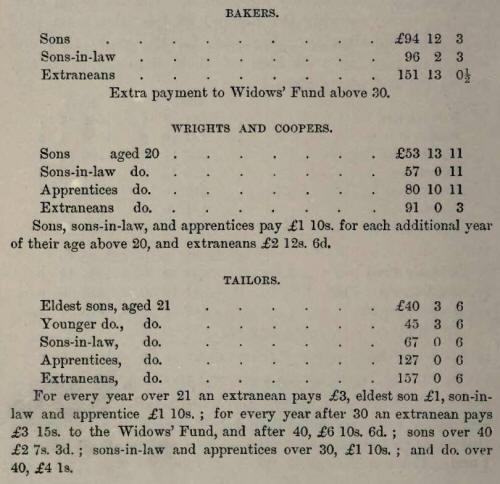
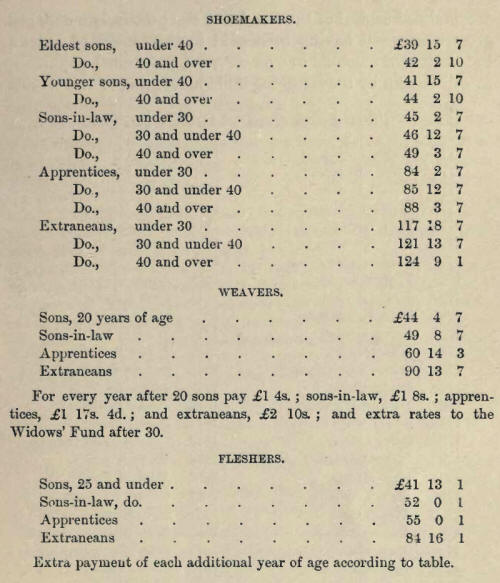
The scale of benefit
varies in the different Trades. Annuitants receive from £25 to £70 per
annum; widows, from £20 to £35; indigent sons and daughters, from £4 to
£6; orphans, from £3 to £9; while in several of the Trades considerable
sums are annually voted by "warrant" in cases of necessity.
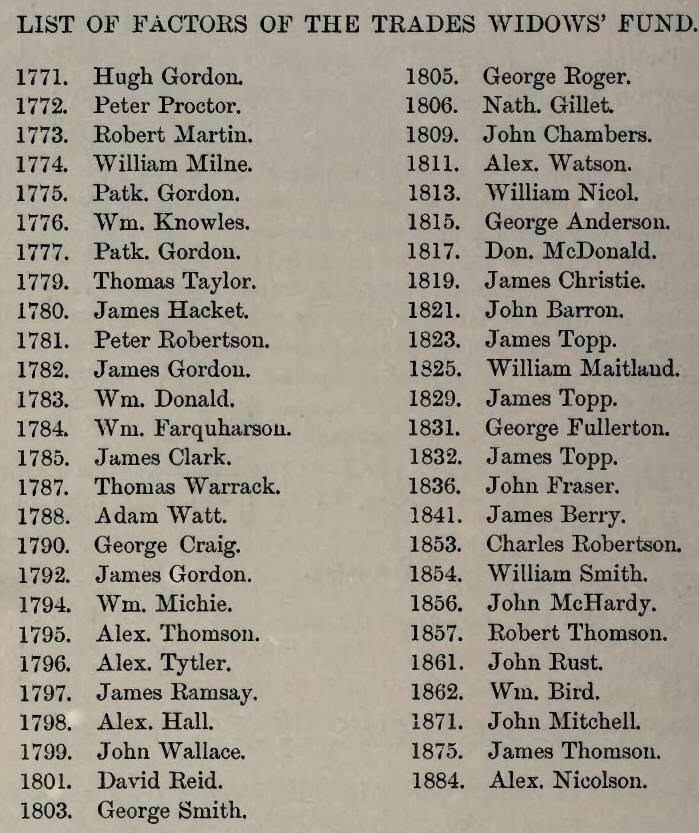
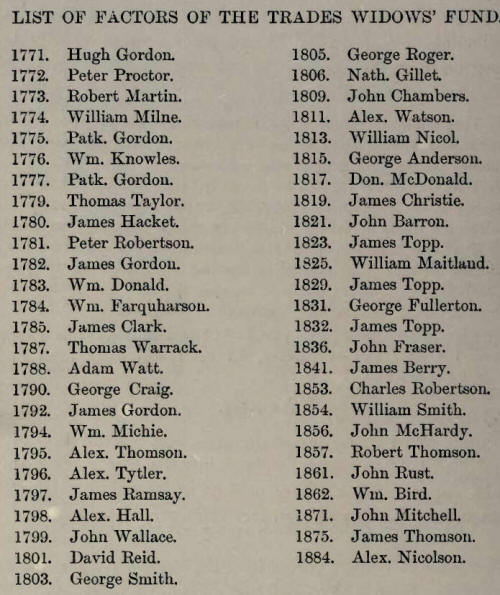
The Widows' Fund
mentioned in these tables was established in 1771 for the purpose of
supplementing the sums given by the individual Trades to the widows of
their deceased members. Annual contributions are made to this general
fund by the Convener Court and the seven Trades, while a portion of the
entry money paid by each entrant is allocated to the Widows' Fund. For a
considerable time—in fact, down to 1851—the accumulated capital of the
Fund was comparatively small, but greater attention having been paid to
this branch of benefit, the stock now amounts to over £30,000, the
annual payments, as will be seen by the foregoing table, amounting to
over £1200.
In 1816 a Supplementary
Widows' Fund was established, mainly through the exertions of Mr. John
Leslie, goldsmith, a worthy citizen whose hand was visible in many a
good work among his fellow-citizens. It is optional for members to join
this fund, but the dues are by no means heavy, considering that the
annual allowance to widows in the fund is £9. If under thirty years of
age, entrants pay £19; if above thirty and under forty, £25; if above
forty and under fifty, £30; if above fifty and under sixty, £35; and if
above sixty, £40. Baillie James Berry is at present factor of this fund.
\Ve have already referred
in a previous chapter to the Bursars' Fund, under the management of the
convener, master of hospital, and seven deacons; and, to still further
encourage members to provide the best education attainable for their
children, several of the Trades have, since the Trades School was given
up, established educational funds of their own. The Trades School was
for many years a valuable adjunct in connection with the Trades. It was
established in 1808, under the following resolutions:-
(1) That the lower rooms
of the Trinity House be set apart and fitted up for the schoolhouse, the
expense to be defrayed from the fabric money (i.e., money set aside for
maintaining the house).
(2) That six pounds
sterling be annually paid from the funds of each of the Seven
Incorporations, and of the Hospital, making altogether £48 annually—the
whole or part of which to be paid as salary to the master.
(3) That the managers of
the school shall consist of seventeen, viz.:—the patron, convener, and
master of hospital, ex ojicio, and two elected from each Trade. The
patron, or in his absence, the convener, to have the casting vote at all
the meetings—seven to be a quorum.
When the new hall was
built a portion of the building was set apart for the school, where it
was conducted with marked success until 1878; but, for various reasons,
it had reluctantly to be given up. Owing to the enlarged area of the
town, many members could not take advantage of the school; while the
passing of the Education Act forced up the cost of maintaining a school
to such an extent that the disadvantages and loss became greater than
the advantages. |