|
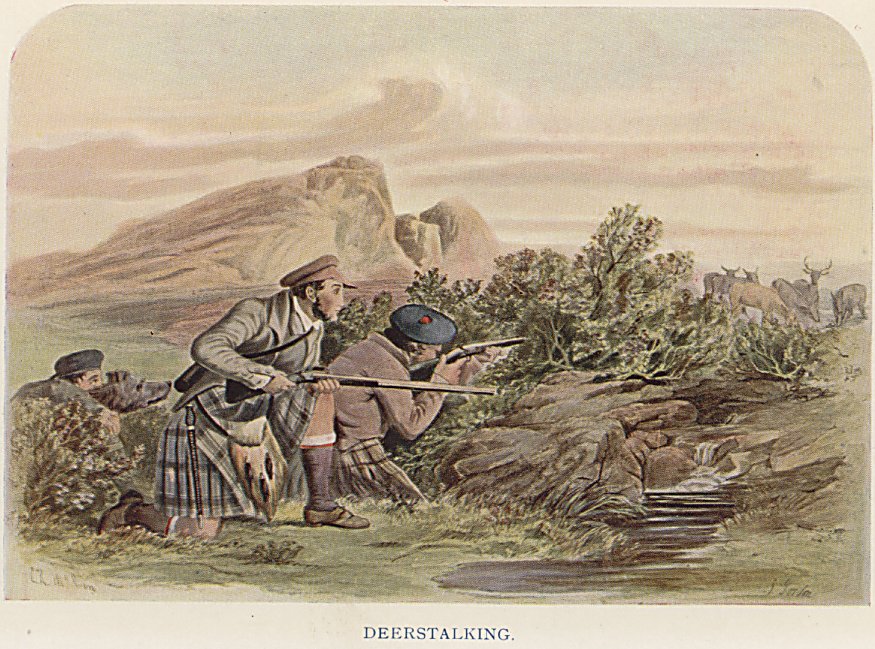
THIS is the most notable of all
field-sports, as regards the majestic character of the prey, and its
keenness of instinct, the qualities necessary for the hunter, and the
grandeur of the scenery where he pursues his game. The deer,
notwithstanding its great strength and fleetness, is an extremely shy and
solitary animal, and so vigilantly does it guard against the approach of
man, that it is a matter of the greatest difficulty to get within reach of
shot. The deer possesses the keenest of eyes, and its olfactory powers are
surprising; hence it is scarcely possible to advance, especially on the
weather side, the animal never, but from necessity, going ‘down the wind,’
without giving alarm, while still perhaps at an unseen distance.
It is further remarkable of the
deer, that in a herd there is always a stag of commanding age and size,
which takes the van, and is indeed the leader, the whole following his
movements, and taking warning of danger from him. The sportsman must,
therefore, have recourse to the most skilful manoeuvring to get within
reach of his game, with which he has to deal much in the way of the red
warriors of America, adopting the same tactics to entrap his prey as the
Indian practises to surprise his enemy. Like him, also, he must possess
the necessary qualities for the arduous task: energy—perseverance—
endurance of bodily fatigue and privation— quickness of sight, and
precision of aim. The Highland deer-hunter will have to go through
numberless fatigues; wading through bogs and streams, swimming rivers,
clambering among rugged mountains, lying prostrate for hours, advancing on
hands and knees—a movement in sporting parlance called ealadh—and even
creeping like a snake among the lank heather, are some of the pleasures of
this manly recreation. A bivouac on the naked heath after a day spent in
the above evolutions, and a frugal breakfast of oatcake and water,
happily, at times qualified by a glass of whiskey, are not to be reckoned
hardships. When the deer are discovered, the softened exclamation Eid,
passes quickly along the company.
There is not, throughout the
Highlands, a man who possesses a superiority in every qualification
required in a hunter of the hills to John Mac Rae, gamekeeper to Grant of
Glenmoriston, in Inverness—shire, and from a sketch of this worthy the
principal figure in the print is taken.
The stealthy manner in which the
deer is slain is called Stalking; but although a covert attack, resembling
the method used by illegal trespassers, is thus made on the game, which is
incompatible with the rules of the open chase,
it must in nowise be
confounded with poaching. The country does not permit the deer to be
followed as on the gentle uplands in the southern portion of the kingdom,
with the exhilarating attendants of hound and horn.
When hunting was necessarily pursued
for the supply of food, or, in accordance with a Gaelic practice, to
honour the visits of strangers, it was on a scale which gave it the aspect
of a military campaign. The Scottish monarchs frequently retired from the
cares of royalty to enjoy the chase in their Highland dominions; and our
most gracious Queen, like the unhappy Mary of Scotland, evinces a
partiality for this ‘royal divertisement.’
This ancient mode of hunting was
performed by surrounding a large extent of country by numbers of men, who,
at a signal, advanced slowly with loud shouting, and by these means roused
the game, and drove the whole towards a certain point, where the animals
were shot or cut down by the broad-sword. This extensive battue is not in
exact accordance with the modern rules; but it had formerly necessity in
its favour, and it is so agreeable to a Highlander’s habits, that it is
not yet abandoned when such a circumstance occurs as a royal visit. It is
called Timchioll na Sealg, or the Circuit of Hunting. Curious accounts are
preserved by olden chroniclers of several of these magnificent huntings,
which have been made the subject of an entertaining article in the ‘United
Service Magazine’ for November, 1844.
At that held in honour of Queen Mary, I 563,
there were collected, besides fallow and roe, 2000 red deer, of which
more than 360 were killed. In another of these ‘hunting matches,’ given by
the Earl of Athol to King James V., there fell "thirty score hart and hynd,
with other small beasts, as roe, wolf, fox, and wild cats."
Taylor, an English writer, called
the Water— Poet, accompanied Lord Erskine, ancestor of the Earl of Mar, to
the Highlands of Aberdeenshire, where he witnessed a splendid deer hunt,
with the subsequent banquet, and gives a very particular detail of the
whole proceedings, in quaint prose and quainter verse. The camp contained
1400 or 1500 men, who were sumptuously regaled.
"The modern method of deer-stalking,
though not carried out with such semi-barbaric display, has very largely
increased during the last half of the nineteenth century. This is more
strikingly illustrated when we state that the deer-forests of Scotland
cover a space of over two million square acres. These are chiefly rented
by English noblemen, wealthy merchants, or American millionaires. Though
called deer-forests in Scotland, there is really now little wood in them.
They chiefly consist of large tracts of ground, lofty mountains, pasture,
heather, moorland, and sheltered corries. These vast solitudes are
supposed to be more favourable for the purpose of breeding the deer and
for sport, if other game, sheep and cattle, are excluded. It is a
debatable point whether the extension of these forests has done much to
displace the crofters and sheep in the
Highlands. The great deer-forests of Scotland
are nearly all in the counties of Aberdeen, Sutherland, Ross, Argyll,
Perth, and Inverness."
As may be supposed, the English
terms of venery are not in use among the Highlanders. A deer is called
Fiadh, a male roe Boc, a female, Earb, and Earbag, the diminutive, is
usually applied to a fawn. The young at six months of age is called Laogh,
a calf. Mang or Iiadh ôg will correspond with the English term brocket;
when the animal is three years old, it acquires the name Damh, which it
retains until it is five, and is afterwards called Lan-damh, a full
stag. The same terms are applied to the roe, except that after the third
year the female obtains the name of Eilid.
The Antlers are called Cabar, from
which the deer is frequently called Cabarach. A male deer at the age of
one year has knobs, or cnapan, on his forehead and small brow antlers
appear. The horns are shed annually, and the new attain their full growth
in three months, when a velvet—like coat, called Mogan, which covers them
at first, drops off. The horns are the perquisites of the gamekeeper, and
they are valuable, but are so seldom found in comparison with the numbers
which are cast, that it has often excited surprise. From so many being
found in lakes and marshes, it is supposed that the animal resorts to
these places at the time the horn begins to get loose.
The size of the stag depends on the
supply of pasturage in the range he inhabits: eighteen or twenty stone is
the average weight; but instances have occurred of their weighing thirty.
The longevity of the deer is very great. By a Gaelic Rann, or verse, it is
said to be three times the age of a man, and cases have occurred which
fully verify the calculation. |