THE art of forming threads from
wool, flax, cotton or other material, was practised in the most early
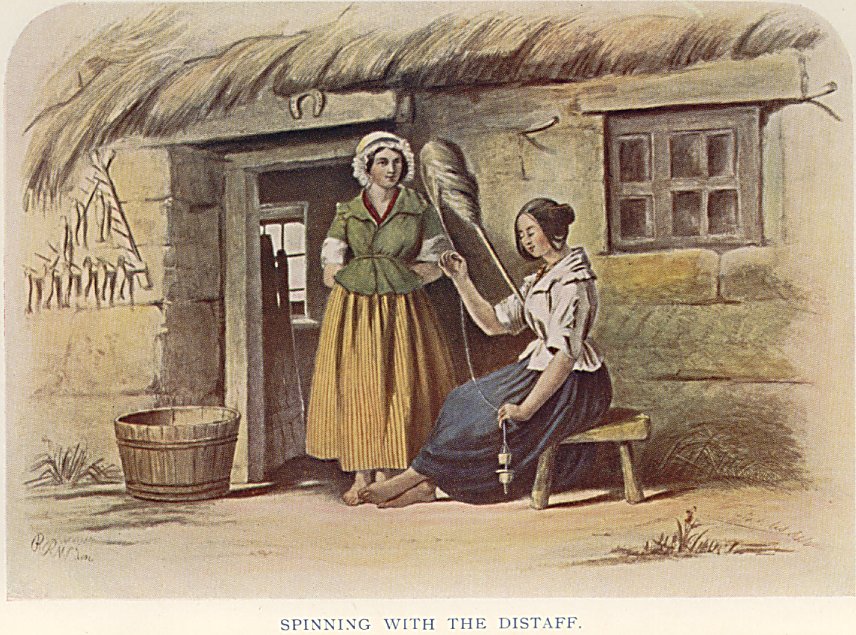
ages. In the sculptures of ancient Egypt are representations of females
spinning, who use the spindle and distaff in precisely the same manner as
represented in the illustrative print; and in the Bible record, frequent
allusion is made to this manual occupation, as one of the most excellent
of female qualifications. In Exodus xxxv.
26, the Jewish women
are extolled for their diligence and skill in spinning; and in that
beautiful book, the Proverbs xxxi. 13, a strong recommendation of a good
wife is that "she seeketh wool and flax, and worketh willingly with her
hands." It is the most natural expedient that could have been adopted for
the combination of fibres, and the primitive operation continues in
practice among the inhabitants of our Celtic countries, and in the rural
districts of the continental nations.
The Dealgan, or Spindle, the Whorl of the low country,
is a piece of hard wood, round, smooth, and tapering at one end to a small
point, the thicker end being downwards, which serves to give it sufficient
impetus to spin round. The whorl, or whirling part, is, however, often
composed of a circular bit of wood, sometimes even of bone or ivory,
through which the spindle is thrust, fixing it near the lower end. The
Fearsajd differs from the Dealgan in being formed like a slender cone of
such weight as to maintain a proper velocity.
The Cuigeil or Distaff, called Kogel by the Welsh, is
the staff, around the top of which is wrapped the material to be spun, and
it is kept upright at the side by being fixed in the string or belt,
fastened around the waist. This part is frequently carved, as the dirk
hilts are, with tracery, much similar to the implements used by the Indian
tribes, and they are preserved for generations. It appears that this part
of the simple apparatus was often held in the hand, and the spindle was
twirled on the ground, on which the women were seated, in the same manner
as children spin their tops; but by a simple noose which prevents the
thread from unwinding, the fearsaid, or spindle, can be suspended so that
the spinner may work while standing or walking, thus gaining a greater
length of thread. Having set it in motion by the fingers and thumb, or a
smart roll against the thigh, the fibres which have been attached to the
small end are twisted into thread of the requisite fineness, and the
spinner continues to draw off proportionate supplies until a convenient
length is obtained, when she winds it around the thicker part of the
spindle, repeating the operation and removing the balls of worsted or
thread until the task is completed. When the spindle was worked on the
ground and rapidly whirling, the spinner was enabled to make it wind up
the thread by bending it with the finger to right angles with the spindle,
and when it was thus wound up, the spinning was recommenced without
stopping, a process requiring the greatest dexterity.
The great, or one thread wheel, was the first
improvement on this tedious occupation. By this the spindle is worked
horizontally, the end, to which the thread is attached, projecting beyond
its frame. The wheel being driven quickly round, which gives great
velocity to the spindle; as it continues to revolve, the spinner goes
backwards, supplying the wool, which is not put on a distaff, but held in
the hand or affixed to the side; and when a sufficient line of thread is
formed, it is either wound up in the manner above described, or allowed to
wind itself up as the person slowly walks towards the wheel. Artless and
toilsome as these modes of spinning may appear, they require an attention
and dexterity which nothing but long and careful practice can produce.
The Saxon, or small wheel, for spinning linen thread,
common elsewhere for household use, is so little known in the Highlands,
that it is unnecessary to say more respecting it.
By these methods of spinning one thread only is formed,
and when two or more are to be united, so many balls are put in a basket
and wound into one as in the first operation, or an instrument is used for
the purpose, called Caitir-leasg, or Catti-suirig.
The simple reel on which the threads are wound
preparatory to making them into iornan or hanks, is represented in the
figure carding wool in Number III.
The picture was made from a sketch taken in Strathglàs,
Inverness-shire, a romantic glen near the baronial castle of the Chisholm.
The costume of these damsels is such as is commonly worn by Highland girls
in these days— rather modern, especially the cap. The short upper frock,
called in parts of the low country, a wrapper, is the Bedagoun of the Gaël,
a term derived, it is presumed, with the garment from the Saxon. The want
of stockings or shoes is no privation to the Highland fair sex, for in
going to church or elsewhere, when it is becoming to wear them, it is done
with reluctance, and in returning they will often be seen to sit down by
the way and denude themselves of such unpleasant restraint.
The cottage walls are formed partly of turf and stone,
a very usual mode of building, and the roof is thatched with straw. The
‘Hake’ on which the fish are hung, is a usual appendage to the cottager’s
house, except in the more inland parts, where from the want of conveyance,
that excellent food cannot readily be procured.
The horse-shoe is placed over the door to prevent the
effects of witchcraft or intrusion of the Sithichean, or fairies, who,
although they are called ‘the good people,’ no Highlander wishes in any
way to encounter. This potent preservative is also affixed to the masts of
boats and ships to save them from being wrecked by malevolent spirits; but
the superstition is not confined to the Gaël, it is prevalent among the
higher civilized English; and we have seen the talisman at the threshold
of more than one house, even in London.