|
THIS branch of our national
commerce, the source of great wealth, gives employment to many thousands,
and affords a cheap and excellent food to millions.
The name of this prolific and useful
fish is derived from the German Heer, an army, a term descriptive of the
prodigious numbers in which they appear; in Gaelic it is called Sgadan.
The shoal which proceeds from
Iceland, occupies an extent of surface equal to that of Great Britain and
Ireland. It reaches the shores of these kingdoms about the middle of June,
and dividing, one division proceeds southwards by the east coast, as far
as Great Yarmouth, while the other passes by the Hebrides and west coast
of Scotland, to Ireland and Wales. They are in full roe until the end of
June, and are in good condition until the beginning of winter, when they
begin to deposit their spawn and disappear from the southern seas,
retiring, it is supposed, to their native haunts in the polar ocean.
The Dutch have obtained the credit
of being the first to engage in the herring fishing, and they have for
centuries enjoyed the best part of it; but there is good reason to believe
that the inhabitants of Britain had devoted their attention to it at an
earlier period. From Anderson’s "History of Commerce," it appears that
traders from the Netherlands resorted to Scotland in 836, for the purchase
of salted fish; and in the "Annals of Batavia," it is recorded that the
Scots were accustomed to sell their herrings there in the ninth century, a
traffic which led to a commercial alliance, which long subsisted, between
the two countries. The Dutch, who date their regular fishing from 1163,
nevertheless, appear to have acquired a sort of
monopoly of the herring fishery, while it became much neglected by the
Scots. To revive this trade, King James III., considering it
"expedient for the common good of the realm, and great increase of
riches," enacted, in 1471, that certain lords, spiritual and temporal, and
burghs, should make or procure "ships, busses, and other pink boats, with
nets, etc., for fishing." This was confirmed by James IV., when the burghs
were ordered to provide ships and boats of not less than twenty tons, with
nets and all other necessaries, according to the substance of each burgh.
Subsequently the attempt was made to establish towns in the Highlands for
the promotion of fishing, which after many years’ perseverance by the "
Undertakers," or barons and gentlemen, empowered for the purpose, in the
island of Lewes, was ultimately frustrated by the opposition of the
Highlanders.
It has been remarked by the author
of "Caledonia," that no encouragement has induced the Celtic race, in
Ireland, Wales, or Scotland, to enter with spirit into the fisheries, for
which their coasts are so favourable; the herring is, however, so
desultory in its habits, that the Highlanders may be unjustly blamed, for
sometimes a loch, or tract of coast, will be entirely deserted for years ;
neither does it appear that in other portions of the empire have even
bounties and privileges produced greater enterprise. The herring fishery
has been regulated by many Acts of the Legislature; but the first bounty
on the exportation of herrings was granted by the Scottish parliament, in
1705.
The Highland Society of Scotland,
with characteristic patriotism, charged itself with the duty of framing a
bill for the revival of this important branch of employment, which was
passed in 1808, and by the encouragement given by subsequent regulations,
and the services of the Board for Fisheries, etc., it has since been
prosecuted with spirit.
The art of curing herrings is
supposed to have been discovered by William Beukelings, a Dutchman, who
died in 1397; but there is reason to believe that he was only an improver
on the art, for from 1306 to 1360, the herring fair and fishery of
Yarmouth formed a great branch of its trade; and, in 1313, a ship of Lynn,
a neighbouring town, was captured, which had been fishing for herrings on
the Norwegian coast.
The herrings of the west coast are
not so plentiful, but are much superior to those of the east ; and, as the
season commences, the Highlanders pass round in great numbers, when the
town of Wick, in Caithness, the most noted place of resort, presents a
highly animated appearance. When multitudes of boats from both north and
south are collected, the scene is singular and pleasing. In the northern
latitudes, a dim twilight continues during the mid-summer nights, and the
boats are often within hail of each other.
The stillness is broken by the
occasional mirth of the crews, or the plaintive lorrams, or boat songs of
the West Highlanders, whose thoughts are of their distant home and the
relatives and friends they have there left.
When the boats arrive with their
cargoes, which are reckoned by crans, or barrelfuls, the fish to be cured
have the entrails taken out by a particular nip, leaving the melt and roe
; but they are not opened, as several of the most esteemed Encyclopedias
describe; they are then put into a strong brine, where they are allowed to
remain from twelve to sixteen hours, and when taken out are well drained,
and packed closely on their backs, in a circular form, the cooper
finishing the process by putting in the heads of the barrels very tightly.
This is called the White pickle. Red herrings must be kept in the salt
water twenty-four hours, they are then strung by the head on wooden spits,
and placed, to the number of many thousands, in chimneys, where brushwood,
or turf, is kindled on the floor, and managed so as to give a great deal
of smoke without flame, from which is derived their peculiar flavour and
colour. They are generally dry in about twenty-four hours, when they are
put into barrels for keeping. These barrels will hold from 500 to 800
fish.
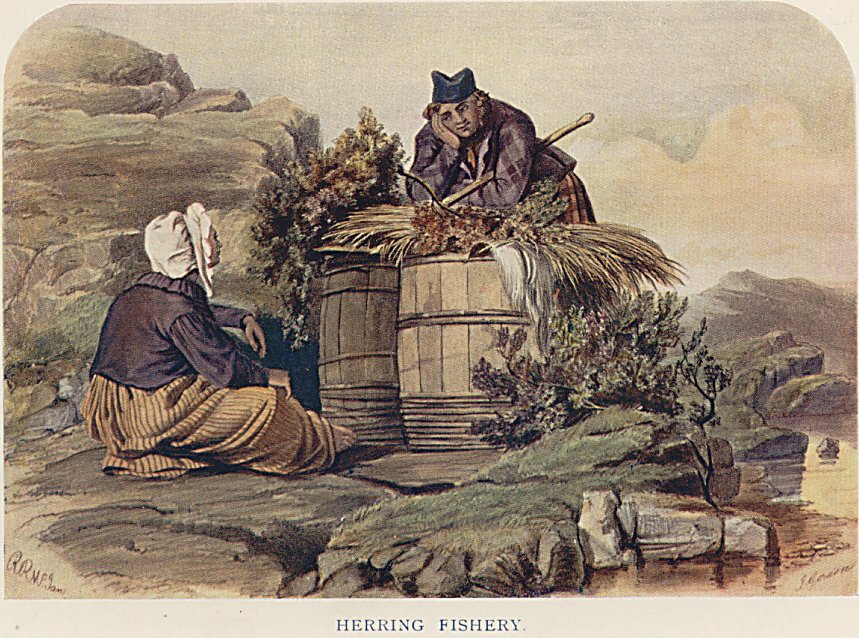
The sketch was taken on the side of
Loch nan Uagh, in Arisaig, and the male figure is that of a man not more
experienced as a fisher than notorious as a smuggler; and it is said that
in barrels, such as represented, he has at times contrived to convey
without detection, a keg of good poit du’, or whiskey, concealed among the
fish. A curious circumstance had occurred at the time the artist made his
drawing. The fishermen, having one night caught a young whale, the old one
making its appearance, attacked the boats furiously, and continued in the
loch for some days, so that without harpoons or other weapons they could
not venture on an attack. The group represents an idle peasantry, in their
usual costume, having at the time no avocation to withdraw them from ‘a
friendly crack’ about the country news.
It is matter of just complaint that
the Dutch should be allowed to fish so near the coasts, and drive a
lucrative trade on our very shores; it
indicates a laxity in the enforcement of the
international laws, which regulate the mutual rights of different
countries. |