THE supply of fuel in a northern country of variable
climate, is an object of primary solicitude to the inhabitants. In the
north and west parts of Scotland the only material in general use for the
domestic hearth is turf or peat, called in the Highlands foid and mom. It
is necessary to describe so well known a natural feature as a moss or bog,
and the manner of its formation from the marshy deposit of vegetable
substances, accumulating for ages. Such a tract is sometimes of wide
extent, and although in many cases shallow, in others the depth is found
astonishingly great. One at the foot of the Grampian Mountains in
Aberdeenshire was sounded by an auger of forty feet without meeting other
soil!
Mosses are often an unsightly blemish on the fair
fields of a proprietor, and are frequently brought under tillage and
rendered excellent soil by agricultural skill. This is accomplished
sometimes by cutting up the surface, which is burned and the ashes
scattered around; at other times, judicious irrigation speedily transforms
the dusky heath into a verdant field; and, in the case of the great Blair
Drummond Moss in Perth-shire, the turf being cut deeply out, it was, by an
ingenious contrivance, carried, away by water and floated into the river
Forth. Where the fuel is plentiful, a moss may be brought into cultivation
without hardship to the people, and should it be wanted in future, the
peat will be again found under the surface soil.
The destruction of the Caledonian forest, which covered
the Highlands, and the progress of improvement has denuded the country of
its ancient wood, and where coal is wanting, mosses afford a supply, as if
by the order of Providence, of an article of the first necessity, for
which no substitute is to be found.
In some parts where peat is valuable, the several farms
have certain allotments, or ‘peat banks,’ specified in the tack or lease;
but great liberality is generally shown in this matter, the poorer
tenantry being by most landowners allowed to supply themselves with as
much as they require during the year. Some proprietors have, indeed,
restricted this practice, of immemorial observance, at which the people,
very reasonably, grumble, as an interference with their ancient rights.
The peat—harvest, to assume an expression, takes place
in the months of summer, and the cutting or ‘casting’ begins in May, the
operation being performed with an implement called Torrisgian, by which
the turf is cut into pieces of the form of a brick, but thinner and some
inches longer. The surface being taken off, the torrisgian is
applied, and the spade part being furnished with a sharp projection at
right angles, cuts the mom into the shape described. This is done within a
certain breadth, the workman passing alternately from side to side, and
the operation is continued to a suitable depth, the pieces being detached
with rapidity and thrown to the bank, where a person dextrously catches
them; and when there are no wheelbarrows, and plenty of hands, the peats
are passed from one to another, spread out to harden, and then set on end
by threes and fours to dry. If the weather is propitious and the people
diligent, they are then removed home and ‘stacked,’ or built up in an
oblong form beside the house, like a small hut, and protected from wet by
a covering of the upper part of the moss. They are often, however, left in
this state on the muir, and portions carried home when required for use.
The primitive stack was conical, and hence called Cruach mhoine, as
descriptive of its form.
The poorer people have their ‘firing’ cut and
taken home for them by their friendly neighbours, and there is often seen
a spirit of cheerful co—operation, such as a Socialist might envy. A
certain farmer wishes to have the whole quantity of fuel which he requires
cut up at once, he therefore intimates his desire, when all the adjacent
tenants turn out, both men and women, and the work is speedily
accomplished—generally in one day. This affords a scene of great
animation, for casks of whiskey and ale, bread, cheese, fish, and mutton
are provided in cheering abundance, and now-a-days the female portion of
the labourers are provided with their valued beverage, the heart—healing
tea. This is a mutual service rendered to each other with great delight,
and is particularly remarkable in the county of Sutherland.
Peat-fuel is burned on the hearth, and considerable
skill is said to be necessary in its right management. It makes a cheerful
fire, throwing out great heat with a smell which pervades the whole house,
but is not disagreeable, and its effects are said to be less injurious
than those of coal. The ashes are carefully preserved and are a useful
manure, especially ‘when mixed with sea-weed or other substances.
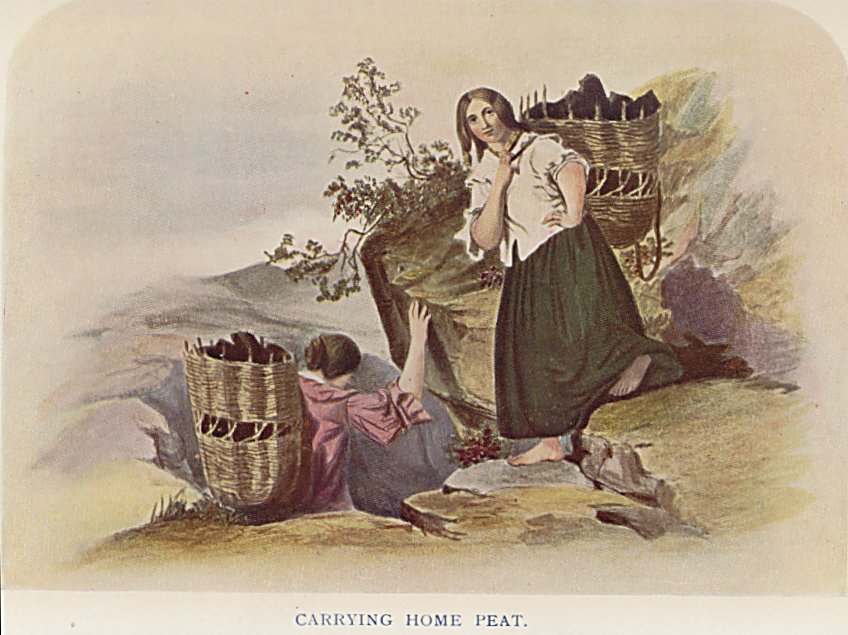
The illustration represents two Cailleagan carrying
home a portion of their winter comfort, from the Maol a Cruadh, in
Lochâber, by a path where it is evident neither horse nor cart could be
used. The principal figure was sketched from a Glenco girl, named Caorag
rua’; both are in the usual costume of Highland peasants, and the basket,
the Scottish creel, is called Cliabh. The open work is for the convenience
of lifting it, and reeving the rope by which it is carried.