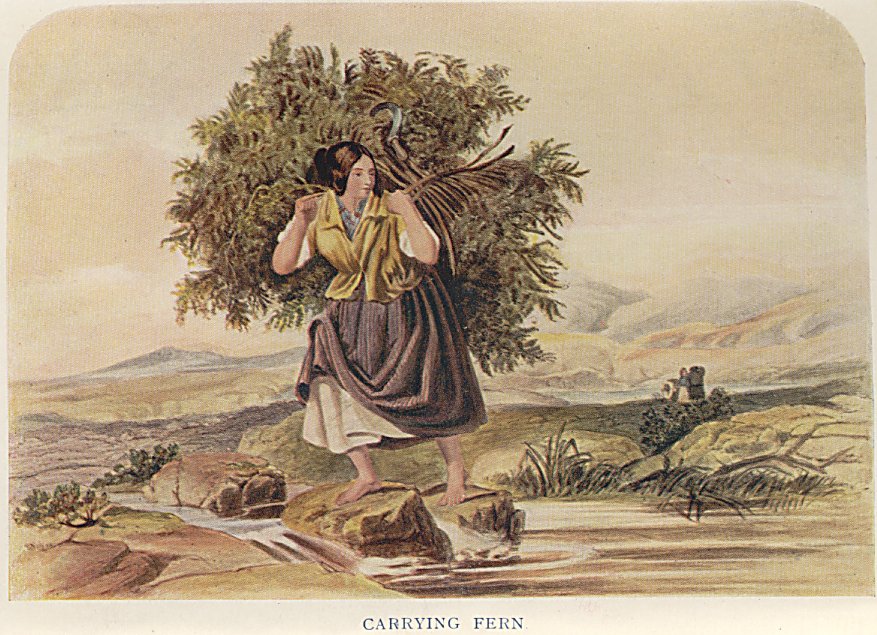
THIS beautiful plant, the Filix of botanists, is found
in the greatest abundance and luxuriance in most parts of the Highlands,
rapidly spreading wherever it takes root, a single leaf often bearing no
less than one hundred millions of seeds, and when it gets into land under
cultivation for grass or crop, it is a matter of great difficulty to expel
it from the soil. It is chiefly found in wooded situations, but it is
otherwise seen overspreading large tracks, forming a contrast to the brown
or purple heathy muirs. In autumn, when it assumes a deep golden colour,
some of the small uninhabited isles of the west present a pleasing and a
singularly gorgeous appearance.
The Fern is called Raineach in Gaelic, and receives the
name of Braikens in the south and east of Scotland, a term which is
properly applied to the female plant, and is evidently derived from the
word ‘breac,’ signifying spotted, the seeds appearing in numerous brown
specks or clusters beneath the leaf.
The Raineach is applied to different purposes by the
economic Highlanders. It serves as a ready and excellent litter for
cattle, and it forms no unpleasant bed for a weary traveller. It is highly
valuable as a compound in manure, either of itself when green or taken
from the cowhouse. It forms an excellent covering for corn stacks and
houses, being much cheaper, while it is greatly superior for this purpose,
to straw or rushes; it is next to Heath in durability as an article for
thatching, and if well laid on it will last without requiring any repair,
from fifteen to twenty years, heather being equal to slate and standing as
long as eighty to a hundred, if the timber do not decay!
The practice in thatching, Tughadh in the vernacular,
is to lay an under covering of Foid, scotice, divots or thin cuttings of
turf, which are placed with care and regularity in manner of fish scales,
on cabers or pieces of wood laid transversely on the rafters or great
beams, which in the houses of old construction spring from the ground,
giving great strength to the building. On this the Fern is carefully
spread, but it is frequently the sole covering. The plant is first laid at
the top of the side walls, the stems being usually placed downwards and
successive layers are added as the work advances upwards to the ridge,
where it is terminated by a fastening of divot or turf; sometimes also its
security is increased by ropes of straw or birch twigs, held in their
place by wooden pegs.
To the above applications of this useful plant may be
mentioned that of having it burned when green, to procure a lye for the
process of bleaching.
It has been observed in a former number, that in all
primitive society, a large proportion of work is performed by women, more
particularly that which appertains to the management of flocks, and the
domestic regulation of the household. The same practice is continued to a
great degree in the Highlands, and from observing the performance of
duties which, from their severity, seem to devolve with more propriety on
the men, travellers have taken frequent occasion to charge them with the
harsh treatment of the females, an assertion altogether groundless and
uncharacteristic of the people. When travellers observe the women engaged
in what appears hard work, in fishing villages and habitations on the
coast, they must recollect, that the men are spending their weary days and
nights seeking a precarious livelihood on a stormy sea. Many duties in
rural life necessarily fall to the care of the females, by whom they are
performed with cheerfulness, however laborious, and such, indeed, is the
force of habit, that they would not willingly be prevented from these acts
of attention, which they believe it incumbent on them to perform. One of
these employments is conveying home Ferns. From their lightness a quantity
of great bulk may be easily carried, and the Highland girl, with a light
heart and an agile step, bounds along the dusky plain and across the
roughly rushing brook, with her sylvan load. The Raineach stubble and the
wiry heath are not, to be sure, the softest materials on which the naked
feet may tread, but habit has inured the peasant to the practice, and
shoes would sadly cramp the elasticity of gait so observable in the
Highland population: in fact, the females have a dislike to the use of
shoes and stockings, although they may have them.
The visit of Her Majesty to Badenach, last year,
afforded the artist an opportunity of sketching one of many girls employed
to cut and carry from the hills the choicest Ferns to ornament the rustic
arches raised in honour of the Royal landing at Fort William. The dress is
that which is now worn, and has nothing in it more particular than what
has been shewn in the illustrations of some former numbers. Heretofore the
gown was open in front, which allowed it to be tucked behind with a degree
of grace and convenience. In this figure it is partially pinned up, loose,
and negligé, without the appearance of scantiness; neat, and befitting the
nature of alpine and pastoral life.
In elder times, while the men marched bare thighed to
the field of honour, the better part of human creation went with uncovered
leg to those employments which threw comfort and happiness around their
mountain dwellings, and enhanced the solace of their "am fire side."