 THE
art of reducing grain to meal for human food is coeval with the first
practice of agriculture. The corn productions of the earth were ground by
manual labour, the simple method of using a Hand-mill being common to all
people in the early stages of civilization, and it is still in practice
among those whose primitive circumstances have not estranged them from the
artless manners of their fathers. Baking and boiling were the only
preparations in ancient use, and Sarah is the first on record who kneaded
meal, and she has left, says the quaint and honest Thomas Fuller, in "The
Holie State," the prints of her knuckles in the leaven to this day.
THE
art of reducing grain to meal for human food is coeval with the first
practice of agriculture. The corn productions of the earth were ground by
manual labour, the simple method of using a Hand-mill being common to all
people in the early stages of civilization, and it is still in practice
among those whose primitive circumstances have not estranged them from the
artless manners of their fathers. Baking and boiling were the only
preparations in ancient use, and Sarah is the first on record who kneaded
meal, and she has left, says the quaint and honest Thomas Fuller, in "The
Holie State," the prints of her knuckles in the leaven to this day.
The circumstances recorded in Holy Writ of Esau having
parted with his birthright for a mess of porridge, is a proof of the early
use of meal in the state so generally served up in the north; and although
the people in that part of the kingdom may be jeered on the subject of
their roughish fare, as the Sybarites of old were on their black broth, it
is now fairly proved by analysis, that oatmeal contains more nutritious
substance than the flour of wheat, or that of any other grain.
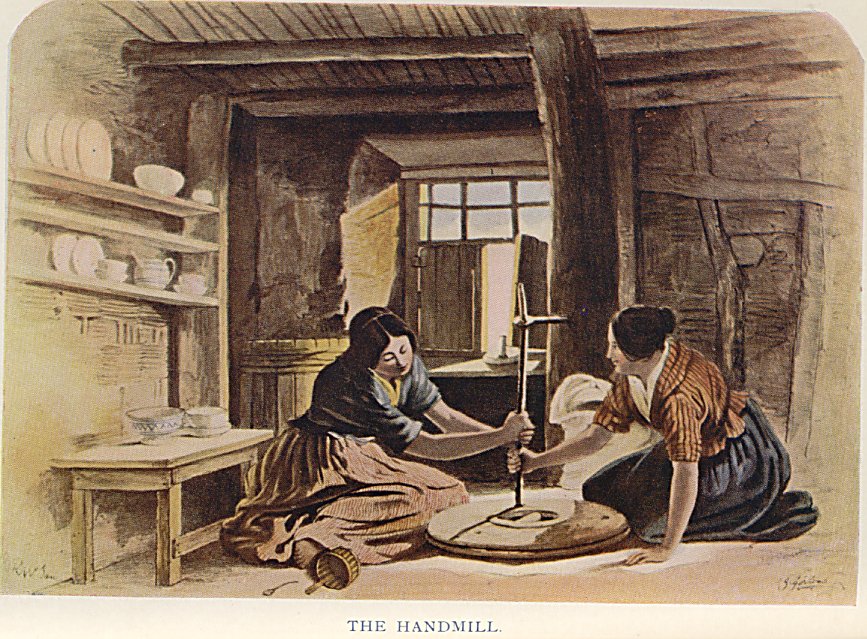
The Hand-mill is called in Gaelic, Muillean-bra’, which
will strike one as being a term very similar to the French Moulin a bras;
in the Irish idiom it is Bronn, and in the Lowland Scots it is named
Quern. The stones are eighteen to thirty inches in diameter, the undermost
being rather larger than the upper, and having a spike in the centre as a
pivot on which the other is turned. The women, when at work, seat
themselves on the ground, beside the Muillean, and with a stick, which is
fixed into a hole in the margin of the stone, turn it
round while they pour in the grain by a central opening. There are
generally two females employed, who sit opposite to each other, and as
usual in almost all their avocations, they lighten their labours by
appropriate songs. In this employment we are reminded of the Scriptural
passage, Matthew xxiv. 41: "Two women shall be grinding at the mill; the
one shall be taken and the other left;" and we are told by Dr. Shaw, that
the Arabs at this day use two small grindstones, the uppermost turned by a
handle of wood placed in its edge, and when expedition is required, then
two persons, who are generally women, sit at it.
When water and windmills were introduced, the lairds
very strictly prohibited the use of the hand-stone, by which they were
deprived of their thirlage dues, and the miller of his lawful multure;
consequently, wherever found they were broken up. In 1284, it was enacted
by King Alexander III., that "na man sail presume to grind Quheit,
Maishlach, or Rye, with a Hand Mylne, except he be compellit be storm, or
be in lack of mylnes quhilk suld grind the samen;" if he was found to do
so, he was muicted of the thirteenth measure, or multure, and by a
repetition of the offence, he was to "tyne," or lose, "his hand-mylne
perpetuallie." The exception permitted their very general use in remote
parts, where they cannot yet be laid aside, and in caves and beside the
ruins of ancient houses these stones are frequently discovered.
The conversion of grain into bread, or other food, was
an operation which did not occupy much of the time of a Highland goodwife,
as will be seen from the following account, among many others that could
be given. It is furnished by Ian fada, or long John, of Ben Nevis, a much
respected gentleman and true-hearted Celt. He verges on the patriarchal
age of fourscore, and recollects when a boy having been sent by his
grand-father, Ian du’, or dark John of Aberarder, on a message to a
distant part of the country, and when he reached the end of his journey,
he found there was no bread, or other eatables, where he was to take up
his quarters for the night. The woman of the house, however, speedily
supplied this want; for taking a reaping-hook, she went to the field, cut
a sufficient quantity of corn, and quickly separating the grain from the
straw, winnowed it in the open air, dried it in an
iron pot, ground it by the Quern, and presented it in well—baked Bonaich—cloich,
or cakes prepared on a stone before the turf fire; the time occupied in
these various operations not exceeding half an hour! Long John is a Mac
Donald of the braes of Lochaber, and adds to his other qualifications that
of being one of the best and most extensive distillers of the native Uisge—bea’,
or Whiskey.
The corn and meal prepared in this ancient manner is
called Graddan, from grad, quick, speedy, and the operation after reaping
is thus performed :—A woman sitting down takes a handful of corn, and
holding it by the stems in her left hand, she sets
fire to the ears, which immediately flame up; but to prevent them being
burnt, with a small stick held in her right hand, she dextrously beats the
grain off the straw, the moment when it is sufficiently done. For sifting
the meal from the husks, a sheep’s skin, perforated by a small hot iron,
is stretched on a hoop.
It is maintained all over the Highlands, that the meal
thus manufactured is more pleasant to the palate and is more wholesome
than what is dried and ground by the aid of machinery, and the graddan
meal is preferred for bannocks, brose, brochan, lite, or porridge, fuarag,
a mixture of meal with cream, or water, and other culinary preparations of
the Celtic housewives.
The practice of burning corn in the straw prevailed
among the Irish; but as they performed it so recklessly as to destroy most
part of the straw, an Act of Parliament was passed in 1635, which declared
it illegal.
Oats and rye, we find, were raised by the Britons
before the introduction of wheat and barley, and in the barbarous ages
acorns were ground for bread, hence, by the Welsh laws, the oak tree is
declared to be common property.