|
 THE
conveyance of written communications is one of the most important objects
of civilized society, and without
the consideration of telegraphic dispatch, it is accomplished by railroad
in these days with a celerity and certainty altogether astonishing. THE
conveyance of written communications is one of the most important objects
of civilized society, and without
the consideration of telegraphic dispatch, it is accomplished by railroad
in these days with a celerity and certainty altogether astonishing.
The only written correspondence
which took place in former ages was between princes on matters of state,
or the more powerful nobility,
on matters of consequence to themselves, and the functionaries to whom the
responsible duty of its conveyance was entrusted, were called Nuncios.
Edward IV. of England, during his war with the Scots in 1481, established
Posts twenty miles distant from each other, where relays of horses
were stationed for the transmission of letters from one to another, which
was duly performed at the rate of two hundred miles a day. From this early
arrangement, it would thus appear, arose the name of the national
establishment which has now attained such universal magnitude.
Long after this time the public conveyance of literary
correspondence remained in the hands of private individuals, but letters
were transmitted by special messengers among the higher classes, who did
not choose to commit them to the dilatory progress and uncertainty of the
stage-waggon, or horseman; for the injunction which so frequently
accompanied the superscription, ‘haste poste, haste,’ indicates an
occasional want of punctuality in those carriers of the good old times.
It was soon perceived that the ‘promiscuous use of
transmitting or taking up of letters, whereby the secrets of the realm
might be disclosed,’ ought not to be entrusted to private enterprise, but
that it was of political and pecuniary importance for Government to assume
the sole management of epistolary conveyance. A proclamation of Charles I.
was issued in 1635, for regulating the ‘letter office,’ and a running post
was established between Edinburgh and London, to go thither and return in
six days. The city of London and other parties, nevertheless, maintained
for a considerable time a rivalry with the Government ‘master of the
posts, messengers, and couriers,’ but all opposition was finally put down
in 1656, by an Act which instituted ‘one general post-office and one
postmaster-general of England.’
The post-office of Scotland was settled by Act of 1698,
but it was so troublesome and unprofitable, that a grant of £300 a-year,
with the whole receipts, would not induce Sir Robert Sinclair to retain
his situation of superintendent! The penny postage which had been
established in Edinburgh by Peter Williamson, a person who attained
celebrity by having lived many years among the American Indians, into
whose hands he had fallen, was purchased by Government about 1760.
From the nature of the country, it was much more
difficult to establish a regular system of post conveyance in the northern
part of the kingdom; and at this day the transmission of letters in many
Highland districts is accomplished with considerable difficulty and delay.
It would seem, at the same time, that the post—office authorities decline
the conveyance of letters to parts of the country which do not pay the
expense, or are considered too insignificant to receive the favour, for
the proprietors of remote districts, as the Isles of Lewis, Barra, etc.,
are obliged to keep yachts for the purpose of communication with the
mainland!
It is said that the first Duke of Gordon, who received
the title in 1684, was accustomed to dispatch a confidential retainer to
the south country, in order that he might glean in his travels all news of
importance, which he was to relate faithfully to his Grace on return, and
traditions exist as to the same practice in other families. These
messengers were expected to bring home an ample budget of various
information from ‘beyond the month.’
The Gille-ruithe, or running footman, was a member of
the Luchdtachd, a body of personal attendants kept by a Highland laird,
and his most important duty was to carry throughout the country, at his
chief’s behest, all missives and messages.
The Highland postman must be qualified for his toilsome
occupation by great activity and hardihood, having to traverse
unremittingly, in all weathers, a country, in many parts very uninviting
in the finest season. He has not often the advantage
of a regular road, but knowing all the localities, he urges his way even
in the darksome night, through hill and glen, fording the streams when
they cross his path. This last is one of his greatest perils, for the
mountain torrents come down so suddenly, that the wayfarer is often
surprised by finding a flooded river when it is quite unlooked for.
The post bags sometimes get wet to the damage of their
contents, and it is said that one of those useful and adventurous
couriers, in passing a river while her Majesty sojourned at Ard Ferigie,
having got the mail packet wet, the circumstance gave rise to the idle
story of some of the royal letters having been opened in transitu!
An old man, who died about thirty years ago, carried
the letters for Braemar during thirty-six years, in which time it was
calculated he had walked no less than about 260,000 miles!
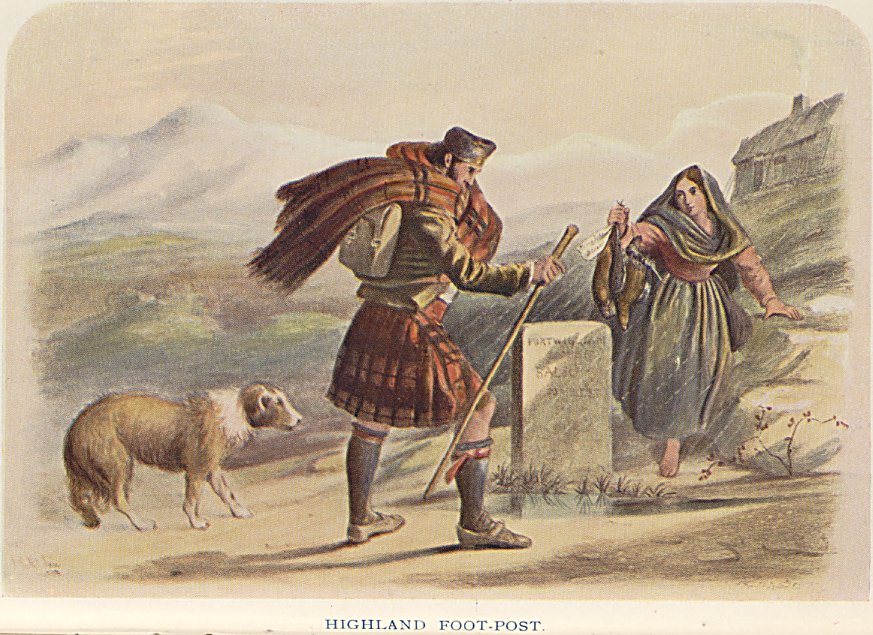
The postman here represented is a specimen of these
hardy pedestrians, who, it will be seen, are occasionally loaded with
other property than letters or papers. He is always a welcome
visitor,—except, indeed, when he unhaply brings evil news. When he has any
time to spare, he gratifies his eager hearers with all the news he has
acquired; and as those for whom he has letters are often in remote
localities, the epistles are frequently left with others, who cheerfully
undertake to transmit their charge to the proper parties, either by some
one going the way of their dwellings, or personally delivering the letters
on meeting them at kirk or market. |