View our terms and conditions for use of our web site and our privacy policy. Visit Electric Scotland's Aois Community, our social networking site. Find our contact information and learn more about us. The Home Page of Electric Scotland ES Common Header Bar
This is where you'll find a comprehensive resource on Scottish accommodations. Electric Scotland's Article Service where you can both read articles and post your own. Beth's Newfangled Family Tree is a monthly publication giving genealogy advice as well as what's hapening on the Scottish Scene around the world. This is where you'll find around 300 books on Scottish history that we've published on the site. Our pages where you'll find books and articles about Robert Burns and his work. Gives you some information on the business scene in Scotland. This is where you can view Scottish events around the world and add your own. Learn about the history of Clans and Families of Scotland and the Scots-Irish. The personal site of Alastair McIntyre where he's posted his own mini biography as well as his travel journals. 5 volumes worth of biographies relating to Significant Scots. A weekly newsletter about the political scene in Scotland from the Scots Independent Newspaper. Lots of Scottish recipes along with contributions from our visitors. Play our collection of online games. 6 volume Gazetter on the place names of Scotland. This is our page for trying to give you advice on Genealogy. A FAQ where you go to get answers to frequently asked questions. Information and pictures about Historic places in Scotland such as castles and other properties. Main index page for our very large history section. Children resources including over 800 children's stories and lots of online and offline games. A bit of a catch-all page where you find loads of pages about music, haggis, scots language, culture, religion, humor and lots more. Our nature page where you can explore information on Scottish Wildlife, Plants, Flowers and lots more. Our weekly newsletters archive. Thousands of pictures of Scotland for you to enjoy. Loads of poetry and stories for you to enjoy with many contributions from visitors to our site. Our very own Webcard program which you can use to send online postcard to friends and relatives. Huge resources about the Scots Diaspora around the world and here is where you can find this information. A continually building information resource on the Scots-Irish who emigrated to Ulster and then onto many parts of the world, especially the USA. Create your own family tree with our special software. You can also import and export gedcom files. Our web-based scottish search engine which is a free resource for Scottish companies as well as Scottish organisations around the world. Current Scottish News headlines and links to Scottish news resources. A range of services, both big and small, that we currently offer. Our Tartan pages, giving you access to information on Tartans as well as tartan search engines. Sponsored by House of Tartan. Our travel section where we have loads of suggested tours of Scotland as well as old historic travel books. A wee collection of videos some of which we've produced ourselves. Learn about the last 100 pages we've added to our site which is updated daily.


Click here to get a Printer Friendly Page
 

Send Flowers

Huntly Castle
The Ice-House


Extract from the Proceedings of the Society of Antiquaries of Scotland
Vol XCIII Session 1959-60

About 110 yards from the Castle down the north-east slope of the rock an icehouse has been built into an excavation on the sloping face.

On the lower side of the slope a semicircular court has been excavated to a depth of 7 feet and a radius of 9 feet with a rubble retaining wall and cobbled flooring. On the NW side a flight of ten stone steps gives access to this forecourt. At the centre of the straight side, facing NE is a doorway, 5 feet in height by 3 feet 3 inches wide, the rybats and lintel being checked 1 inches by 1 inches to receive a door which gives entrance to a passage 9 feet in length by 3 feet 3 inches wide. The side walls of the passage are built of rubble work 4 feet 9 inches up to the springing of a barrel-vaulted ceiling made of a handmade bricks giving a total height of 5 feet 8 inches to the centre of the vaulting. The floor is of flagstones and drops slightly to the outer end. The ceiling of the passage groins into the dome of the ice-house proper. This chamber is constructed entirely of hand-made bricks, each 9 inches by 4 inches and is in ovate form 13 feet 3 inches in depth and 12 feet in diameter at the level of the floor of the passage, from which springs a dome of 6 feet radius. From there the chamber is sharply concaved to a base width of 3 feet where there is a scarcement of 3 inches above a drainage sump 2 feet 6 inches in diameter and 1 foot 6 inches in depth and with an exit drain at the bottom. In use a wooden grid would be fitted to the scarcement.

The outer door had been hung with crook and band hinges the remnants of the crooks remaining in the wall. There had been a second door at the inner end of the passage as is evinced by the remains of wooden bats in the walling to which wooden standards would be fitted.

All the brickwork is in perfect condition and the chamber after three hundred years is thoroughly dry. In comparison from drawings and descriptions of other ice-houses throughout Great Britain it would seem to be one of the finest examples extant.

Owing to the heavy overload of soil it was not possible to measure the thickness of the walling of the passage or of the chamber itself or to find out whether it was constructed with single or cavity walling as was found in some ice-houses of similar design.

The whole structure of Castle Huntly ice-house is very similar to that at Moredun House, Midlothian, but the latter does not have the concave sides.

The ice-house at Castle Huntly then called Castle Lyon was installed by Patrick Lyon 3rd Earl of Kinghorne who succeeded to the Castles of Huntly and Glamis in 1646. Records in the Charter Room at Glamis have been examined through the kindness of Mr Kemp the Factor. Most of the payments entered in the account books of the period in question are given only as total amount due to the various tradesmen without details of the work done but in a ‘Compt Book of the Lordship of Lyon for the year 1692’ there is recorded a payment to one William Watson, Mason, for various jobs including ‘work done at the Ice-House at Castle Lyon’ which shows that it was in existence at that date.

After 1660 the Earl began the reconditioning and improvement of Castle Huntly and lived there for several years carrying out the work before he commenced any improvements at Glamis and writing in his diary ‘The Glamis Book of Record’ about Castle Huntly as a feudal fortalice says. "Such houses are worn quite out of fashion, as feuds are which is a great happiness and I wish that every man who has such houses would reform them for who can delight to live in his house as in a prison and I am much addicted to general reformation and have not a little propagate that humour in the country where I live as general improvements have been more since the time of the King’s happy restoration than has been a hundred years before."

The Earl was a good deal in London at the Court of Charles II who in 1672 granted him a charter erecting the lands of Castle Huntly into a Free Barony to be called the ‘Lordship of Lyon’ and in 1677 another charter provided that in future the Earls of Kinghorne should be styled ‘Earls of Strathmore, Viscounts Lyon and Barons Glamis, Tannadyce, Sidlaw and Strathdichtie’.

From about 1650 ice-houses were being introduced into the mansions in St James Park in London ‘As is the mode in France and Italy’. Accounts of building several in St James Park area are to be found in Government Records.

In The Times of 19th September 1957 there is a report of the discovery of an icehouse when a bombed site in St James Place was being cleared up. This ice-house is mentioned in a document of 1680 which implies that it was installed for Barbara Villiers, Duchess of Cleveland as an adjunct to her mansion in Cleveland Row. The ice-house was surveyed and photographed before the site was again built on. From the photograph it appears to have been of similar design to that at Castle Huntly.

The majority of the seventeenth-century ices-houses were egg-shaped with domed tops and side entrances. Such have been found scattered throughout the country; the egg-shape with the earth pressure all round gave the greatest stability. Later the design changed to cup-shaped chambers with vertical sides and by the eighteenth and nineteenth centuries they became degenerated and often were of rectangular shape and with mounts of earth raised over them. Few eighteenth century country houses lacked this amenity and those properly buried in a mound of earth often survived the mansion itself.

Local traditions of secret underground passages are often traceable to a disused ice-house its purpose being long forgotten. This tradition became attached to one at Hereford Castle which was burrowed into the dry bank of a former moat. The true nature of the passage was not realised until the Castle grounds came into the possession of the Borough Council by whom it was cleared out and preserved. The Hereford ice-house is situated at the end of a vaulted passage and has a brick dome of excellent craftsmanship.

A similar tradition was attached to the ice-house at Castle Huntly which has been in disuse for over a hundred years and when the writer was making his survey of the castle he was constantly being asked by the local people if he had found any traces of the underground passage supposed to have run from Castle Huntly to Glamis (a distance of 14 miles).

After 1728 Castle Lyon ceased to be used as a residence by the Earls and was mostly occupied as a Dower House by the widows of various Earls.
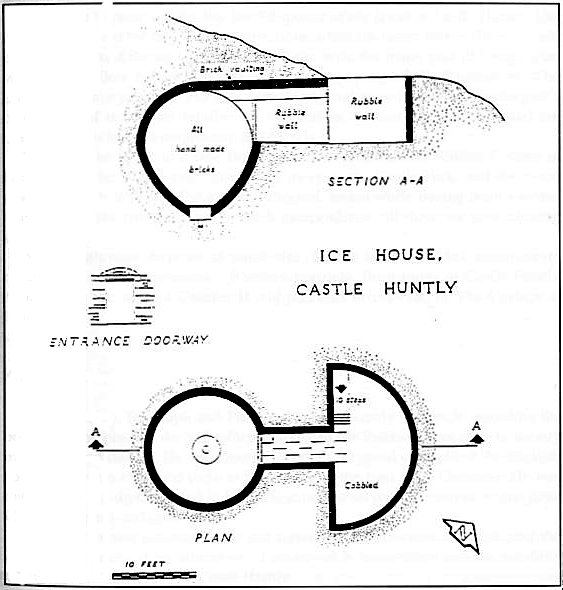
Ice House


Previous Page | Return to Index | Next Page

