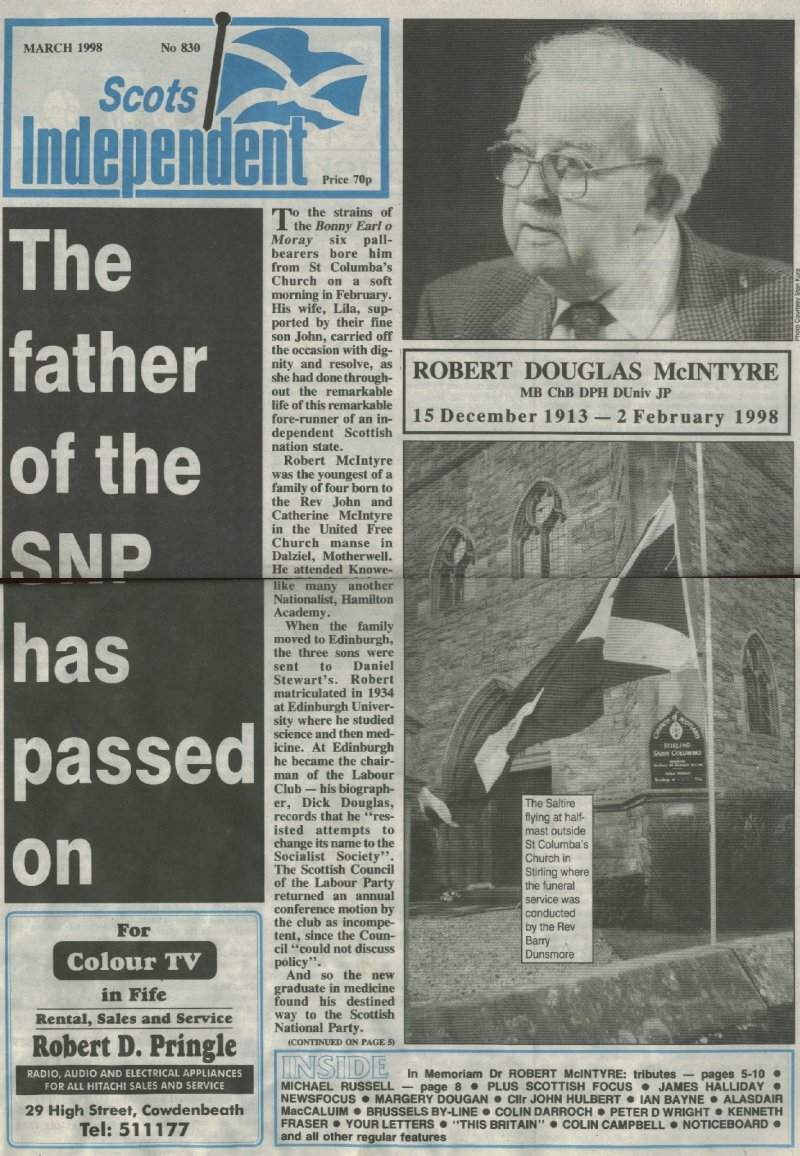
So much for that distinguished career.
For relaxation the family sailed their converted Loch Fyne 35-foot skiff,
the Violante, offshore of the Highland village of Plockton. And all the
rest of his waking hours were taken up with the promulgation of his
political goal, the self-government of Scotland.
He undertook the task of national
organiser of the Scottish National Party. Between 1929 and 1942 the
national secretary was John MacCormick, who was the key figure of this
period of the cause's development.
The Party had been rocked by the
hostility of many of its leading figures to England’s war. The security
forces retaliated by rounding up Arthur Donaldson, Douglas Young, Muriel
Gibson and Roland Muirhead. Then Dr MacCormick persuaded the Party to
adopt the role of an "agent to unite Scottish opinion, irrespective
of Party differences, behind an agreed measure of Scottish Home
Rule".
That effectively split the Party. John
MacCormick, concluding that there had to be a consequent "parting of
the ways", stood as a Liberal candidate while masterminding the
breakaway Scottish Convention.
Robert McIntyre, with Arthur Donaldson,
soldiered on and kept the Party together, in the strong conviction that it
had to be a "totally independent political party fighting for a
Scottish Parliament".
Then history took a hand. The Labour MP
for Motherwell & Wishaw, James Walker, was killed in a car accident.
He had had a majority of 430 over the Tories. With the wartime coalition
pact still in operation, the Tories did not field a by-election candidate
against Labour’s Alex Anderson.
In 1944 Secretary McIntyre had set out
the political stances of the SNP in a pamphlet entitled "Some
Principles for Scottish Reconstruction". Those who believe that the
SNP did not concern itself with politics half a century ago would do well
to read the document which also formed the basis of the SNP’s
by-election address. This covered the range of social and economic
concerns (in the policy areas of housing, transport, mines, land,
fisheries, agriculture, emigration, environment ...) which a
self-governing Scotland free of the "centralised bureaucratic
shackles of absentee government".
"A selggoverning Scotland", he
wrote, "would depend on the natural organisation of the family and
local community for its stability. Rejecting the "vested interests of
the Right and the Left", McIntyre also refused to discuss politics in
terms of the English political agenda. His programme was no fudged
compromise between the two polarised tyrannies. His was a clearly defined
Nationalist agenda.
And it was with this manifesto that, in
a straight fight, he defeated his Labour opponent by 617 votes.
The story of his refusal to be
"introduced" to the House by two sponsors from any British party
is told elsewhere. His brief tenure until the General Election later in
the year rocked the Establishment and at a stroke injected electoral
credibility into the independence movement. While it is true, as opponents
claim, that a generation had to elapse before Winnie Ewing became the
second SNP Parliamentary victor, Robert McIntyre had unlocked the door to
independence which has opened progressively wider as the Party grew and
grew. If he did nothing else subsequently, that feat would have been
enough to earn him his unique place in the history of the cause.
It was in fact fortunate that he lost
the seat at the General Election because that freed him to set about
building up the modem political Party which he, with Arthur Donaldson and
Tom Gibson, were to design and construct.
He was Party Chairman from 1948 until
1956 and its President thereafter until 1980. At the same time he was
applying the principles of Nationalism to local government which resulte
in his being elected as the burgh’s first SNP councillor, town treasurer
and then planning convener. Achievements directly attributable to him
include the restoration of the Top o the Town, the shopping centre,
swimming pool, much new housing and a key role in the foundation of the
University. In recognition of all of that he was made a Freeman of the
Royal Burgh and an honorary doctor of the University.
All this time he was directing the
development of the Scots Independent — even, from time to time,
undertaking onerous editorial duties.
All political parties betray schismatic
tendencies and the SNP, as it grew, was no exception. So Dr McIntyre, even
in his latter years, had to undertake unifying locum duties once again. In
the mid 1970s the SNP had risen to its, still unsurpassed, Parliamentary
peak of 11 MPs and inevitable frictions grew between the Party in the
country and the Party at Westminster. Significantly, the NEC turned to Dr
McIntyre to act as liaison representative, with considerable effect.
Then the strategy conflagrations of the
late Seventies and early Eighties made a further call on his therapeutic
talents. While the looming, Media-fanned split was formally, averted by a
truce — drafted, ironically perhaps, by John MacCormick’s son, Neil
— it was Robert McIntyre who more than anyone else helped to smooth most
of the ruffled feathers on both sides and brought the young turks
gradually back into the philosophical fold.
He remained an intellectually and
physically active elder statesman, as well as Party worker on the streets,
throughout the 1990s, the Westminster Parliamentary group recently
electing him as their first-ever Honorary President.
The Scots Independent salutes him