|
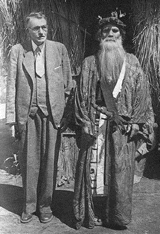 A Japanese senator,
Shigeru Kayano has made a pilgrimage to the home of the Chief of the
Munros, Foulis Castle, near Evanton, in the Scottish Highlands, to pay
tribute to a Scottish doctor who died in 1942 after spending a lifetime
administering medicine to an ancient Japanese people. A Japanese senator,
Shigeru Kayano has made a pilgrimage to the home of the Chief of the
Munros, Foulis Castle, near Evanton, in the Scottish Highlands, to pay
tribute to a Scottish doctor who died in 1942 after spending a lifetime
administering medicine to an ancient Japanese people.
As part of the Japan 2001 Festival, the National Museums of Scotland is
presenting a fascinating display of the collection of Dr Neil Gordon Munro
who lived in Japan for fifty years and built a collection of important
artefacts which otherwise might have been lost.
Dr Munro was a champion of the Ainus, an ancient people from Hokkaido, the
northern part of Japan. They had always been discriminated against in
Japan and it’s only in the latter part of the twentieth century that
this has changed.
Shigeru Kayano, an Ainu himself, made his pilgrimage to perform an Ainu
ritual to thank the spirit of Dr Munro for his support in helping the Ainu
to survive against all the odds. When he arrived at Foulis Castle, the
home of the clan chief of the Munros, Hector Munro, he said, "Dr
Munro’s house was built between the hills and the river. Seeing Hector
Munro’s house, I am immediately reminded of Dr Munro’s house. I now
understand why Dr Munro chose to live in Nibutani , my home town, as the
beauty of the Highlands reminds me of my roots."
The ceremony was filmed for the Japanese equivalent of the BBC and Casia
Zajac of the Highlands of Scotland Tourist Board hopes that the story will
help attract Japanese visitors to the Highlands.
"The Japanese market is important to Scotland, including the 30,000
Japanese who live in London. This fascinating story will raise awareness
of the Highlands and hopefully encourage more of our Japanese friends to
come to the north of Scotland."
The first detailed account of the Ainu, the
little-known aboriginal people of Japan, Neil Gordon Munro's classic work,
was based on decades of research in the first half of this century. Munro,
a medical doctor who lived and worked in Japan for almost fifty years,
studied the Ainu for years before finally going to live among them for the
last twelve years of his life.
Munro's object in writing Ainu Creed and
Cult was not only to give an account of his close observation of this
mysterious people and their customs, but also to demonstrate to the world
at large and to the Japanese in particular that the Ainu had an
independent culture worthy of respect and preservation.
The author's unique insider's position
among the Ainu enabled him to accurately describe their religious beliefs,
homes, ceremonies, social organizations, arts, festivities, and funerary
practices. Ainu Creed and Culture establishes the intricacy of the
group's spiritual beliefs and ritual practices, a dominant force in their
daily lives.
Munro's work stands today as a fine example
of the anthropological method, as a historical record of those decades at
the beginning of the century when the old Ainu ways were still followed,
and as an eloquent and timeless plea for the dignity and survival of a
minority cultural group.
About the Author
Neil Gordon Munro (1863-1942), born and educated in Edinburgh, Scotland,
traveled in India and Japan before settling in Yokohama as director of the
General Hospital in 1893. He lived in Japan until his death in 1942.
|



