|
Geology is the science which
investigates the history of the earth. Its object is to trace the progress
of our planet from the earliest beginnings of its separate existence through
its various developments to its present condition. Geology does not confine
itself to changes in the inorganic world; it shows as well that the present
race of plants and animals are the descendants of other and very different
races which once peopled the earth, and that, however imperfectly
characteristic types of the animal and vegetable kingdoms have been
preserved or may be deciphered, materials exist for a history of life upon
the earth. While receiving help from other sciences, geology claims as its
peculiar territory the rocky frame-work of the globe. In these materials lie
the main data of geological history, arranged in chronological sections, the
oldest lying at the bottom and the newest at the top. Geological structure
has of course intimate connection with the quality and natural fertility of
soil, so that its influence on agriculture and food production is direct and
intimate.
The predominant rocks in
Banffshire are granite, quartz rock, mica-slate, clay-slate, syenitic
greenstone, graywacke, graywacke-slate, Old Red Sandstone, metamorphic
limestone, and serpentine.
Gneiss, and to a greater
extent mica-slate, form the lowest stratified rocks running nearly
south-west from the coast between Cullen and Portsoy to the upper valleys of
the Fiddich, Deveron, and Aven. Generally they are fine-grained slaty rocks,
and form low rounded mountains, decomposing into soils of considerable
fertility. In many places the mica-slate alternates or passes into
quartzite, which differs from it chiefly in the almost entire absence of
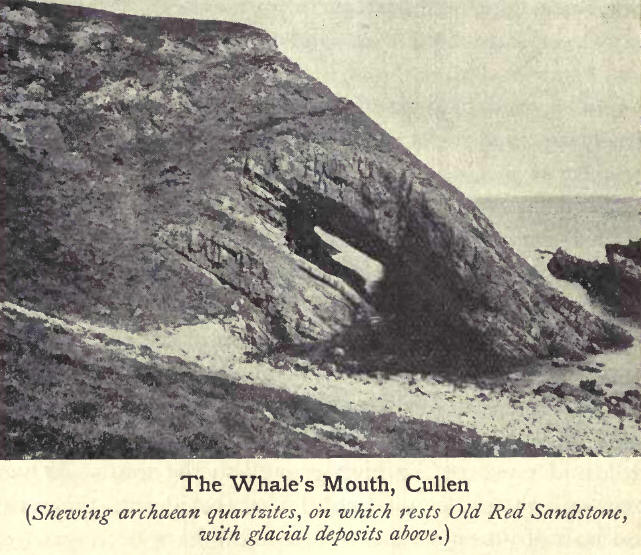
mica. Quartzite in a more independent form is seen on the coast between
Cullen and Buckie, and forms also the Durn Hill, near Portsoy; the Bin of
Cullen; the Knock Hill, and much of the high ground to the south. Where it
prevails the soil is not fertile. Connected with this series also beds of
limestone are common and have been quarried in many places, as in the Boyne,
Fordyce, Keith, Mortlach and Kirkmichael. The limestone extends a long
distance and may be traced, indeed, from Portsoy to Glentilt in Braemar. In
Glenlivet, limestone may be found in almost every stream and under every
field; some years ago line kilns were to be seen on almost every farm in
that district. Clay-slate occurs in considerable abundance; in some places
perhaps merely a finer variety of mica-slate; in others coarser in texture,
the so-called greywacke. Large masses occur near Boharm, and from Dufftown
south to Kirkmichael. It also forms the north coast from Knock Head by
Banff, Macduff, and Gamrie to Troup Head, rising on occasion into bold lofty
cliffs.
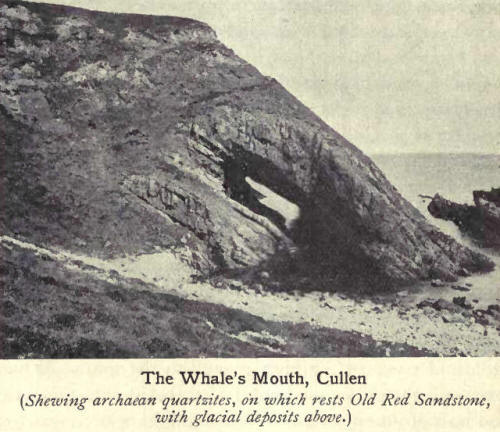
Resting on these rocks,
Devonian or Old Red Sandstone and conglomerate beds are seen in a few
places. The Morayshire beds, for instance, cross the Spey near Fochabers,
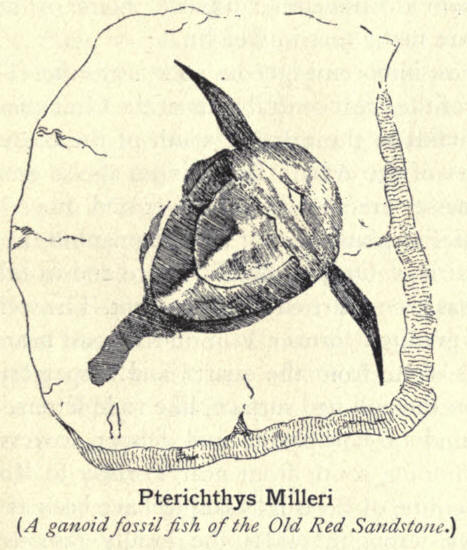
running along the coast to Buckie, and in this district, in the Tynet Burn
in particular, they have yielded many characteristic fossil fishes. Gamrie
Bay has been eroded out of Old Red Sandstone by the sea, the action of which
has been resisted more successfully by the harder rocks of Gamrie Mhor and
Troup Head, but between Troup Head and Pennan there are precipices of Old
Red Sandstone 400 to 500 feet high. The Old Red Sandstone of this district
has been long famous for fossil fishes, and for exposed sections of the
strata which show clearly the succession of the beds.
In the southern extremity of
the county, near Tomintoul, another deposit of Old Red Sandstone occurs over
an area of nine by two-and-a-half miles.
Indications of more recent
formations are seen in the chalk flints common in the vicinity of Portsoy,
and in the oolite fossils found in the brick-clays at Blackpots, Boyndie.
The raised beach, with recent shells, more than 200 feet above the
sea-level, near the old church of Gamrie, is also interesting, while Boyndie,
Portsoy, Sandend, Findochty, also provide examples of recent and raised
beaches. The surface of the county generally is covered with masses of
boulder clay and stratified drift beds, the materials often derived from a
considerable distance. Some of the granite boulders are many tons in weight.
The most important igneous
rock is granite. This rock, a portion of the great central mass of the
Grampians, forms the mountains in the extreme south of the county round the
sources of the Aven. Ben Rinnes also is granite, and smaller masses are seen
in Glenlivet and other localities. Small bosses of granite occur at
Longmanhill, in Gamrie, and at Cairn of Ord, in Banff. There and in other
areas the rock has been quarried to some extent. The well-known "graphic
granite" forms a vein on the coast near Portsoy. It gets its name from the
quartz and felspar crystals appearing on the polished surface, like rude
letters. Syenite, a compound of hornblende and felspar, covers a large
district, running south from near Portsoy to Rothiemay. The serpentine of
Portsoy is said to have been at one time extensively wrought. It is the
locally famous Portsoy marble, from which Louis XIV had chimney-pieces made
for the Palace of Versailles. The district of Portsoy has been described
indeed as a geological museum, showing a unique section on a small scale of
the rocks which compose the Highlands of Scotland. Within a comparatively
small area we find serpentine, diorite, Labradorite, graphite, quartzite,
clay-slate, mica-schist, grey granite, graphic granite, and other rocks.
|