|
[Letter dated "Salt Lake,
July, 1877." Editor.]
LILIES are rare in Utah; so
also are their companions the ferns and orchids, chiefly on account of the
fiery saltness of the soil and climate. You may walk the deserts of the
Great Basin in the bloom time of the year, all the way across from the snowy
Sierra to the snowy Wahsatch, and your eyes will be filled with many a gay
malva, and poppy, and abronia, and cactus, but you may not see a single true
lily, and only a very few liliaceous plants of any kind. Not even in the
cool, fresh glens of the mountains will you find these favorite flowers,
though some of these desert ranges almost rival the Sierra in height.
Nevertheless, in the building and planting of this grand Territory the
lilies were not forgotten. Far back in the dim geologic ages, when the
sediments of the old seas were being gathered and outspread in smooth sheets
like leaves of a book, and when these sediments became dry land, and were
baked and crumbled into the sky as mountain-ranges; when the lava-floods of
the Fire Period were being lavishly poured forth from innumerable rifts and
craters; when the ice of the Glacial Period was laid like a mantle over
every mountain and valley- throughout all these immensely protracted
periods, in the throng of these majestic operations, Nature kept her flower
children in mind. She considered the lilies, and, while planting the plains
with sage and the hills with cedar, she has covered at least one mountain
with golden erythroniums and fritillarias as its crowning glory, as if
willing to show what she could do in the lily line even here.
Looking southward from the
south end of Salt Lake, the two northmost peaks of the Oquirrh Range are
seen swelling calmly into the cool sky without any marked character,
excepting only their snow crowns, and a few small weedy-looking patches of
spruce and fir, the simplicity of their slopes preventing their real
loftiness from being appreciated. Gray, sagey plains circle around their
bases, and up to a height of a thousand feet or more their sides are tinged
with purple, which I afterwards found is produced by a close growth of dwarf
oak just coming into leaf. Higher you may detect faint tintings of green on
a gray ground, from young grasses and sedges; then come the dark pine woods
filling glacial hollows, and over all the smooth crown of snow.
While standing at their feet,
the other day, shortly after my memorable excursion among the salt waves of
the lake, I said: "Now I shall have another baptism. I will bathe in the
high sky, among cool wind-waves from the snow." From the more southerly of
the two peaks a long ridge comes down, bent like a bow, one end in the hot
plains, the other in the snow of the summit. After carefully scanning the
jagged towers and battlements with which it is roughened, I determined to
make it my way, though it presented but a feeble advertisement of its floral
wealth. This apparent barrenness, however, made no great objection just
then, for I was scarce hoping for flowers, old or new, or even for fine
scenery. I wanted in particular to learn what the Oquirrh rocks were made
of, what trees composed the curious patches of forest; and, perhaps more
than all, I was animated by a mountaineer's eagerness to get my feet into
the snow once more, and my head into the clear sky, after lying dormant all
winter at the level of the sea.
But in every walk with Nature
one receives far more than he seeks. I had not gone more than a mile from
Lake Point ere I found the way profusely decked with flowers, mostly
compositae and purple leguminosa, a hundred corollas or more to the square
yard, with a corresponding abundance of winged blossoms above them, moths
and butterflies, the leguminosa of the insect kingdom. This floweriness is
maintained with delightful variety all the way up through rocks and bushes
to the snow - violets, lilies, gilias, anotheras, wallflowers, ivesias,
saxifrages, smilax, and miles of blooming bushes, chiefly azalea,
honeysuckle, brier rose, buckthorn, and eriogonum, all meeting and blending
in divine accord.
Two liliaceous plants in
particular, Erythronium grandiflorum and Fritillaria pudica, are marvelously
beautiful and abundant. Never before, in all my walks, have I met so
glorious a throng of these fine showy lihiaceous plants. The whole
mountain-side was aglow with them, from a height of fifty-five hundred feet
to the very edge of the snow. Although remarkably fragile, both in form and
in substance, they are endowed with plenty of deep-seated vitality, enabling
them to grow in all kinds of places - down in leafy glens, in the lee of
wind- beaten ledges, and beneath the brushy tangles of azalea, and oak, and
prickly roses - everywhere forming the crowning glory of the flowers. If the
neighboring mountains are as rich in lilies, then this may well be called
the Lily Range.
After climbing about a
thousand feet above the plain I came to a picturesque mass of rock, cropping
up through the underbrush on one of the steepest slopes of the mountain.
After examining some tufts of grass and saxifrage that were growing in its
fissured surface, I was going to pass it by on the upper side, where the
bushes were more open, but a company composed of the two lilies I have
mentioned were blooming on the lower side, and though they were as yet out
of sight, I suddenly changed my mind and went down to meet them, as if
attracted by the ringing of their bells. They were growing in a small,
nestlike opening between the rock and the bushes, and both the erythronium
and the fritillaria were in full flower. These were the first of the species
I had seen, and I need not try to tell the joy they made. They are both
lowly plants, - lowly as violets, - the tallest seldom exceeding six inches
in height, so that the most searching winds that sweep the mountains scarce
reach low enough to shake their bells.
The fritillaria has five or
six linear, obtuse leaves, put on irregularly near the bottom of the stem,
which is usually terminated by one large bell-shaped flower; but its more
beautiful companion, the erythronium, has two radical leaves only, which are
large and oval, and shine like glass. They extend horizontally in opposite
directions, and form a beautiful glossy ground, over which the one large
down-looking flower is swung from a simple stem, the petals being strongly
recurved, like those of Lilium superbum. Occasionally a specimen is met
which has from two to five flowers hung in a loose panicle. People
oftentimes travel far to see curious plants like the carnivorous
darlingtonia, the fly-catcher, the walking fern, etc. I hardly know how the
little bells I have been describing would be regarded by seekers of this
class, but every true flower-lover who comes to consider these Utah lilies
will surely be well rewarded, however long the way.
Pushing on up the rugged
slopes, I found many delightful seclusions - moist nooks at the foot of
cliffs, and lilies in every one of them, not growing close together like
daisies, but well apart, with plenty of room for their bells to swing free
and ring. I found hundreds of them in full bloom within two feet of the
snow. In winter only the bulbs are alive, sleeping deep beneath the ground,
like field mice in their nests; then the snow-flowers fall above them,
lilies over lilies, until the spring winds blow, and these winter lilies
wither in turn; then the hiding erythroniums and fritillarias rise again,
responsive to the first touches of the sun.
I noticed the tracks of deer
in many places among the lily gardens, and at the height of about seven
thousand feet I came upon the fresh trail of a flock of wild sheep, showing
that these fine mountaineers still flourish here above the range of Mormon
rifles. In the planting of her wild gardens, Nature takes the feet and teeth
of her flocks into account, and makes use of them to trim and cultivate, and
keep them in order, as the bark and buds of the tree are tended by
woodpeckers and linnets.
The evergreen woods consist,
as far as I observed, of two species, a spruce and a fir, standing close
together, erect and arrowy in a thrifty, compact growth; but they are quite
small, say from six to twelve or fourteen inches in diameter, and about
forty feet in height. Among their giant relatives of the Sierra the very
largest would seem mere saplings. A considerable portion of the south side
of the mountain is planted with a species of aspen, called "quaking asp" by
the wood-choppers. It seems to be quite abundant on many of the eastern
mountains of the basin, and forms a marked feature of their upper forests.
Wading up the curves of the
summit was rather toilsome, for the snow, which was softened by the blazing
sun, was from ten to twenty feet deep, but the view was one of the most
impressively sublime I ever beheld. Snowy, ice-sculptured ranges bounded the
horizon all around, while the great lake, eighty miles long and fifty miles
wide, lay fully revealed beneath a lily sky. The shore-lines, marked by a
ribbon of white sand, were seen sweeping around many a bay and promontory in
elegant curves, and picturesque islands rising to mountain heights, and some
of them capped with pearly cumuli. And the wide prairie of water glowing in
the gold and purple of evening presented all the colors that tint the lips
of shells and the petals of lilies -the most beautiful lake this side of the
Rocky Mountains. Utah Lake, lying thirty-five miles to the south, was in
full sight also, and the river Jordan, which links the two together, may be
traced in silvery gleams throughout its whole course.
Descending the mountain, I
followed the windings of the main central glen on the north, gathering
specimens of the cones and sprays of the evergreens, and most of the other
new plants I had met; but the lilies formed the crowning glory of my bouquet
- the grandest I had carried in many a day. I reached the hotel on the lake
about dusk with all my fresh riches, and my first mountain ramble in Utah
was accomplished. On my way back to the city, the next day, I met a grave
old Mormon with whom I had previously held some Latter- Day discussions. I
shook my big handful of lilies in his face and shouted, "here are the true
saints, ancient and Latter-Day, enduring forever!" After he had recovered
from his astonishment he said, "They are nice."
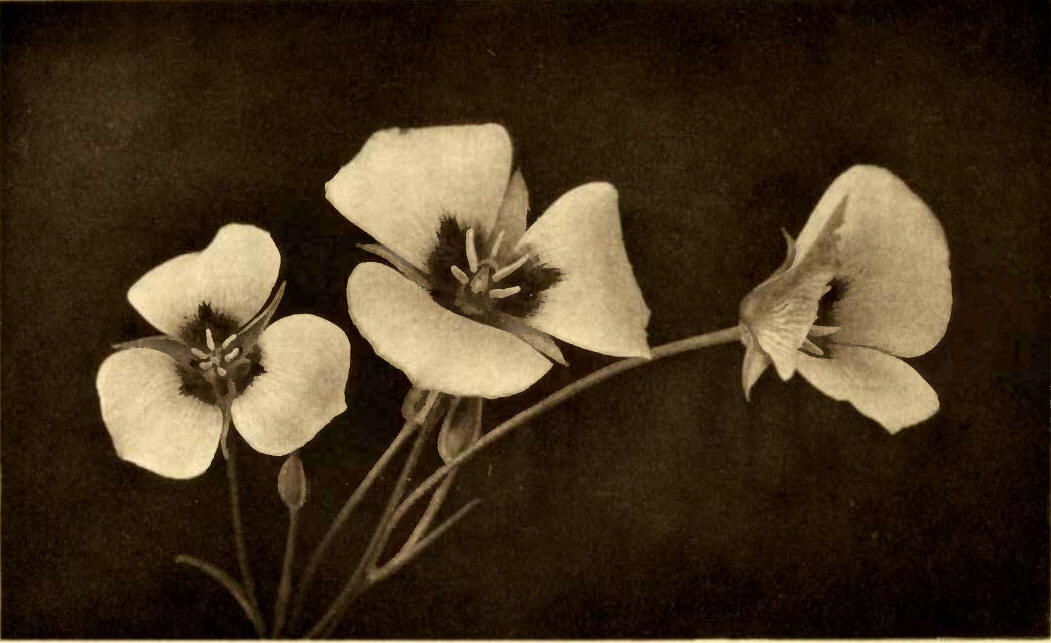
The other liliaceous plants I
have met in Utah are two species of zigadenas, Fritillaria atropurpurea,
Calochortus Nuttallii, and three or four handsome alliums. One of these
lilies, the calochortus, several species of which are well known in
California as the "Mariposa tulips," has received great consideration at the
hands of the Mormons, for to it hundreds of them owe their lives. During the
famine years between 1853 and 1858, great destitution prevailed, especially
in the southern settlements, on account of drouth and grasshoppers, and
throughout one hunger winter in particular, thousands of the people
subsisted chiefly on the bulbs of these tulips, called "sego" by the
Indians, who taught them its use.

Liliaceous women and girls
are rare among the Mormons. They have seen too much hard, repressive toil to
admit of the development of lily beauty either in form or color. In general
they are thickset, with large feet and hands, and with sun-browned faces,
often curiously freckled like the petals of Fritillaria atropurpurea. They
are fruit rather than flower - good brown bread. But down in the San Pitch
Valley at Gunnison, I discovered a genuine lily, happily named Lily Young.
She is a granddaughter of Brigham Young, slender and graceful, with
lily-white cheeks tinted with clear rose. She was brought up in the old Salt
Lake Zion House, but by some strange chance has been transplanted to this
wilderness, where she blooms alone, the "Lily of San Pitch." Pitch is an old
Indian, who, I suppose, pitched into the settlers and thus acquired fame
enough to give name to the valley. Here I feel uneasy about the name of this
lily, for the compositors have a perverse trick of making me say all kinds
of absurd things wholly unwarranted by plain copy, and I fear that the "Lily
of San Pitch" will appear in print as the widow of Sam Patch. But, however
this may be, among my memories of this strange land, that Oquirrh mountain,
with its golden lilies, will ever rise in clear relief, and associated with
them will always be the Mormon lily of San Pitch, |