CARSON, AGLIONBY
ROSS, M.A., LL.D.,
rector of the High School of Edinburgh, a classical scholar of
reputation, was born at Holywood, Dumfries-shire, in the year 1780. He
received the elements of his classical education in the endowed school
of Wallace Hall, in the neighbouring parish of Closeburn; in which
institution he subsequently acted as an assistant teacher. In 1797he
entered the university of Edinburgh; and from May 1799, till October
1800, acted as assistant to Mr. John Taylor, of the grammar school,
Musselburgh. He was enrolled a student of divinity in the university of
Edinburgh in 1799. The grammar school of Dumfries having become vacant
by the removal of Mr. Gray to Edinburgh, Mr. Carson was unanimously
elected his successor, on the 15th of October, 1801. In
January 1806, in consequence of Mr. Christison’s promotion to the chair
of humanity in Edinburgh, Mr. Carson obtained a mastership in the High
School. In 1820, when Mr. Pillans vacated the rector’s chair, in
consequence of having succeeded Professor Christison in the university,
the patrons of the High School placed Mr. Carson t the head of the
school. His appointment as rector took place on the 20th
August, 1820. He had, three months prior, declined acceptance of the
Greek professorship in the university of St. Andrews, to which, though
not a candidate, he had been elected. Six years afterwards, that
university, in token of his great learning, conferred on him the degree
of LL.D. On the 9th of October, 1845, he found it necessary,
on account of the precarious state of his health, to tender his
resignation as rector of the High School into the hands of the patrons.
On this occasion the magistrates and council testified their
appreciation of his long and faithful services by settling upon him an
annuity for life of a hundred pounds. At a meting of his colleagues, a
series of resolutions were passed, expressive of their deep regret at
his resignation of rector, and bearing testimony to the merit, acumen,
and profundity of his contributions to critical literature – especially
in regard to his treatise on the Latin relative. The resolutions also
spoke of his long, laborious, and valuable services in the High School,
and his popularity as a teacher. They characterized him as a man of
unobtrusive worth – endowed with rare powers of instruction, and as
possessing a playful manner even in matters of discipline, while he
maintained order by the gentlest means.
A half-length
portrait of Dr. Carson, painted in 1833 by Watson Gordon, Esq.,
president of the Royal Society of Arts, ornaments the hall of the High
School, of which the following is a woodcut:
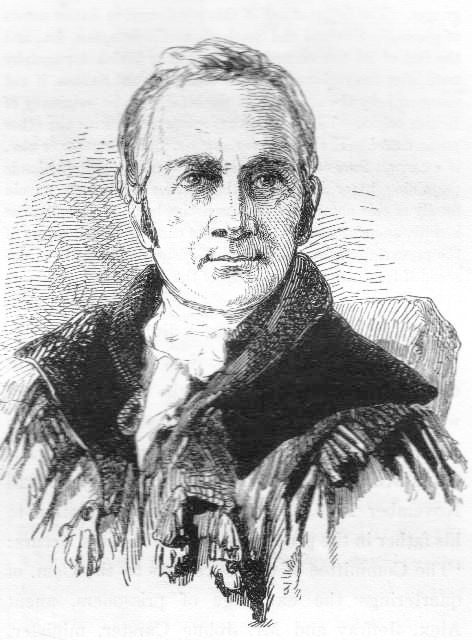
The
expense was defrayed by a subscription by several of his pupils, and was
presented to the school by Dr. Balfour.
He was succeeded in the office of rector of the High School, on the 16th
of December, 1845, by Dr. L. Schmitz, a native of Eupen, a village near
Aix-la-Chapelle, in the Rhenish province of Prussia. Dr. Carson died at
Edinburgh on the 4th November 1850. – Dr. Steven’s History
of the High School.
Dr.
Carson’s contributions to literature are, an edition of ‘Phaedrus,’
‘Mair’s Introduction,’ ‘Turner’s Grammatical Exercises,’ and
particularly an edition of ‘Tacitus,’ all of which, especially the last,
are highly valued.
Of the excellence of his work entitled ‘The Relative, Qui, Quae, Quod,’
ample testimony is borne by its universal adoption as a guide to the
tyro.
He also contributed largely to the ‘Classical Journal,’ the ‘Scottish
Review,’ and the ‘Encyclopaedia Britannica.’
From
the Dictionary of National Biography
CARSON, ALEXANDER (1776–1844),
baptist minister, was born near Stewartstown, co. Tyrone, in 1776. His
parents were Scottish Calvinistic presbyterians, settled in Ireland, who
consecrated their son to the ministry at an early age. He was sent to a
classical school, and afterwards to the university of Glasgow, where he
made himself a good Greek scholar — 'the first scholar of his time,'
says Robert Haldane. He proceeded B.A and M.A. At twenty-two he was
ordained pastor of the presbyterian congregation at Tobermore, near
Coleraine. His rigid Calvinism caused a disagreement with his hearers,
who inclined to Arianism. After a time Carson resigned the pastorate,
shook off the shackles of presbyterianism, and published his 'Reasons
for Separating' in 1804. Part of his congregation followed him. For some
years he preached in barns and in the open air. In 1814 they built a
small meeting-house, in which he devotedly laboured for thirty years. In
the intervals of his ministry he employed his pen in vindicating the
principles of his belief, and published books on biblical
interpretation, Transubstantiation, the Trinity, &c. In 1827 he had a
sharp controversy with Samuel Lee, professor of Hebrew at Cambridge, and
published a book entitled 'The Incompetency of Prof. Lee for translating
the Holy Scriptures,' followed by a reply to Lee's answer. In attempting
to refute Haldane's 'New Views of Baptism' he converted himself, and
afterswards published (1831) a book on 'Baptism, its Mode and Subjects.'
Of this he printed an enlarged edition in 1844; it was subscribed for by
four hundred baptist ministers. The whole impression was rapidly
disposed of, and a new edition of ten thousand copies called for. By his
writings and the publication of his books Carson became widely known;
and so much were they esteemed in America that two universities
simultaneously bestowed upon him the honorary degree of LL.D. He also
became well known nearer home by travelling through most of the English
counties, preaching ashe went on behalf of baptist missions. Returning
from his last tour in 1844, while waiting at Liverpool for the steamer
to Belfast, he fell over the edge of the quay, dislocated his shoulder,
and was nearly drowned. He was rescued and taken to the steamer; but on
his arrival at Belfast he was unable to proceed further, and after eight
days he died, on 24 Aug. 1844, in the sixty-eighth year of his age. His
remains were removed to 'Solitude,' his residence near Tobermore, and
buried near the chapel where he had preached, and where six months
before he had buried his wife. A collection of Carson's works has since
been printed in six stout volumes. At the end of the sixth volume is a
copious collection of extracts from sixteen different notices of Carson
and his writings, in which he is said to be a second Jonathan Edwards,
and the first biblical critic of the nineteenth century.
[Coleraine Chronicle, 24 and 31 Aug. 1844; Baptist Magazine, 1844, pp.
185-91, 525; G. C. Moore's Life of Alexander Carson, 1851; Douglas's
Biographical Sketch of Alexander Carson, 1884.]
CARSON, JAMES, M.D. (1772–1843),
physician, a Scotchman, was originally educated for the ministry, but
his inclination leading him to the study of physic, he attended medical
classes at Edinburgh, and graduated doctor of medicine there in the
autumn of 1799 (inaugural essay, 'De Viribus quibus Sanguis
circumvehitur'). He then removed to Liverpool, where he remained for the
greater part of his professional career. In 1808 his name came
prominently before the public in connection with the case of Charles
Angus, a Liverpool merchant, who was charged with the murder of Miss
Margaret Burns under what appeared to be circumstances of peculiar
atrocity. At the trial held at Lancaster assizes on 2 Sept. of that year
Carson in Angus's behalf stoutly maintained his opinion as to the cause
of death against that of the four medical witnesses called for the
crown, among whom was Dr. John Bostock the younger [q. v.] In the result
a verdict of 'not guilty' was returned. Some angry pamphleteering
ensued, and Carson defended himself in 'Remarks on a late Publication
entitled "A Vindication of the Opinions delivered in Evidence by the
Medical Witnesses for the Crown on a late Trial atLancaster,"' 8vo,
Liverpool, 1808. He continued at Liverpool, and subsequently held
several appointments there. He died at Sutton, Surrey, 12 Aug. 1843
(Annual Register, 1843, p. 286). He was elected a fellow of the Royal
Society on 1 June 1837, having many years previously communicated a
paper ‘On the Elasticity of the Lungs’ (Phil. Trans. cx. 29–44).
Carson's other writings are: 1. ‘Reasons for colonizing the Island of
Newfoundland,’ 8vo, 1813. 2. ‘A Letter to the Members of Parliament on
the Address of the Inhabitants of Newfoundland to the Prince Regent,’
8vo, 1813. 3. ‘An Enquiry into the Causes of the Motion of the Blood,’
8vo, Liverpool, 1815 (second and enlarged edition under the title of ‘An
Inquiry into the Causes of Respiration,’ &c., 8vo, London, 1833). 4. ‘A
New Method of slaughtering Animals for Human Food,’ 8vo, London, 1839.
[Dict. of Living Authors, 1816, p. 56; Brit. Mus. Cat.]



