CARSTAIRS,
a surname derived from the parish of Carstairs, in the upper ward of
Lanarkshire. In charters of the twelfth and thirteenth centuries the
name appears in the form of Castleterres or Castletarres, and in
documents subsequent to that date in that of Carstares, Carstaires, and
Carstairs. The prefix car or caer, which occurs in the old
British language, signifies either a fort, walled place, or city, and
most probably therefore any place built of stone and lime, originally
derived from the Latin calx, cal, lime, used in countries where
Roman colonies once existed, to denote a building of stone and lime, as
caes, a quay or wharf, in its abstract form of caero or
caeiro, lime-kiln, or place where lime is used, still met with in
the Spanish and Portuguese languages. The frequent use of this word
caer, in Saxon names of places, in England and Scotland, as
Carhampton, &c., and the fact of its not occurring in British or
Welsh topography until after the regions had been visited by the Saxons,
if not conquered by them, makes it doubtful if it be originally of
British origin. The word is thus synonymous with the other prefix
castel. The affix stairs or stair, anciently staer
or ster, is a corrupt form of the word terrae or
terrace signifying lands pertaining to or holding of the castle.
There was an old family of this name who possessed the lands of
Kilconquhar in Fife, and from them that estate came to the ancestors of
the present proprietor, Sir John Lindsay Bethune, Bart., descended from
the Lords Lindsay of the Byres.
CARSTAIRS, WILLIAM,
a divine of great political eminence, was born, February 11, 1649, at
Cathcart, near Glasgow, of the high church of which city his father, who
was descended from an ancient family in Fife, was minister. In
‘Balfour’s Annals,’ (vol. Iv. p. 168), under date 22d November 1650, the
following entry, relative to his father in the proceedings of the
Estates, occurs: ‘The Committee of estaits remitts to the Com. of
quarterings the exchange of prissoners, anent Alex. Jeffray and Mr.
Johne Carster, minister, with some Englishe prissoners in the castle of
Dumbartan.’ His mother, Jane Muir, was of the family of Glanderston, in
Renfrewshire. When very young he was sent to a school at Ormiston in
East Lothian, then kept by a Mr. Sinclair, which under his care had
attained to great celebrity. At this school many of the sons of the
nobility and gentry who afterwards distinguished themselves in life,
were his companions. With several of them he formed an intimacy which
continued through life, and to this, he was wont to ascribe, in a great
measure, his future fortunes. In due time he was entered a member of the
university of Edinburgh, but afterwards, in consequence of the
distracted state of the times in Scotland, he went to Utrecht, where his
prudence and address recommended him to the notice of the prince of
Orange, to whom he was introduced by the pensionary Fagel. In 1682 he
returned to Scotland with the view of entering the church, but,
discouraged by the persecution to which the presbyterians were subjected
at that period, he, after receiving a license to preach, resolved to
return to Holland. As he had to pass through London, he was instructed
by Argyle and his friends to treat with Russell, Sydney, and the other
leaders of that party in England who wished to exclude the duke of York
from the succession to the throne, whereby he became privy to the
Rye-House Plot, on the discovery of which he was apprehended in Kent,
and frequently examined. While, however, he avowed the utmost abhorrence
of any attempt on the life of the king or the duke of York, he refused
to give farther information, and was sent down to Scotland to be tried.
After a rigorous confinement in irons, he was twice put to the torture,
on the 5th and 6th of Sept. 1684, which he endured
with great firmness; but being afterwards promised a full pardon, and
deluded with the assurance that his answers would never be used against
any person, he consented to make a judicial declaration. The privy
council immediately published a statement, which he declared to be a
false and mutilated account of his confession; and, in violation of
their engagement, produced his evidence in court against his friend, Mr.
Baillie of Jerviswood. After the Revolution, the privy council of
Scotland made Mr. Carstairs a present of the ‘thumbikins,’ which had
formed the instrument of his torture. On his release he returned to
Holland in the winter of 1684-5, when the prince of orange made him one
of his own chaplains, and procured his election to the office of
minister of the English congregation at Leyden. He attended the prince
in his expedition to England, and was constantly consulted by him in
affairs of difficulty and importance. On the elevation of William and
Mary to the throne, Carstairs was appointed his majesty’s chaplain for
Scotland, to which were annexed all the emoluments of the chapel royal,
and was the chief agent between the church of that country and the
court. The king required his constant presence about his person,
assigning him apartments in the palace when at home, and when abroad
with the army, allowing him five hundred pounds a-year for camp
equipage.
William was at
first anxious that episcopacy should be the religion of Scotland as well
as of England, but Carstairs convinced him of the impropriety of this
project, which the king was forced to abandon, and the establishment of
the presbyterian form of church government was the consequence. He was
also, in 1694, of great service to the church in getting the oath of
allegiance, with the assurance, declaring William to be king de jure,
as well as de facto, dispensed with, the clergy naturally being
averse to the taking a civil oath as a qualification for a sacred
office.
On the death
of William he was no longer employed in public business, but Anne
continued him in the office of chaplain-royal. On 12th May
1703, he was appointed principal of the university of Edinburgh, for
which he drew up new rules. In the same year he was presented to the
church of Greyfriars in that city, and three years after was translated
to the High Church. He was four times chosen Moderator of the General
Assembly. To the universities of his native country he was a great
benefactor. In 1693 he obtained from the Crown, out of the bishops’
rents in Scotland, a gift of three hundred pounds sterling per annum to
each of the Scottish universities; and at various times he procured
donations for them for the encouragement of learning. When the union
between the two kingdoms came to be agitated, he took an active part in
its favour. He vigorously opposed the patronage act of Queen Anne, and
at all times vigilantly watched over the liberties and privileges of the
Church of Scotland. He warmly promoted the succession of the House of
Hanover to the throne of these realms, and was continued by George the
First in his post as chaplain to the king. Principal Carstairs died in
December 1715, while holding the office for the fourth time of Moderator
of the General Assembly. In 1774 his State Papers and Letters, with an
account of his Life, were published, in one vol, 4to, by the Rev. Dr.
Joseph M’Cormick, principal of the university of St. Andrews. There is a
portrait of him in the university of Edinburgh. Another, by Aikman, is
in possession of Alexander Dunlop, Esq. of Keppoch, which has been often
engraved.
The following
is a woodcut from an engraving by H. Adlard:
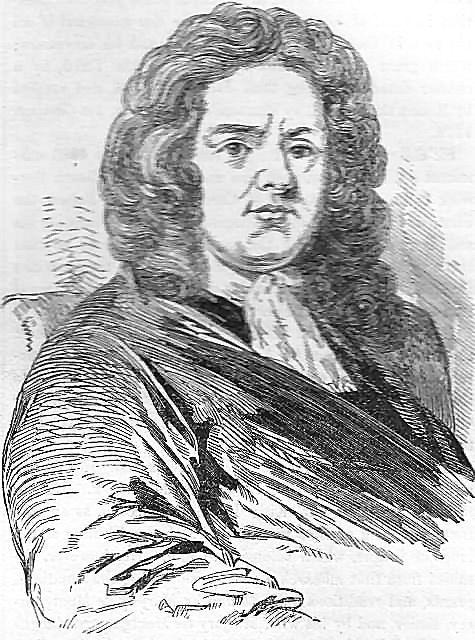
[portrait of
William Carstairs]
Principal Carstairs was a man of great learning and eminence in the
church. So complete was his mastery of the Latin language that Dr.
Pitcairn, who regularly attended the, in those days, customary opening
Latin oration of the principal, delivered before the professors and
students in the common hall of the university, used to observe that when
Mr. Carstairs began to address his audience he could not help fancying
himself transported to the forum, in the days of ancient Rome. “He
managed,” says Bower, “Scottish affairs with such discretion, during the
reigns of William and Anne, that he made few public enemies; and such
was his knowledge of human nature, his prudence, and conciliating
temper, that he was held in the highest estimation by those who still
adhered to the house of Stuart. So great was his influence in church and
state that he was generally called Cardinal Carstairs.”
Another bio of him from the Dictionary of National Biography
CARSTARES, WILLIAM (1649–1715),
Scottish statesman and divine, was the eldest of nine children of John
Carstares, minister of Cathcart, near Glasgow, where William was born on
11 Feb. 1649, and Janet Mure of Glanderston, a branch of the Mures of
Caldwell. His father, who had been at the battle of Dunbar, where he was
taken prisoner by Cromwell, was exchanged soon after for a prisoner in
the hands of General Leslie, and became conspicuous for his zealous
preaching in Glasgow ‘against the times,’ which, in spite of the
presbyterian clergy, had declared themselves in Scotland, as in England,
for Cromwell. ‘Let the Lord own him for His’ is the first notice of
William Carstares's existence in a letter from his father to his
sister-in-law, Katherine Wood, a few days after the birth of his
first-born. He was sent when young to board with Sinclair, the minister
of Ormiston in East Lothian, a scholar of repute, in whose family Latin
was spoken. In 1663 he entered the college of Edinburgh, where he
studied with credit under William Paterson, then regent, and afterwards
clerk of the privy council, and graduated in 1667. His father—an ardent
Remonstrant, as the party was called which insisted on the acceptance of
the covenant and extirpation of prelacy as well as popery by Charles II
against the resolutioners, who were content with the recognition of the
presbyterian polity—took part in the rising at Rullion Green for which
he was forfeited. He had to protect himself by keeping out of the way,
hiding probably in the highlands, perhaps in Holland, but the traces of
his life are obscure. To Holland, at all events, the safest refuge from
the persecution which Scotland suffered, he sent his son. ‘William
Carstares, Scoto-Britannus,’ appears in the ‘Students' Album’ at Utrecht
in 1669, and he was still there in March 1672. He studied Hebrew under
Leusden, and divinity under Witsius, and was probably ordained in the
Dutch church, though the record of his ordination has not been
preserved. In Holland he was introduced by the pensionary Fagel to
William of Orange, already on the look-out for the ablest instruments to
further his designs in Britain. In 1672 he went to London, and two years
later, in a letter to his sister Sarah, after expressing disappointment
that he had been forced to be so expensive to his parents by his study
there, expresses the hope that ‘it may be at least in providence I may
have some door opened whereby I may be in a capacity to do some little
service in my generation, and not always be insignificant in my station;
but, alas, what service can I do, in what will God accept from me who
have lived for so many years in the world and yet for no end.’ His
ambition was cut short by his arrest and examination before Lauderdale
on no desperate charge, probably on the suspicion that he had a share in
distributing a pamphlet entitled ‘An Accompt of Scotland's Grievances by
reason of the D. of Lauderdale's Ministrie,’ and his connection with the
exiles in Holland. Though nothing was proved, his answers were deemed
unsatisfactory, and he was sent to Scotland, where he was kept prisoner
in Edinburgh Castle without trial for five years. There is a pretty
anecdote that a boy of twelve, son of the governor, whose good-will he
gained by telling him stories, supplied him with paper, pens, and ink,
and carried his letters. He is said to have solaced his captivity by
reading the ‘History of De Thou.’ At last, in August 1679, when Monmouth
and James were trying to conciliate the Scotch by clemency, he was
released. During the next few years he seems to have lived chiefly in
England, but made a visit to Ireland in 1680. On 6 June 1682 he married
Elizabeth, daughter of Peter Kekewich of Trehawk in Cornwall. In 1682
and, after a visit to England, again in 1683 he returned to Utrecht,
leaving his wife in England. His movements at this time are difficult to
trace with accuracy, as was natural, for he was actively engaged in the
plots then rife, of which Holland was the centre. He went by the name of
‘Mr. Red’ in the cipher correspondence of the plotters, but though
cognisant of the Rye House plot it did not meet his approval. It was the
bolder scheme for a general rising in England and Scotland, of which
Shaftesbury, Russell, and Argyll were the leaders, in which he acted as
agent. At this time he appears to have visited Scotland, where his
brother-in-law, Dunlop, was preparing to escape from the troubles of the
times by emigrating to Carolina, and thence to have gone to London,
where, along with Baillie of Jerviswood, Fletcher of Saltoun, and James
Stewart of Coltness, he endeavoured to raise money for Argyll's
contemplated expedition to Scotland. The necessary money, which Argyll
had fixed at 30,000l., was not to be got, and it was thought expedient
that Carstares should return to Utrecht. He there had many meetings with
both the English and Scotch exiles; but there was a want of unanimity in
their counsels, and Carstares advised delay. The discovery of the Rye
House plot, which led to the execution of Lord Russell on 21 July, was
followed in a few days by the capture of Carstares, who had again
crossed the Channel, and was seized at Tenterden in Kent, where he was
in hiding under his mother's name of Mure. On his refusal to take the
corporation oath and abjure the covenant he was sent to prison, and
after a fortnight's imprisonment removed to London, where he was twice
examined before a committee of the council. He was thence transmitted to
Scotland, as he himself thought, and the event proved, ‘because it was
judged that violent tortures which the law of England, at least the
custom, does not admit of, would force to anything.’ On 14 Nov. he was
committed to the Tolbooth of Edinburgh. After lying there some time in
the hope of a voluntary confession, Spence, one of his associates, was,
under torture, forced to name Carstares as participant in Argyll's plot,
and the same instrument, the thumbkins, with the threat of the boot,
joined with Lord Melfort's assurance that his depositions should not be
used against any person, induced him to make a deposition as to his
knowledge of the plot. Contrary to the promise embodied in a minute
somewhat modified in form, declaring only that Carstares was not to be
brought ‘as a witness,’ the privy council published an abstract, and
used it at the trial of Baillie of Jerviswood, who was found guilty and
executed. Carstares expostulated, but without any effect, against the
breach of faith in using his depositions, and, declining payment of his
expenses during imprisonment, returned by way of England to Holland.
After a tour in the Low Countries and the Rhine, he settled for a short
time at Cleve, and in the winter of 1686–7 at Leyden, where he was
appointed second minister of the Scottish congregation and chaplain of
William of Orange. He accompanied William in his voyage to Torbay, and
conducted the thanksgiving service on the beach where the troops landed.
From this time Carstares was seldom long absent from William. He had
apartments at court, and accompanied the king as chaplain in his
campaigns. When the jealousy of others attacked him, ‘Honest William
Carstares’ was the only answer the king deigned to make to these
detractors. He was nicknamed by the Jacobites ‘the cardinal,’ and,
especially in Scotch affairs, his advice was constantly taken. He had
the courage to offer it even when not asked if he deemed it useful to
his country's interest. The revolution settlement, by which the Scottish
presbyterian church was established, was pre-eminently the result of his
counsels. William himself was disposed to favour the episcopal form of
church government, or at least some compromise between it and
presbyterianism, but Carstares satisfied him that this was impossible.
His ‘Hints to the King’ were founded on the argument that ‘the episcopal
party were generally disaffected to the revolution … whereas the
presbyterians had almost to a man declared for it, and were, moreover,
the great body of the nation.’ Carstares was sent to consult with Lord
Melville, the commissioner in Edinburgh, and, having rejoined the king
after the victory of the Boyne at the siege of Limerick, returned with
him to London. When there the draft of the proposed Scottish Act of
Settlement of the church was forwarded by Melville and considered clause
by clause by the king and Carstares, who suggested modifications
embodied in remarks, which William dictated to him and which were
adopted. One of them is a sufficient example of their tendency: ‘Whereas
it is said their majesties do ratify the presbyterian church government
to be “the only government of Christ's church in this kingdom,” his
majesty deems it may be expressed otherwise, thus: “To be the government
of the church in the kingdom established by law.”’
On the knotty point of patronage Carstares advised against its
abolition, but Melville took the opposite view, and William gave a
reluctant assent to the act for repealing patronage.
In 1691 Carstares accompanied William to Flanders. It was at this time
that the measures which led to the massacre of Glencoe were determined
on, but the only reference to them in Carstares's correspondence is an
approval of Lord Breadalbane's scheme to distribute money among the
chiefs, so that he appears to be free from the stain which rests on the
memory of the Master of Stair and William. The next two years he was
again with the king in the Flanders campaigns, and received from him a
gift of the ward of Lord Kilmarnock. ‘I am apt to think it will have
much to do,’ he writes to his brother-in-law Dunlop, the principal of
Glasgow, ‘to defray two campaigns, but I have a very good master.’ In
the spring of 1694, having been absent from London when William had
agreed to instructions being sent to Scotland for exacting the oaths of
allegiance and assurance from all ministers before admitting them to the
church courts, and to depose those who refused, Carstares arrived before
the messenger was despatched, and is said to have had the courage to
countermand him. He immediately went, though it was midnight, to the
king's bedchamber at Kensington, asked pardon for what he had done, and
after explaining his reasons, founded on the abhorrence of the Scottish
clergy to any civil oath, not only obtained it, but was allowed to issue
in the king's name an order dispensing with the oaths. Such is the
statement of his first biographer and relative, M'Cormick, who derived
his information from Mr. Charles McKie, afterwards professor of history
in Edinburgh, who lived in Carstares's house during his student years,
and though possibly somewhat coloured it is consistent with the
characters of both Carstares and William. Carstares was again with
William on the continent in 1695–6, and continued to be consulted by
him, as his voluminous correspondence shows, on all Scotch business,
including the appointment of the officers of state and judges down to
his death. He was especially zealous in the interests of the ministers,
but all he could procure was a pittance of 1,200l. a year, taken from
the thirds of the benefices of the church, to be divided among the poor
ministers, which it required renewed exertion in the next reign to get
paid. He tried to persuade his master, but without effect, to visit
Scotland; but he dissuaded him more successfully from the appointment of
a permanent council for Scotland in London. Carstares was himself
undoubtedly the best councillor a foreign king could have, for he was
intimately acquainted with all classes of his countrymen, and gave his
advice without fear, favour, or self-interest, regarding only the
interests of William and of Scotland. ‘As for Mr. Carstares,’ William
said not long before his death, ‘I have known him long, and I know him
thoroughly, and I know him to be a truly honest man.’
With the accession of Anne the direct political influence of Carstares
ceased, but he was appointed principal of the university of Edinburgh in
1703, and showed his sterling character by devoting himself with equal
zeal to the duties of the smaller as of the larger sphere. The
large-minded spirit in which he administered the university was proved
by his exertions to obtain a chair for Calamy, his scheme for the
education of English nonconformists under the care of a warden in the
university of Edinburgh, and his suggestion that Glasgow should get
professors of theology and philosophy from Holland, ‘for good men are to
be found there.’ He revised the statutes of the university, and by his
courteous manner proved equally acceptable to the students, professors,
and town council, which was then the patron, and regulated the
government of the college. It appointed him minister of the Grey Friars'
Church, and as the principal's office required him to give lectures on
divinity once a week during session, his life must have been a busy one.
But though he was respected as a professor and preacher, his talents
were those of an administrator and statesman, and he left no works to
vindicate his fame as a man of learning. As might be expected, he used
his great influence to procure the passage of the Treaty of Union, which
had been a favourite project of William. It was chiefly due to him that
the opposition of the presbyterian clergy was overcome. An anonymous
letter, supposed to be from a member of the cabinet, declared that ‘the
union could never have had the consent of the Scotch parliament if you
had not acted the worthy part you did.’
As a member of the assembly of 1704 he took part in the committee for
preparing the forms of process which still, with some modifications,
regulate the procedure in the courts of the church. Next year he was
elected moderator, and for the first time made a prepared speech on
taking the chair, a practice which has been since followed. ‘Lord
Portland,’ writes Lord Seafield to him, ‘asked kindly about you. I told
him you governed the church, the ministry, and all your old friends
here. He said it was a satisfaction to him to know that you and I, in
whom King William reposed so great a trust, were still in such
consideration in the present reign.’
In the summer after the Act of Union was passed Carstares went to
London, where he had an audience with the queen, who thanked him for his
services and presented him with one of the silver medals cast in
commemoration of it.
Next year (1708) he was again chosen moderator of the assembly, and in
his opening address prudently avoided reference to the union, still
distasteful to many of his brethren, but directed their attention to the
danger of a French invasion in support of ‘the pretences of St. Germain.’
Calamy, in his ‘Autobiography,’ gives some interesting particulars of
Carstares during his visit in 1709 to Edinburgh to receive the degree of
D.D., mentioning the respect with which he was listened to in the
assembly, where he was usually ‘one of the last to speak and for the
most part drew the rest unto his opinion,’ his courtesy to opponents,
and the ‘harmony between the principal and masters of the college, they
expressing a veneration for him as a common father, and he a tenderness
for them as if they had all been children.’ A trifling anecdote
indicates his kindly and considerate charity. A poor ejected curate of
the episcopal church was persuaded to accept a suit of new clothes
Carstares had made for himself, under the pious subterfuge that the
tailor had mistaken his measure. But Carstares was a stout presbyterian,
and could not show the same charity to the episcopal church, of whose
Jacobite leanings he was no doubt honestly afraid. In the affair of
Greenshields, the Irish curate who ventured to read the liturgy in
Edinburgh in public, for which he was imprisoned by the magistrates,
whose decision was affirmed by the Scotch court, though reversed on
appeal to the House of Lords, he drafted the address from the assembly
to the queen, which though more moderate than some of his brethren
desired, asserted the exclusive rights of the presbyterian
establishment. In 1711 he was for the third time moderator, an honour
without parallel, and in his address answered the charge of persecution
of the episcopalians by the quotation, ‘Quis tulerit Gracchos de
seditione querentes?’ This assembly, alarmed by the conduct and
character of the tory ministry and the queen's supposed favour for the
Stuarts, passed an act recommending prayers ‘for the Princess Sophia and
the protestant house’ along with those for the queen. It also passed
another requiring a stricter formula of subscription from the clergy.
The question of the restoration of patronage having been mooted,
Carstares was sent on a deputation to London to protest against it; but
in spite of their remonstrances an act for that purpose and another for
the toleration of Scots episcopal ministers and the use of the liturgy
in Scotland, to which they were equally hostile, were carried in the
parliament of 1712. On his return home he counselled moderation to his
brethren, whose feelings, heated by these acts, had been brought to a
climax by the requirement of the abjuration oath. This oath, under cover
of an engagement to support the line of heirs in the English Act of
Settlement, by which the monarch must be a member of the English church,
was deemed inconsistent with the presbyterian establishment. Carstares
set the example of taking the oath, with a declaration that ‘nothing was
intended by it inconsistent with the doctrine, worship, discipline, or
government of the church established by law,’ and he induced the
assembly in 1713 to pass an act charging ministers and people to abstain
‘from all diverse courses upon occasion of different sentiments and
practices about the said oath.’ The government appreciated so much his
conduct at this dangerous juncture that they consulted him as to who
should be named commissioner, and by his advice appointed the Duke of
Atholl. On the death of Queen Anne, Carstares was sent on a deputation
from the assembly to congratulate George I on his accession, when
Carstares made the usual complimentary speech. ‘Some allege,’ Wodrow
writes, when the printed speech had come to Scotland, ‘there is too much
of compliment and the courtier, and too little of the minister in that
to the king.’ Since the days of Knox the ideal of the presbyterian
minister's address to the sovereign was exhortation and rebuke, not
courtesy or ceremony. On his return Carstares was for the last time
elected moderator in the assembly of 1715, and during its sittings
distinguished himself as usual by conduct worthy of the title of his
office. An attack of apoplexy in August ended in his death, which he
awaited ‘with great peace and serenity,’ on 28 Dec. 1715. He was buried
in the Grey Friars' churchyard, next to his father's grave, and beside
that of Alexander Henderson. His wife was buried in the same place in
1724. They had no children, but Carstares usually had some young
relation or friend in his house who was studying at the university. He
had a Scotchman's attachment to his kindred, and his letters, especially
to his sister, show an affectionate heart not injured by worldly
prosperity. A benevolent scheme of his for the support of the deprived
nonjurors was ruined through the lukewarmness of the government, who
would not grant the necessary funds. In the crowd at his funeral two
ejected curates were observed lamenting the loss of their benefactor,
who had supported their families out of his own purse. More a statesman
than a divine, there has seldom been an ecclesiastic of any church who
has taken part in politics with greater honour to himself and advantage
to his country than Carstares. A portrait of Carstares by Ackman has
often been engraved. Another portrait is in the university of Edinburgh.
[Carstares' State Papers, to which
M'Cormick's Memoir is prefixed; Rev. R. H. Story's Life of Carstares;
Sir A. Grant's Story of the University of Edinburgh.]
William
Carstares: a character and career of the revolutionary epoch.
1649-1715
by Story, Robert Herbert, 1835-1907



