|
ERSKINE,
anciently spelled Areskin, and sometimes Irskyn, a surname of great
antiquity, and one which has been much distinguished in all periods of
Scottish history, was originally derived from the lands and barony of
Erskine in Renfrewshire, situated on the south side of the Clyde, the most
ancient possession of the noble family who afterwards became Lords Erskine
and earls of Mar.
An absurd
tradition asserts that at the battle of Murthill fought with the Danes, in
the reign of Malcolm the Second, a Scotsman having killed Enrique, a
Danish chief, cut off his head, and with the bloody dagger in his hand,
showed it to the king, saying in Gaelic, Eris Skene, alluding to
the head and dagger; on which Malcolm gave him the name of Erskine. In
those remote times, however, surnames were usually assumed from lands, and
all such traditions referring to the origin of the names of illustrious
families are seldom to be depended upon. The appearance of the land
justifies the derivation of the name from the British word ir-isgyn,
signifying the green rising ground. The earliest notice of the name is
in a confirmation of the church of “Irschen” granted by the bishop of
Glasgow in favour of the monastery of Paisley, betwixt the years 1202 and
1207 [Chartulary of Paisley, p. 113.] In 1703, the estate of
Erskine was purchased from the Hamiltons of Orbinston by Walter, master of
Blantyre, afterwards Lord Blantyre, in which family the property remains.
Henry de Erskine
was proprietor of the barony of Erskine so early as the reign of Alexander
the Second. He was witness of a grant by Amelick, brother of Maldwin, earl
of Lennox, of the patronage and tithes of the parish church of Roseneath
to the abbey of Paisley in 1226.
His grandson,
‘Johan de Irskyn,’ submitted to Edward the First in 1296.
Johan’s son, Sir
John de Erskine, had a son, Sir William, and three daughters, of whom the
eldest, Mary, was married, first to Sir Thomas Bruce, brother of King
Robert the First, who was taken prisoner and put to death by the English,
and secondly to Sir Ingram Morville; and the second, Alice, became the
wife of Walter, high steward of Scotland.
Sir William de
Erskine, the son, was a faithful adherent of Robert the Bruce, and
accompanied the earl of Moray and Sir James Douglas in their expedition
into England in 1322. For his valour he was knighted under the royal
banner in the field. He died in 1329.
Sir Robert de
Erskine, knight, his eldest son, made an illustrious figure in his time,
and for his patriotic services, was, by David the Second, appointed
constable, keeper, and captain of Stirling castle. He was one of the
ambassadors to England, to treat for the ransom of that monarch, after his
capture in the battle of Durham in 1346. IN 1350 he was appointed by
David, while still a prisoner, great chamberlain of Scotland, and in 1357
he was one of those who accomplished his sovereign’s deliverance, on which
occasion his eldest son, Thomas, was one of the hostages for the payment
of the king’s ransom. On his restoration, David, in addition to his former
high office of chamberlain, appointed Sir Robert Justiciary north of the
Forth, and constable and keeper of the castles of Edinburgh and Dumbarton.
In 1358 he was ambassador to France, and between 1360 and 1366 he was five
times ambassador to England. In 1367 he was warden of the marches, and
heritable sheriff of Stirlingshire. In 1371 he was one of the great barons
who ratified the succession to the crown of Robert the Second, grandson,
by his daughter Marjory, of Robert the Bruce, and the first of the Stuart
family. To his other property he added that of Alloa, which the king
bestowed on him, in exchange for the hunting district of Strathgartney, in
the Highlands. He died in 1385.
His son, Sir
Thomas Erskine, knight, succeeded his father, as governor of Stirling
castle, and in 1392 was sent ambassador to England. By his marriage with
Janet Keith, great-grand-daughter of Gratney, eleventh earl of Mar, he
laid the foundation of the succession on the part of his descendants to
the earldom of Mar and lordship of Garioch.
Sir Robert
Erskine, knight, his son, was one of the hostages for the ransom of James
the First in 1424. On the death of Alexander, earl of Mar, in 1435, he
claimed that title in right of his mother, and assumed the title of earl
of Mar, but the king unjustly kept him out of possession. He died in 1453.
Sir Thomas
Erskine, his son, was dispossessed of the earldom of Mar by an assize of
error, in 1457, but in 1467 he was created a peer under the title of Lord
Erskine.
This family were
honoured for several generations with the duty of keeping, during their
minority, the heirs apparent to the crown.
Alexander, the
second Lord Erskine, had the charge of James the Fourth, when prince of
Scotland, and ever after continued in high favour with him. He died in
1510.
John, the fourth
Lord Erskine, had the keeping of James the Fifth during his minority. On
his coming of age he was sent by James in 1534 ambassador to France, to
negociate a marriage with a daughter of the French king, and afterwards he
was sent ambassador to England. On the death of James, in conjunction with
Lord Livingston, he had committed to him the charge of the infant queen
Mary. He dept her for some time in Stirling castle, and afterwards removed
her to the priory of Inchmahome, situated on an island in the lake of
Monteith, in Perthshire; which priory had been bestowed upon him by James
the Fifth, as commendatory abbot. Subsequently, for greater security, he
conducted the youthful Mary to France. He died in 1552. Margaret Erskine,
daughter of this nobleman, was the mother, by James the Fifth, of the
regent Murray.
His eldest son,
the master of Erskine, was killed at the battle of Pinkie in 1547. He was
the ancestor, by an illegitimate son, of the Erskines of Shielfield, near
Dryburgh, of which family the famous Ebenezer and Ralph Erskine, the
originators of the first secession from the Church of Scotland, were
cadets. Memoirs of them are given below. The fourth son, the Hon. Sir
Alexander Erskine of Gogar, was the ancestor of the earls of Kellie. [See
KELLIE, earl of.]
The second son,
John, the fifth Lord Erskine, succeeded his father as governor of
Edinburgh castle. Although a Protestant himself, he preserved a strict
neutrality in the struggles between the Lords of the Congregation and the
queen regent, Mary of Guise, while he upheld the authority of the latter,
to whom, when hard pressed by her enemies, he gave protection in the
castle of Edinburgh, where she died in June 1560. On the return of Queen
Mary from France in 1561 he was appointed one of her privy council. In the
following year he submitted his claim to the earldom of Mar to parliament,
and was successful in establishing his right as the descendant, in the
female line, from Gratney, eleventh earl of Mar. [See MAR, earl of.] In
consequence of Lord Erskine being confirmed earl of Mar, the queen’s
natural brother, afterwards regent, who then bore the title, was styled
earl of Moray instead. On the birth of James the Sixth in 1566, the new
earl of Mar was intrusted with the keeping of the young prince; and on the
death of the earl of Lennox in 1571 he was chosen regent in his stead. He
died in the following year, leaving a high reputation for integrity and
honesty of purpose. From a portrait of the regent Mar in Pinkerton’s
Scottish Gallery, the subjoined woodcut is taken:
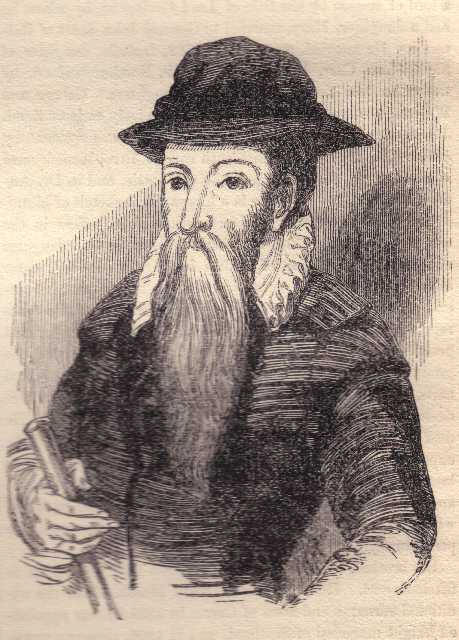
[portrait of John Lord Erskine]
The first of the family of Erskine, barons of Dun, as separated from that
of Erskine of Erskine, the original stock, was John the son of Sir Thomas
Erskine of that ilk, who had a charter from King Robert the Second of the
barony of Dun, near the town of Montrose, in Forfarshire, dated November
8, 1376. The name of Dun is Gaelic, and signifies a hill or rising ground.
This Sir Thomas was twice married; first to Janet Keith, by whom he had
Sir Robert Erskine, and a daughter, married to Duncan Weems, younger of
Lochar Weems; and secondly, to Jean Barclay, by whom he had John Erskine,
already mentioned, who succeeded to the lands of Dun, as appears by a
charter to him, from King Robert the Third, of these lands, dated October
25, 1393.
The next in succession in the lands of Dun was Alexander Erskine, supposed
to be the son of John. He resigned the lands of Dun, reserving his own
liferent, to his son, John the second, who received from King James the
Second a charter to the same, of date January 28, 1449. The vesting the
fee of the property in the eldest son, while the father retained the
liferent, became afterwards a practice in the family.
John Erskine of Dun, the second of that name, had three sons: John, his
heir, Thomas, and Alexander. He resigned his lands of Dun to his eldest
son in 1473, retaining the liferent, and died March 15, 1508.
John Erskine of Dun, the third of that name, had several sons, of whom
Thomas Erskine of Brechin, the second son, was secretary to King James the
Fifth. He fell on the fatal field of Flodden, September 9, 1513. This John
Erskine, laird of Dun, treated the inhabitants of Montrose in the most
tyrannical manner, and in consequence of his oppressive conduct and that
of his family the town applied to the king for redress. A summons of
spulzie was accordingly issued against him and four of his sons, 4th
October, 1493.
Sir John Erskine, the fourth of that name, married Margaret Ruthven,
daughter of William first Lord Ruthven, widow of the earl of Buchan, by
whom he had John Erskine of Dun, knight, one of the principal leaders of
the Reformation in Scotland, and afterwards superintendent of Angus, of
whom a memoir is afterwards given below.
A
succeeding proprietor of Dun, John by name, was poisoned on the 23d May,
1613, by his uncle Robert. The trial of the latter, as well as that of his
three sisters, by whom he was instigated to the atrocious deed, will be
found in Pitcairn’s Criminal Trials, vol. iii. pp. 261-266.
Of
the later lairds of Dun the only other personage of public note was David
Erskine, Lord Dun, a judge of the court of session, of whom also a notice
is afterwards given.
The estate of Dun came into possession of the noble family of Kennedy, by
the marriage, on June 1, 1793, of Archibald, 12th earl of
Cassillis, and first marquis of Ailsa, with Margaret, 2d daughter of John
Erskine, Esq. of Dun. Their 2d son, John, born June 4, 1802, on inheriting
the property, assumed the additional surname of Erskine. He married, in
1827, Lady Augusta Fitzclarence, 4th daughter of William IV.,
and died at Pisa, March 6, 1831. His widow married again, in 1836, Lord
John Frederick Gordon Hallyburton of Pitcur, 3d son of 9th
marquis of Huntly. Mr. Kennedy Erskine, with two daughters, left one son,
William Henry, born July 1, 1828, at one time a captain 17th
lancers, unmarried. The elder daughter, Wilhelmina, married, in 1855, her
cousin, 2d earl of Munster; the younger, Millicent Ann Mary, became the
wife of J. Hay Wemyss, Esq. of Wemyss Castle, Fifeshire.
Alexander Erskine, plenipotentiary for Sweden at the treaty of Munster, a
distinguished officer in the army of Gustavus Adolphus, was of the family
of Erskine of Kirkbuddo in Fife, sprung from the Erskines of Dun. Ennobled
in Sweden, some of his descendants were settled at Bonne in Germany.
_____
The Erskines of Alva (represented by the earl of Rosslyn) are sprung from
a branch of the noble house of Mar, descended from Hon. Charles Erskine, 5th
son of John, 7th earl of Mar. His eldest son, Charles Erskine
of Alva, was created a baronet of Nova Scotia, 30th April 1666.
Sir Charles had four sons and one daughter. Charles, Lord Tinwald, his
third son, a lord of session, and afterwards lord justice clerk, was
father of James Erskine, Lord Alva, also a lord of session.
The grandson of the first baronet, Lieutenant-general Sir Henry Erskine,
distinguished himself as a minor song writer. The second son of Sir John
Erskine of Alva, second baronet, he succeeded to the baronetcy, on the
death of his elder brother, in 1747. He was for many years M.P. for the
Anstruther district of burghs. He early entered the army, but in 1756 he
lost his rank, on account of his opposition to the importation of the
Hanoverian and Hessian troops into this country. After the accession of
George III. in November 1760, he was restored to his rank in the army, and
appointed colonel of 67th foot. He married at Edinburgh, in
1761, Janet, only daughter of Peter Wedderburn, Esq. of Wedderburn, a lord
of session, under the name of Lord Chesterhall. Sir Henry was deputy
quarter-master-general, and succeeded his uncle, Hon. General St. Clair,
in the command of the Royal Scots in 1762. He was the author of the song,
‘In the garb of old Gaul,’ the air of which was composed by the late
General Reid. He died at York, 9th August 1765. His eldest son,
Sir James Erskine, also in the army, assumed the surname of St. Clair, and
on the death of his uncle, Alexander Wedderburn, earl of Rosslyn, in 1805,
became 2d earl of Rosslyn, and died 8th June 1837. (Electric
Scotland Note: We got in an email from Toni saying that this date is
incorrect and gave us
January
18th, 1837 as the correct date.) [See ROSSLYN,
earl of.]
_____
There is also the family of Erskine of Cambo in Fife, on which a baronetcy
was conferred in 1821. Sir David, the first baronet, was the grandson of
the tenth earl of Kellie. He died in 1841. His son, Sir Thomas, the 2d
baronet, born in 1824, is an officer in the army, and married, with issue.
ERSKINE,
JOHN,
of Dun, knight, one of the principal promoters of the Reformation in
Scotland, was born in 1508, at the family seat of Dun, near Montrose. His
grandfather, father, uncle and granduncle, fell at Flodden, and he
succeeded to the estate of Dun when scarcely five years old. By the care
of his uncle, Sir Thomas Erskine of Brechin, secretary to King James the
Fifth, he received a liberal education; but had scarcely attained to the
years of majority, when he appears to have killed Sir William Forster, a
priest of Montrose. The document which preserves the record of this fact,
and of the assythment or manbote paid by him to the father of the
deceased, dated 5th February 1530, is inserted among the Dun
papers in the Miscellany of the Spalding Club, vol. fourth. None of the
circumstances are given, except that the deed was committed in the Bell
Tower of Montrose. He studied at a foreign university, and he has the
merit of being the first to encourage the acquisition of the Greek
language in Scotland, having, in 1534, on his return from abroad, brought
with him a Frenchman capable of teaching it, whom he established in
Montrose. He seems about this time to have married Lady Elizabeth Lindsay,
daughter of the earl of Crawford. This lady died 29th July
1538, and he subsequently married Barbara de Beirle.
On
the 10th of May, 1537, he had a license from James V. for
himself, his son John, and other relatives, permitting them “to pas to the
partis of France, Italie, or any uthiris beyond se, and thair remane, for
doing of thair pilgramagis, besynes, and uthir lefull erandis, for the
space of thre yeiris.” His uncle, Sir Thomas Erskine of Brechin, had
obtained from the same monarch a gift of the office of constabulary of
Montrose, which he conveyed by a charter, dated 9th February
1541, to John Erskine of Dun, the subject of this notice, in liferent, and
to his son and heir apparent, John Erskine, in fee. In April 1542 he and
his cousin, Thomas Erskine of Brechin, and John Lambie of Duncarry, had a
license to travel into France, Italy, and other places, for two years. [Dun
Papers in Spalding Club Miscellany, vol. 4.]
Having early become a convert to the Reformed doctrines, he was a zealous
and liberal encourager of the Protestants, especially of those who were
persecuted, to whom his house of Dun was always a sanctuary, as he was a
man of too much power and influence for the popish bishops to interfere
with. In his endeavours, however, to promote the Reformation, he did not
neglect his other duties. During the years 1548 and 1549 he supported the
queen dowager and the French party in opposing the English forces, and we
learn from the histories of the time that in 1548, some English ships
having landed about eighty men in the neighbourhood of Montrose, for the
purposes of plunder, Erskine of Dun collected a small force from the
inhabitants of that town, of which he was then provost, and had for some
years been constable, and fell upon them with such fury, that not a third
of them regained their ships. Among the Dun papers which have been
published, are several letters to the laird of Dun from Mary, the queen
dowager. These refer to the passing events of the period, and show the
high estimation in which he was held by her. One of them, dated 29th
August, 1549, relates to the coming to Montrose of the French Captain
Beauschattel, and his company, regarding which Erskine seems to have
remonstrated, dreading some attempts against his rights, as her majesty
assures him that there was “na entent bot till kepe the fort, and nocht
till hurt you in your heretage or ony othir thing.” It appears that a
small hill, close to the river, was called the Fort, or Constable Hill [Bowick’s
Life of Erskine, page 62, quoted in the Spalding Club Miscellany,
vol. 4, preface, page xii, note], and it has been
conjectured that Erskine may have thought the occupation of this fort by
the French captain derogatory to his rights as constable, and so made it
subject of complaint. He was considered not only by his own countrymen,
but by foreigners, as one of the most eminent heroes which the Scottish
nation had produced in that age, so fertile in great men, and M. Beauge,
in his History of the Campaigns in Scotland of 1548 and 1549, makes
frequent and honourable mention of him and his exploits at that time.
At
Stirling, March 10, 1556, the laird of Dun and some others, signed a
“call” to John Knox, then at Geneva, to return to Scotland, and promote
the Reformation. On Knox’s arrival, that year, Erskine, being in
Edinburgh, was one of those who used to meet in private houses to hear him
preach. It was at supper in the laird of Dun’s house, that all present
there with Knox resolved, that, whatever might be the consequence, they
would wholly discontinue their attendance at Mass. On his invitation, the
Reformer followed him to Dun, where, on this, as well as on a subsequent
visit, he preached almost daily, and made many converts. On the 3d
December 1557 Erskine of Dun subscribed the first Covenant at Edinburgh,
along with the earls of Argyle and Glencairn, and other noblemen and
gentlemen, and thus became one of the lords of the congregation.
In
the parliament which met December 14, 1557, he was appointed, under the
title of ‘john Erskine of Dun, knight, and provost of Montrose,” to go to
the court of France, as one of the commissioners, to witness the young
Queen Mary’s marriage with the dauphin. “Of which trust he acquitted
himself with great fidelity and honour, and was approved by the parliament
on his return.” On his return, he found the Reformation making great
progress in Scotland; and when the Protestants, encouraged by their
increase of numbers, and the accession of Queen Elizabeth to the English
throne, petitioned the queen regent, more boldly than formerly, to be
allowed the free exercise of their religion, the laird of Dun was one of
those who joined in the prayer, but he seems to have used milder language,
and been more moderate in his demands than the others. So far, however,
from granting the toleration requested, the queen regent issued a
proclamation requiring the Protestant ministers to appear at Stirling on
May 10, 1559, to be tried as heretics and schismatics. The lords of the
congregation, and other favourers of the Reformation, seeing the danger to
which their preachers were exposed, resolved to accompany and protect
them. Anxious to avoid bloodshed, Erskine of Dun left his party at Perth,
and, with their consent, went forward to Stirling, to have a conference
with the queen, who acceded to his advice, and agreed that the ministers
should not be tried. He accordingly wrote to those who were assembled at
Perth to stay where they were, as the queen regent had consented to their
wishes. But while many of the people dispersed on receiving this
intelligence, the barons and gentlemen, rightly distrusting the regent’s
word, resolved to remain in arms till after the 10th of May.
And well was it that they did so, for the queen had no sooner made the
promise than she perfidiously broke it. The preachers not appearing on the
day named, were denounced rebels, which so incensed and disgusted the
laird of Dun that he withdrew from court, and joined the lords of the
congregation at Perth, when he explained to them that in giving his advice
to disperse he had himself been deceived by the regent. He therefore
recommended them to provide against the worst, as they might expect no
favour, and a civil war ensued, which lasted for some time, and ended at
last, first in the deposition, October 23, 1559, and secondly on the death
of the queen regent, June 10, 1560, in favour of the Protestants.
The laird of Dun, previous to that event, had relinquished his armour, and
become a preacher, for which he was, from his studies and disposition,
peculiarly qualified. In the ensuing parliament, he was nominated one of
the five ministers who were appointed to act as ecclesiastical
superintendents, the district allotted to him being the counties of Angus
and Mearns. This appointment took place in July 1560, and he was installed
in 1562 by John Knox. The superintendents were elected for life, and
though their authority was somewhat similar to that of a bishop, they were
responsible for their conduct to the General Assembly. The other four
superintendents were, Mr. John Spottiswood of Spottiswood, the father of
Archbishop Spottiswood, of Lothian; John Willocks, formerly a Dominican
friar, of Glasgow; John Winram, formerly subprior of St. Andrews, of Fife;
and John Carsewell, of Argyle and the Isles. The laird of Dun not only
superintended the proceedings of the inferior clergy, but performed
himself the duties of a clergyman. He was appointed moderator of the ninth
General Assembly at Edinburgh, December 25, 1564; also of the eleventh the
same day and place, 1565; also of the twelfth at Edinburgh, June 25, 1566;
and of the thirteenth at Edinburgh, December 25, 1566. In January 1572 he
attended the convention held at Leith, where episcopacy was established.
His gentleness of disposition recommended him to Queen Mary, who, on being
requested to hear some of the Protestant preachers, answered, as Knox
relates, “That above all others she would gladly hear the superintendent
of Angus, Sir John Erskine, for he was a mild and sweet-natured man, and
of true honesty and uprightness.”
In
1569, by virtue of a special commission from the Assembly, he held a
visitation of the university of Aberdeen, and suspended from their
offices, for their adherence to popery, the principal, sub-principal, and
three regents or professors of King’s college, Aberdeen. In 1571 he showed
his zeal for the liberties of the church, in two letters which he wrote to
his chief, the regent earl of Mar, the first of which will be found in
Calderwood, vol. 3. They are written, says Dr. M’Crie, “in a clear,
spirited, and forcible style, contain an accurate statement of the
essential distinction between civil and ecclesiastical jurisdiction, and
should be read by all who wish to know the early sentiments of the Church
of Scotland on this subject.” In 1577 he assisted in compiling the ‘Second
Book of Discipline.’ Besides the duties belonging to his spiritual charge,
he was frequently called upon to execute those belonging to his military
character as a knight; thus, on the 20th of September 1579, he
was required, by a warrant from the king, to recover the house of
Redcastle from James Gray, son of Patrick Lord Gray, and his accomplices,
by whom it had been seized and retained, and deliver it to John Stewart,
the brother of the Lord Innermeith. Notwithstanding that the reformation
had, in his day, made so great progress in Scotland, and that he himself
had been one of the principal promoters of it, he was it seems not
altogether divested of some of the superstitious observances of popery. In
the ‘Spalding Miscellany,’ vol. iv. mention is made of a license from the
king, signed James R., with consent of his privy council, of date February
25, 1584, to John Erskine of Dun, to eat flesh all the time of Lent, and
as oft as he pleases on the forbidden days of the week, to wit, Wednesday,
Friday, and Saturday; noted upon the back, with the same hand, a license
to your L— to eat flesh; he being then past the age of seventy-six. In
1580, four years before this, he had received a license, wherein he, and
three in company with h im, are allowed to eat flesh from February 13 to
March 26.
From the laird of Dun’s conciliatory disposition, as well as his high
intelligence, his advice and assistance were valued by all parties, as
appears by various letters in the ‘Spalding Miscellany,’ vol. iv. Perhaps
one of the most important of these, in its bearing on the church, is one
addressed to him by the earl of Montrose and the secretary Maitland on 18th
November 1584, which seems to have been written with the view of obtaining
Erskine’s assent to certain statutes, then recently passed in parliament,
at the king’s instance, declaring his supremacy in all ecclesiastical
matters, which were obnoxious to the leading clergy of the time. The
ministers were required to subscribe an “obligation,” recognising his
majesty’s supremacy, under pain of deprivation of their benefices; and the
proceedings which ensued on the proclamation for the fulfilment of these
enactments are minutely detailed in ‘Calderwood’s Church History,’ vol.
iv. page 209, et seq.
In
consequence of the part taken by Erskine in prevailing on the ministers
within his bounds to subscribe “the obligation,” he acquired some
unpopularity among them; in the expressive words of Calderwood, “the laird
of Dun was a pest then to the ministers in the north.” A letter from
Patrick Adamson, titular archbishop of St. Andrews, to Erskine, dated 22d
January 1585, inserted among the Dun papers in the ‘Spalding Miscellany,’
seems intended to give explanations about “the obligation,” as he says
“the desyr of his Maiesties obligatioun extrendis no forthir bot to his
hienes obedience, and of sik as bearis charge be lawfull commission in the
cuntrie, quheirof his Maiestle hes maid ane speciall chose of your
lordship: as for the diocese of Dunkeld, I think your lordship will
understand his Maiesties meining at your cuming to Edinbrught, and as ffor
sik pairtis as is of the diocese of Sanct Androwis in the Merns and Anguse,
I pray your lordship to tak ordour thairin for thair obedience and
conformitie, as your lordship hes done befoir, that they be nocht
compellit to travell forthir, bot thair suspendis may be rathir helpit nor
hinderit;” with more to the same purpose. It appears from a summons, at
the instance of the laird of Dun, for payment of his stipend as
superintendent of Angus and Mearns, dated 9th September 1585,
that the whole amount of it in money and victual, did not much exceed
£800. The portion paid in money was £337 11s. 6d. [Miscellany of
Spalding Club, vol. iv, Editor’s preface.] He died March 12,
1591, in the 82d year of his age. Buchanan, Knox, Spottiswood, and others,
unite in speaking highly of his learning, piety, moderation, and great
zeal for the Protestant religion. Spottiswood says of him that he governed
that portion of the country committed to his “superintendence with great
authority, bill his death, giving no way to the novations introduced, nor
suffering them to take place within the bounds of his charge, while he
lived. A baron he was of good rank, wise, learned, liberal, and of
singular courage; who, for diverse resemblances, may well be said to have
been another Ambrose. He left behind him a numerous posterity, and of
himself and of his virtues a memory that shall never be forgotten.” –
Miscellany of the Spalding Club. – Scott’s Lives of Reformers. – M’Crie’s
Lives of Knox and Melville. – Calderwood’s History.
ERSKINE,
DAVID, LORD DUN,
an eminent lawyer, of the same family as the superintendent, was born at
Dun, in Forfarshire, in 1670. From the university of St. Andrews he
removed to that of Paris, and having completed the study of general
jurisprudence, he returned to Scotland, and was, in 1696, admitted
advocate. He was the staunch friend of the nonjurant episcopal clergy, and
in the last Scottish parliament zealously opposed the Union. In 1711 he
was appointed one of the judges of the court of session, and in 1713 one
of the lords of justiciary. In 1750 his age and infirmities induced him to
retire from the bench. In 1754 he published a small volume of moral and
political ‘Advices,’ which bears his name. He died in 1755, aged 85. By
his wife, Magdalen Riddel, of the family of Riddel of Haining in
Selkirkshire, he left a son, John, who succeeded him in the estate of Dun,
and a daughter, Anne, married first to James, Lord Ogilvy, son of David,
third earl of Airly, and secondly to Sir James Macdonald of Sleat. –
Scots Mag. 1754.
ERSKINE,
HENRY, REV.,
a divine of considerable eminence, the ninth of twelve children, – not
thirty-three, as has been generally stated, – of Ralph Erskine of
Shielfield, in Berwickshire, descended from the noble house of Mar, was
born at Dryburgh, Berwickshire, in 1624. He studied at the university of
Edinburgh, where he took the degree of M.A., and was soon after licensed
to preach the gospel. In 1649 – as stated by Wodrow, but according to Dr.
Harper, in his Life of Ebenezer Erskine, more probably ten years later,
viz. in 1659, as stated by Calamy and Palmer – he was, by the English
Presbyterians, ordained minister of Cornhill, in the county of
Northumberland, where he continued till he was ejected by the act of
Uniformity, August 24, 1662. He was thus minister of Cornhill for three
years. [Calamy’s Continuation, Palmer’s Noncon. Memorial.] He now
removed with his family to Dryburgh, where he appears to have resided for
eighteen years, and where he occasionally exercised his sacred office. In
the severe persecution to which the Presbyterians in Scotland were at that
period subjected, this faithful minister could not of course expect to
escape; and, accordingly, on Sabbath, April 23, 1682, a party of soldiers
came to his house, and, seizing him while worshiping God with his family,
carried him to Melrose a prisoner. Next day he was released on bond for
his appearance when required, and soon after was summoned to appear before
the council at Edinburgh, to answer charges of sedition and disobedience,
because he presumed to exercise his ministry without conforming to the new
order of things. On his refusal to swear that he had not altogether
refrained from the duties of his ministry, and to “give bond that he would
preach no more at conventicles,” he was ordered to pay a fine of 5,000
merks, and committed to the Tolbooth of Edinburgh, to be afterwards sent
to the prison of the Bass till the fine was paid; but, on petition, he
obtained a remission of his sentence on condition of leaving the kingdom.
One account states, that he took refuge in Holland, whence the want of the
necessaries of life induced him to return to Scotland, when he was
imprisoned in the Bass for nearly three years, but this statement rests on
questionable authority. It is certain that he resided for some time at
Parkbridge, in Cumberland, and afterwards at Monilaws, about two miles
from Cornhill, in Northumberland, whence he had been ejected. On July 2,
1685, he was again apprehended, and kept in prison till the 22d, when he
was set at liberty, in terms of the act of Indemnity passed at the
commencement of the reign of James II. In September 1687, after the
toleration granted by King James’ proclamation of indulgence, Mr. Erskine
became minister of Whitsome, on the Scots side of the Border; and it was
under his ministry, at this place, that the celebrated Thomas Boston
received his first religious impressions. He remained at Whitsome till
after the Revolution, when he was appointed minister of Chirnside, in the
county of Berwick. He continued minister of that place till his death,
August 10, 1696, aged sixty-eight. He left several Latin manuscripts,
among others, a Compend of Theology, explanatory of some difficult
passages of Scripture, none of which were ever published. He was twice
married. His first wife, who died in 1670, was the mother of eight
children, one of whom, Philip, conformed to the Church of England, and,
receiving episcopal orders, held a rectory in the county of
Northumberland. Another child of the first marriage became afterwards
well-known as Mrs. Balderstone of Edinburgh, a woman of superior
intelligence and of devoted piety. By his second wife, Margaret Halcro, a
native of Orkney, a descendant of Halcro, prince of Denmark, and whose
great grandmother was the Lady Barbara Stuart, daughter of Robert, earl of
Orkney, son of James V., he was the father of Ebenezer and Ralph Erskine,
the founders of the Secession in Scotland.
The death of Mr. Henry Erskine took place in the midst of his family; and
the circumstances of it as related by Dr. Calamy [Continuation] are
peculiarly interesting, from the impression which they appear to have made
on the young hearts of his two celebrated sons, Ebenezer and Ralph. Long
after, remarks Dr. Harper, the scene was referred to by them as one of
their hallowed recollections. “The Lord helped me,” says Ebenezer on one
occasion, “to speak of his goodness, and to declare the riches of his
grace in some measure to my own soul. He made me tell how my father took
engagements of me on his deathbed, and did cast me upon the providence of
his God.” Ralph, in like manner, more than thirty years after the event,
put on record, “I took special notice of the Lord’s drawing out my heart
towards him at my father’s death.” – Memoir of Rev. H. Erskine. – Dr.
Harper’s Life of Ebenezer Erskine.
ERSKINE,
EBENEZER,
the founder of the Secession church in Scotland, fourth son of the
preceding, was born June 22, 1680. Some accounts say his birth-place was
the prison of the Bass, but this is evidently erroneous. His biographer,
the Rev. Dr. Fraser of Kennoway, thinks it probable that he was born at
the village of Dryburgh, in Berwickshire, and in confirmation of this the
Rev. Dr. Harper of Leith, in his Life of Ebenezer Erskine, gives the
following extract from a small manuscript volume belonging to Mr. Henry
Erskine, Ebenezer’s father, in possession of the Rev. Dr. Brown of
Broughton Place church, Edinburgh: “Eben-ezer was borne June 22d, being
Tuesday, at one o’clock in the morning, and was baptized by Mr. Gab:
Semple July 24th, being Saturnday, in my dwelling house in
Dryburgh 1680.” He appears to have received the elements of his education
at home, under the superintendence of his father, and in his fourteenth
year he was sent to the university of Edinburgh, where he held a bursary
on the presentation of Pringle of Torwoodlee, and where he prosecuted his
studies for a period of nine years, four of which were devoted to the
classics and philosophy, and five to theology. IN June 1697, he took his
degree of M.A., and on leaving college he became tutor and chaplain in the
family of the earl of Rothes. He was licensed to preach by the presbytery
of Kirkaldy on the 11th February 1703, and in the succeeding
September was ordained minister of Portmoak, Kinross-shire. It was not
till after his ordination that his heart appears to have received its
first powerful impressions of evangelical and vital religion, and a
corresponding change to the better of spirit and style took place in his
public ministrations. Exemplary in the discharge of his ministerial
duties, and devoted to his people, he soon became popular amongst them.
“Nor,” says Dr. Harper, “was Mr. Erskine’s popularity and usefulness
confined to Portmoak and its immediate vicinity. From all parts of the
country, in every direction, sometimes at the distance of sixty miles,
eager listeners flocked to his preaching. On sacramental occasions
particularly, the gatherings were great. From all accounts of the sacred
oratory of the man, there is no doubt that there was in it much to impress
a promiscuous audience. His bodily presence was commanding, – his voice
full and melodious, – his manner grave and majestic, – and after the
fulness and fervour of his heart broke through the trammels of his earlier
delivery, his bearing in the pulpit combined ease with dignity in an
unwonted degree. But to whatever extent these external advantages
commended him to the people, it is gratifying to remark the most
unequivocal proofs that the great charm – the element of power which
signalized Mr. Erskine as a preacher, – was the thoroughly evangelical
matter and spirit of his discourses.” [Life of Ebenezer Erskine by Dr.
Harper, pp. 10, 21.]
In
the various religious contests of the period he took an active part,
particularly in the famous Marrow controversy, which commenced in 1719,
and in which he came forward prominently in defence of the doctrines,
which had been condemned by the General Assembly, contained in the work
entitled ‘The Marrow of Modern Divinity.’ He revised and corrected the
Representation and Petition presented to the Assembly on the subject, May
11, 1721, which was originally composed by Mr. Boston; and drew up the
original draught of the answers to the twelve queries put to the twelve
brethren; along with whom he was, for their participation in this matter,
solemnly rebuked and admonished by the moderator. This took place in the
Assembly of 1722. The twelve representers submitted to the authority of
the supreme court, but accompanied their submission with a protest against
the deed, and their claim of liberty “to profess, preach, and still bear
testimony to the truths condemned.” In the cases, too, of Mr. Simson,
professor of divinity at Glasgow, and Mr. Campbell, professor of church
history at St. Andrews, who, though both had been proved to have taught
heretical and unscriptural doctrines, were very leniently dealt with by
the Assembly, as well as on the question of patronage, he distinguished
himself by his opposition to the proceedings of the church judicatories.
The high estimation in which Mr. Erskine was held procured him at
different times the honour of a call from Burntisland, Tulliallan,
Kirkcaldy, and Kinross, but the church courts, in full concurrence with
his own views and inclinations, decided against his removal in all these
cases, although party feeling, particularly as regards Kirkcaldy, had its
influence in preventing his translation. In May 1731 he accepted of a call
to the third charge, or West church, at Stirling, and, in September of
that year, he was settled one of the ministers of that town. Having always
opposed patronage, as contrary to the standards of the Church, and as a
violation of the treaty of Union, he was one of those who remonstrated
against the act of Assembly of 1732 regarding vacant parishes. As
moderator of the Synod of Perth and Stirling, he opened their meeting at
Perth, on October 10th of that year, with a sermon from Psalm
cxviii. 24, in which he expressed himself with great freedom against
several recent acts of the Assembly, and particularly against the rigorous
enforcement of the law of patronage, and boldly asserted and vindicated
the right of the people to the election of their minister. Several members
of Synod immediately complained of the sermon, and, on the motion of Mr.
Mercer of Aberdalgie, a committee was appointed to report as to some
“unbecoming and offensive expressions,” alleged to have been used by the
preacher on the occasion. Having heard Mr. Erskine in reply to the charges
contained in the report of the committee, the Synod, after a keen debate
of three days, by a majority of not more than six, “found that he was
censurable for some indecorous expressions in his sermon, tending to
disquiet the peace of the Church,” and appointed him to be rebuked and
admonished. From this decision twelve ministers and two elders dissented.
Mr. Erskine, on his part, protested and appealed to the next Assembly. To
his protest, Messrs. William Wilson of Perth, Alexander Moncrieff of
Abernethy, and James Fisher of Kinclaven, ministers, adhered.
The Assembly, which met in May 1733, refused to hear the reasons of
protest, but took up the cause as it stood between Mr. Erskine and the
Synod; and, after hearing parties, “found the expressions vented by him,
and contained in the minutes of Synod, and his answers thereto, to be
offensive, and to tend to disturb the peace and good order of the Church;
and therefore approved of the proceedings of the Synod, and appointed him
to be rebuked and admonished by the moderator at their bar, in order to
terminate the process.” Against this decision Mr. Erskine lodged a
protest, vindicating his claim to the liberty of testifying against the
corruptions and defections of the Church upon all proper occasions. To
this claim and protestation the three ministers above named adhered, and
along with Mr. Erskine, withdrew from the court. On citation they appeared
next day, when a committee was appointed to confer with them; but,
adhering to their protest, the farther proceedings were remitted to the
Commission, which met in the ensuing August, when Mr. Erskine and the
three ministers were suspended from the exercise of their office, and
cited to appear again before the Commission in November. At this meeting
the four brethren were, by the casting vote of the moderator, declared to
be no longer ministers of the Church of Scotland, and their relationship
with their congregations formally dissolved. When the sentence of the
Commission was intimated to them, they laid on the table a paper declaring
a secession from the prevailing party in the established church, and
asserting their liberty to exercise the office of the Christian ministry,
notwithstanding their being declared no longer ministers of the Church of
Scotland.
On
the 5th day of the subsequent December, the four ejected
ministers met together at the Bridge of Gairney, near Kinross, and after
two days spend in prayer and pious conference, constituted themselves into
a presbytery, under the designation of the “Associate Presbytery.” Mr.
Erskine was elected the first moderator, and from this small beginning the
Secession Church took its rise.
The General Assembly of 1734, acting in a conciliatory spirit, rescinded
several of the more obnoxious acts, and authorised the Synod of Perth to
restore the four brethren to communion and to their respective charges,
which was done accordingly by the Synod, at its next meeting, on the 2d
July. The seceding ministers, however, refused to accept the boon, and
published their reasons for this refusal. On forming themselves into the
“Associate Presbytery,” they had published a ‘Testimony to the Doctrine,
Worship, and Discipline of the Church of Scotland.’ In December 1736 they
published a Second Testimony, in which they condemned what they considered
the leading defections of both Church and State since 1650. In February
1737 Mr. Ralph Erskine, minister of Dunfermline, brother to Ebenezer, and
Mr. Thomas Mair, minister of Orwell, joined the Associate Presbytery, and
soon after two other ministers also acceded to it.
In
the Assembly of 1739 the eight brethren were cited to appear, when they
gave in a paper called ‘The Declinature,’ in which they denied the
Assembly’s authority over them, or any of their members, and declared that
the church judicatories “were not lawful nor right constituted courts of
Jesus Christ.” In the Assembly of 1740 they were all formally deposed from
the office of the ministry. In that year, a meeting-house was built for
Mr. Erskine by his hearers at Stirling, where he continued to officiate to
a very numerous congregation till his death. During the rebellion of 1745,
Mr. Erskine’s ardent loyalty led him to take a very active part in support
of the government. Animated by his example the Seceders of Stirling took
arms, and were formed into a regiment for the defence of the town. Dr.
Fraser, his biographer, relates that one night when the rebels were
expected to make an attack on Stirling, Mr. Erskine presented himself in
the guardroom fully accoutred in the military garb of the times. Dr. John
Anderson, late professor of natural philosophy in the university of
Glasgow, and Mr. John Burns, teacher, father of the Rev. Dr. Burns, Barony
parish in that city, happened to be on guard the same night; and,
surprised to see the venerable clergyman in this attire, they recommended
him to go home to his prayers as more suitable to his vocation. “I am
determined, was his reply, “to take the hazard of the night along with
you, for the present crisis requires the arms as well as the prayers of
all good subjects.” [Life by Fraser, p. 439.] When Stirling was
taken possession of by the rebel forces, Mr. Erskine was obliged, for a
short period, to retire from the town, and his congregation assembled for
worship on Sundays, in the wood of Tullibody, a few miles to the north of
Stirling. So great, indeed, was the zeal displayed by him in the service
of the government that a letter of thanks was addressed to him by command
of the duke of Cumberland.
When the controversy concerning the lawfulness of swearing the religious
clause contained in the Burgess oath led, in April 1747, to the division
of the Secession church, Mr. Erskine was one of those who adhered to the
Burgher portion of the synod. In consequence of Mr. Moncrieff of
Abernethy, who held the office of professor of divinity to the associate
presbytery, adhering to the Antiburgher portion of the Secession, the
Burgher portion was left destitute of a professor; and Mr. Erskine
consented, at the request of his brethren, to fill the office, but, at the
end of two years, he resigned it on account of his health in 1749. He died
June 2, 1754, aged 74. He had been twice married; first, in 1704, to
Alison Turpie, daughter of a writer in Leven, by whom he had ten children,
and who died in 1720; and, secondly, in 1724, to Mary, daughter of the
Rev. James Webster, minister of the Tolbooth church, Edinburgh, by whom
also he had several children. His eldest daughter, Jean, was married to
the Rev. James Fisher of Glasgow. “During the night on which he finished
his earthly career, Mrs. Fisher, having come from Glasgow to visit her
dying father, was sitting in the apartment where he lay, and engaged in
reading. Awakened from a slumber, he said, ‘What book is that, my dear,
you are reading?’ ‘It is your sermon, father,’ she replied, ‘on that text,
I am the Lord thy God.’ ‘O woman,’ said he then, ‘that is the best
sermon ever I preached.’ The discourse had proved very refreshing to
himself, as well as to many of his hearers. A few minutes after that
expression had fallen from his lips, he requested his daughter to bring
the table and candle near the bed; and having shut his eyes, and laid his
hand under his cheek, he quietly breathed out his soul into the hands of
his Redeemer, on the 2d of June, 1754. Had he lived twenty days longer, he
would have finished the seventy-fourth year of his age; and had he been
spared three months more, he would have completed the fifty-first of his
ministry, having resided twenty-eight years at Portmoak, and nearly
twenty-three at Stirling.” [Life, by Dr. Fraser.] He published at
Edinburgh, in 1739, ‘The Sovereignty of Zion’s King,’ in some discourses
upon Psalm ii. 6. 12mo. In 1755 appeared a collection of his Sermons,
mostly preached upon Sacramental occasions, 8vo; and in 1757, three
volumes of his Sermons were printed at Glasgow in 1762, and a fifth at
Edinburgh in 1765. “Besides at least six volumes on ‘Catechetical
Doctrine,’” says Dr. Fraser, “
written
at Portmoak between 1717 and 1723, inclusive, he left in all forty-seven
notebooks of evangelical, sacramental, and miscellaneous sermons; fifteen
of which books were composed subsequently to his translation to Stirling.
Most of them consist of 220 pages; and all of them, with the exception of
a few words in common hand interspersed, are written in shorthand
characters. Each may contain on an average about thirty-six sermons of an
hour’s length. He left also several volumes of expository discourses,
including a series of lectures on the Epistle to the Hebrews, studied and
delivered immediately after his admission to his second charge.” [Life,
page 341.] The following is a list of his printed discourses:
The Sovereignty of Zion’s King; in some Discourses upon Psalm ii. 6. Edin.
1739, 12mo.
A
Collection of Sermons, mostly preached upon Sacramental Occasions. Edin.
1755, 8vo.
Discourses. 1757, 3 vols. 8vo.
Sermons, Glasgow, 1762, 4 vols, 8vo. A fifth vol. Edin. 1765.
ERSKINE,
RALPH,
one of the founders of the Secession Church, third son of the Rev. Henry
Erskine, minister of Chirnside, by his second wife, Margaret Halcro, was
born at the village of Monilaws, Northumberland, March 15, 1685. He was
educated, with his brother, Ebenezer, in the university of Edinburgh,
where he took the degree of M.A. in 1704. During his first session at
college, in the winter of 1699-1700, a great fire took place in the
Parliament-square, and the house in which he lodged being in that square
he narrowly escaped being burned to death. He had to force his way through
the flames, carrying a number of his books. Referring to this deliverance
a number of years afterwards, he mentions, in his diary, that on a day set
apart for private humiliation and prayer, he made it the subject of
grateful acknowledgment to God. “I took special notice,” says he, “of what
took place upon my first going to Edinburgh to the college, in the burning
of the Parliament close; and how mercifully the Lord preserved me, when he
might have taken me away in my sin, amidst the flames of that burning,
which I can say my own sins helped to kindle.” While engaged prosecuting
his theological studies, a considerable part of his time was spent in the
family of Colonel Erskine of Cardross, in the capacity of tutor. In June
1709 he was licensed to preach by the presbytery of Dunfermline, and, in
1711, he received a unanimous call from the parish of Tulliallan to become
their minister; and nearly at the same time he was unanimously called to
become the second minister in the collegiate charge of Dunfermline. The
latter he accepted. He was ordained on the 7th August of that
year, and about four years and a half after his ordination, Mr. Thomas
Buchanan his colleague died, and he was promoted to the first charge.
In
the controversy regarding the Marrow of Modern Divinity, Mr. Ralph Erskine
took a deep interest. The synod of Fife, of which he was a member, were
peculiarly strict in enforcing compliance with the act of Assembly, passed
in 1720, prohibiting all ministers from recommending the Marrow. As Mr.
Erskine did not choose to comply with this prohibition, he was formally
arraigned before the synod for noncompliance, and strictly charged to be
more obedient for the future, on pain of being subjected to censure. The
synod farther required that he, as well as the other Marrow-men within
their bounds, should subscribe anew the Confession of Faith, in a sense
agreeably to the Assembly’s deed of 1720. Mr. Erskine refused to submit to
this injunction; but professed his readiness to subscribe anew the
Confession of Faith, as received by the Church of Scotland in 1647. [supplement
to M’Kerrow’s History of the Secession Church, page 837.] In the
famous controversy with the General Assembly, which led to the Secession,
concerning the act of Assembly of 1732, with respect to the planting of
vacant churches, as related in the life of Ebenezer Erskine, his brother
Ralph Erskine adhered to all the protests that were entered in behalf of
the four brethren, and was present at Gaiorney Bridge, in December 1733,
when the latter formed themselves into the Associate Presbytery, although
he took no part in their proceedings. On the 18th of February,
1737, he formally joined himself to the Seceders, and was accordingly
deposed by the General Assembly, along with the other Seceding brethren,
in 1740.
Soon after entering on the ministry, he composed his ‘Gospel Sonnets,’
which have often been reprinted. About 1738 he published his poetical
paraphrase of ‘The Song of Solomon.’ Having frequently been requested by
the Associate Synod to employ some of his vacant hours in versifying all
the Scripture songs, he published, in 1750, a new version of the Book of
Lamentations. He had also prepared ‘Job’s Hymns’ for the press, but they
did not appear till after his decease. When the rupture took place in the
Associate Synod in 1747 on account of the Burgess oath, Mr. Erskine joined
the Burgher section, while his son Mr. John Erskine, minister at Leslie,
adhered to the Antiburghers. His son James became colleague and successor
to his uncle, Ebenezer, at Stirling in January 1752.
Mr. Erskine died of a nervous fever, November 6, 1752. He was twice
married; first, to Margaret daughter of Mr. Dewar of Lassodie, by whom he
had ten children; and, secondly, to Margaret, daughter of Mr. Simpson,
writer to the signet, Edinburgh, by whom he had four children. It is
related that the only amusement in which this celebrated divine indulged
was playing on the violin. He was so great a proficient on this
instrument, and so often beguiled his leisure hours with it, that the
people of Dunfermline believed he composed his sermons to its tones.
His son, Henry, in a letter addressed to a relative, giving an account of
his father’s death, says: “He preached here last Sabbath save one with
very remarkable life and fervency. He spoke but little all the time, that
the disease did not evidently appear to be present death approaching; the
physicians having ordered care to be taken to keep him quiet. But after he
had taken the remarkable and sudden change to the worse, which was not
till Sabbath, he then spoke a great deal, but could not be understood.
Only among his last words he was heard to say, ‘I will be for ever a
debtor to free grace,’” Mr. Whitefield, giving an account of the last
expressions of several dying Christians, in a sermon preached from Isa.
lx. 19, says, “Thus died Mr. Ralph Erskine. His last words were, ‘Victory,
victory, victory!’” Mr. Erskine, as a preacher, is said to have had a
“pleasant voice, an agreeable manner, a warm and pathetic address.” In his
public appearances, he endeavoured to adapt himself to the capacity of his
audience; and, instead of using the ‘enticing words of man’s wisdom,’ he
addressed to them the truths of the gospel in their genuine purity and
simplicity. His style was strictly evangelical and experimental.
On
the 27th of June, 1849, a monument to his memory was formally
inaugurated at Dunfermline. The monument, which consists of a statue of
the venerated Seceder, modelled and sculptured in Berrylaw stone by Mr.
Handyside Ritchie, is placed on an appropriate pedestal in the area in
front of the Queen Anne Street church, of the congregation attending which
Mr. Ralph Erskine was minister. The figure is of a large monumental size,
and represents Erskine in the dress of the period in which he lived – the
full skirted coat, with large cuffs, breeches, and stockings, the clerical
costume of the middle of the 18th century.
The greater part of Ralph Erskine’s works were originally printed in
single sermons and small tracts. The following is a list of them:
Sermons: with a Preface by the Rev. Dr. Bradbury. London, 1738.
Gospel Compulsion: a Sermon, preached at the Ordination of Mr. John
Hunter. Edin. 1739, 12mo.
Four Sermons of Sacramental Occasions, on Gal. ii. 20. Edin. 1740, 12mo.
Chambers of Safety in Time of Danger; a Fast Sermon. Edin. 1740, 12mo.
A
Sermon. Glasg. 1747, 12mo.
Clean Water; or, The Pure and Precious blood of Christ, for the Cleansing
of Polluted Sinners; a Sermon on Ezekiel xxxvi. 25. Glasg. 1747, 12mo.
A
New Version of the Song of Solomon, into Common Metre. Glasg. 1752, 12mo.
Job’s Hymns; or, a Book of Songs on the Book of Job. Glasg. 1753, 8vo.
Scripture Songs, in 3 parts. Glasg. 1754, 12mo.
Gospel Sonnets; or, Spiritual Songs, in six parts, 25th
edition, in which the Holy Scriptures are fully extended. Edin. 1797. 8vo.
Faith no Fancy, or, a Treatise of Mental Images.
The Harmony of the Divine Attributes Displayed in the Redemption and
Salvation of Sinners by Jesus Christ; a Sermon preached at Dunfermline,
1724, from Psalm lxxxv. 10. Falkirk, 1801, 12mo.
A
Short Paraphrase upon the Lamentations of Jeremiah, adapted to the common
times. Glasg. 8vo.
His Works; consisting principally of Sermons, Gospel Sonnets, and a
Paraphrase in Verse of the Song of Solomon, were published at Glasgow,
1764-6, 2 vols. fol. Afterwards printed in 10 vols. 8vo.
ERSKINE,
HENRY,
third Lord Cardross, an eminent patriot, eldest son of David, second Lord
Cardross, by his first wife, Anne, fifth daughter of Sir Thomas Hope,
king’s advocate, was born in 1650, and succeeded to the title in 1671. He
had been educated by his father in the principles of civil and religious
liberty, and he early joined himself to the opposers of the earl of
Lauderdale’s administration, in consequence of which he was exposed to
much persecution. In 1674 he was fined £5,000 for the then serious offence
of his lady’s hearing divine worship performed in his own house by her own
chaplain. Of this fine he paid £1,000, and after sic months’ attendance at
court, in the vain endeavour to procure a remission of the rest, he was,
on August 5, 1675, imprisoned in the castle of Edinburgh, wherein he
continued for four years. In May of that year, while his lordship was at
Edinburgh, a party of soldiers went to his house of Cardross at midnight,
and after using his lady with much rudeness and incivility, fixed a
garrison there to his great loss. In 1677 his lady having had a child
baptized by a non-conforming minister, he was again fined in £3,000,
although it was done without his knowledge, he being then in prison. In
June 1679, the king’s forces, on their march to the west, went two miles
out of their road, in order that they might quarter on his estates of
Kirkhill and Uphall, in West Lothian.
On
July 30, 1679, Lord Cardross was released, on giving bond for the amount
of his fine, and, early in 1680, he repaired to London, to lay before the
king a narrative of the sufferings which he had endured; but the Scottish
privy council, in a letter to his majesty, accused him of
misrepresentation, and he obtained no redress. His lordship now resolved
upon quitting his native country, and accordingly proceeded to North
America, and established a plantation on Charlestown Neck, in South
Carolina. In a few years he and the other colonists were driven from this
settlement by the Spaniards, when his lordship returned to Europe, and
arriving at the Hague, attached himself to the friends of liberty and the
Protestant religion, then assembled in Holland. He accompanied the prince
of Orange to England in 1688; and having, in the following year, raised a
regiment of dragoons for the public service, he was of great use under
General Mackey in subduing the opposition to the new government. In the
parliament of 1689 he obtained an act restoring him to his estates. He was
also sworn a privy councillor, and constituted general of the mint. He
died at Edinburgh May 21, 1693, in the 44th year of his age.
ERSKINE,
JOHN,
eleventh earl of Mar, or Marr, as it was originally spelt, eldest son of
Charles, tenth earl of the name of Erskine, and Lady Mary Maule, daughter
of the earl of Panmure, was born at Allow, in February 1675. He succeeded
his father in 1689, and, on coming to the title, found the family estates
much involved. Following the footsteps of his father, who joined the
revolution party, merely because he considered it his interest so to do,
the young earl, on entering into public life, attached himself to the
party then in power, at the head of which was the duke of Queensberry, the
leader of the Scottish Whigs. He took the oaths and his seat in parliament
in Sept. 1696, was sworn in a privy councillor the following year, and was
afterwards appointed to the command of a regiment of foot, and invested
with the order of the Thistle. In 1704, when the whigs were superseded by
the country party, the earl, pursuant to the line of conduct he intended
to follow, of making his politics subservient to his interest, immediately
paid court to the new administration, by placing himself at the head of
such of the duke of Queensberry’s friends as opposed the marquis of
Tweeddale and his party. In this situation he showed so much dexterity,
and managed his opposition with so much art and address, that he was
considered by the Tories as a man of probity, and well inclined to the
exiled family. Afterwards, when the Whig party came again into power, he
gave them his support, and became very zealous in promoting all the
measures of the court, particularly the treaty of union, for which he
presented the draught of an act in parliament, in 1705. To reward his
exertions, he was, after the prorogation of the parliament, appointed
secretary of state for Scotland, instead of the marquis of Annandale, who
was displaced, because he was suspected of holding a correspondence with
the squadron, who were inclined to support the succession to the
crown without, rather than with, the proposed union. His lordship was
chosen one of the sixteen representative peers in 1707, and re-elected at
the general election the following year, and in 1710 and 1713. By the
share he had taken in bringing about the union, Mar had rendered himself
very unpopular in Scotland; but he endeavoured to regain the favour of his
countrymen, by attending a deputation of Scottish members, consisting of
the duke of Argyle, himself, Cockburn, younger of Ormiston, and Lockhart
of Carnwath, which waited on Queen Anne in 1712, to inform her of their
resolution to move for a repeal of the union with England. When the earl
of Findlater brought forward a motion for repeal in the house of lords,
Mar spoke strongly in favour of it, and pressed the dissolution of the
union as the only means to preserve the peace of the island. He was made a
privy-councillor in 1708, and on the death of the duke of Queensberry in
1713, the earl was again appointed secretary of state for Scotland, and
thus for the second time joined the Tory party.
On
the death of Queen Anne, on the 1st of August 1714, the schemes
of the Bolingbroke ministry having been baffled by the activity of the
leaders of the whigs, his lordship, secretary of state, signed the
proclamation of George I., and in a letter to the king, then on his way
through Holland, dated Whitehall, August 30, made protestations of his
loyalty, and reference to his past services to the government. He likewise
procured a letter to be addressed to himself by some of the heads of the
Jacobite clans, sais to be drawn up by Lord Grange, his brother, but
evidently his own composition, declaring that as they had always been
ready to follow his lordship’s directions in serving Queen Anne, they were
equally ready to concur with him in serving his majesty. A loyal address
of the clans to the king to the same effect was drawn up by his brother,
Lord Grange, which, on his majesty’s arrival at Greenwich, he intended to
present. But the king was too well aware that, in order to ingratiate
himself with Queen Anne, he had procured from the same parties an address
of a very opposite character only a few years previous. He was accordingly
unnoticed on presenting himself to the king on his landing, and dismissed
from office within eight days afterwards.
Though not possessed of shining talents, he made ample amends for their
deficiencies by artifice and an insinuating and courteous deportment, and
managed his designs with such prudence and circumspection as to render it
extremely difficult to ascertain his object when he desired concealment;
by which conduct “he showed himself,” in the opinion of a contemporary,
“to be a man of good sense, but bad morals.” [Lockhart, vol. i., p.
436.] The versatility of his politics was perhaps owing rather to the
peculiar circumstances in which he was placed than to any innate
viciousness of disposition. He was a Jacobite from principle, but as the
fortunes of his house had been greatly impaired in the civil war by its
attachment to the Stuarts, and, as upon his entrance into public life, he
found the cause of the exiled family at a low ebb, he sought to retrieve
the losses which his ancestors had sustained; while, at the same time, he
gratified his ambition, by aspiring to power, which he could only hope to
acquire by attaching himself to the existing government. The loss of a
place of five thousand pounds a-year, without any chance of ever again
enjoying the sweets of office, was gall and wormwood to such a man. This
disappointment, and the studied insult he had received from the king,
operating upon a selfish and ambitious spirit, drove him into open
rebellion, with no other view than the gratification of his revenge. But
whatever were his qualifications in the cabinet, he was without military
experience, and consequently unfit to command an army, as the result
showed.
As
early as May 1715, a report was current among the Jacobites of Scotland,
of the design of the Chevalier de St. George to make a descent on Great
Britain, in order to recover the crown, in consequence of which they began
to bestir themselves, by providing arms, horses, &c. These and other
movements indicated to the government that an insurrection was intended.
Bodies of armed men were seen marching towards the Highlands, and a party
of Highlanders appeared in arms near Inverlochy, which was, however, soon
dispersed. In this situation of matters, the lords-justices sent down to
Scotland a considerable number of half-pay officers, to officer the
militia of the country, under the direction of Major-General Whitham, then
commander-in-chief in Scotland. These prompt measures alarmed the
Jacobites, who, after several consultations, returned to their homes. As
the lords-justices had received information that the chevalier intended to
land in North Britain, they offered a reward of £100,000 sterling for his
apprehension.
On
the eve of Mar’s departure from England, to place himself at the head of
the intended insurrection in Scotland, he resolved to show himself at
court; and, accordingly, he appeared in the presence of King George on the
first of August, 1715, with all the complaisance of a courtier, and with
that affability of demeanour for which he was so distinguished.
Having matured his plans and apprised his confederates, he disguised
himself by changing his usual dress, and on the following day embarked at
Gravesend on board a collier bound for Newcastle. On arriving there he
went on board another vessel bound for the Firth of Forth, and was landed
at Elie, a small port on the Fife coast, near the mouth of the Firth.
Visiting various Jacobite friends on his way, he reached his seat of
Kildrummy in the Braes of May on the 18th, and on the following
day summoned a meeting of the neighbouring noblemen and gentlemen to a
grand hunting match at Aboyne on the 27th, which was numerously
attended, and where he addressed them in a regular and well ordered
speech. The result was an unanimous resolution to take up arms. According
to arrangements at a subsequent meeting at the same place on 3d September,
he on the 6th set up the standard of the Pretender at
Castletown of Braemar, assuming the title of lieutenant-general of his
majesty’s forces in Scotland. The Chevalier was about the same time
proclaimed king, under the name of James VIII., at Aberdeen, and various
other towns. The earl immediately marched to Dunkeld, and, after a few
days’ rest, to Perth, where he established his headquarters. Finding his
army increased to about 12,000 men, he resolved to attack Stirling, and
accordingly left Perth on November 10; but encountered the royal army,
under the command of the Duke of Argyle, at Sheriffmuir, near Dunblane, on
the 13th, when the advantage was on the side of the king’s
troops, the rebels being compelled to return to Perth.
The unfortunate and ill-advised James having landed at Peterhead from
France, December 22, 1715, the earl, now created by him duke of Mar,
hastened to meet him at Fetteresso, and attended him to Scone, where he
issued several proclamations, distinguished, like all his previous ones,
by great ability, including one for his coronation of January 23; but soon
after they removed to Perth, where it was resolved to abandon the
enterprise. The Pretender, with the earl of Mar, Lord Drummond, and
others, embarked at Montrose, February 4, in a French ship which had been
kept off the coast, and were landed at Waldam, near Gravelines, February
11, 1716. For his share in this rebellion, the earl was attainted by act
of parliament, and his estates forfeited.
His lordship accompanied the Pretender to Rome, and remained in his
service for some years, having the chief direction of his affairs. Having,
soon after his return, been violently accused by Bolingbroke – his former
superior in the English ministry – with regard to the conduct of the
rebellion in 1715, he, in order to revenge himself on his rival, prevailed
on the duke of Ormond to report, in presence of the Chevalier, certain
abusive expressions which Bolingbroke, when in a state of intoxication,
had uttered in disparagement of his master. Bolingbroke was, in
consequence, deprived of the seals, then possessed by him. He thereupon
proffered his services to King George, and some years afterwards obtained
a pardon and had his estates restored to him. IN 1721 the earl of Mar left
Rome, and, after a short residence in Geneva, where he was subjected to a
brief confinement at the instance of the British government, he took up
his residence at Paris as minister of James at the French court. During
his residence in Geneve, he applied for and received a loan from the earl
of Stair, the British ambassador at Paris, and soon thereafter accepted a
pension of two thousand pounds from the British government, which, at the
same time, allowed his countess and daughter one thousand five hundred
pounds annually, of jointure and aliment, out of the produce of his
estate.
These relations with the British ministry, however, induced James
gradually to withdraw his confidence from him, and being involved in
disputes with parties connected with the household, and accused by Bishop
Atterbury of having betrayed the secrets of his master to the English
ministry, he was in 1724 dismissed from his post as minister at Paris, and
finally broke with the Stuarts in 1725. He prepared a narrative in
exculpation, and although his justification is far from complete, it is
evident that there exist no sufficient data on which to found a charge of
deliberate treachery. His negociations with the earl of Stair, the British
ambassador in France, for a pardon, which, however, were unsuccessful, are
printed in the Hardwicke Collection of State Papers. In 1729, on account
of the bad state of his health, he went to Aix-la-Chapelle, where he died
in May 1732. His lordship was twice married; first, to Lady Margaret Hay,
daughter of the earl of Kinnoul, by whom he had two sons; and, secondly,
to Lady Frances Pierrepont, daughter of Evelyn, duke of Kingston, by whom
he had one daughter. His principal occupation in his exile was the drawing
of architectural plans and designs. His forfeited estates were bought of
government for his son Lord Erskine, by the uncle of the latter, Erskine
of Grange.
ERSKINE,
JOHN,
of Carnock, an eminent lawyer, son of the Hon. Colonel John Erskine of
Carnock, third son of Lord Cardross by his second wife Anne, eldest
daughter of William Dundas of Kincavel, was born in 1695. His father, from
his conscientious support of the presbyterian church, and the civil and
religious liberties of the country, during the arbitrary reign of James
the Second of England, was obliged to retire to Holland, where he obtained
the command of a company in a regiment of foot, in the service of the
price of Orange. He was one of the most zealous supporters of the
revolution of 1688, and on the occurrence of that event he accompanied the
prince to England. As a reward for his service and attachment, he was
appointed lieutenant-governor of Stirling castle, and a lieutenant-colonel
of a regiment of foot, and afterwards received the governorship of the
castle of Dumbarton. In the last Scottish parliament, he was
representative of the town of Stirling, and was a great promoter of the
union. In 1707 he was nominated to a seat in the united parliament of
Great Britain, and at the general election in the following year he was
chosen member for the Stirling district of burghs. He died at Edinburgh,
January 1743, in the 892d year of his age. His son John, the subject of
this notice, became a member of the faculty of advocates in 1719; and, in
1737, on the death of Professor Bayne, succeeded him as professor of Scots
law in the university of Edinburgh. In 1754 he published his ‘Principles
of the Law of Scotland,’ which thenceforth became a manual for students.
In 1765 he resigned the professorship, and retired from public life,
occupying the next three years chiefly in preparing for publication his
‘Institute of the Law of Scotland,’ which, however, did not appear till
1773, five years after his death. The Institute continued to be regarded
as the standard book of reference in the courts of law of Scotland.
Mr. Erskine died March 1, 1768, at Cardross, the estate of his
grandfather, Lord Cardross. He was twice married; first, to Margaret,
daughter of the Hon. James Melville of Balgarvie, Fifeshire, of the noble
family of Leven and Melville, by whom he had the celebrated Dr. John
Erskine, one of the ministers of Edinburgh, the subject of the following
notice; and secondly, to Anne, second daughter of Mr. Stirling of Kier, by
whom he had four sons and two daughters.
The following is a list of his works: –
The Principles of the Law of Scotland, in the order of Sir George
Mackenzie’s Institutions of that Law. Edin. 1754, 1757, 1764, 8vo. With
Notes and Corrections by Gillon. 1809, 8vo.
Institutes of the Laws of Scotland; in 4 books, in the order of Sir George
Mackenzie’s Institutions of that Law, Edin. 1773, fol. 2d edition
enlarged. Edin. 1773, 1785, fol. 4th edition enlarged. Edin.
1804, fol. Enlarged with additional Notes, and improved by Gillon. 1805,
fol. New edition with Additional Notes by James Ivory, advocate, 1828, 2
vols. fol.
ERSKINE,
JOHN, D.D.,
eldest son of the preceding, was born June 2, 1721. He received the
rudiments of his classical education, assisted by a private tutor, at the
school of Cupar in Fife, and at the high school of Edinburgh, and entered
the university there in the winter of 1734-35. Among his contemporaries at
college was Robertson the historian, afterwards principal of the
university, with whom he formed an intimate friendship, which,
notwithstanding their difference of opinion in matters of church polity in
after years, continued to be cherished through life with unabated
sincerity. At that period several of the chairs in the university of
Edinburgh were occupied by men of considerable eminence. Sir John Pringle,
who was afterwards president of the Royal Society of London, was professor
of moral philosophy, while Mr. Stevenson ably filled the chair of logic,
and Dr. Erskine derived considerable benefit from their lectures. He was
originally destined for the bar, a profession in which his father had
acquired distinguished reputation, and in which, had he applied himself to
it, he had every reason to expect its emoluments and honours. With this
view, after his course of philosophy was finished, he attended some of the
law classes. His own inclination, however, led him to prefer the church.
Possessed of an uncommon seriousness of temper, and a quiet meditative
disposition, his attachment to the ministry of the gospel overcame the
pride of family, the love of honour, and the temptation of riches. His
resolution to study theology met with the most determined opposition from
his family, but his path had been chosen, and at last, but with great
difficulty, he obtained his father’s consent, and after attending the
divinity classes, he was, in 1743, licensed to preach by the presbytery of
Dunblane. He preached his first public sermon in the church of Torryburn,
of which parish he was afterwards patron, from Psalm lxxxiv. 10, a passage
remarkably suitable to his own circumstances. In 1741, before he was
twenty years of age, Mr. Erskine had written, and published anonymously, a
pamphlet, entitled ‘The Law of Nature sufficiently propagated to the
Heathen World; or an Enquiry into the ability of the Heathens to discover
the Being of a God, and the Immortality of Human Souls,’ being intended as
an answer to the erroneous doctrines maintained by Dr. Campbell, professor
of divinity in the university of St. Andrews, in his treatise on ‘The
Necessity of Revelation.’ Having sent a copy of his pamphlet to Dr.
Warburton and Dr. Doddridge, they both expressed their high approval of
it, in a correspondence which it was the means of opening up between them.
In
May 1744 Mr. Erskine was ordained minister of Kirkintilloch, in the
presbytery of Glasgow. In 1754 he was translated to the parish of Culross,
in the presbytery of Dunfermline, and in June 1758 he was called to the
New Greyfriars church, Edinburgh. His ‘Theological Dissertations’ appeared
in 1765, and in November 1766, the university of Glasgow conferred on him
the degree of D.D. In July 1767, he was united with his early friend Dr.
Robertson in the collegiate charge of the Old Greyfriars parish of that
city, a connexion which subsisted till the death of Dr. Robertson in 1793.
It is not easy to conceive two individuals who differed more in spirit,
preaching, and various parts of Christian character, than these two amen,
both eminent, though in very different respects. Dr. Robertson, a man of
the finest taste and talents, and of the most winning and courteous
manners, was devoted to the pursuit of literary renown. He was the leader
of the anti-evangelical or extreme moderate party in the church, and was
more prominent as such than, with all his genius, distinguished as a
preacher of the gospel. Dr. Erskine, on the other hand, was a man deeply
versed in religious knowledge, devoted to his Master’s work, and alive to
everything which involved his glory; who regarded Christianity as a
revelation which chiefly relates to things invisible and eternal. Dead to
the world, and ambitious only of the approbation of God, he was looked up
to as the father of the orthodox clergy, and as the friend of all good
men. In every point of view, it was a singular combination. That Dr.
Erskine had some way of reconciling his mind to the propriety of a
situation, the irksomeness of which he must have felt, in which he every
Lord’s day listened to doctrines very different from his own, and had to
co-operate where there could be no cordial agreement, we are bound to
believe. But it often gave rise, it is said, to rather awkward collisions.
The story is told that his colleague one morning had given his audience a
very flattering picture of virtue, concluding with declaring his
conviction, that if ever perfect virtue should appear on the face of the
earth, the world would fall down and worship it. Dr. Erskine took an
opportunity, as it is reported, of advertising to the same subject in the
afternoon, and with equal confidence, and much greater truth, declared,
that when the most perfect virtue that ever adorned humanity, descended to
the earth, the world, instead of admiring it, cried, “Crucify it! Crucify
it!”
His great desire to obtain the most authentic information as to the state
of religion in the provinces of North America, as well as one the
continent of Europe, led him into an extensive correspondence with divines
and eminent men in all parts of the world. With America, we are told, his
intercourse began at a very early period; and there were few of its more
celebrated writers or preachers with whom he did not exchange books and
letters. This practice, we are told, added much to his labour, not only by
an increased and voluminous epistolary intercourse, but in “being called
upon, by the friends of deceased divines, to correct and superintend the
publication of posthumous works.” The celebrated Jonathan Edwards was one
of his earliest and most esteemed trans-Atlantic correspondents. To assist
him in carrying on the Arminian controversy, Dr. Erskine sent him many
useful books, and by his advice and exhortations powerfully contributed to
the production of some of his most valuable publications. The greater part
of the works of President Edwards, Dickenson, Stoddart, and Fraser of
Alness, were edited by him at the request of the relatives of these
distinguished men, which necessarily entailed upon him an amount of labour
that, though very great, was cheerfully undertaken by him.
For more than half a century Dr. Erskine was the centre of one of the most
extensive religious circles in Great Britain, or perhaps anywhere else;
and such was his anxiety to be informed of the state of religion,
morality, and learning on the continent, that at an advanced period of his
life he made himself master of the Dutch and German languages. In 1790 he
published the first volume of his valuable ‘Sketches and Hints of Church
History and Theological Controversy, chiefly translated or abridged from
modern foreign writers,’ the second volume of which appeared in 1799. His
zeal in the cause of religious truth led him to take a principal share in
the business of the Society for Propagating Christian Knowledge, of which,
so long as his strength remained, he was an active and useful member. In
the Church courts he was for many years the leader of the popular party,
while his colleague, Dr. Robertson, with whom he always continued on terms
of intimate friendship, was the head of the moderate side of the Church.
In
political matters Dr. Erskine entertained bold and independent opinions,
which he did not scruple to express freely when occasion demanded. The
breach with the American colonies he viewed with much concern, and
considered the war which followed as on both sides unnatural, unchristian,
and impolitic. He published several pamphlets on the subject, before its
commencement, and during its progress, which are written with ability and
candour. One of these, a discourse, entitled ‘Shall I go to War with my
American Brethren?’ is said to have given so great offence to those in
power, that no bookseller would run the risk of its publication, and it
appeared at London in 1769, without any publisher’s imprint being attached
to it. The discourse, however, was reprinted at Edinburgh in 1776, with
the author’s name, and the addition of a preface and appendix, even more
in opposition to the views of government than the discourse itself. He was
opposed to the constitution given to Canada, conceiving that the Roman
Catholic religion had been too much favoured. He dreaded the progress of
popery, both at home and aborad, and thought it his duty to warn his
countrymen against its dangerous doctrines, and insidious wiles. In 1778,
when an attempt was made to repeal certain enactments against the Roman
Catholics of Great Britain, he entered into a correspondence with Mr.
Burke, on the subject, which was afterwards published. The bill of 1780,
for relieving the Roman Catholics, was also opposed by him. However
tolerant his sentiments, and anxious to admit all classes to equal liberty
of worship, he could not but consider popery in its political as well as
religious aspect, and as a system of persecution and superstition he
utterly condemned it. On the subject of the Catholic controversy, Dr.
Campbell of Aberdeen took the opposite side to Dr. Erskine, and published
an ably written ‘Address to the People of Scotland, upon the alarms that
have been raised in regard to Popery.’ The General Assembly, on the other
hand, supported the views of Dr. Erskine, and deliberately decided against
the Catholic claims.
Hi
had been from his infancy of a weak bodily constitution, and as old age
approached his appearance was that of a man whose strength was gone. For
several winters he had been unable to preach regularly, and for the last
sixteen months of his life he had preached none at all, his voice having
become so weak as to be incapable of making himself heard. His mental
faculties, however, remained unimpaired to the last. Since 1801 he had
commenced a periodical publication, five numbers of which were published,
entitled ‘Religious Intelligence from Aborad;’ and, the week previous to
his death, he sent his bookseller notice that he had materials collected
for another number. On Tuesday, January 18, 1803, he was occupied till a
late hour in his study. About four o’clock of the morning of the 19th
he was taken suddenly ill, and almost immediately expired, in the
eighty-second year of his age. Besides the works already mentioned, and
various others of less general interest, Dr. Erskine was the author of two
volumes of sermons, the one published by himself in 1798, and the other
edited after his death by the late Rev. Sir Henry Moncrieff, and published
in 1804. In Guy Mannering, Sir Walter Scott has taken occasion to
introduce a graphic and interesting description of the person and manner
of preaching of this celebrated divine. “His external appearance,” he
says, “was not prepossessing. A remarkably fair complexion, strangely
contrasted with a black wig, without a grain of powder; a narrow chest and
a stooping posture; hands which, placed like props on either side of the
pulpit, seemed necessary rather to support the person than to assist the
gesticulation of the preacher; a gown (not even that of Geneva), a tumbled
band, and a gesture, which seemed scarcely voluntary, were the first
circumstances that struck a stranger.” The annexed woodcut is a faithful
representation of his attitude in the pulpit on commencing his discourse.
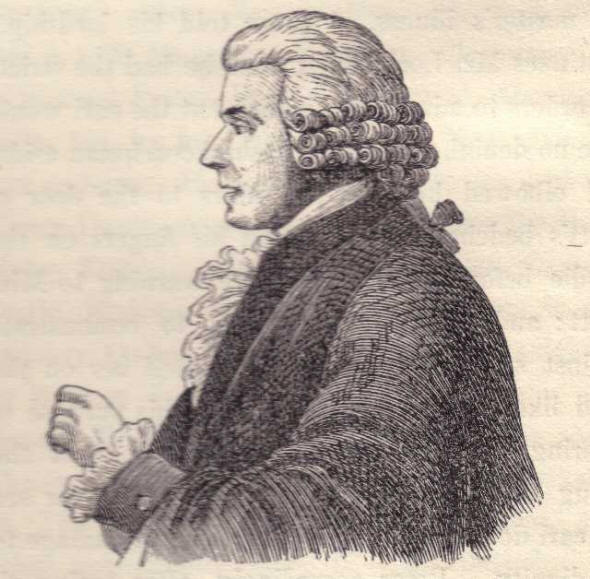
[woodcut of John Erskine, D.D.]
His body was interred in the Greyfriars churchyard. By his wife, the Hon.
Christian Mackay, third daughter of George third Lord Reay, he had a
family of fourteen children, but only four survived him, namely, David
Erskine, Esq. of Carnock, and three daughters, one of whom was the mother
of James Stuart, Esq. of Dunearn, who shot Sir Alexander Boswell in a duel
in 1822.
Dr. Erskine was remarkable for his simplicity of manners, unaffected
humility, and kindly and benevolent disposition. His temper was ardent,
his affections warm, and his attachments, like his piety, constant and
sincere. Of his good nature the following anecdote is told. For several
Sundays he had returned from church without his pocket handkerchief, and
could not account for the loss. Mrs. Erskine, suspecting an
elderly-looking poor woman who constantly occupied a seat on the stair
leading to the pulpit, sewed a handkerchief to the pocket of Dr. Erskine’s
Sunday coat. On the following Sunday, the doctor was proceeding in his
usual manner towards the pulpit, when, on passing the suspected person, he
felt a gentle tug from behind. The minister turned gently round, and,
clapping her on the head, merely remarked, “No the day, honest woman; no
the day.” [Kay’s Edinburgh Portraits.]
During the disturbances in Edinburgh in 1778, occasioned by the bill for
the repeal of the penal statutes against the Roman Catholics, a furious
mob, incensed at the support which his colleague, Principal Robertson, had
given to that obnoxious measure, assembled in the college yard, for the
purpose of demolishing the house of the latter, which they would, in all
probability, have done, in defiance of the military who had been called to
the spot, had not Dr. Erskine appeared, and exhorted them to disperse
quietly. So great was his influence and popularity that they immediately
obeyed. On the death of the principal, Dr. Erskine preached his funeral
sermon, and did amble justice to his great talents, and many estimable
qualities.
In
the years 1741 and 1742, when Dr. Erskine was a student at college, Mr.
Whitefield, the founder of the Calvinistic Methodists, visited Scotland,
and excited unusual attention by his powerful eloquence, and the doctrines
which he taught. Among the warmest admirers of this celebrated preacher
was the subject of this notice, and his merits and character having become
the subject of discussion in a literary society, of which Erskine and his
friend and fellow-student Dr. Robertson were members, the debate was
conducted with so much warmth and asperity on both sides that it is said
to have led to the dissolution of the society, and Erskine and Robertson
having taken opposite views, a temporary breach of their friendship and
intercourse was the consequence. In 1748 when Whitefield again came to
Scotland, and visited the west country, he was, as on the former
occasions, admitted to the pulpits of many of the established clergy, and
among the rest to that of Dr. Erskine, who was then minister of
Kirkintilloch, as well as to the churches of some of his friends who held
similar views to his in ecclesiastical matters. This liberality was not
relished by some of his clerical brethren, and at a meeting of the synod
at Glasgow in October 1748, a motion was made with special reference to
Mr. Whitefield, who had just been in that district, “That no minister in
their bounds should employ a stranger of doubtful character, till after
consulting his presbytery.” This produced an animated and prolonged
debate, in which Dr. Erskine took an active part, and of which he
afterwards published a short account, without his name.
Of
Mr. Wesley’s doctrines he was not so great an admirer as he had been of
those of Mr. Whitefield. Some time previous to his being translated to the
Old Greyfriars parish of Edinburgh, he became engaged in a controversy
with Mr. John Wesley. He published anonymously a small pamphlet entitled,
‘Mr. Wesley’s principles detected,’ ion which he endeavoured to expose the
enthusiasm, the erroneous views, and religious management of that
gentleman. Mr. Wesley was too prudent to enter the lists of theological
warfare with Dr. Erskine; but endeavoured to smooth over the affair by a
very flattering and complimentary letter to him.
Dr. Erskine’s learning was extensive, various, and solid, though he never
employed it, nor his natural talents, which were very great, for the
purpose of display. As a public speaker he was too little attentive to
those external recommendations, which give the great charm to many
preachers. His pronunciation was uncommonly broad, and his gestures and
action extremely awkward. Neither were his sermons distinguished by
studied elegance of language, or by the higher graces of eloquence, but
they possessed what was of far greater value, a native simplicity of
style, an energy of sentiment, a richness in scriptural illustration, and
a purity of doctrine, which were scarcely excelled by those of any
minister of his day. The character of his pulpit oratory is well described
by Sir Walter Scott in that passage of Guy Mannering, a small portion of
which had been already quoted: “A lecture was delivered,” says the
novelist, in this case depicting faithfully, “fraught with new, striking,
and entertaining views of scripture history – a sermon in which the
Calvinism of the kirk of Scotland was ably supported, yet made the basis
of a sound system of practical morals, which should neither shelter the
sinner under the cloak of speculative faith or of peculiarity of opinion,
nor leave him loose to the waves of unbelief and schism. Something there
was of an antiquated turn of argument and metaphor, but it only served to
give zest and peculiarity to the style of elocution. The sermon was not
read – a scrap of paper, containing the heads of the discourse, was
occasionally referred to, and the enunciation, which at first seemed
imperfect and embarrassed, became, as the preacher warmed in his progress,
animated and distinct; and although the discourse could not be quoted as a
correct specimen of pulpit eloquence, yet Mannering had seldom heard so
much learning, metaphysical acuteness, and energy of argument brought into
the service of Christianity.” An ‘Account of the Life and Writings of Dr.
Erskine,’ by the late Rev. Sir Henry Moncrieff Wellwood, baronet, minister
of St. Cuthberts, was published in 1818, 8vo, which presents much
interesting and valuable information relative to the ecclesiastical state
of Scotland during the eighteenth century.
The following is a list of Dr. Erskine’s works, besides the various
publications edited by him, or for which he wrote prefaces: –
The Law of Nature sufficiently promulgated to the Heathen World; in some
miscellaneous reflections occasioned by Dr. Campbell’s (professor of
Divinity at St. Andrews) Treatise on the necessity of Revelation.
Edinburgh, 1741. Republished in ‘Theological Dissertations.’ London, 1765.
The Signs of the Times considered. Edinburgh, 1742. Anonymous.
The People of God considered as all righteous; or, three Sermons, preached
at Glasgow, April, 1745. Edinburgh, 1745. Republished in the first volume
of Dr. Erskine’s Discourses.
Meditations and Letters of a pious youth, lately deceased, (James Hall,
Esq., son of the late Sir John Hall, Bart. of Dunglass), to which are
prefixed, Reflections on his death and character, by a friend in the
country. Edinburgh, 1746.
An
Account of the Debate in the Synod of Glasgow and Ayr, October 6, 1748;
respecting the employment of Mr. Whitefield to preach in the pulpits of
the Synod. Edinburgh, 1748, Anonymous.
An
humble attempt to promote frequent Communicating. Glasgow, 1749.
Republished in ‘Theological Dissertations.’
The Qualifications necessary for Teachers of Christianity; a Sermon
preached before the Synod of Glasgow and Ayr, 2d October, 1750. Glasgow,
1750.
The Influence of Religion on National Happiness; a sermon preached at the
anniversary meeting of the Society for Propagating Christian Knowledge, in
the High Church of Edinburgh, January, 1756.
Ministers of the Gospel cautioned against giving offence; a sermon
preached before the Synod of Lothian and Tweeddale, November 3, 1763; to
which is added, a charge at the Ordination of the late Mr. Robertson,
minister of Ratho. Edinburgh, 1764.
Mr. Wesley’s Principles detected; or, a defence of the Preface to the
Edinburgh edition of ‘Aspasio Vindicated,’ written by Dr. Erskine in
answer to Mr. Kershaw’s Appear – to which is prefixed the Preface itself.
Edinburgh, 1765.
Theological Dissertations, (1) On the Nature of the Sinai covenant, (2) On
the Character and Privileges of the Apostolic churches, (3) On the Nature
of Saving Faith. London, 1765.
Shall I go to War with my American Brethren? A discourse on Judges xx. 28,
addressed to all concerned in determining that important question. London,
1769. Anonymous. Reprinted in Edinburgh with a Preface and Appendix, and
the author’s name, 1776.
The Education of the poor children recommended; a sermon before the
Managers of the Orphan Hospital, 1774.
Reflections on the Rise, and Progress, and probable Consequences of the
present contentions with the Colonies; by a Freeholder. Edinburgh, 1776.
The Equity and Wisdom of the Administration, on measures that have
unhappily occasioned the American Revolt – tried by the Sacred Oracles.
Edinburgh, 1776.
Considerations on the Spirit of Popery, and the intended Bill for the
relief of the Papists in Scotland. Edinburgh, 1778.
A
Narrative of the Debate in the General Assembly of the Church of Scotland,
May 25, 1779. Occasioned by the apprehensions of an intended repeal of the
penal statutes against Papists. With a dedication to Dr. George Campbell,
principal of the Marischal College, Aberdeen. Edinburgh, 1780.
Prayer for those in civil and military offices; a sermon preached before
the election of the Magistrates of Edinburgh. October 5, 1779, and
published at the request of the Magistrates and Town council.
Sketches and Hints of Church History and Theological Controversy, chiefly
translated and abridged from modern foreign writers, vol. i. Edinburgh,
1790.
Letters, chiefly written for comforting those bereaved of Children and
Friends. Edinburgh, 1790. 2d edition with additions. Edinburgh, 1800.
The fatal Consequences and the General Sources of Anarchy; a discourse on
Isaiah, xxiv. 1, 5. Edinburgh, 1793.
A
Supplement to Two Volumes, published in 1754, of Historical Collections,
chiefly containing late remarkable instances of Faith working by Love;
published from the Manuscript of the late Dr. John Gillies, one of the
ministers of Glasgow. With an account of the pious Compiler, and other
additions. Edinburgh, 1796.
Sketches and Hints of Church History and Theological Controversy, chiefly
translated and abridged from modern foreign writers, vol. ii. Edinburgh,
1797.
Discourses preached on several occasions, vol. i. 2d edition, 1798. Volume
ii. posthumous, prepared for the press and published by Sir H. Moncrieff
Wellwood, 1804.
Dr. Erskine’s Reply to a printed Letter, directed to him by A.C.; in which
the gross misrepresentations in said Letter, of his Sketches of Church
History, are considered. Edin. 1798.
Religious Intelligence and seasonable Advice from Aborad, concerning lay
preaching and exhortation, in four separate Pamphlets. Edinburgh, 1801.
Discourses on the Christian temper, by J. Evans, D.D., with an account of
the Life of the author, by Dr. Erskine. Edinburgh, 1802.
New Religious Intelligence, chiefly from the American States. Edinburgh,
1802.
ERSKINE,
DAVID STEUART,
eleventh earl of Buchan, [counting from ‘Hearty James,’ the uterine
brother of King James the Second, on whom the title was conferred in
1466,] a nobleman distinguished for his patronage of literature, was born
June 1, 1742. He was educated in the university of Glasgow, where he
applied himself ardently to study, and also devoted some time to the arts
of designing, etching, and engraving, in the academy of Robert Foulis the
printer. An etching by him of the abbey of Icolmkill, with an account of
that island, is inserted in the first volume of the Transactions of the
Society of Scottish Antiquaries, published in 1792. In the same volume
also appeared the following papers from his pen, viz.: Memoirs of the Life
of Sir James Steuart Denham; Account of the parish of Uphall; and a Life
of Mr. James Short, Optician. On leaving college he entered the army, but
never rose higher than a lieutenant. He afterwards entered the diplomatic
department under the celebrated Lord Chatham, and in 1766 was appointed
secretary to the British embassy in Spain.
On
the death of his father in 1767, he succeeded to the earldom, and,
returning to Scotland, devoted the remainder of his life to the study of
the history and antiquities of his native country. Although the impaired
fortunes of his family led him to adopt a plan of the most rigid economy,
it is highly honourable to his memory that he not only voluntarily took
upon himself the payment of his father’s debts, but was at the principal
charge of the education of his two younger brothers, the Hon. Henry
Erskine, and Thomas, afterwards lord high chancellor of Great Britain. He
also distinguished himself by patronising public works and institutions.
He offered premiums for competition between the students of the high
school of Edinburgh and those of the university of Aberdeen; and to his
exertions the Society of Antiquaries at Edinburgh is indebted for its
existence, having been originated by him on November 14, 1780. He was the
friend and patron of Burns, the poet; Barry, the painter; Pinkerton, the
historian, and other men of talent. In 1791 he instituted an annual
festival in commemoration of Thomson, the author of ‘The Seasons,’ at
Ednam, in Roxburghshire, the poet’s native place; and on his grounds at
Dryburgh, he erected an Ionic temple, with a statue of Apollo in the
inside, and a bust of the bard of ‘The Seasons’ surmounting the dome. He
also raised a colossal statue of Sir William Wallace, on the summit of a
steep and thickly planted hill, which was placed on its pedestal September
22, 1814, the anniversary of the victory at Stirling bridge in 1297. “It
occupies so eminent a situation,” says Mr. Chambers, “that Wallace,
frowning towards England, is visible even from Berwick, a distance of more
than thirty miles.” Dryburgh abbey and the estate, which he had become
possessed of in 1785, originally belonged to the Halyburtons of Merton.
His lordship has given along account of the abbey in Grose’s Antiquities.
Lord Buchan died at an advanced age, in April 1829, at his seat of
Dryburgh abbey, Berwickshire. He had married in 1771 his cousin, Margaret,
eldest daughter of William Fraser, Esq. of Fraserfield, Aberdeenshire, but
by her, who died 12th May 1819, he had no issue. He was
succeeded by his nephew, Henry David, eldest son of his brother the Hon.
Henry Erskine. He had a natural son, Captain David Erskine, at one time a
professor in the Military College at Sandhurst, who was knighted by
William IV. soon after his accession to the throne. Sir David died at
Dryburgh abbey in 1838. The earl of Buchan was an industrious contributor
to ‘The Bee,’ ‘The Gentleman’s Magazine,’ and other publications; and, in
1812, published at Edinburgh his ‘Anonymous and Fugitive Essays, collected
from various periodical works.’ His principal publications consist of a
‘Speech intended to have been Spoken at the Meeting of the Peers of
Scotland in 1780;’ ‘An Account of the Life, Writings, and Inventions of
Napier of Merchiston,’ written in conjunction with Dr. Walter Minto, 1787;
and an ‘Essay on the Lives and Writings of Fletcher of Saltoun and the
Poet Thomson,’ 1792. In this last year, his lordship had sent, by the
hands of Mr. Archibald Robertson, a portrait painter, who then visited
America, to the president of the United States an elegantly mounted
snuff-box, made from the tree which sheltered Wallace. The box had been
presented to Lord Buchan by the goldsmiths of Edinburgh in 1782, from whom
he obtained leave to transfer it to ‘the only man in the world to whom he
thought it justly due.’
Lord Buchan’s residence was for many years in Edinburgh, but in 1787 he
retired, on account of his health, to Dryburgh abbey, a property he had
acquired by purchase. The most prominent feature of his character was
vanity, of which many amusing anecdotes are told. A remarkable instance of
it is narrated by Mr. Lockhart, in his Life of Sir Walter Scott. In 1819
when Scott was lying very ill, in his house in Castle Street, Edinburgh,
the earl of Buchan, hearing that he was at the point of death, proceeded
to the house of the great novelist, and found the knocker tied up. He then
descended to the area door, and was there received by Peter Mathieson, the
coachman of Scott, whose face confirmed the woful tidings of his master’s
illness. “Peter told his lordship,” continues Mr. Lockhart, “that he had
the strictest orders to admit no visitor; but the earl would take no
denial, pushed the bashful coachman aside, and elbowed his way up stairs
to the door of Scott’s bedchamber. He had his fingers on the handle before
Peter could give warning to Miss Scott; and when she appeared, to
remonstrate against such an intrusion, he patted her on the head like a
child, and persisted in his purpose of entering the sick-room to
strenuously, that the young lady found it necessary to bid Peter see the
earl down stairs again, at whatever damage to his dignity. Peter
accordingly, after trying all his eloquence in vain, gave the tottering,
bustling, old meddlesome coxcomb a single shove, – as respectful, doubt
not, as a shove can ever be, – and he accepted that hint, and made a rapid
exit. Scott, meanwhile, had heard the confusion, and at length it was
explained to him; when, fearing that Peter’s gripe might have injured Lord
Buchan’s feeble person, he desired James Ballantyne, who had been sitting
by his bed, to follow the old man home, make him comprehend, if he could,
that the family were in such bewilderment of alarm that the ordinary rules
of civility were out of the question; and, in fine, inquire what had been
the object of his lordship’s intended visit. James proceeded forthwith to
the earl’s house in George Street, and found him strutting about his
library in a towering indignation. Ballantyne’s elaborate demonstrations
of respect, however, by degrees softened him, and he condescended to
explain himself. ‘I wished,’ said he, ‘to embrace Walter Scott before he
died, and inform him that I had long considered it as a satisfactory
circumstance that he and I were destined to rest together in the same
place of sepulchre. The principal thing, however, was to relieve his m ind
as to the arrangements of his funeral – to show h im a plan which I had
prepared for the procession – and, in a word, to assure him that I took
upon myself the whole conduct of the ceremonial at Dryburgh.’ He then
exhibited to Ballantyne a formal programme, in which, as may be supposed,
the predominant feature was not Walter Scott, but David earl of Buchan. It
had been settled, inter alia, that the said earl was to pronounce
an eulogium over the grave, after the fashion of the French Academicians
in the Père la Chaise.” “And this silliest and vainest of
busybodies,” adds Lockhart, ‘was the elder brother of Thomas and Henry
Erskine! But the story is well-known of his boasting one day to the late
duchess of Gordon of the extraordinary talents of his family – when her
unscrupulous Grace asked him, very coolly, whether the wit had not come by
the mother, and been all settled on the younger branches.” Scott outlived
the earl, and formed one of the company at his lordship’s funeral ten
years after the scene above described had taken place. Under date April
20, 1829, he has the following entry in his diary: “Lord Buchan is dead, a
person whose immense vanity, bordering on insanity, obscured, or rather
eclipsed, very considerable talents. His imagination was so fertile, that
he seemed really to believe in the extraordinary fictions which he
delighted in telling. His economy, most laudable in the early part of his
life, when it enabled him, from a small income, to pay his father’s debts,
became a miserable habit, and led him to do mean things. He had a desire
to be a great man and a Mecaenas – a bon marché. The two celebrated
lawyers, his brothers, were not more gifted by nature than I think he was,
but the restraints of a profession kept the eccentricity of the family in
order. Both Henry and Thomas were saving men, yet both died very poor. The
latter at one time possessed £200,000; the other had a considerable
fortune. The earl alone has died wealthy. It is saving, not getting, that
is the mother of riches. They all had wit. The earl’s was crackbrained,
and sometimes caustic; Henry’s was of the very kindest, best-humoured, and
gayest sort that ever cheered society; that of Lord Erskine was moody and
muddish; but I never say him in his best days.” Lord Buchan’s personal
vanity was also exhibited in the numerous portraits and busts of him which
were taken during his lifetime. An excellent painting, by Sir Joshua
Reynolds, adorns the hall of the Scottish Antiquaries. Another, by
Alexander Runiciman, is in the Museum of the Perth Antiquarian Society. He
also presented to the faculty of Advocates a portrait in crayons, with an
inscription written by, and highly complimentary to, himself. When
Napoleon threatened to invade this country, Lord Buchan, with his pen,
endeavoured to promote union among his countrymen, and like other
patriotic noblemen and gentlemen of the time, he buckled on his sword,
ready, should they have landed, to have repelled the invaders by force of
arms. His political principles, however, were opposed to those of the
government of that day, and when the influence of the ruling powers had
destroyed all form of freedom in the election of the Scottish peers, he
stood forward singly in defence of the privileges of his order, and after
a long and unaided contest, at last succeeded in securing their
independence. – Douglas’ Peerage, edited by Wood. – New Scots Mag. –
Lockhart’s Life of Scott. – Kay’s Edinburgh Portraits.
ERSKINE,
the Hon HENRY,
a distinguished advocate and wit, second son of Henry David, tenth earl of
Buchan, and brother of the preceding, was born at Edinburgh, November 1,
1746. He was educated at the universities of St. Andrews, Edinburgh, and
Glasgow, and while prosecuting his legal studies, he attended the Forum
debating society established at Edinburgh, where he cultivated with
success those posers of extempore speaking which afterwards brought him
into such high eminence as a pleader. He was in 1768 admitted a member of
the faculty of advocates; and his transcendent talents and great legal
knowledge, together with his quickness of perception, playfulness of
fancy, and professional tact, soon placed him at the head of the Scottish
bar. The forensic eloquence of Scotland was at that period by no means of
a high order, and the then forms of court seemed contrived to prevent
anything like oratory on the part of the pleaders. Young Erskine, however,
rose above all the trammels that bore repressingly on his brethren at the
bar, and introduced a style of pleading, animated and graceful beyond
anything that had yet been witnessed in the court of session. He and
Robert Blair, afterwards president of the court of session, were generally
engaged as opposite counsel, as the two most eloquent and able members of
the bar; and the clear reasoning and sound law of the latter were not
always a match for the wit and felicity of remark of his opponent. The
subjoined woodcut represents Erskine in the act of pleading.
In
the General Assembly of the national church, then “the best theatre for
deliverative eloquence to be found in Scotland,” and an arena where Henry
Dundas, Lord Melville, trained himself for the debates of the senate, Mr.
Erskine had opportunities of displaying his oratorical powers to great
advantage. He advocated from principle and with great consistency the
interests of the Evangelical or popular party, as it was called, in that
court; and in the memorable struggle for the office of its clerk between
Professor Dalzell and Dr. Carlisle of Inveresk in 1789, the successful
issue in favour of the former gentleman, their candidate – the subject of
several humorous caricatures by Kay – was due to his judicious precaution
of having it provided, before proceeding to the election, that there
should be a retrospective scrutiny of the votes. He had, about ten years
previous (1779), nearly achieved for it an earlier triumph in his own
person, in the election of procurator of the church of Scotland, when,
after a keen contest, William (afterwards Lord ) Robertson, son of the
eminent historian, his opponent, obtained it by a narrow majority.
At
the bar his talents were as much at the service of the poor gratuitously
as they were at the command of the rich, who could amply remunerate him
for his exertions. He was ever ready to rescue innocence from persecution,
and to vindicate the cause of the oppressed. One remarkable instance of
this, (but little known to the public,) was on behalf of Donald M’Arthur,
a poor Baptist missionary preacher, the pastor of a small congregation at
Port Bannatyne in Bute, who was violently seized, on the 20th
October 1805, while celebrating divine service, by one of the local
magistrates, and sent as an impressed seaman into his majesty’s navy. Mr.
Erskine not only effected his release, after he had been conveyed with
rapidity to Ireland, in order to defeat an interdict obtained in the
Scotch courts, and thence to the Downs, in order to frustrate an
application for a writ of habeas corpus in that kingdom, by an
order from the admiralty served after he had passed from one to another of
various ships of war, – but obtained a certificate that he should never
again be impressed, and instituted a civil process of damages at his own
risk, which resulted in a composition of, it is said, £500 to escape a
heavier penalty. To his generous interference in this case, the friends of
civil and religious liberty are greatly indebted, as since that time, no
one has ventured in Scotland to interfere with the persons of those who
are engaged in religious instruction, however humble of unprotected. [Buchanan’s
Reports, pp. 60-72.] So well, indeed, was this generous trait in his
character known, that a poor man, in a remote district of the country,
when advised by his solicitor not to enter into a lawsuit with a wealthy
neighbour, on account of the expense in which it would involve him, at
once replied – “Ye dinna ken what ye say, maister; there’s nae a puir man
in Scotland need to want a friend, or fear an enemy, while Harry Erskine
lives!”
Mr. Erskine, like his elder brother, had early embraced Whig principles,
and, on the accession of the Coalition ministry in 1783, he succeeded Mr.
Dundas, afterwards Lord Melville, as Lord advocate. On the morning of the
appointment he had an interview with Dundas, in the Outer House; when,
observing that the latter had already resumed the ordinary stuff gown
which advocates are in the custom of wearing, he said gaily that he “must
leave off talking, to go and order his silk gown,” the official robe of
the lord advocate and solicitor-general. “It is hardly worth while,” said
Dundas, drily, “for the time you will want in – you had better borrow
mine.” Erskine’s reply was exceedingly happy 00 “From the readiness with
which you make the offer, Mr. Dundas, I have no doubt that the gown is a
gown made to fit any party; but, however short my time in office
may be, it shall ne’er been said of Henry Erskine that he put on the
abandoned habits of his predecessor.” The new administration, however,
was soon broken up, when he resumed his station at the bar. Mr. Erskine
was succeeded, as lord advocate, by Ilay Campbell, Esq., afterwards lord
president, to whom he said, upon resigning his gown, “My lord, you must
take nothing off it, for I’ll soon need it again.” Mr. Campbell replied,
“It will be bare enough, Harry, before you get it.” In 1786 he was
elected dean of the faculty of advocates, but on account of his liberal
politics, was defeated in an election for the same office, some years
afterwards.
On
the return of the liberal party to power in 1806, he once more became lord
advocate, and was returned member for the Dumfries district of burghs, in
the room of major general Dalrymple. On the dissolution of the Whig
administration soon after, he again lost his office and his seat in
parliament. In consequence of declining health, he retired, in 1812, from
public life to his beautiful seat of Ammondell, in West Lothian, where he
died October 8, 1817, in the 71st year of his age. In early
life he had cultivated a taste for poetry and music, and was throughout
his long and distinguished career celebrated for his witticisms. Sir
Walter Scott said of him, “Henry Erskine was the best-natured man I ever
knew, thoroughly a gentleman, and with but one fault – he could not say
no, and thus sometimes misled those who trusted him.” IN person, Mr.
Erskine is described as having been above the middle size, and eminently
handsome. His voice was powerful, his manner of delivery peculiarly
graceful, and his enunciation accurate and distinct. He was long a member
of the Scottish Antiquarian Society, founded by his brother, the earl of
Buchan, in 1780. One of the members remarked to him that he was a very bad
attender of their meetings, adding, at the same time, that he never gave
any donations to the Society. A short time afterwards he wrote a letter to
the secretary apologising for not attending the meetings, and stating that
he had “enclosed a donation, which, of you keep long enough, will be the
greatest curiosity you have.” This was a guinea of George III. He was
universally acknowledged to have been the wittiest man of his time, and
his puns and bon mots were so numerous that almost every witticism
of the day was sure to be attributed to him. Some of his points were very
effective. On one occasion, his namesake, Mr. Erskine of Alva, advocate,
afterwards a lord of session, under the title of Lord Barjarg, a man of
small stature, was retained as counsel in a very interesting case, in
which the Hon. Henry Erskine appeared for the opposite party. The crown in
court being very great, in order to enable young Alva to be seen and heard
to more advantage, a chair was brought for him to stand upon. On this Mr.
Erskine quaintly remarked, “That is one way of rising at the bar,” The
different modes of spelling the name of Erskine formerly used, Ereskin,
Areskin, and sometimes Areseskin, seems to have puzzled Voltaire, for in
his ‘Letters on the English Nation,’ he writes it Hareskins. A common
pronunciation of the name in Scotland is Askin, which gave rise to
one of the best repartees of Henry Erskine. During the time that he was
dean of faculty, a silly fellow, an advocate, not liking a question put to
him by the dean, testily said, “Harry, I never meet you but I find you
Askin.” “And I,” replied the wit, “never meet you but I find an
Anser,” (the Latin word for goose).
Notwithstanding his liveliness of fancy and gaiety of spirit, his habits
were eminently domestic, and he delighted in retirement and country
employments. His feelings and desires in this respect are pleasingly
depicted in the following lines, written by himself: –
“Let sparks and topers o’er their bottles sit.
Toss bumpers down, and fancy laughter wit;
Let cautions plodders o’er their ledger pore,
Note down each farthing gain’d, and wish it more;
Let lawyers dream of wigs, poets of fame,
Scholars look learn’d, and senators declaim;
Let soldiers stand, like targets in the fray,
Their lives just worth their thirteen pence a-day.
Give me a nook in some secluded spot,
Which business shuns, and din approaches not, –
Some snug retreat, where I may never know
What monarch reigns, what ministers bestow;
A book – my slippers – and a field to stroll in –
My garden-seat – an elbow-chair to loll in –
Sunshine when wanted – shade, when shade invites –
With pleasant country sounds, and smells, and sights,
And now and then a glass of generous wine,
Shared with a chatty friend of ‘auld langsyne;’
And one companion more, for ever nigh,
To sympathise in all that passes by,
To journey with me in the path of life,
And share its pleasures, and divide its strife.
These simple joys, Eugenics, let me find,
And I’ll ne’er cast a lingering look behind.”
“These lines,” says his relative, Mr. Henry David Inglis, who was allowed
to copy them from the author’s scrap-book, “were written after Mr.
Ersksine’s second marriage, and refer, no doubt, in the latter part, to
his second wife, who proved a most valuable companion and a tender nurse
in his declining years. What degree of happiness his first connexion
yielded in his early days, I have no access to know; but the extreme
nervous irritability, and somewhat eccentric ways of the first Mrs.
Erskine, did not contribute greatly to his happiness in her later years.
One of her peculiarities consisted in not retiring to rest at the usual
hours. She would frequently employ half the night in examining the
wardrobe of the family, to see that nothing was missing, and that
everything was in its proper place. I recollect being told this, among
other proofs of her oddities, that one morning, about two or three
o’clock, having been unsuccessful in a search, she awoke Mr. Erskine, by
putting to him this important interrogatory, ‘Harry, lovie, where’s your
white waistcoat?’”
In
the very interesting account of Mr. Erskine, after his retirement from the
bar, written by Mr. Inglis, and inserted in the Edinburgh Literary
Journal, we have the following particulars, descriptive of the almost
Arcadian simplicity, in which the latter years of the “old man eloquent”
were passed: “The mail-coach,” says Mr. Inglis, “used to set me down at
Ammondell gate, which is about three-quarters of a mile from the house;
and yet I see, as vividly as I at this moment see the landscape from the
window at which I am now writing, the features of that beautiful and
secluded domain, – the antique stone bridge, – the rushing stream, the
wooded banks, – and, above all, the owner, coming towards me with his own
benevolent smile and sparkling eyes. I recollect the very grey hat he used
to wear, with a bit of the rim torn, and the pepper-and-salt short coat,
and the white neckcloth sprinkled with snuff. No one could, or ever did,
tire in Mr. Erskine’s company, He was society equally for the child and
for the grown man. He would first take me to see his garden, where, being
one day surprised by a friend while digging potatoes, he made the now
well-known remark, that he was enjoying otium cum diggin a tautie,
(the Scottish word for potato). He would then take me to his melon bed,
which we never left without a promise of having one after dinner; and then
he would carry me to see the pony, and the great dog upon which his
grandson used to ride. Like most men of elegant and cultivated minds, Mr.
Erskine was an amateur in music, and himself no indifferent performer on
the violin. I think I scarcely ever entered the hall along with him that
he did not take down his Cremona – a real one, I believe, which hung on
the wall, and, seating himself in one of the wooden chairs, play some
snatches of old English or Scottish airs; – sometimes ‘Let’s have a dance
upon the heath,’ an air from the music in Macbeth, which he used to say
was by Purcel, and not by Locke, to whom it has usually been ascribed –
sometimes, ‘The flowers of the forest,’ of ‘Auld Robin Gray’ – and
sometimes the beautiful Pastoralé from the eighth concerto of Coreilli,
for whose music he had an enthusiastic admiration. But the greatest treat
to me was when, after dinner, he took down from the top of his bookcase,
where it lay behind a bust, I thin, of Mr. Fox, his manuscript book full
of jeux d’esprit, charades, bon mots, Uc., all his own
composition. Few men have ever enjoyed a wider reputation for wit than the
Hon. Henry Erskine; the epithet then, and even now, applied to him, par
excellence, is that of the witty Harry Erskine; and I do believe that
all the puns and bon mots which have been put into his mouth, –
some of them, no doubt, having originally come out if it, – would eke out
a handsome duodecimo. I well recollect that nothing used to distress me so
much as not perceiving at once the point of any of Mr. Erskine’s
witticisms. Sometimes, half an hour after the witticism had been spoken, I
would begin to giggle, having only then discovered the gist of the saying.
In this, however, I was not singular. While Mr. Erskine practised at the
bar, it was his frequent custom to walk after the rising of the courts, in
the Meadows; and he was often accompanied by Lord Balmuto, one of the
judges, a very good kind of man, but not particularly quick in his
perception of the ridiculous, His lordship never could discover at first
the pint of Mr. Erskine’s wit; and, after walking a mile or two perhaps,
and long after Mr. Erskine had forgotten the saying, Lord Balmuto would
suddenly cry out, ‘I have you now, Harry – i have you now, Harry!’ –
stopping, and bursting into an immoderate fit of laughter.”
When Mr. John Wright, who had been bred a shoemaker, but afterwards became
a lecturer on law, applied in 1781, to be admitted a member of the faculty
of advocates, some opposition was shown to his admission by the vice-dean
of faculty, Mr., afterwards Lord Swinton, and others, which was thought to
have originated in their objections to Mr. Wright’s humble birth. Mr.
Wright, however, was ably supported by Mr. Erskine, and was ultimately, in
January 1783, admitted advocate. It was said that Mr. Erskine had entered
the opposition so much that they at last yielded. After listening to their
observations – “Well, well,” said he, “they say I am the son of the earl
of Buchan, – and you (pointing to one) are the son of the laird of -----;”
and thus going over the whole opposition in a strain of inimitable and
biting sarcasm, he would up the enumeration in his usual forcible manner –
“Therefore no thanks to us for being here; because the learning we have
got has been hammered into our brains! – whereas, all Mr. Wright’s has
been acquired by himself; therefore he has more merit than us all.
However, if any of you can put a question to Mr. Wright that he cannot
answer, I will hold that to be a good objection. But, otherwise, it would
be disgraceful to our character as Scotsmen were such an act of exclusion
recorded in the books of this Society. Were he the son of a beggar, did
his talents entitle him, he has a right to the highest distinction in the
land.” Mr. Wright was the author of a work on mathematics, which brought
him a very considerable sum. This he entered in Stationers’ Hall; but as
the law then only secured copyrights for seven years, at the end of that
period he had the mortification to find his treatise inserted in the
Encyclopedia Britannica, without permission sought or obtained. Mr. Wright
was so much offended at this appropriation of his property that he
seriously contemplated bringing the case before the court of session, but
he was dissuaded from this step by his friend Mr. Erskine, who, in his
usual strain of pleasantry, told him, ‘”just to wait the expiry of other
seven years, and then, to retaliate, by printing the whole of the
Encyclopedia along with his own work.” On the day after Wright’s death,
which took place in 1813, Mr. Sheriff Anstruther, on meeting Mr. Erskine,
said, “Well! Harry, poor Johnny Wright is dead.” “Is he?” exclaimed Henry.
“He died very poor. They say he has left no effects.” “That is not
surprising,” was the rejoinder, “as he had no causes, he could have
no effects.”
“The character of Mr. Erskine’s eloquence,” says one who knew him long and
intimately, “bore a strong resemblance to that of his noble brother, Lord
Erskine, but being much less diffusive, it was better calculated to leave
a forcible impression: he had the art of concentrating his ideas, and
presenting them at once in so luminous and irresistible a form, as to
render his hearers masters of the view he took of his subject; which,
however dry or complex in its nature, never failed to become entertaining
and instructive in his hands; for, to professional knowledge of the
highest order, he united a most extensive acquaintance with history,
literature, and science, and a thorough conversancy with human life and
moral and political philosophy. In the most rapid of his flights, when his
tongue could scarce keep pace with his thoughts, he never failed to seize
the choicest words in the treasury of our language. The apt, beautiful,
and varied images which constantly decorated his judicial addresses,
suggested themselves instantaneously, and appeared, like the soldiers of
Cadmus, in complete armour and array to support the cause of their
creator, the most remarkable feature of whose eloquence was, that it never
made him swerve by one hair-breadth from the minute details most befitting
his purpose; for, with matchless skill, he rendered the most dazzling
oratory subservient to the uses of consummate special pleading, so that
his prudence and sagacity as an advocate were as decisive as his speeches
were splendid. For many years of his life, Mr. Erskine had been the victim
of ill health, but the native sweetness of his temper remained unclouded,
and during the painfully protracted sufferings of his last illness, the
language of complaint was never hears to escape his lips, nor the shadow
of discontent seen to cloud his countenance! ‘Nothing in his life became
him, like the leaving it.’ He looked patiently forward to the termination
of his painful existence, and received with mild complacency the
intelligence of his danger, while the ease and happiness of those, whose
felicity through life had been his primary consideration, were never
absent from his thoughts.”
Mr. Erskine was twice married; first to Christina, only daughter of George
Fullarton, Esq., collector of customs at Leith, by whom he had three
daughters, and two sons, Henry, who succeeded as earl of Buchan, and
George; and secondly, to Mrs. Turnbull, formerly Miss Munro, by whom he
had no issue. – Kay’s Edinburgh Portraits. – Edinburgh Ann. Register.
1819.
ERSKINE,
THOMAS, LORD ERSKINE,
a distinguished pleader, was the third and youngest son of David Henry,
tenth earl of Buchan, by, as already states, his countess Agnes, daughter
of Sir James Steuart of Coltness, baronet, a woman of highly cultivated
mind, the sister of Sir James Steuart, whose scientific writings,
especially upon political philosophy, have rendered his name celebrated.
He was born, according to ‘Douglas’ Peerage,’ on the 10th of
January, 1749, old style; but Lord Campbell, in his ‘Lives of the
Chancellors,’ makes the date a year later. He says: “On the 10th
of January, 1750, in a small and ill-furnished room in an upper ‘flat’ of
a very lofty house in the old town of Edinburgh first saw the light the
Hon. Thomas Erskine, the future defender of Stockdale, and lord Chancellor
of Great Britain.” The latter is correct, and the alteration of the style
would make the date of his birth the 21st of January 1750. He
received the rudiments of his education at the high school of Edinburgh.
His father and mother having, for the sake of economy, removed, in the
beginning of 1762, with their family to St. Andrews, he completed his
studies at the university of that town. His father had a numerous family,
with a reduced fortune, his income at one period not exceeding £200
a-year. A profession was in consequence the only resource for both him and
his second brother, the Hon. Henry Erskine; and it is singular that each
of them became the most eloquent and successful advocate at the bar to
which he belonged.
At
first, Thomas was destined for the naval service, and, accordingly,
embarking at Leith, went to sea, as a midshipman, with Sir John Lindsay, a
nephew of the celebrated earl of Mansfield, and, from that period, did not
revisit Scotland till a few years before his death. Though he acted for a
short time as a lieutenant, through the friendship of his commanding
officer, he never rose higher than a midshipman, and, after a service of
four years, cruising about in the West Indies and on the coast of America,
his ship was ordered home, and on its arrival at Portsmouth, it was paid
off. On applying at the admiralty he was told that on account of the great
number of midshipmen who had served longer than him, and whose friends
were applying for their promotion, he could not yet obtain a lieutenant’s
commission, and there was no saying when his turn might come. He
indignantly resolved not to go to sea again as a midshipman, after having
served as a lieutenant. He now determined to try the army, and through the
recommendation of John Duke of Argyle, colonel of the Scots Royals, or
first regiment of foot, he obtained an ensign’s commission in that corps
at the regulation price, which absorbed the whole of his patrimony. On 29th
May 1770 he married his first wife, Frances, daughter of Daniel Moore,
Esq., M.P., with whom he received no fortune, and soon after he went with
his regiment to Minorca, where he remained two years.
While in that island he devoted himself to obtaining a thorough
acquaintance with English literature, and made himself familiar with
Milton, Shakspeare, Dryden, Pope, and other eminent British poets. “He
likewise,” says his biographer, Lord Campbell, “showed the versatility of
his powers by acting as chaplain to the regiment, the real chaplain being
at home on furlough by reason of ill health. At first he contented himself
with reading the service from the Liturgy, but he found that this was not
altogether relished by the men, who were chiefly Presbyterians. Thereupon,
his mind being imbued with the religious notions implanted in it by his
mother and the godly divines whom she patronised, he would favour them
with an extempore prayer, and he composed sermons, which he delivered to
them with great solemnity and unction from the drumhead. He used always to
remember and to talk of this portion of his life with peculiar
satisfaction.” In after-life it was his boast that he had been a sailor
and a soldier, a parson and a lawyer.
On
the return of the regiment from Minorca in 1772, Erskine obtained leave of
absence for nearly six months. This space he spent chiefly in London,
where he became acquainted with Dr. Johnson, Sir Joshua Reynolds, the
bishop of St. Asaph, Dr. Burney, and other celebrated wits of the day; and
acquired considerable reputation for the acuteness and versatility of his
conversational powers. In Boswell’s Life of Johnson it is recorded of him
that he even ventured to controvert some of the opinions of the literary
giant, particularly in conversing on the merits of Fielding and
Richardson, when Erskine defended the former, whom Johnson, in his
characteristic manner, styled a “blockhead: and a “barren rascal.” During
this year (1772) he published a pamphlet on the Abuses of the Army,
without his name, which created no small sensation at the time. On the 21st
April 1773, he was promoted to the rank of lieutenant, but having no money
to purchase higher commissions, he became discontented with his position
and prospects, and in August 1774 he formed the resolution to study for
the bar. Lord Campbell relates that he was led to this determination by
the following circumstance: ‘It so happened,” says his lordship, “that the
assizes were held in the town in which he was quartered. The longing
lieutenant entered the court in his regimentals. Lord Mansfield, the
presiding judge, inquired who he was, and finding that this was the
youngest son of the late earl of Buchan, who had sailed with his nephew,
invited him to sit on the bench by his side, explained to h im the nature
of the proceedings that were going forward, and showed him the utmost
civility. Erskine heard a cause of considerable interest tried, in which
the counsel were supposed to display great eloquence. Never undervaluing
his own powers he thought within himself that he could have made a better
speech than any of them, on whichever side he had been retained. Yet these
gentlemen were the leaders of the circuit, each making a larger income
than the pay of all the officers of the Royals put together, – with the
chance of being raised by their own abilities to the Woolsack. The thought
then suddenly struck him that it might not even now be too late for him to
study the law, and be called to the bar. Lord Mansfield invited him to
dinner, and being greatly struck with his conversation, and pleased with
his manners, detained him till late in the evening. When the rest of the
company had withdrawn, the lieutenant, who ever showed great moral
courage, in consideration of the connection between the Murrays and the
Erskines, and the venerable earl’s great condescension and kindness,
disclosed to him his plan of a change of profession, with a modest
statement of his reasons. Lord Mansfield by no means discouraged him; but
advised him before he took a step so serious to consult his near
relations. He accordingly wrote to his mother, and she, justly
appreciating the energy and perseverance as well as the enthusiasm
belonging to his nature, strongly advised him to quit the army for the
law. His brothers did not oppose, – although Henry warned him of the
thorny and uphill path on which he was entering. His resolution was now
firmly taken, and he came up to London to carry it into effect. It was not
till the spring of the following year that financial difficulties were so
far removed as to render it possible for him to make the experiment. The
period of five years was then required by all the inns of court for a
student to be on the books of the society, before he could be called, –
with this proviso, that it was reduced to three years for those who had
the degree of M.A. from either of the universities of Oxford or Cambridge.
It was resolved that Erskine should immediately be entered of an inn of
court; that he should likewise be matriculated at Cambridge, and take a
degree there; that he should keep his academical and law terms
concurrently, and that as soon as it could be managed, he should become a
pupil to some eminent special pleader, so as to be well grounded in the
technicalities of his new craft. Accordingly, on the 26th day
of April 1775, he was admitted a student of Lincoln’s Inn, and on the 13th
of January 1776, he was matriculated at Cambridge, and entered on the
books of Trinity college as a gentleman commoner, with the privilege of
wearing a hat. He had rooms in college, in which he resided the
requisite periods to keep his terms, but being entitled to a degree
without examination, he paid no attention to the peculiar studies of the
place. But he still assiduously applied to belles lettres, and
practised English composition both in verse and prose. He gained some
applause by a burlesque parody of Gray’s Bard. The ode is not very
remarkable for poetical excellence; but he gained the prize given by the
college for English declamation. The subject which he chose was the
revolution of 1688. He took the honorary degree of A.M. in June 1778.
While still a student at Cambridge he contrived to keep his terms at
Lincoln’s Inn. He had not yet actually quitted the army, having obtained
sic months’ leave of absence. It is said that during Easter and Trinity
terms he excited a great sensation in the dining hall by appearing with a
student’s black gown over the scarlet regimentals of the Royals, probably
not having a decent suit of plain clothes to put on. He obtained a supply
of cash by the sale of his lieutenancy on the 19th September
1775.
In
order to acquire the requisite knowledge of the technical part of his new
profession, he became a pupil of Judge Buller, then an eminent special
pleader. On the promotion of Mr. Buller to the bench, he went into the
office of Mr., afterwards Baron Wood, where he continued for a year after
he had obtained considerable business at the bar, to which he was called
on the 3d of July, in the end of Trinity term 1778.
At
this period, and for three years after his retirement from the army, he
was in great pecuniary straits. With an increasing family, and the
necessary expenses he incurred in preparing for the bar, notwithstanding
the strictest economy, and the kind assistance of some of his friends, he
was often put to his shifts for a dinner. He dressed shabbily, resided in
small lodgings near Hampstead, and lived chiefly on cow-beef and tripe,
because he could not afford anything better. Reynolds, the comic writer,
who in his ‘Life and Times’ mentions these particulars, states, that he
expressed the greatest gratitude to Mr. Harris, the manager of Covent
Garden theatre, for occasional free admissions to that place of
entertainment. He was in the habit of taking part in the debates at the
Robin Hood, coachmaker’s Hall, and other spouting clubs, which were
attended by all sorts of people, where each person paid sixpence, and over
the glass of porter or gin and water which was received in return,
political, legal, and literary subjects were publicly discussed.
In
the succeeding Michaelmas term, an opportunity was afforded him of
distinguishing himself in Westminster Hall. He had been accidentally
introduced, at the table of a friend, to Captain Baillie, who had been
suspended from the superintendence of Greenwich Hospital, by the earl of
Sandwich, then first lord of the admiralty; and the attorney-general
having been instructed to move for leave to file a criminal information
against that gentleman for an alleged libel on the noble earl, having
stated that, for electioneering purposes, his lordship had placed in the
hospital a great number of landsmen, Mr. Erskine was retained to oppose
the motion. There were four other counsel on the same side, and he bring
the junior was apprehensive that he would not have an opportunity to
speak. Fortunately for him, however, the court adjourned before the case
was finished, and next morning he made that display of his powers which at
once established his reputation. In the course of his speech, the young
advocate hesitated not to attack the noble earl in very indignant terms:
“The defendant,” he said, “is not a disappointed malicious informer,
prying into official abuses because without office himself, but himself a
man in office; not troublesomely inquisitive into other men’s departments,
but conscientiously correcting his own; – doing it pursuant to the rules
of law, and what heightens the character, doing it at the risk of his
office, from which the effrontery of power has already suspended him
without proof of his guilt: – a conduct not only unjust and illiberal, but
highly disrespectful to this court, whose judges sit in the double
capacity of ministers of the law, and governors of this sacred and abused
institution. Indeed, Lord Sandwich has, in my mind, acted such a part” . .
. Here Lord Mansfield, observing Mr. Erskine heated with his subject, and
growing personal on the first lord of the admiralty, told him that Lord
Sandwich was not before the court. “I know that he is not formally before
the court,” said the bold and indignant counsel, “but for that very reason
I shall bring him before the court. He has placed these men in front of
the battle, in hopes to escape under their shelter; but I will not join in
battle with them; their vices, though screwed up to the highest
pitch of human depravity, are not of dignity enough to vindicate the
combat with me. I will drag him to light who is the dark
mover behind this scene of iniquity. I assert that the earl of Sandwich
has but one road to escape out of this business without pollution and
disgrace; and that is, by publicly disavowing the acts of the prosecutors,
and restoring Captain Baillie to his command. If he does this, then his
offence will be no more than the too common one of having suffered his own
personal interest to prevail over his public duty, in placing his voters
in the hospital. But if, on the contrary, he continues to protect the
prosecutors, in spite of the evidence of their guilt, which has excited
the abhorrence of the numerous audience that crown this court; if he keeps
this injured man suspended, or dares to turn that suspension into a
removal, I shall then not scruple to declare him an accomplice in their
guilt, – a shameless oppressor, a disgrace to his rank, and a traitor to
his trust.” The rule was discharged with costs, and such was the
impression made by Captain Baillie’s counsel, Mr. Erskine, on this his
first appearance as an advocate, that, on leaving the court, he received
no less than thirty retainers from attorneys who happened to be present on
the occasion.
In
January 1779 he was engaged as counsel in the famous court-martial held at
Portsmouth, on Admiral Keppel, to try the charges brought against him by
Sir Hugh Palliser, of incapacity and misconduct in the battle of Ushant,
with the French fleet under the command of Count d’Orvilliers. Mr. Erskine
was engaged for the defence on the recommendation of Mr. Dunning, as in
addition to his abilities, he had the advantage of understanding naval
language and naval manoeuvres. The trial lasted thirteen days, during all
which time Erskine exerted himself for his client with unabated zeal and
consummate discretion. He was not allowed to examine the witnesses, nor to
address the court, but he suggested questions which were put in writing;
and he composed the speech which Admiral Keppel delivered on the merits of
his case. The admiral was unanimously and honourable acquitted, and he
immediately enclosed to his counsel, Mr. Erskine, the munificent present
of a thousand pounds.
In
the following May he appeared at the bar of the House of Commons as
counsel for Mr. Carnan, the bookseller, against a bill introduced by Lord
North, then prime minister, to re-vest in the two English universities the
monopoly in almanacs, which Mr. Carnan had succeeded in abolishing by
legal judgments; and by his eloquence he prevailed on the House to reject
the bill. His reputation was now so much established, that he was
henceforth engaged in all the most important causes that took place during
a period of twenty-five years. His defence of Lord George Gordon, whose
trial for high treason came on in the court of King’s Bench, before Lord
Mansfield and his brethren, February 5, 1771, placed him immeasurably
above all the law orators of the day. In it he completely overthrew the
doctrine of constructive treason, and its effect on the audience who heard
it, and the tribunal to which it was addressed, was overwhelming. A
singular passage, to be found in his speech on this occasion, says the
Reviewer of Erskine’s speeches in the 16th volume of the
‘Edinburgh Review,’ “affords a great contrast to the calm and even mild
tone of its peroration. It is indeed, as far as we know, the only instance
of the kind in the history of modern eloquence; and we might justly have
doubted, if even Mr. Erskine’s skill, and well-known discretion as a
public speaker, had not forsaken him, and allowed his heat and fancy to
hurry him somewhat too far, had we not, in the traditional account of the
perfect success which attended this passage, the most unequivocal evidence
in his favour. After reciting a variety of circumstances in Lord George’s
conduct, and quoting the language which he used, the orator suddenly,
abruptly, and violently breaks out with this exclamation – ‘I say, by God,
that man is a ruffian, who shall, after this, presume to build upon such
honest, artless conduct, as an evidence of guilt!’ The sensation produced
by these words, and by the magic of the voice, the eye, the face, the
figure, and all we call the manner, with which they were uttered, is
related, by those present on this great occasion, to have been quite
electrical, and to baffle all power of description. The feeling of the
moment alone, – that sort of sympathy which subsists between an observant
speaker and his audience, – which communicates to him, as he goes on,
their feelings under what he is saying, – deciphers the language of their
looks, – and even teaches him, without regarding what he sees, to adapt
his words to the state of their minds, by merely attending to his own, –
this intuitive and momentary impulse could alone have prompted a flight,
which it alone could sustain; and, as its failure would indeed have been
fatal, so its eminent success must be allowed to rank it among the most
famous feats of oratory,” The jury acquitted Lord George, and all
reasonable men rejoiced at the verdict.
In
May 1783 Mr. Erskine received a silk gown, when he had scarcely been five
years at the bar. He usually practised in the court of King’s Bench, and
in the early part of his professional career he belonged to the Home
Circuit, but soon ceased to attend it, or any other, except on special
retainers, of which it is said that he received more than any man in his
time. His fee for a special retainer was not less than £300. The same year
(1783) he was elected M.P. for Portsmouth, and unanimously rechosen for
the same borough on every succeeding election, until raised to the
peerage. The rights of juries he firmly maintained on all occasions, but
particularly in the trial of the dean of St. Asaph, who was indicted in
1783, for a seditious libel, in having caused to be republished a tract,
written by Sir William Jones, recommending parliamentary reform. The trial
was postponed till the summer assizes at Salop in 1784, when Mr. Justice
Buller refused to receive the verdict of “Guilty of publishing only.” Mr.
Erskine insisted on the word “only” being recorded, when the judge said,
“Sit down, Sir; remember your duty, or I shall be obliged to proceed in
another manner.” On which Mr. Erskine replied, “Your lordship may proceed
in what manner you think fit. I know my duty as well as your lordship
knows yours. I shall not alter my conduct.” In allusion to the threat of
the judge, he thus concluded his argument; – “It was the first command and
counsel of my youth, always to do what my conscience told me to be my
duty, and to leave the consequences to God. I shall carry with me the
memory, and, I trust, the practice, of this parental lesson to my grave. I
have hitherto followed it, and have no reason to complain that my
obedience to it has been even a temporal sacrifice. I have found it, on
the contrary, the road to prosperity and wealth; and I shall point it out
as such to my children.” In the ensuing Michaelmas, on the ground of
misdirection, Mr. Erskine moved for a new trial. On this occasion he went
into an elaborate argument to prove that it was the office of the jury,
not of the judges, to pronounce upon the intention and tendency of an
alleged libel; and to him is ascribed the honour of having prepared the
way for the libel bill, introduced by Mr. Fox in 1792, and seconded by
himself, in which the rights and province of the jury are clearly defined,
and the position established, for which he, in a small minority of his
professional brethren, had contended. This, as has been well remarked, was
a triumph of which the oldest and most practised lawyer might well have
been proud.
His most celebrated argument on the law of libel was that delivered in
Percival Stockdale’s case in 1789. Mr. Stockdale, a respectable bookseller
in London, had published a pamphlet written by Mr. John Logan the poet, in
defence of Warren Hastings, in the course of which he had ventured to
animadvert very unguardedly on the conduct of the managers of the
impeachment then carrying on against the ex-governor of India. The
managers complained of this, and the publisher was tried before Lord
Kenyon and a special jury, in the court of king’s bench at Westminster, on
an information filed by the attorney-general. On this occasion, Mr.
Erskine, as counsel for Mr. Stockdale, delivered what the Edinburgh
reviewer has pronounced to be “the finest of all his orations, – whether
we regard the wonderful skill with which the argument is conducted, – the
soundness of the principles laid down, and their happy application to the
case, – or the exquisite fancy with which they are embellished and
illustrated, – and the powerful and touching language in which they are
conveyed. It is justly regarded, by all English lawyers, as a consummate
specimen of the art of addressing a jury; – as a standard, a sort of
precedent for treating cases of libel, by keeping which in his eye, a man
may hope to succeed in special pleading his client’s case within its
principle, who is destitute of the talent required even to comprehend the
other and higher merits of his original. By those merits it is recommended
to lovers of pure diction, – of copious and animated description, – of
lively, picturesque, and fanciful illustration, – of all that constitutes,
if we may so speak, the poetry of eloquence, – all for which we admire it,
when prevented from enjoying its music and its statuary.”
The fact of the publication being admitted, Mr. Erskine proceeded to
address the jury, and after some introductory observations he burst out
with the following eloquent passage: “Gentlemen, the question you have
therefore to try upon all this matter is extremely simple. – It is neither
more nor less than this. – At a time when the charges against Mr. Hastings
were, by the implied consent of the commons, in every hand, and on every
table; – when, by their managers, the lightning of eloquence was
incessantly consuming him, and flashing in the eyes of the public; – when
every man was with perfect impunity saying, and writing, and publishing
just what he pleased of the supposed plunderer and devastator of nations –
would it have been criminal in Mr. Hastings himself to have reminded the
public that he was a native of this free land, entitled to the common
protection of her justice, and that he had a defence in his turn to offer
to them, the outlines of which he implored them in the mean time to
receive, as an antidote to the unlimited and unpunished poison in
circulation against him? – This is, without colour or exaggeration, the
true question you are to decide. Because I assert, without the hazard of
contradiction, that if Mr. Hastings himself could have stood justified or
excused in your eyes for publishing this volume in his own defence, the
author, if he wrote it bona fide to defend him, must stand equally
excused and justified; and if the author be justified, the publisher
cannot be criminal, unless you had evidence that it was published by him
with a different spirit and intention from those in which it was written.
The question therefore is correctly what I just now stated it to be: could
Mr. Hastings have been condemned to infamy for writing this book?
Gentlemen, I tremble with indignation to be driven to put such a question
in England. Shall it be endured, that a subject of this country (instead
of being arraigned and tried for some single act in her ordinary courts,
where the accusation, as soon at least as it is made public, is followed
within a few hours by the decision) may be impeached by the commons for
the transactions of twenty years, – that the accusation shall spread as
wide as the region of letters, – that the accused shall stand, day after
day, and year after year, as a spectacle before the public, which shall be
kept in a perpetual state of inflammation against h im; yet that he shall
not, without the severest penalties, be permitted to submit anything to
the judgment of mankind in his defence? If this be law (which it is for
you to-day to decide), such a man has no trial: that great hall, built by
our fathers for English justice, is no longer a court but an altar; – and
an Englishman, instead of being judged in it by God and his country, is a
victim and a sacrifice.”
On
the merits of the work, it was his argument that the tenor of the whole,
and the intentions of the writer were to be regarded, and that if these
should be found praiseworthy, or innocent, the introduction of a few
detached passages, which, taken separately, might seem calculated to bring
the House of Commons into contempt, were altogether insufficient to
justify conviction. Among other things urged in defence of Mr. Hastings in
the pamphlet was the nature of his instructions from his constituents.
Commenting on this, he proceeded as follows: “If this be a wilfully false
account of the instructions given to Mr. Hastings for his government, and
of his conduct under them, the author and publisher of this defence
deserve the severest punishment, for a mercenary imposition on the public.
But, if it be true, that he was directed to make the safety and prosperity
of Bengal the first object of his attention, and that under his
administration it has been safe and prosperous; if it be true that the
security and preservation of our possessions and revenues in Asia were
marked out to him as the great leading principle of his government, and
that those possessions and revenues, amidst unexampled dangers, have been
secured and preserved; then a question may be unaccountably mixed with
your consideration, much beyond the consequences of the present
prosecution, involving perhaps the merit of the impeachment itself which
gave it birth; a question which the Commons, as prosecutors of Mr.
Hastings, should, in common prudence, have avoided; unless, regretting the
unwieldy length of their prosecution against them, they wished to afford
him the opportunity of this strange anomalous defence. For although I am
neither his counsel, nor desire to have anything to do with his guilt or
innocence, yet in the collateral defence of my client I am driven to state
matter which may be considered my many as hostile to the impeachment. For
if our dependencies have been secured, and their interests promoted, I am
driven in the defence of my client to remark that it is man and
preposterous to bring to the standard of justice and humanity, the
exercise of a dominion founded upon violence and terror. It may, and must
be true that Mr. Hastings has repeatedly offended against the rights and
privileges of Asiatic government, if he was the faithful deputy of a power
which could not maintain itself for an hour without trampling upon both;
he may and must have offended against the laws of God and nature, if he
was the faithful viceroy of an empire wrested in blood from the people to
whom God and nature had given it; he may and must have preserved that
unjust dominion over timorous and abject nations by a terrifying,
overbearing, insulting superiority, if he was the faithful administrator
of your government, which, having no root in consent or affection, no
foundation in similarity of interests, nor support from any one principle
which cements men together in society, could only be upheld by alternate
stratagem and force. The unhappy people of India, feeble and effeminate as
they are from the softness of their climate, and subdued and broken as
they have been by the knavery and strength of civilization, still
occasionally start up in all the vigour and intelligence of insulted
nature. When governed at all, they must be governed with a rod of iron;
and our empire in the East would long since have been lost to Great
Britain, if civil skill and military prowess had not united their efforts,
to support an authority which Heaven never gave, by means which it can
never sanction.
“Gentlemen, I think I can observe that you are touched with this way of
considering the subject, and I can account for it. I have not been
considering it through the cold medium of books, but have been speaking of
man and his nature, and of human dominion, from what I have seen of them
myself among reluctant nations submitting to our authority. I know what
they feel, and how such feelings can alone be repressed. I have heard them
in my youth, from a naked savage, in the indignant character of a prince
surrounded by his subjects, addressing the governor of a British colony,
holding a bundle of sticks in his hand, as the notes of his unlettered
eloquence. ‘Who is it,’ said the jealous ruler over the desert, encroached
upon by the restless foot of English adventure; ‘who is it that causes
this river to rise in the high mountains, and to empty itself into the
ocean? Who is it that causes to blow the loud winds of winter, and that
clams them again in the summer? Who it is that rears up the shade of these
lofty forests, and blasts them with the quick lightning at his pleasure?
The same Being who gave to you a country on the other side of the waters,
and gave our to us; and by this title we will defend it,’ said the
warrior, throwing down his tomahawk on the ground, and raising the war-cry
of his nation. These are the feelings of subjugated man all round the
globe; and depend upon it, nothing but fear will control, where it is vain
to look for affection. These reflections are the only antidotes to those
anathemas of superhuman eloquence which have lately shaken these walls
that surround us; but which it unaccountably falls to my province, whether
I will or no, a little to stem the torrent of, by reminding you, that you
have a mighty sway in Asia which cannot be maintained by the finer
sympathies of life, or the practice of its charities and affections. What
will they do for you when surrounded by two hundred thousand men with
artillery, cavalry, and elephants, calling upon you for their dominions
which you have robbed them of? Justice may, no doubt, in such a case
forbid the levying of a fine to pay a revolting soldiery; a treaty may
stand in the way of increasing a tribute to keep up the very existence of
the government; and delicacy for women may forbid all entrance into a
zenana for money; whatever may be the necessity for taking it. All these
things must ever be occurring. But under the pressure of such constant
difficulties, so dangerous to national honour, it might be better perhaps
to think of effectually securing it altogether, by recalling our troops
and merchants, and abandoning our oriental empire. Until this be done,
neither religion nor philosophy can be pressed very far into the aid of
reformation and punishment. If England, from a lust of ambition and
dominion, will insist on maintaining despotic rule over distant and
hostile nations, beyond all comparison more numerous and extended than
herself, and gives commission to her viceroys to govern them, with no
other instructions than to preserve them, and to secure permanently their
revenues; with what colour of consistency or reason can she place herself
in the moral chair, and affect to be shocked at the execution of her own
orders; adverting to the exact measure of wickedness and injustice
necessary to their execution, and complaining only of the excess as the
immorality; considering her authority as a dispensation for breaking the
commands of God, and the breach of them only punishable when contrary to
the ordinances of man. Such a proceeding, gentlemen, begets serious
reflections. It would be better perhaps for the masters and the servants
of all such governments to join in supplication, that the great Author of
violated humanity may not confound them together in one common judgment.”
The jury in Stockdale’s case, after two hours’ deliberation, returned a
verdict of not guilty.
The spirit and independence exhibited by him on every occasion led to his
being employed in defence of most of the parties who were prosecuted for
sedition or libel by the government. In 1792, being retained in behalf of
Thomas Paine, when proceeded against for the publication of the second
part of his ‘Rights of Man,’ he declared that, waiving all personal
considerations, he deemed it incumbent on him, as an English advocate, to
obey the call; in consequence of which he was suddenly dismissed from his
office of attorney-general to the prince of Wales. Five years afterwards
he conducted the prosecution of the ‘Age of Reason,’ when Williams the
publisher was found guilty and condemned to a year’s imprisonment.
One of the most brilliant, as well as most arduous, events in Mr.
Erskine’s professional life, arose out of the part cast upon him, in
conjunction with Mr., afterwards Sir Vicary Gibbs, on the trials of Hardy,
Horne Tooke, and others, for high treason in 1794. The prisoners were
tried separately, Hardy being the first. They were charged with compassing
the death of the king, the evidence of this intention being a conspiracy
to subvert by force the constitution of the country, under pretence of
procuring, by legal means, a reform of the house of commons. Mr. Erskine
was their counsel, and as in the case of Lord George Gordon, he completely
overthrew the doctrine of constructive treason attempted to be
established, and showed that their ostensible object, so far from
necessarily involving any evil designs, was one which had been advocated
by the earl of Chatham, Mr. Burke, and Mr. Pitt himself; and that the very
measures of reform which it was sought to introduce had been openly avowed
and inculcated by the duke of Richmond, then holding office in the
ministry of which Mr. Pitt was chief. The prisoners were successively
acquitted, and the other state prosecutions were then abandoned. On the
conclusion of these trials the public gratitude to Mr. Erskine showed
itself in the strongest manifestations of popularity. “On the last night
of the trials,” says Lord Campbell, “his horses were taken from his
chariot – amidst bonfires and blazing flambeaux, he was drawn home by the
huzzaing populace to his house in Serjeant’s Inn, – and they obeyed his
injunction, when addressing them from a window, with Gibbs by his side, he
said, – ‘Injured innocence still obtains protection from a British jury,
and I am sure, in the honest effusion of your hearts, you will retire in
peace and bless God.’ The freedom of many corporations was voted to him,
and his portraits and busts were sold in thousands all over Great Britain.
What was more gratifying, his speeches for the prisoners were read and
applauded by all men of taste, and his political consequence was much
enhanced with his party. He now occupied a position as an advocate which
no man before had reached, and which no man hereafter is ever likely to
reach at the English bar.” These trials lasted for several weeks, and the
ability and energy displayed by Mr. Erskine on this eventful occasion were
readily acknowledged by all parties.
He
was a warm supporter of Mr. Fox, and a strenuous opposer of the war with
France, on which subject he embodied his sentiments in a pamphlet,
entitled a ‘View of the Causes and Consequences of the War with France;’
and such was the attraction of his name, that it ran through forty-eight
editions. In 1802, the prince of Wales not only restored him to his office
of attorney-general, but appointed him chancellor of the duchy of
Cornwall. In 1803, on the formation of the volunteer body in the
metropolis, he was appointed lieutenant-colonel of the Temple corps of
lawyers, generally called “The Devil’s own.”
On
the death of Mr. Pitt in 1806, when a new administration was formed by
Lord Grenville, Mr. Erskine was raised to the dignity of lord high
chancellor of Great Britain, and created a peer by the title of Lord
Erskine of Restormel castle, in Cornwall. On this occasion he took for his
motto “Trial by Jury.” His father’s motto was “Judge Nought.” On the
dissolution of the ministry in the following March, he retired with the
usual pension of £4,000 a-year. The short period during which he presided
in the court of chancery makes it difficult to estimate how far his
extraordinary powers of mind, and in particular the eminently legal
understanding which he possessed, would have enabled him to overcome the
difficulties of so new a situation. But none of his judgments were
appealed against, except one, and it was affirmed. Over the proceedings in
the impeachment of Lord Melville, in 1806, he presided as lord steward,
and united the greatest acuteness and readiness with singular firmness of
purpose, and all that urbanity which neither in public nor in private life
ever quitted him for an instant. In reference to this case it may be said,
that to Lord Erskine belongs the merit of showing that this mode of trial
may still be so conducted as to prove an efficient safeguard to the
constitution, though discredited by the vexations procrastination which
had characterized the last instance of its use, in the case of Warren
Hastings.
On
quitting the woolsack Lord Erskine retired in a great degree from public
life. In 1807 he was one of the principal opposers of the famous ‘Orders
in Council’ respecting neutral navigation, which he truly foretold would
lead to a war with America; and in the following year he made a speech
against the bill for prohibiting the exportation of Jesuit’s bark to the
continent of Europe, designed as an act of hostility against France, which
both for argument and eloquence is said to have been worthy his most
celebrated efforts. In 1809 he introduced into the House of Lords a bill
for the prevention of cruelty to animals, which passed that branch of the
legislature, but was thrown out by the Commons. In 1815 he was made a
knight of the Thistle. In the memorable proceedings of 1820, relative to
the Queen’s trial, he took a prominent part against the bill of pains and
penalties, and was mainly instrumental in causing it ultimately to be
abandoned. Soon after the close of these proceedings he visited Scotland,
for the first time since he had left it a midshipman in 1764, and was
entertained at a public dinner at Edinburgh, by the principal gentlemen of
liberal politics of that city. To this dinner, as a mark of high esteem
and respect, he had been specially invited.
Owing to an unfortunate purchase of land, and other circumstances, his
lordship, in the latter years of his life, laboured under considerable
pecuniary difficulties; while his former fame was obscured by an unhappy
second marriage with a Miss Sarah Buck, and certain eccentricities of
conduct which were very incompatible with his age and station. By his
first wife, who died 22d December, 1805, he had four sons and four
daughters. He had also issue by his second marriage.
In
his leisure hours he occupied himself with editing several of the State
Trials. He was the author of the Preface to Mr. Fox’s Collected Speeches,
as well as of a political romance, in 2 vols., entitled ‘Armata,’ and some
pamphlets in support of the Greek cause. His speeches, on constructive
treason, and on subjects relating to the liberty of the press, fill four
octavo volumes. A fifth contains his speeches on miscellaneous subjects;
among which those of behalf of Hadfield, for shooting at the king, and Mr.
Bingham, defendant in a crim. con. case, are especially worthy of
attention.
In
the autumn of 1823 he resolved to revisit Scotland, and to pass the
ensuing winter there. Accordingly, accompanied by two of his sons, he
embarked at Wapping, in a smack, for Leith, there being neither railways
nor London steamers in those days. When the ship was opposite Harwich, a
violent gale arose, and Lord Erskine was severely attacked with
inflammation in the chest. On the ship reaching Scarborough, he was so
seriously ill that it was deemed necessary to put him ashore. He rallied
to a certain degree, and was able, by easy stages on l and, to reach
Almondale (now called Amondell) House, the seat of his nephew near
Edinburgh, where, experiencing a relapse, he expired, on the 17th
November, 1823, in the 73d year of his age. He was buried in the family
burying-place at Uphall, in the county of Linlithgow. Immediately after
his decease the members of that profession of which he had been the
ornament and the favourite, caused a marble statue of him to be executed,
which was placed in the hall of Lincoln’s Inn, where he had presided as
chancellor, and where it now stands.
The consummate talents of this advocate shone in their full lustre in the
defence of Hardy and the other parties indicted of high treason in the
course of 1794, already alluded to; on which occasion his pleadings were
unmatched at the bar. His exertions and his success in these trials have
thus been comprehensively described: “His indefatigable patience – his
eternal watchfulness – his unceasing labour of body and of mind – the
strength of an Herculean constitution – his untameable spirit – a subtlety
which the merest pleader might envy – a quickness of intellect which made
up for the host he was opposed to; – these were the great powers of the
man; and the wonderful eloquence of his speeches is only to be spoken of
as second to these. Amidst all the struggles of the constitution, in
parliament, in council, and in the field, – there is no one man,
certainly, to whose individual exertions it owes so much, as to this
celebrated advocate; and if ever a single patriot saved his country from
the horrors of a proscription, this man did this deed for us, in stemming
the tide of state prosecutions.”
The most remarkable features of Lord Erskine’s personal character were his
egotism and vanity, which increased upon him in the later years of his
life, and of which many amusing anecdotes are told. He was fond of pet
birds, monkeys, and dogs, and believed in ghosts, apparitions, and the
second sight. “Tom Erskine,” says Sir Walter Scott, in his diary, “was
positively mad. I have heard him tell a cock and a bull story of having
seen the ghost of his father’s servant, John Burnet, with as much gravity
as if he believed every word he was saying.”
He
was not ignorant of the little artifices which tend to give effect to a
person’s appearance, nor did he deem it undignified to take advantage of
them to aid his eloquence. When he went on circuit he examined the court
the night before the proceedings, in order to select the most advantageous
place for addressing the jury. On the cause being called, the crowded
audience were, perhaps, kept waiting a few minutes before the celebrated
advocate made his appearance; and when at length he gratified their
impatient curiosity, a particularly nice wig and a pair of new yellow
gloves distinguished and embellished his person, beyond the ordinary
costume of the barristers of the circuit. [Annual Obituary, vol.
ix. p. 57.]
Like his brother Henry, he was much addicted to punning, and Westminster
Hall rang with his jokes as much as ever the parliament house of Edinburgh
did with the wit of his brother. When at the bar, he was retained as
counsel for the proprietors of a stage coach, against whom Polito, the
keeper of the wild beasts in Exeter Change, had brought an action for
negligence, his portmanteau having been stolen from the boot of the coach
behind, he himself having been riding on the box. “Why did he not,” said
Erskine, “take a lesson from his own sagacious elephant, and travel with
his trunk before him?” The joke produced a verdict for the defendant.
Once, on being consulted by the duke of Queensberry, as to whether he
could sue a tradesman for a breach of contract about the painting of his
house, he wrote his opinion in the following words: “I am of opinion that
this action will not lie, unless the witnesses do.”
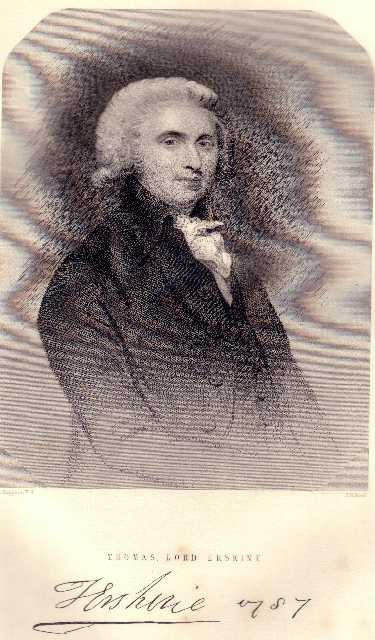
[portrait of Thomas Lord Erskine]
In
person Lord Erskine possessed many advantages: his features were regular,
intelligent, and animated, and his action is said to have been exceedingly
graceful. His constitution was remarkably strong; and it was mentioned by
himself in the House of Lords as a singular fact, that during the
twenty-seven years of his practice he had not been for a dingle day
prevented in his attendance on the courts by any indisposition.
Lord Erskine was, perhaps, the most powerful advocate that ever pleaded at
the bar of England; and some leading, but, till his appearance, disputed
constitutional doctrines, have been firmly established by his exertions,
especially on the two great subjects of constructive treason and the
liberty of the press. While, however, as a forensic orator, he had no
equal, he was only entitled to a secondary rank as a parliamentary
speaker. He was succeeded by his eldest son, David Montagu, at one period
minister plenipotentiary at the court of Bavaria.
The following is a list of his publications:
Arguments on the Right of Juries, in the Cause of the Dean of St. Asaph,
in the Court of King’s Bench. London, 1791, 8vo.
The whole Proceedings on a Trial of an Information ex officio, by the
Attorney-general, against John Stockdale, for a supposed Libel on the
House of Commons, in the Court of King’s Bench, before Lord Kenyon. To
which is subjoined, an Argument in support of the Right of Juries. 1791,
8vo.
His speech on the Liberty of the Press. Lond. 1793, 8vo.
His Speech in Defence of Thomas Hardy and John Horne Tooke, Esq. tried on
a Charge of High Treason. London, 1795, 8vo.
Speeches of the Hon. T. Erskine, and S. Kyd, Esq. on the Trial of T.
Williams, for publishing Paine’s Age of Reason; with Lord Kenyon’s Charge
to the Jury. Lond. 1797, 8vo.
A
View of the Causes and Consequences of the present War with France. Lond.
1797, 8vo.
Substance of his Speech in the House of Commons, on a Motion for an
Address to the Throne, approving of the Refusal of Ministers to treat with
the French Republic. London, 1800, 8vo.
An
Explanation of all the Acts of Parliament relative to the Volunteer Corps.
Lond. 1803.
Speech on Malicious and Wanton Cruelty to Animals. 1809, 8vo.
The speeches of the Hon. T. Erskine, when at the Bar, on Subjects
connected with the Liberty of the Press, and against Constructive Treason.
Collected by James Ridgway. Lond. 1810, 3 vols. 8vo.
Armata, a political romance. 2 vols. 8vo, 1811.
Speeches of Lord Erskine, when at the Bar, on Miscellaneous Subjects. Lond.
1812, 8vo.
Letter to Lord Liverpool, a pamphlet in support of the Greeks, 1822.
Agricultural Distress, a pamphlet, 1823.
ERSKINE,
THOMAS ALEXANDER,
sixth earl of Kellie, an eminent musical genius, eldest son of Alexander,
fifth earl, by his second wife, Janet, daughter of Dr. Archibald Pitcairn,
the celebrated physician and poet, was born September 1, 1732, and
succeeded his father in 1756. He possessed a considerable share of wit and
humour, with abilities that would have distinguished him in any public
employment; but he devoted himself almost exclusively to musical science,
in which he attained an uncommon degree of proficiency. After receiving
his education, he travelled into Germany. Previous to this, we are told,
he could scarcely tune his fiddle, but during his residence at Manheim he
studied composition with the elder Stamitz, and “practised the violin with
such serious application,” says Dr. Burney, in his History of Music,
“that, at his return to England, there was no part of theoretical or
practical music in which he was not equally well versed with the greatest
professors of his time. Indeed, he had a strength of hand on the violin,
and a genius for composition, with which few professors are gifted.”
Unfortunately, however, led away by the pernicious fashion of the times,
his convivial habits were as remarkable as his musical taste, and his
almost constant intemperance and dissipation tended seriously to impair
his constitution.
Robertson of Dalmeny, in his ‘Enquiry into the Fine Arts,’ styles the earl
of Kellie the greatest secular musician in his line in Britain. “In his
works,” he says, “the fervidum ingenium of his country bursts
forth, and elegance is mingled with fire. From the singular ardour and
impetuosity of his temperament, joined to his German education, under the
celebrated Stamitz, and at a time when the German overture or symphony,
consisting of a grand chorus of violins and wind instruments, was in its
highest vogue, this great composer has employed himself chiefly in
symphonies, but in a style peculiar to himself. While others please and
amuse, it is his province to rouse and almost overset his hearer.
Loudness, rapidity, enthusiasm, announced the earl of Kellie. His
harmonies are acknowledged to be accurate and ingenious, admirably
calculated for the effect in view, and discovering a thorough knowledge of
music. From some specimens, it appears that his talents were not confined
to a single style, which had made his admirers regret that he did not
apply himself to a greater variety of subjects. He is said to have
composed only one song, but that an excellent one. What appears singularly
peculiar in this musician is what may be called the velocity of his
talents, by which he composed whole pieces of the most excellent music in
one night.” His lordship died at Brussels, unmarried, October 9, 1781.
Journal
of the Hon. John Erskine of Carnock 1683-1687
Edited from the original Manuscript with Introduction and Notes, by the
Rev. Walter MacLeod (1893) (pdf)
Life of Ebenezer
Erskine
It was he who struck the first blow against ecclesiastical despotism,
and that blow resounded throughout the utmost borders of Scotland. By
Jean L. Watson (1881) (pdf)
Speeches of Thomas Lord Erskine
Reprinted from the five volume octavo edition of 1810 with a Memoir of
his Life by Edward Walford, M.A. in two volumes (1870)
Volume 1 |
Volume 2
Life of
John Erskine, Baron of Dun
Containing remarks upon the religious and political affairs of Scotland
during the sixteenth century by James Bowick (1828) (pdf) |



