GILMOUR,
(Anglicé, Gilmore) a surname derived from the Gaelic, gillie-mhor,
great servant, being the designation of the henchman or follower of
a Highland chief. The family of Gilmour of Craigmillar, Mid Lothian,
carried in their armorial bearings three writing pens, with, as crest, a
dexter hand holding a scroll of paper, and the motto Nil penna, sed
usus, to indicate that their rise was from being writers or lawyers.
They acquired in 1661, the castle of Craigmillar, celebrated as the
residence of Mary queen of Scots on her return from France a hundred
years before. John Gilmour, an eminent writer to the signet of the early
part of the seventeenth century, had a son, Sir John Gilmour, who became
lord president of the court of session, and continued in that office for
ten years. Having passed advocate on 12th December 1628, he
was, in 1641, appointed by the Estates of parliament one of the counsel
to the earl of Montrose, and conducted himself so much to the
satisfaction of the royalist party that he obtained, through their
means, a very extensive practice at the bar. On 13th February
1661, he was nominated by the king lord president of the court of
session, which court, after an interruption of nearly eleven years,
resumed its sittings on the 1st June following. As president
he received a yearly pension of £500. At the same time he was appointed
a privy councillor, and one of the lords of Exchequer. Chosen one of the
commissioners for the shire of Edinburgh, in the parliament of 1661, he
continued to represent that county till his death, acting all the time
as one of the lords of the articles. Although he had always favoured the
king’s side, he distinguished himself by his opposition to the arbitrary
proceedings of the first “terrible parliament,” as it is well named by
Kirkton, of Charles the Second. He obtained the insertion of a clause in
the militia act, that the kingdom should not be obliged to maintain any
force levied by the king otherwise than as it should be agreed by
parliament, or a convention of estates. When the marquis of Argyle was
brought to trial before the same parliament, Sir John Gilmour made an
attempt to save him by declaring that, after paying all the attention in
his power to the case, he could find nothing proved against him but what
the greater part of the house was as deeply involved in as he. On this
the commissioner, the earl of Middleton, rose and observed that what Sir
John had said was very true; but that the king might pitch upon whom he
pleased to make an example of. [Wodrow’s Analecta, printed for
the Maitland Club, vol, ii. P. 145.]
Sir John
Gilmour seems to have belonged to the party of Lauderdale, and by that
statesman was made instrumental in procuring the fall of Middleton in
1663. In the following year he was appointed a member of the high
commission court, and vainly endeavoured to moderate the violence of the
prelates who ruled there. He is said to have refused to vote, as a privy
councillor, for the capital prosecution of the insurgents taken at
Pentland, and promised quarter; but signed the more objectionable
opinion of the court of session that it was lawful to pronounce sentence
of forfeiture against the absent, provided they had been cited to
appear. In consequence of infirmity and weakness, he resigned the lord
president’s chair on 22d December 1670, and died in 1671. He reported
the decisions of the court from July 1661 till July 1666. Subjoined is
his portrait, from a print in Smith’s Iconographia Scotica, engraved
from a painting by Old Scougal.
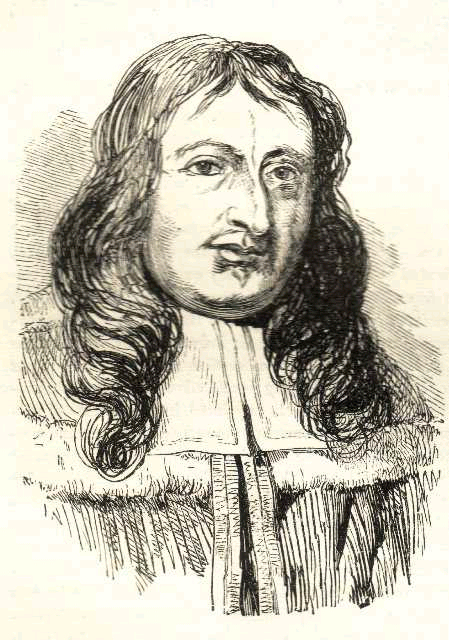
[portrait of Sir John Gilmour]
Sir John Gilmour’s character as a pleader has been drawn by Sir George
Mackenzie, in his famous book of a forensic eloquence, entitled ‘Idea
Eloquentiae Forensis.’
Sir Alexander Gilmour of Craigmillar was created a baronet in 1668. His
son, Sir Alexander Gilmour, second baronet, born 6th December
1657, married the Hon. Grizel Ross, daughter of the eleventh Lord Ross,
and died in October 1731. With several daughters, he had a son, Sir
Charles Gilmour, third baronet, who was elected M.P. for the county of
Edinburgh in 1737. He died at Montpellier, 9th August, 1750.
His son, Sir Alexander Gilmour, fourth baronet, an officer in the foot
guards, was M.P. for Mid Lothian from 1761 to 1774. In 1765 he was
appointed one of the clerks comptrollers of the board of green cloth. He
died unmarried in France, 27th December, 1792, when the
baronetcy became extinct, and the estate of Craigmillar devolved upon
William Charles Little of Liberton, also in the county of Edinburgh, who
thereupon assumed the additional name of Gilmour. This gentleman was
grandson of Helen Gilmour, eldest daughter of Sir Alexander Gilmour, the
second baronet, and the Hon. Grizel Ross, his wife. She had married
William Little of Liberton, and their only child, Grizel Little,
becoming the wife of her cousin, Walter Little of Liberton, had an only
son, the said William Charles Little Gilmour of Craigmillar and Liberton,
who died 1st October 1797, aged 66. He had five sons and
three daughters, The eldest son, Walter Little Gilmour of Craigmillar
and Liberton, married, 6th July, 1805, Miss James Anne
Macdowal, heiress of Canonmills, near Edinburgh, and died 1st
April 1807. With a daughter, Jane, born 29th Aril 1806, he
had a posthumous son, Walter James Little Gilmour of Craigmillar and
Liberton, born 24th April, 1807.
Lieutenant-general Sir Dugald Little Gilmour, of Stonehouse,
Stirlingshire, the youngest of the five sons of Mr. William Charles
Little Gilmour of Craigmillar and Liberton above mentioned, was major of
the 95th regiment of foot, or Rifle corps, which he commanded
in Lord Wellington’s last campaign in Portugal, with the rank of
lieutenant-colonel in the army.



