HAMILTON,
a surname originally derived from the lordship and manor of
Hambledon in Leicestershire, the seat of the ancient family of
Hamilton, the first of whom settled in Scotland in the thirteenth
century. In the time of William the Conqueror, as we learn from the
index to Domesday Book, there were several places in England of the
names of Hameldun, Hameldune, Hameledone, Hameltun, Hameltune, and
Hameledune; and different families of the name were established in
various parts of England, about the time of the early Scottish
Hamiltons, but there is no reason to suppose that any of them
settled in Scotland. A william de Hamilton, who belonged to a
Yorkshire family, is repeatedly taken notice of in the Faedera
Angliae, from 1274 to 1305, being employed in various
negociations and transactions of importance. He was archbishop of
York and lord-chancellor of England during the reign of Edward the
first, and one of the commissioners appointed by that monarch who
met at Upsettlington, near Norham castle, on 2d June 1292, to
determine the claims of the competitors for the Scottish crown. In
Cleland’s ‘Annals of Glasgow,’ vol. ii. p. 484, there is inserted
the translated copy of a charter from Malcolm Canmore (who reigned
between 1057 and 1093) to the masons of Glasgow, granting them very
ample privileges, one of the witnesses to which is designed Andrew
Hamilton, bishop of Glasgow; but the authenticity of the deed is
doubted from the fact that there were no bishops of Glasgow for a
considerable period after this; the first, according to Chalmers,
having been John (preceptor of David I.,) who died in 1147. The
first person of the name in Scotland that can be relied upon was
Walter de Hamilton, usually designed Walterus fulius Gilberti, or
Walter Fitz-Gilbert, and from him the ducal family of Hamilton are
descended. His father, Sir Gilbert Hamilton, is said to have been
the son of Sir William de Hamilton, one of the sons of Robert de
Bellomont, surnamed Blanchemaine, third earl of Leicester, who died
in 1190. The story told by Hector Boece, Lesly, Buchanan, and
others, of the first Hamilton who settled in Scotland having been
obliged to flee from the court of Edward the Second in 1323, for
slaying John Despencer, is quite in character with the legendary
origins of families formerly so universal, and is evidently an
invention. The fable goes on to state that having been closely
pursued in his fight, Hamilton and his servant changed clothes with
two woodcutters, and taking the saws of the workmen, they were in
the act of cutting an oak-tree when his pursuers passed. Perceiving
his servant to notice them, Sir Gilbert cried out to him “Through,”
which word, with the oak-tree and saw through it, he took for his
crest. Sir Gilbert’s son, Sir Walter, however, was settled in
Scotland long before this period. In the chartulary of Paisley he
appears as one of the witnesses to the charter of confirmation by
James, great steward of Scotland, to the monastery of Paisley, of
the privilege of a herring fishery in the Clyde, in 1294; and in
1292, and again in 1296, we find him among the barns who swore
fealty to King Edward the First, for ands lying in Lanarkshire and
different other counties. During the contest which ensued for the
succession to the Scottish crown he adhered to the English or Baliol
interest. By Edward the Second he was appointed governor of the
castle of Bothwell, and he held that important fortress for the
English at the period of the battle of Bannockburn. He is mentioned
by Barbour as “Schyr Waltre gilbertson.” He seems soon after to have
been taken into favour with Robert the Bruce, as that monarch
bestowed on him the barony of Cadyow in Lanarkshire, and several
other lands and baronies in that county, and in Linlithgowshire and
Wigtonshire. He continued faithful to King David Bruce, the son of
his great benefactor, and during his minority he accompanied the
regent Douglas to the relief of Berwick, then threatened with a
siege by the English. He was also present at the battle of
Halidon-hil, where he had a command in the second great body of the
army under the young Stewart. He was twice married. His second wife
was Mary, only daughter of Adam de Gordon, ancestor of al the
Gordons in Scotland. He had two sons: Sir David, and John de
Hamilton, who, marrying Elizabeth, daughter of Alan Stewart of
Dreghorn, got with her the lands of Ballencrief, &c. Of him are
descended the Hamiltons of Innerwick, the earls of Haddington, and
others. Sir Walter had two brothers, Sir John de Hamilton de
Rossaven, and Hugo de Hamilton. The former had a charter from his
nephew, Sir David de Hamilton de Cadyow, of the barony of Fingaltoun
in Renfrewshire, dated in 1339. He was ancestor of the Hamiltons of
Fingaltoun and Preston, from whom are sprung the families of Airdrie
and ellershaw, and from the latter are said to be descended the
Hamiltons of Cairnes, and the Hamiltons of Mount Hamilton in
Ireland.
Sir David
de Hamilton, lord of Cadyow, was, like his father, a faithful
adherent of David the Bruce, and after that monarch’s return from
France, he accompanied him in all his excursions into the northern
counties of England. He was taken prisoner with the king at the
disastrous battle of Durham, 17th October, 1346, but soon
obtained his freedom on payment of a heavy ransom. He is mentioned
as one of the magnates Scotiae, at a meeting of the Estates
held at Scone, 27th March 1371, to settle the succession,
when John earl of Carrick was unanimously acknowledged to be the
eldest lawful son of King Robert the Second, and undoubted heir to
the crown. He had three sons: Sir David, his successor; Walter de
Hamilton, ancestor of the Hamiltons of Cambuskeith and Grange in
Ayrshire; and Alan de Hamilton of Lethberd or Larbert in
Linlithgowshire.
The eldest
son, sir David de Hamilton, was knighted by Robert the Second, who,
in 1377, made him a grant of the lands of Bothwell muir. He died
before 1392. He married Janet or Johanetta de Keith, only daughter
and heiress of the gallant Sir William Keith of Galston, and the
ancestrix, not only of the noble family of Hamilton, but of their
cousins the Stewarts of Darnley, from whom James the First of
England, and the subsequent monarchs of the house of Stuart, were
lineally descended. By this lady he had; with a daughter, Elizabeth,
married to Sir Alexander Fraser of Cowie and dores, ancestor of the
Frasers, Lord Salton; five sons; namely, Sir John, his successor;
George, ancestor of the Hamiltons of Boreland in Ayrshire; William,
ancestor of the Hamiltons of bathgate; Andrew, ancestor of the
Hamiltons of Udston; and John, ancestor of the family of Bardowie.
The eldest
son, Sir John Hamilton of Cadyow, when returning from France, in
1398, with Sir John Hamilton of Fingaltoun, and some other Scottish
gentlemen, was captured at sea by the English. Prompt complaints of
this breach of public faith having been made by the Scottish
government, King Richard the Second issued an order, dated 28th
October 1398, for them to be set at liberty, the ship and cargo
restored, and the damages made good. The following year he was one
of the Scottish commissioners appointed for receiving the oath of
King Richard for the fulfilment of the truce with Scotland; and,
some time after, he was present with the duke of Albany on the
borders, when he and the duke of Lancaster on the part of England,
prolonged the truce between the two countries. With a daughter,
Catherine, married to Sir William Baillie of Lamington, he had three
sons; viz. Sir James, his successor; David, ancestor of the
Hamiltons of Dalserf, Blackburn Green, &c.; and Thomas of Darngaber,
common ancestor of the Hamiltons of Raploch, Milburne, Stanehouse,
Neisland, Torrance, Aikenhead, Dechmont, Barnes, &c., as well as of
the earls of Clanbrassil, and other families of note in Ireland.
Thomas de Hamilton of Darngaber was ordered to be released out of
the Tower of London, having been for some time a prisoner of war.
The order is dated 12th April 1413, immediately after the
accession of King Henry the Fifth.
The eldest
son, Sir James Hamilton, and his next brother, David, obtained
letters of safe-conduct, dated 6th September 1413, from
King Henry the Fourth, to travel into England, as far as the castle
of Calthorpe in Lincolnshire. He was one of the hostages for James
the First, when he was allowed to return to Scotland in 1421, and in
1424 he was one of those who went to London as sureties for their
sovereign. He had five sons, namely, Sir James, his successor, first
Lord Hamilton; Alexander, ancestor of the Hamiltons of Silvertonhill
and Westport; John, designated of Whistleberry; Gavin, provost of
the collegiate church of Bothwell, ancestor of the Hamiltons of
Orbinstoun, progenitor of the Hamiltons of Dalzier, Haggs, Monkland,
Kilbrachmont, Parkhead, Longharmiston, Barr, &c.; and Robert.
James, the
eldest son, was created a lord of parliament by royal charter, on
July 3, 1445, under the title of Lord Hamilton of Cadyow. In 1449,
he was one of the commissioners appointed to meet on the borders and
renew the truce with England. In accordance with the practice of the
age amongst the great landed proprietors of forming collegiate
establishments, Lord Hamilton obtained from Pope Sextus V. authority
to erect the parich church of Hamilton (formery Cadyow) into a
collegiate church, and to add to it a provost and six prebendaries
to a former foundation of two chaplainries in the said church. A new
church having been built in 1732, the old Gothic fabric erected by
his lordship was pulled down, with the exception of one of the
aisles, which now covers the burying vault of the Hamilton family.
In 1450 he accompanied the earl of Douglas on his celebrated tour to
Rome, and after their return to Scotland the following year, he went
with him on a pilgrimage to St. Thomas’ tomb at Canterbury. He
joined the confederacy which Douglas had formed with the earls of
Moray, Crawford, and Ross, and in 1452, when King James invited that
powerful nobleman to the fatal conference in Stirling castle, he
accompanied him to the gate; but on attempting to follow Douglas
within it, he was rudely thrust back by the porter, and drawing his
sword to avenge the insult, his relation, Sir Alexander Livingston,
from within held him back with a long halbert till they got the gate
made fast. Afterwards, when he heard of the murder of Douglas, he
knew that his being denied entrance was done for his safety. A
friend in the castle, privily conveying a pair of spurs to Lord
Hamilton, (a hint for him to escapt,) gave the first intimation to
Douglas’ friends in the town of his fate. As he adhered to the
earl’s brother, Sir James Douglas, who succeeded as ninth and last
earl of Douglas, the king, in November 1454, after ravaging
Douglasdale, proceeded to Lord Hamilton’s lands in Avondale and
Clydesdale, which he also laid waste. He afterwards went to England
to solicit from King Henry the sixth assistance in men and money for
Douglas; but although he failed in his efforts as regarded the earl,
he obtained for himself a considerable sum of money with which, on
his return, he equipped a body of 300 horse and 300 foot. Soon
after, the earl, at the head of 40,000 men, took the field in open
rebellion against his sovereign. He encamped on the south bank of
the Carron, about three miles from the Torwood in Stirlingshire. The
king at the same time advanced from Stirling with an army of 30,000
men. At this crisis, Bishop Kennedy sent a private message to Lord
Hamilton, offering, in the king’s name, a free pardon for all that
was past, and great rewards in future, if he deserted Douglas, and
submitted to the government. Immediately repairing to that nobleman,
as his troops were drawing out from the camp, he represented to him
that as he never would probably again be at the head of a more
numerous and well-appointed force, so he never could have a better
opportunity of fighting the king to advantage; and added, that he
would find it extremely difficult to keep his troops longer
together. The earl haughtily replied, “That if he (Lord Hamilton)
was tired or afraid, he might be gone.” the same night, collecting
his kinsmen and followers, Lord Hamilton carried them over to the
royal camp, and was received by the king with open arms; but, for
the sale of apprearances, he was sent to Roslin castle for a few
days. In consequence of this and other desertions, the earl of
Douglas, with two hundred horse, all that remained to him, hastily
retired to the borders. The following year (1455) he renewed his
depredations on the estates of the royalists, but being overtaken at
Ancrum moor in Teviotdale, by a body of troops under the earl of
Angus and Lord Hamilton, he was routed with great loss, and driven
out of the kingdom. Lord Hamilton subsequenty obtained from his
grateful sovereign grants of extensive territorial possessions in
Lanarkshire and other counties, and among others, of the lands of
Fynnart in Renfrewshire, forfeited by the earl of Douglas. In1455 he
was appointed one of the commissioners on the part of Scotland to
treat of peace, with the Lord Montague and others, on the part of
England; for which purpose they met at York. He was employed again
in 1461, 1471, 1472, and in 1474, in which last year he was one of
the ambassadors extraordinary to the court of England. Two years
thereafter, he was one of the commissioners appointed to meet the
plenipotentiaries of England to prolong the truce, and to negociate
a marriage between the Princess Cicely, the daughter of Edward IV.,
and the duke of Rothesay, prince of Scotland, both of whom were then
in their childhood – a union that never took place. His name appears
frequently in the ‘Acta Dominorum concilii,’ as one of these judges,
during the years 1478 and 1479, in which latter year he died. He was
married, first, to Lady Euphemia Graham, eldest daughter of Patrick
earl of Strathearn, and widow of Arcibald, fifth earl of Douglas and
second duke of touraine; and, secondly, in 1474, to the Princess
Mary, eldest daughter of King James the Second, and widow of Thomas
Boyd, earl of Arran. By the former he had two daughters, Elizabgeth,
married to David, fourth earl of Crawford, created, by James III.,
duke of Montrose, and Agnes, married to Sir James Hamilton of
Preston; and by the latter he had a son, James, 2dLord Hamilton, and
a daughter, Elizabeth, married to Matthew, 2d earl of Lennox. He had
also several natural sons, but of these only are known James de
Hamilton, whose name appears in the succession charter of 1455; Sir
Patrick Hamilton of Kincavel, father of Patrick Hamilton, the
martyr; and John Hamilton of Broomhill. He had also a daughter,
married to Sir John Macfarlane, chief of the clan Macfarlane.
James,
second Lord Hamilton and first earl of Arran, was held in high
estimation by his cousin, King James IV., who made him one of his
privy councillors. In 1503 he was sent, with some other noblemen, to
the court of England, to negociate a marriage betwixt the Princess
Margaret, eldest daughter of Henry VII., and his royal relative,
which was concluded the following year. On this occasion King James
made him a grant of the island of Arran, at the same time creating
him earl thereof, by letters patent, dated 11th August
1503. He also gave him a charter or commission of justiciary with
the island. During the marriage rejoicings, Lord Hamilton and the
celebrated French knight, Anthony D’Arcy, better known by the name
of the Sieur de la Beauté, who was renowned all over Europe for his
martial prowess, tilted together in presence of the whole court, and
after several trials, neither could boast of any advantage over the
other, “only,” says Sir J. Balfour in his Annals, “the Lord
Hamilton, one day at Falkland, was judged to have the honour, which
La Beauté did impute to his own indisposition of body that day.” The
same year (1504) he was appointed to the command of a force of
10,000 men which James IV. Sent to the assistance of the king of
Denmark, when engaged in hostilities with the Swedes and Norwegians.
In 1507, with the archbishop of St. Andrews, he was sent as
ambassador to France. On his return through England, the following
year, accompanied by his natural brother, Sir Patrick Hamilton, he
was arrested in Kent by Vaughan, an officer of Henry the Eighth. He
was at first treated with distinction, bt, on his refusal to swear
fidelity to King Henry, he was committed to the custody of a guard.
The English monarch having sent an envoy to Scotland to vindicate
himself, King James desired this ambassador to inform his master
that he highly approved of the earl’s conduct in refusing to swear
fealty to England; adding, that to obtain the freedom of his
kinsman, he would delay the renewal of the league with France, if he
were released. In June following, the bishop of Moray repaired to
London again to solicit his libertion, but without effect; and it
appears that he was not set at liberty till towards the end of that
year. During his residence in England, his brother, Sir Patrick
(whom Andréof Toulouse, in his Diary for the year 1508, styles a
most famous knight,) vanquished, in single combat, an Irish
gentleman of eminent skill in arms. Soon after, the earl was
appointed to the command of a body of auxiliaries which was sent to
the assistance of Louis the Twelfth of France, who, for the
seasonable aid thus rendered him, settled an annual pension on the
earl for life, besides making him many valuable presents. On his
return to Scotland, he was driven by stress of weather into the port
of Carrickfergus in Ireland; but the inhabitants of that place
having maltreated his men, the earl landed a choice body of his
sailors, assaulted and stormed the town, and gave it up to be
plundered.
During his
absence on this expedition, James the Fourth, with the flower of his
obility, had been slain at Flodden, and the queen-mother had been
declared regent of the kingdom. On her resignation of that office,
soon after, an assembly of the estates was held at Perth to elect a
new regent, when the voices were much divided between the duke of
Albany, then in France, and the earl of Arran. Through the
influence, however, of Elphinston, bishop of Aberdeen, and Lord
Home, the former was elected, and Sir Patrick Hamilton and the Lyon
King at arms sent to France, to notify the election to him. In 1515,
after Albany had taken prisoner Lord Home, whose overgrown power and
turbulent disposition had become dangerous to the state, he
committed him to the custody of the earl of Arran, governor of the
castle of Edinburgh. The latter, who disliked the regent, was easily
persuaded by Home to retire with him to the borders, where they
commenced hostilities, on which he was required to surrender himself
within fifteen days, to avoid being proclaimed a rebel as Home and
his brother had been. At the same time, the regent, at the head of a
select body of troops, and a small train of artillery, proceeded to
invest the castle of Cadyow, the earl’s principal stronghold, and
required its immediate surrender. His mother, the Princess Mary,
aunt of Albany, resided at that time in Cadyow castle, and on her
solicitation the regent consented to pardon Arran, on his returning
to his duty, which he accordingly did. In the following year, at the
instigation of the English king, Arran, who still aimed at the
regency, associated with the earls of Glencairn, Lennox, and the
majority of the noblemen and gentlemen of the west, and seized the
royal magazines at Glasgow. They also sent a body of troops to take
possession of some French ships, with supplies of arms and
ammunition for Albany, which had arrived in the Clyde. The vessels,
however, had sailed, but a quantity of gunpowder and other
ammunition landed from them, they brought to Glasgow, where, lest it
might fall into the hands of their enemies, the powder was thrown
into a draw-well. The earl of Arran, at the same tie, by a stratagem
made himself master of the castle of Dumbarton, expelling Lord
Erskine, the governor. An accommodation, however, between the regent
and the leaders of the malcontents was soon brought about, chiefly
through the means of Forman, archbishop of Glasgow. In 1517, on
Albany’s departure for France, Arran was constituted
lieutenant-general and one of the lords of the regency, and, on the
murder of the Sieur de la Beauté, warden of the marches. In the
latter capacity he committed to prison Sir George Douglas, the
brother of Angus, and Mark Ker, for some misdemeanor, and took
possession of the castles of Hume, Wedderburne, and Langton. By the
members of the regency he had been elected their president, but was,
upon all occasions, opposed by the earl of Angus. Having, in 1519,
while the plague raged at Edinburg, conveyed the young king, for
greater security, to the castle of Dalkeith, he was, on his return
to Edinburgh, denied entrance by the citizens, on the instigation of
Angus, and the gates shut against him. His followers and those of
Angus had a fierce encounter on the High Street of Edinburgh, 30th
April 1520, when several were slain on both sides, and the Hamilton
party obliged to disperse. Arran himself and his son, Sir James
Hamilton, fighting their way through the melee, retired down a wynd
on the north side of the High Street, where, finding a coal-horse
standing, they threw off his burden, and rode through the North
Loch, at a shallow place, no one thinking of pursuing them that way.
Among those slain were Sir Patrick Hamilton of Kincavel, already
mentioned, and Sir James Hamilton, younger of Preston. In 1523 Arran
joined the queen dowager in opposing the regent, and after the final
retirement of the latter to France the following year, he had again
the chief direction of affairs under the king. In 1526, however, on
Angus obtaining the superiority, he retired for a time from court to
his estates, but on the 4th September of that year, he
commanded the royal ary against his nephew, the earl of Lennox, at
the battle near Linlithgow, where the latter was slain by Sir James
Hamilton of Finnart. On the forfeiture of Angus he had a charter of
the lordship of Bothwell, 16th November 1528. He died
before 21st July 1529. He married, first, Beatrix,
daughter of John, Lord Drummond, by whom he had a daughter, married
to Andrew Stewart., Lord Evandale and Ochiltree, whose grandson was
the notorious favourite of James the Sixth, Captain James Stewart,
the titular earl of Arran. He married, secondy, Elizabeth, sister of
Alexander Lord Home, by whom he had no issue. It being found that
this lady’s former husband, Sir Thomas Hay, of the family of Yester,
who had gone abroad and was supposed to be dead, was alive, a
sentence of divorce was pronounced in 1513. He married, thirdly,
Janet, daughter of Sir David Bethune of Creich, comptroller of
Scotland, niece of Cardinal Bethune, and widow of Sir Thomas
Livingston of Easter Wemyss, and by her had, with four daughters,
two sons, namely, James, second earl of Arran, regent of Scotland
and duke of Chatelherault, of whom a memoir is given afterwards, and
Gavin. He had also four natural sons and one natural daughter. The
sons were, Sir James Hamilton of Finnart, already mentioned,
ancestor of the Hamiltons of Evandale, Crawfordjohn, Gilkerscleugh,
&c.; sir John Hamilton of Clydesdale, ancestor of the Hamiltons of
Samuelston; James Hamilton of Parkhill; and John, archbishop of St.
Andrews, executed at Stirling 1st April, 1570. According
to Knox and Buchanan, however, the paternity of the last was
doubtful.
James,
second earl of Arran, and duke of Chatelherault, married Lady
Margaret Douglas, eldest daughter of the third earl of Morton, and
by her had, with four daughters, four sons, namely, James, third
earl of Arran; John, Marquis of Hamilton; Lord David Hamilton, who
died without issue in March 1611; and Lord Claud, ancestor of thte
earls of Abercorn. (Marquises of Abercorn, peerage of Great Britain,
1790).
James,
third earl of Arran, succeeded his father in 1575. The dukedom of
Chatelherault, having been resumed by the crown of France, did not
descend to him. He was in the castle of St. Andrews when Cardinal
Bethune was assassinated in 1546, and was detained prisoner there by
the conspirators. As his father was the presumptive heir to the
crown, on the 14th August 1546, the Estates of the
kingdom passed an act declaring him to be secluded from the
succession as long as he happened to be in the hands of those that
committed the slaughter of the cardinal, or of any enemies of the
realm. He was released on the surrender of the conspirators to the
French, and in 1555, he went over to France, where he obtained the
command of the Scottish guards. Having become a convert to the
reformed doctrines, a plot against his life was formed by the
princes of Lorraine, but entertaining suspicions of the design from
some expressions dropped by the cardinal of Lorraine, he hastily
quitted France in 1559, and on his way home visited the court of
Queen Elizabeth. In 1560, the Scottish Estates proposed the earl of
Arran as a husband to that princess, but with great professions of
regard she declined the alliance. The following year, on the arrival
from France of his own sovereign, Queen Mary, he openly aspired to
her hand, and on her part she showed great partiality for him, but
by his most imprudently opposing the exercise of her religion, he
forfeited her favour altogether. His love, inflamed by
disappointment, gradually undermined his reason, and he was
declared, by a cognition of inquest, to be insane. When his
brothers, Lord John and Lord Claud Hamilton were attainted in 1579,
the earl, though incapable, from his situation, of committing any
crime, was involved, by a shameful abuse of law, in the common ruyin
of his house. He had continued to live secluded at the castle of
Craignethan, under the care of some faithful servants of the family,
but a party being sent to demand the surrender of that fortress, his
servants, after making what defence they could, were forced to
yield, and the earl, with his aged mother, the duchess of
Chatelherault, sent to Linlithgow and placed under the custody of
one Captain Lambie, the same miscreant who insulted Queen Mary on
her surrender at Carberry Hill, a creature of Morton’s, and a most
inveterate enemy of the house of Hamilton. Captain James Stewart,
grandson of Lady Margaret Hamilton, already mentioned, was appointed
his tutor, and afterwards, in 1581, under pretence that he was the
lawful heir of the family, he was created earl of Arran, which title
he held, along with the estates of the Hamilton family, until his
downfall in 1585, when they were restored to the rightful owner.
James Hamilton, third earl of Arran, died without issue in March
1609, and was succeeded by his nephew, James, second marquis of
Hamilton.
Lord John,
the second son of the regent duke of Chatelherault, and first
marquis of Hamilton, born in 1532, had the commendatory of the rich
abbey of Aberbrothwick conferred on him in 1541. When Queen Mar was
imprisoned in 1567, he entered into an association for endeavouring
to procure her liberty; and on her escape from Lochleven castle in
May of the following year, she hastened to Hamilton, where, in a few
days, she was joined by a splendid train of nobles, accompanied by
such numbers of followers as formed an army of 6,000 men, But the
defeat at Langside, the same month, disconcerted all the measures of
her friends. On the death of his father in 1575, the family estates
devolved on Lord John. His lordship and his brother, Lord Claud,
commendator of Paisley, suspected of being accessory to the murder
of the regents Moray and Lennox, had been included in a general bill
of attainder on that account, and in 1579, at the instigation of the
regent Morton, it was resolved, without trial or the examination of
any witnesses, to put it in force against them. Timely information
having reached the brothers of their dander, they made their escape,
but the castle of Cadyow was besieged and taken, and completely
demolished. The garrison, with their hands tied behind their backs,
were led prisoners t Stirling, where their captain, Arthur Hamilton
of Merritoun, was publicly executed. The whole of the Hamilton
estates were confiscated, and the most cruel and oppressive
proceedings directed against almost all the gentlemen of the name, a
number of whom fled from their homes. Lord John Hamilton, disguised
as a seaman, retired to France, where he was kindly received by the
archbishop of Glasgow, ambassador at the French court for Queen
Mary. His refusal to change his religion lost him the favour of that
bigoted court, on which he returned to England, and joined his
brother Lord Claud, who had found a secure asylum at Widdrington, in
the north of England, with a relation of the earl of Northumberland.
In 1585, they returned to Scotland, with the other exiled nobles,
and being admitted into King James’ presence at Stirling, Lord John
Hamilton, in name of the others, said, “That they were come, in all
humility, to beg his majesty’s love and favour.” The king answered,
“My lord, I did never see you before, and must confess that of al
this company you have been most wronged. You were a faithful servant
to my mother in my minority, and, when I understood not, as I do
now, the estate of things, hardly used.” They were immediately
restored to their estates and honours, and in a parliament held at
Linlithgow in December of the same year, an act of oblivion for all
that was past, was solemnly ratified. Lord John was sworn a privy
councillor and made governor of Dumbarton castle. In 1587, while the
unfortunate Queen Mary was under sentence of death, she took a ring
from her finger, which she ordered one of her attendants to deiver
to Lord John Hamilton, and tell him it was all that she had left to
witness her great sence of his family’s constant fidelity to her,
and desired that it should always be kept in the family, as a
lasting evidence of her regard towards them. This ring is still
preserved in the charter-room at Hamilton palace. In 1589, when the
king went to Denmark to bring home his young queen, the Princess
Anne, he nominated Lord John Hamilton lieutenant of the three
wardenries of the marches, and of the whole of the south of
Scotland. The queen, on her arrival, was crowned, with great pomp,
in the abbey church of Holyrood, by the earl of Lennox and Lord
John.
In 1593,
he accompanied the king in his expedition to the north against the
popish lords, after the battle of Glenlivet. On this occasion he
claimed the leading of the vanguard, which the earl of Angus
opposed, alleging that this honour, of right, belonged to him, being
the ancient privilege of the Douglases. The king decided that Lord
John should have the command at this time, but which should not in
any manner impugn the rights and privileges of the house of Douglas.
Lord John sat as one of the jury upon the trial of the earls of
Huntly, Bothwell, and Crawford, when they were found guilty, and
sent to separate prisons. Calderwood has recorded a curious
conversation betwixt the king and Lord John, on the subject of the
excommunication of the popish lords. Having failed in his efforts
with the Edinburgh clergy to prevent the intimation of the sentence
in that city, James paid a visit to Hamilton palace, for the purpose
of sounding that nobleman in the matter. “You see, my lord,” he
said, “how I am used, and have no man in whom I may trust more than
in Huntly. If I receive him, the ministers will cry out that I am an
apostate from the religion, – if not, I am left desolate.” “If he
and the rest be not enemies to the religion,” replied his lordship,
“you may receive them, – if otherwise, not.” “I cannot tell,” said
his majesty, “what to make of that, – but the ministers hold them
for enemies. Always I would think it good that they enjoyed liberty
of conscience.” Upon this Lord Hailton exclaimed, “Sir, then we are
all gone! Then we are all gone! Then we are all gone! If there were
no more to withstand them than I, I will withstand.” The king,
perceiving his servants approach, put an end to the conversation by
saying, with a smile, “My lord, I did this to try your mind.” In
1596, when the clergy, preaching against the king’s government and
measures, forced him to leave Edinburgh, Bruce and Balcanquhal, two
of their number, in name of the others, invited Lord John, then at
Hamilton, to repair to Edinburgh and place himself at their head.
Hastening to the king at Linlithgow, he placed the letter in his
hands. He was created Marquis of Hamilton at Holyroodhouse 17th
April 1599. So great was King James’ regard for him that he
requested him to stand godfather to one of his children, and he
often visited him at Hamilton. He died 12th April, 1604,
in his 72d year. He married Margaret, only daughter of the eighth
Lord Glammis, widow of the fourth earl of Cassillis, and by this
lady, who survived him many years, he had two sons, Edward, who died
young, and James, second marquis of Hamilton; and one daughter, Lady
Margaret, the wife of the eighth Lord Maxwell. He had a natural son,
Sir John Hamilton of Lettrick, father of the first Lord Bargeny, and
a natural daughter, Jean, who was contracted in marriage to Sir
Umfra Colquhoun of Luss.
James,
second marquis of Hamilton, born in 1589, succeeded his father in
1604, and his uncle, the earl of Arran, in May 1609, in his estates
and in the hereditary office of sheriff of Lanarkshire. Besides
being made one of the gentlemen of the king’s bedchamber, he was on
14th January 1613, appointed one of the lords of the
privy council, and lord steward of the household; and on 16th
June 1619, he was created a peer of England by the title of Earl of
Cambridge and Lord Innerdale, titles that had never before been
converred on any but such as were of the blood royal. And here it
becomes necessar to correct an “historical error” that is almost
universaly held, namely, that after the present royal family the
house of Hamilton is heir to the Scottish crown, and of consequence
to the throne of Great Britain, as by the act of Union it is for
ever provided that whosoever is heir to the throne of Scotland shall
be heir also to the throne of the United Kingdom, and vice versa.
During the period of nearly a century (previous to the birth of
children of the marriage of the Princess Elizabeth, which took place
in 1613) the head of the Hamilton family was undoubtedly the next
heir to the Scottish crown. As such, in the year 1542, an act was
passed in the Estates of Scotland, by which “all the lordis
sperituale, temporale, and commissaris of burrowis, representand the
thre estatis of parliament, declarit and declaris James, earle of
Arrane, Lord Hailton (ancestor of the duke of Hamilton) second
persoun of this realme, and narrest to succede to the crown
of the samin, falyeing of our suirane lady (Queen Mary) and the
barnis lauchfullie to be gotten of hir body.” And again, in 1546, as
already stated, the three estates solemnly recognised the eldest son
of the earl of Arran as “the third persoun of the realm,” and
acknowledged “all his rychtis of successionis alsweill of the crowne
as of others.” The head of the house of Hamilton remained in this
distinguished position of “second person of the realm,” or heir
presumptive to the crown, until the birth of King James the Sixth
interposed a third person between him and the throne. After the
dethronement of Queen Mary, the house of Hamilton again reverted to
its pre-eminence of being next heir to the crown, and held that high
position until the numerous issue of King James the Sixth removed
them to a distance in the order of succession. By the act of Union,
confirming
previous acts of succession and settlement of the crown, it is
enacted “that the succession of the monarchy of Great Britain, after
Queen Anne, and in default of issue of her majesty, be, and remain,
and continue, to the most excellent Princess Sophia, (the daughter
of the Princess Elizabeth, queen of Bohemia, daughter of King James
the Sixth of Scotland), and the heirs of her body, being Protestats.”
It is under the provisions of this act that Queen Victoria and her
royal family, as heirs of King George the First, the eldest son of
the Princess Sophia, now hold the crown of the United Kingdom, and
under the same act, in the event of the failure of the present royal
family, the succession to the crown would open up to the next
immediate heirs descended of the body of the Princess Sophia. These
are very numerous. With every day, therefore, the “historical error”
or popular fallacy, of representing the noble house of Hamilton as
“after the royal family, heir to the Scottish crown,” becomes
greater and greater. Their boarst is that they once were the
presumptive heirs to the ancient kingdom of Scotland, and that they
still inherit the royal blood of its long line of sovereigns.
The second
marquis of Hamilton, chosen a knight of the Garter at Whitehall, 9th
February 1621, was high commissioner to the Scottish parliament the
same year, in which the five articles of Perth, so obnoxious to the
presbyterian party, were ratified by a majority of 27. He died at
Whitehall, London, 2d March 1625, in his 36th year, a few
days before King James. As he was sais to have been poisoned by the
duke of Buckingham, with whom he had some difference, three medical
men were appointed to examine his body. Two of them declared that he
had not been poisoned, but the third, Dr. Eglisham, affirmed that he
had, and hesitated not to impute the crime to Buckingham. He was
obliged in consequence to leave England, when he retired to
Flanders, where he published his opinions in the shape of a
pamphlet. The marquis married Lady Anne Cunninghame, fourth daughter
of the seventh earl of Glencairn. Of a firm and masculine spirit,
this lady, who long survived her husband, distinguished herself on
the side of the Covenanters, her father’s family having ever been
warm friends of the presbyterian interest. In 1633, when her son
conducted the English fleet to the forth, to overawe the
Covenanters, she appeared among them on the shore at Leith, and the
head of a troop of horse, and drawing a pistol from her saddlebow,
declared she would be the first to shoot her son, should he presume
to land and attack his countrymen and his country. With three
daughters, the second marquis had two sons, James, third marquis,
and first duke of Hamilton, and William, earl of Lanark, second duke
of Hamilton.
_____
HAMILTON, Duke
of, a title in the peerage of Scotland, conferred, with that of
marquis of Clydesdale, in 1643, on James, earl of Arran, the elder
son of the second marquis of Hamilton, and now held by the Douglas
family, through the marriage of Anne, duchess of Hamilton, niece and
successor of the second duke, with the earl of Selkirk. Of the first
duke of Hamilton, a memoir is afterwards given. His grace having
only surviving daughters, was succeeded by his brother, William,
earl of Lanark.
William,
second duke of Hamilton, was born at Hamilton, December 14, 1616,
and received his education at the university of Glasgow. He
afterwards travelled on the Continent, and resided for some time at
the French court. On his return, in 1637, he became a great
favourite with Charles the First and his queen. On the last day of
March 1639, he was created a Scottish peer by the titles of earl of
Lanark, Lord Machanshyre and Polmont, and in 1640 was made secretary
of state for Scotland. In 1644, he was, by the king’s order,
arrested with his brother the duke, at Oxford, on the false
representation of their enemies. The duke was sent prisoner first to
Pendennis castle in Cornwall, and afterwards to St. Michael’s Mount,
where, two years after, he was set at liberty by some of the
parliament forces. The earl of Lanark, who was to be sent to Ludlow
castle in Wales, made his escape, and went to London, whence he
returned to Scotland, where he made it clearly appear that,
notwithstanding the hard usage he had experienced, he continued as
steadfast to the cause of the king as ever. In 1646, when the king
put himself into the hands of the Scottish army at Newcastle, he was
one of the commissioners sent by the Scots Estates to confer with
his majesty, when he used his utmost endeavours to induce Charles to
agree to the terms submitted to him, but in vain. When his brother
marched into England in 1648, he was appointed commander-in-chief of
the forces in Scotland. Being soon afterwards deprived, by the act
of Classes, of all his public employments for his adherence to “the
Engagement,” he retired to Holland; but he had scarcely arrived
there, when he received the sad intelligence of the execution of his
royal master, and soon after of that of his brother, whom he
succeeded in his titles and estates. In 1650 he accompanied Charles
the Second to Scotland; but was excluded by parliament from the
king’s councils, and not suffered to remain with his majesty. He
retired in consequence to the island of Arran, where he remained
till the end of January 1651, when he was permitted to go to court,
and was received with much distinction by the king.
When the
march into England was decided upon, the duke obtained liberty to
raise a troop of horse, and he soon collected about a hundred men.
He afterwards raised seven other troops, who joined the royal army
at Moffat, previously to its entering England, which it did by the
western marches. At Warrington bridge the royalists defeated General
Lambert, who had been sent against them. The duke accompanied the
king on the whole march until they came to Worcester. Here they
found themselves surrounded by an army of 30,000 men, commanded by
Cromwell in person, who, attacking the royal forces, met with little
resistance, except from General Middleton and the duke of Hamilton.
The duke behaved with uncommon bravery, and charged repeatedly at
the head of his regiment; but he was at last wounded and taken
prisoner. Of this wound he died, September 12, 1651, nine days after
the battle; and his remains were interred in the cathedral church of
Worcester.
He had
married in 1638, Lady Elizabeth Maxwell, eldest daughter and
coheiress of James, earl of Dirleton, and by her had, James, Lord
Polmont, who died an infant, and five daughters, one of whom died
young. The dukedom of Hamilton, with the titles and estates,
devolved on his niece, Anne, duchess of Hamilton. By Cromwell’s act
of grace and pardon, 1654, William duke of Hamilton, deceased, was
excepted from all benefit thereof, and his estates were forfeited,
reserving out of them £400 a-year to his duchess, during her life,
and after her death £100 to each of his surviving daughters. The
English titles of earl of Cambridge and Lord Innerdale, granted to
his father, the second marquis, in 1619, with limitation to the
heirs male of his body, became extinct with him; but the Scottish
honours of the same, included in the patent of the dukedom granted
to his brother in 1643, descended to his niece along with the other
titles.
Anne,
duchess of Hamilton, eldest surviving daughter of James, first duke
of Hamilton, was born about 1636. She married Lord William Douglas,
eldest son of William, first marquis of Douglas, born 24th
December 1634, and created earl of Selkirk, Lord Daer and
Shortcleugh, 4th August, 1646. He was fined £1,000 by
Cromwell’s act of grace and pardon of 1651. On the restoration, in
consequence of a petition from the duchess, he was created duke of
Hamilton for life, 12th October, 1660, and at the same
time sworn a privy councillor. His prudent management enabled him in
the course of a few years to pay off the accumulated debts with
which the Hamilton family were at that time burdened; and in the
parliament of 1673, he distinguished himself by his opposition to
Lauderdale. He and the other leaders of his party went to London, to
represent their grievances to the king, and received from him full
assurances of redress, but on their return to Scotland, they found
that the parliament was dissolved. This excited such popular
discontent that the assassination of Lauderdale was contemplated,
and only averted by the advice of the duke of Hamilton. He was again
invited to court with his friends, when they requested a hearing
from the king, but were desired to present their complaints in
writing, which they declined, knowing well that the most cautious
statement of grievances it was possible to frame would to protect
them from the statute of leasing-making. In the following year
Lauderdale’s opponents were displaced from council, with the
exception of the duke of Hamilton, who, however, was removed in
1676, for opposing the sentence against Baillie of Jerviswood. In
1678, the duke and thirteen other peers repaired to London, to
complain to the king of Lauderdale’s arbitrary proceedings, but as
they had left Scotland without permission, an audience was refused.
They were at length heard in presence of the cabinet council, and
being again required to produce their complaints against Lauderdale
in writing, which they declined to do without a previous indemnity,
the king declared his full approbation of Lauderdale’s proceedings.
On the breaking out of the insurrection in Scotland in 1679, the
duke and the Scottish lords then in London, generously offered to
suppress it, without arms or the shedding of blood, if the
grievances of the people were redressed, but their assistance was
rejected. They afterwards obtained an audience, and were fully heard
on their complaints against Lauderdale, but in vain.
In 1692,
after the fall of that unprincipled minister, his grace was invested
with the order of the Garter; and on the accession of James the
Seventh, he was sworn a privy councillor of Scotland, and appointed
one of the commissioners of the Treasury. He was constituted an
extraordinary lord of session, 26th March 1686, and sworn
a member of the English privy council, 14th April 1687.
On the arrival of the prince of Orange in London the following year,
he was elected president at a meeting of the Scottish nobility and
gentry then in that city, when they framed an address, requesting
the prince to assume the government and call a convention of the
Estates at Edinburgh. This convention was accordingly held 14th
March 1689. The duke was chosen president of the meeting which
declared the throne vacant, and tendered the crown to King William
and Queen Mary. His grace was constituted lord high commissioner to
King William’s first parliament in the following June, and was also
president of the council and high admiral of Scotland. He was again
high commissioner to the parliament which met 18th April
1693, and on 19th December following re-appointed an
extraordinary lord of session. He died at Holyroodhouse, 18th
April 1694, in his 60th year. His wife, Anne, duchess of
Hamilton, survived him till 1717. She resigned her titles in favour
of her eldest son, the earl of Arran, who was accordingly created
duke of Hamilton, with the original precedency. They had, with four
daughters, seven sons, namely, James, fourth duke of Hamilton; Lord
William, who died in France, without issue; Lord Charles, earl of
Selkirk (See SELKIRK, earl of); Lord John, earl of Ruglen (see
RUGLEN, earl of); Lord George, earl of Orkney (see ORKNEY, earl of);
Lord Basin (for whom see SELKIRK, earl of); and Lord Archibald. The
latter, Lord Archibald Hamilton of Riccarton and Pardovan, a
distinguished naval office, master and one of the commissioners of
Greenwith Hospital, who died 5th April 1754, was father
of the Right Hon. Sir William Hamilton, long British ambassador at
Naples, of whom a memoir is afterwards given.
Of James,
fourth duke of Hamilton, and first duke of Brandon in the peerage of
the United Kingdom, a memoir is afterwards given. He was twice
married, and with six daughters, had three sons. The latter, with
four of the daughters, he had by his second wife. The sons were,
James, fifth duke; Lord William, M.P. for Lanarkshire, who died in
July 1734; and Lord Anne, so called after Queen Anne, his godmother,
an ensign in the army, who died in France in December 1748. By Lady
Barbara Fitzroy, third daughter of Charles the Second and the
duchess of Cleveland, his grace, then earl of Arran, had a natural
son, Charles Hamilton, born at Cleveland House, 30th
March 1691, during his father’s confinement in the Tower, as
afterwards related. Incensed at the discovery of this intrigue, the
queen, and the earl’s father, the duke of Hamilton, made the retreat
of Lady Barbara to the Continent the principal condition of his
release from the Tower. She accordingly withdrew to the nunnery of
Pontoise, where she died. Her son was reared at Chiswick by his
grandmother the duchess of Cleveland, and afterwards sent to France,
where his education was intrusted to the earl of Middleton,
secretary of state to the exiled monarch. He was held in great
consideration by the court of St. Germains, where he was styled
count of Arran. After the death of his father, who was killed in a
duel with Lord Mohun, in 1712, he went to Antwerp, and sent a
challenge to General Macartney, Mohun’s second, but it was not
accepted. He subsequently went to Switzerland, where he divided his
time betwixt the pursuits of alchemy, and a friendly intercourse
with the Earl Marischal of Scotland, then in exile. He was the
author of ‘Transactions during the reign of Queen Anne, from the
union to the death of that princess,’ published by his son at London
in one volume, 1790, 8vo. He died at Paris, 13th August,
1754, aged 64, and was buried at Montmartre. He had married in 1737
Antoinette Courtney of Archambaud, by whom he had an only child,
Charles Hamilton, born at Edinburgh 16th July, 1738,
captain in the service of the East India Company, and died at
Holyroodhouse 9th April 1800, aged 62. He was the author
of ‘The Patriot; a Tragedy, altered from the Italian of Metastasio,’
London, 1784, 8vo; ‘An Historical Relation of the Origin, Progress,
and Final Dissolution of the Government of the Rokilla Afghans, in
the Northern Provinces of Hindostan, compiled from a Persian MS. And
other original papers,’ Lond. 1787, 8vo; ‘Hedaya, or Guide; a
Commentary on the Mussulman Laws, translated by order of the
Governor-General and Council of Bengal,’ London, 1791, 4 vols. 4to.
James,
fifth duke of Hamilton, and second duke of Brandon, born about 1702,
succeeded his father when he was only 10 years old. He was installed
a knight of the Thistle at Holyroodhouse 31st October
1726, and appointed in 1727 one of the lords of the bedchamber to
King George the Second; but resigned that office in 1733, not
approving of the measures of Sir Robert Walpole’s administration. At
the general election in 1734, he was a candidate to represent the
Scottish peerage, in opposition to the court list, and died at Bath
9th March 1743, in his 41st year. He was
thrice married; first, to Lady Anne Cochrane, eldest of the three
beautiful daughters of John fourth earl of Dundonald; secondly, to
Elizabeth, fourth daughter of Thomas Strangeways of Melbury Sampford,
Dorsetshire; and, thirdly, to Anne, daughter and co-heir of Edward
Spenser of Redlesham in Suffolk. By his first duchess he had a son,
James, sixth duke of Hamilton, and by his third, a daughter, Anne,
countess of Donegal, and two sons, Archibald, ninth duke of
Hamilton, and Lord Spencer Hamilton, colonel in the guards and one
of the gentlemen of the bedchamber to the prince of Wales, who died
20th March 1791, in his 49th year.
James,
sixth duke of Hamilton, and third duke of Brandon, born in 1724,
succeeded his father in 1743, and was invested with the order of the
thistle, 14th March 1755. He died of inflammation in the
chest, caught in hunting, after a few days’ illness, at Great Tew in
Oxfordshire, on 18th January 1758, in his 34th
year. He married Elizabeth, second daughter of John Gunning of
Castle Coote, in the county of Roscommon, Ireland, one of the three
beautiful Misses Gunning, and by her had a daughter, Lady Elizabeth,
countess of Derby; James-George, seventh duke of Hamilton; and
Douglas, eighth duke. The widowed duchess married, secondly, 3d
March 1759, John, fifth duke of Argyle, and was created a peeress of
Great Britain, 4th May 1766, by the title of Baroness
Hamilton of Hameldon, in the count of Leicester, with the dignity of
Baron Hamilton to the heirs male of her body. She died in 1790.
James-George, seventh duke of Hamilton, and fourth duke of Brandon,
born at Holyroodhouse, 18th February 1755, succeeded his
father when only three years old. On the death of Archibald, duke of
Douglas, in 1761, he became the male representative and chief of the
illustrious house of Douglas, and succeeded to the titles of marquis
of Douglas, earl of Angus, and lord of Abernethy and Jedburgh
Forest. His guardians having asserted his right to the Douglas
estates as male representative of that family, under the belief that
Mr. Douglas, born at Paris, son and heir of Lady Jane Stewart,
sister of the last duke of Douglas, was a supposititious child, the
protracted lawsuit, known as “the great Douglas cause,” was the
consequence. In Paris it was decided in favour of the duke of
Hamilton, and the claim was again sustained by the court of session
in Scotland; but on appeal to the House of Lords, it was ultimately
decided in favour of Mr. Douglas, afterwards created a peer of the
United Kingdom by the title of Lord Douglas of Douglas. Outgrowing
his strength, the duke of Hamilton died at Hamilton palace, 7th
July 1769, in his 15th year. On his monument in the
family cemetery, is a poetical inscription by Dr. Moore, (father of
Sir John Moore,) who had attended his grace to the Continent, and
resided with him.
Douglas,
eighth duke of Hamilton, and fifth duke of Brandon, born 24th
July 1756, succeeded his brother in 1769. In his travels on the
Continent he was attended by Dr. Moore, whose work, in four volumes,
8vo, entitled ‘A View of Society and Manners in France and Italy,’
contains an account of their excursion. The duke came of age in
1777, when he raised the 82d regiment of foot, which highly
distinguished itself in the American war, and in which he accepted a
captain’s commission, but resigned it in 1779. He had a grant of the
offices of keeper of the palace of Linlithgow and castle of
Blackness 25th November 1777, and a further grant of the
same, with power to appoint deputies, 10th January, 1778.
Having presented a petition to the king for a summons to parliament
as duke of Brandon, his majesty, after a reference to the House of
Lords, and the opinion of the twelve judges being taken that the 23d
article of the Union did not debar the creation of peers of Scotland
peers of Great Britain, on 11th June, 1782, caused a
summons to be issued accordingly, and his grace, as duke of Brandon,
took his seat in the house of peers, of which his family had been
for so many years deprived. In 1785, he moved the address of thanks
for the king’s speech, and the following year he was invested with
the order of the Thistle. In 1798 he was appointed colonel of the
militia and lord-lieutenant of the county of Lanark. He died 2d
August 1799, in his 44th year. He had married Elizabeth
Anne, sister of Peter, Lord Gwydir, but having no issue by her, was
succeeded by his uncle, Lord Archibald Hamilton, in al his titles,
except that of Lord Hamilton of Hameldon in Leicestershire, which in
right of his mother went to his brother uterine the marquis of Lorn,
afterwards duke of Argyle.
Archibald,
ninth duke of Hamilton, and sixth duke of Brandon, born 15th
July 1740, inherited through his mother and grandmother, extensive
property in the county of Suffolk, and in Lancashire, and
Staffordshire. At the general election of 1768, he was elected M.P.
for the county of Lancaster, but vacated his seat in 1772. He died
16th February 1819. He had married in 1765, Lady Harriet
Stewart, 5th daughter of 6th earl of Galloway,
and by her, who died in 1788, before her husband’s accession to the
ducal titles, he had 3 daughters and 2 sons; Alexander tenth duke,
and Lord Archibald Hamilton.
The
latter, born March 16, 1769, distinguished himself as a political
reformer and as an active and eloquent public speaker. Chosen, in
1802 M.P. for Lanarkshire, he continued to represent that county
till his death, taking a prominent part against the Pitt, Addington,
and other Tory governments. In 1804 he published a pamphlet entitled
‘thoughts on the Formation of the late and Present Administrations,’
contending for a ministry on a broad and firm basis, and examining
how far that of Mr. Pitt answered the idea. He invariably
endeavoured to correct abuses, and is exertions in the cause of
burgh reform, made his name in his time very popular in Scotland. He
died unmarried Aug. 28, 1827. His sister, Lady Anne Hamilton, eldest
daughter of the 9th duke, was the confidential friend and
companion of Queen Caroline, wife of George IV., and enjoyed no
small amount of popularity for her adherence to that unfortunate
princess. She died Oct. 10, 1846. Lady Charlotte, the next daughter,
became duchess of Somerset, and died June 10, 1827. Lady Susan, the
youngest, married her cousin, the earl of Dunmore, and died May 24,
1846.
Alexander,
10th duke of Hamilton, and 7th of Brandon, the
elder son of the 9th duke, born Oct. 3, 1767, in early
life spent many years in Italy, where he acquired considerable taste
in the fine arts. In 1801 he returned home, and the following year
he was appointed colonel of the Royal Lanarkshire militia, and lord
lieutenant of that county. Till he reached the advanced age of
fifty-two, he bore the courtesy title of marquis of Douglas and
Clydesdale. At the general election of 1803 he was electee M.P. for
Lancaster, but on 28th May 1806, he was appointed British
ambassador at St. Petersburg, under the administration of Charles
James Fox, then for a short time prime minister. On this occasion he
was sworn a member of the privy council. On 4th November
of the same year he was summoned by writ to the house of peers as
Baron Dutton in Cheshire, one of his father’s titles. In 1807 the
Whig administration went out of office on the Roman Catholic
question, when he resigned the Russian embassy, and after having
made an excursion through great part of Russia and Poland, he
returned to Scotland the following year. In 1819 he succeeded his
father. His energies after this period were devoted principally to
the improvement of his estates, and the embellishment of his
princely palace of Hamilton. Besides inheriting two dukedoms, a
Scottish and an English one, he assumed the title of duke of
Chatelherault in France. At the coronations of William IV. And Queen
Victoria, he officiated as high steward. In 1836 he was elected a
knight of the Garter. He was also a fellow of the royal society, and
of the antiquarian society, and president of the royal society of
Scotland. He likewise held two marquisates, three earldoms, and
eight baronies. He never took any prominent part in politics, but
generally gave his votes to the Whig party. A trait of private
generosity is related of him which was highly honourable to his
character. His father, at his death, had left all his personal
property to his second youngest daughter, the duchess of Somerset,
to the exclusion of Lord Archibald Hamilton. The duke, on being
informed of this, immediately presented his brother with £20,000.
His grace died in 1852, aged 85. On April 26, 1810, when 43 years of
age, he married Susan Euphemia, youngest daughter of Mr. William
Beckford of Fonthill Abbey, author of ‘Vathek,’ and grand-daughter
of the celebrated London alderman of that name. Her grandmother was
Lady Margaret Gordon, of the Aboyne family, and her mother was a
Hamilton. The issue of this marriage was a son, the 11th
duke, and a daughter, Lady Susan Harriet Catherine, who was married
Nov. 27, 1832, to the earl of Lincoln (5th duke of
Newcastle), to whom she had 4 sons and 1 daughter, but was divorced
in 1850.
William
Alexander Anthony Archibald, 11th duke of Hamilton and 8th
of Brandon, born Feb. 15, 1811, studied at Oxford; B.A. 1832. He
married in 1843 the princess Mary Amelia Elizabeth Caroline (born
1818), daughter of the grand duke of Baden, and cousin-german of
Napoleon III., emperor of the French; issue, 2 sons and a daughter,
viz., 1. William Alexander Louis Stephen, marquis of Douglas and
Clydesdale, born in 1845; 2. Lord Charles George Archibald, born in
1847; 3. Lady Maria Victoria, born in 1850. His grace is hereditary
keeper of Holyroodhouse, premier peer of Scotland, and knight
marischal of Scotland, 1846; appointed lord lieutenant of
Lanarkshire and colonel of its militia, 1852.
The dukes
of Hamilton have never relinquished their right to the title of duke
of Chatelherault, in France, conferred on the Regent earl of Arran
in 1548. The title is also claimed by the marquis of Abercorn, as
male representative of the house of Hamilton.
_____
The most
ancient cadet of the house of Hamilton is the family of Hamilton of
Preston, East Lothian, and Fingalton, Renfrewshire, which possesses
a baronetcy of Scotland and Nova Scotia, conferred in 1673, on Sir
William Hamilton, born in 1647, the 13th from the
original progenitor of this line. He was the son of Sir Thomas
Hamilton of Preston, whose signature to the Covenant of 1638 is
found on one of the few copies of that national compact that have
escaped the ravages of time. Lieutenant-colonel in the army which,
in 1650, was raised to oppose the English invasion that followed on
the arrival of Charles II. In Scotland, Sir Thomas was present at
the battle of Dunbar. After that defeat his estates were plundered
and his castle of Preston burnt; his charter chest, containing all
his family papers and title-deeds, being consumed. His sacrifices
and exertions in the royal cause, with his subsequent services and
sufferings, and commemorated at length in the records of the
Scottish parliament. At the battle of Worcester in 1651, he also
distinguished himself. He died in 1672, leaving two sons, Sir
William and Sir Robert, and a daughter, Janet, wife of the
celebrated Alexander Gordon of Earlston, whose persecutions she
shared. Her religious meditations in the solitary dungeons of the
Bass, have been frequently republished under the title of ‘Lady
Earlston’s Soliloquies.’ The baronetcy was conferred on the elder
son, on 5th November, 1673, for the services of his
father at Dunbar and Worcester. Sir William, 1st baronet,
maintained the principles, political and religious, of his family,
being a presbyterian and a Whig, though he was wholly adverse to the
extravagances and enthusiasm of his brother Robert, the leader of
the extreme Covenanters. He even accompanied the duke of Monmouth
when marching to quell the insurrection headed by his brother. His
undisguised opposition, however, to the arbitrary measures of the
court exposed him to the hostility of the ruling faction, and,
proceeding to Holland, in 1681, he joined the Scottish and English
malcontents assembled at the Hague. In 1685, he accompanied the earl
of Argyle in his descent on Scotland, and after the failure of that
ill-starred enterprise, he escaped a second time into Holland. He
held a high command in the army of the prince of Orange in the
expedition to England in 1688, but died at Exeter, of a sudden
illness, while the troops were on the march to London, in November
of the same year. As he left no male issue, he was succeeded in the
title and representation of the family by his brother, Sir Robert.
Sir Robert
Hamilton, 2d bart., a rigid Covenanter, was born in 1650. He was
educated under Bishop Burnet, at the university of Glasgow, and,
according to the testimony of that author, (Hist. Of his own
Times, vol. i. p. 471), was, while at college, a sprightly youth
of great promise. When the Presbyterians of Scotland, goaded to
desperation by the oppression and tyranny of the government, at
length rose in arms in defence of their civil and religious
liberties, Robert Hamilton at once placed himself at their head, and
commanded the forces of the Covenanters with great intrepidity in
the victory of Drumclog, and the discomfiture of Bothwell Bridge in
June 1679. Laing, in his Account of the Western Insurrection,
erroneously styles Hamilton a preacher.
After the
defeat at Bothwell Bridge, Hamilton avoided the consequences of his
attainder and condemnation by retiring into Holland; and, along with
his brother-in-law, Gordon of Earlston, he acted as commissioner in
behalf of the “United Societies,” whom he greatly assisted by his
influence in obtaining for them the countenance and support of the
continental churches. He resided principally at Holland till the
Revolution of 1688, when he returned to Scotland. His attainder
being reversed, he succeeded, on his brother’s death, in November of
that year, to the representation and honours of the family; but as
we learn from his own letters and his biographer (in Scots
Worthies, he could not, without violence to his notions of
religious obligation, “acknowledge an uncovenanted sovereign of
these covenanted nations;” and he constantly refused to prefer any
claim to his brother’s estates, as such aa proceeding would have
necessarily involved a recognition of the title of the prince and
princess of Orange to the crown of Scotland. At the same time, being
unmarried, he contented himself with privately securing the entailed
settlement of the family inheritance on the issue of his brother’s
eldest daughter, who had been married to the eldest son of Sir James
Oswald.
Sir Robert
Hamilton’s well-known sentiments in religious matters, with the
intemperate avowal of his opinions, soon involved him in new
troubles. Being suspected, with some show of reason, of having been
the author of the Declaration published at Sanquhar, August 10,
1692, he was soon after arrested at Earlston, and detained a
prisoner in Edinburgh and Haddington for nearly eight months. During
this interval he was frequently brought before the privy council;
but, though he declined their jurisdiction, and refused to answer
the questions put to him, or take the oath of allegiance, or in any
way acknowledge the authority of William and Mary, or enter into any
obligation not to rise against their government, he was at length
set at liberty in May 1693. From this period he was permitted to
testify, without further official molestation, against the
backslidings both in church and state; and his biographer informs us
that he was, during his life, the principal stay and comfort of that
afflicted remnant, who alone, amid the general defection of the
times, continued faithful in their adherence to Christ and his
covenanted cause. He died unmarried, October 20, 1701, aged 51
years.
The
representation and honours of the family devolved on Robert Hamilton
of Airdrie, Lanarkshire, fifth in the male line from John, 2d son of
Sir Robert Hamilton of Preston, 2d of that name. Born in 1650, with
his cousin, Robert Hamilton of Preston, his immediate predecessor,
he was implicated in the western rebellion of 1679, and after the
defeat at Bothwell Bridge, was, with several of his domestics,
arrested and carried prisoner to Edinburgh, but by the interest of
his friends, liberated, after a month’s confinement, on giving
security “not to rise in arms against his majesty or his authority.”
He died January 18, 1705. He had 4 sons: Robert, his successor;
John, and James, whose male issue failed in the first generation;
and Thomas, professor of anatomy and botany in the university of
Glasgow, whose grandson ultimately succeeded to the representation
of the family.
Robert,
the eldest son, embarked in some unfortunate speculations, which
obliged him to alienate a great part of what remained of the family
estates, and the last fragment of his inheritance was sold, after
his death, during the minority of his eldest son. By his wife, Mary,
daughter of John Baird of Craigton, he had 3 sons, William, John,
and Robert, who successively represented the family, and all died
unmarried, and 2 daughters, Grizelda, wife of John Arnot, Esq, and
Mary, who married Thomas Cochrane, M.D.
On the
death of Robert, the youngest son, at St. Helena, in 1799, on his
return from China, the representation of the family devolved on
William, grandson of Professor Thomas Hamilton, above mentioned.
This
Thomas Hamilton married Isabella, daughter of Dr. William Anderson,
professor of church history in the university of Glasgow, and had a
son, William, an eminent surgeon and lecturer on anatomy, born in
that city July 31, 1758. He was educated in his native city, and
took his degree of M.A. in 1775. After studying for the medical
profession at Edinburgh under cullen and black, he proceeded to
London for further improvement. His zeal, application, and
regularity of conduct, recommended him to the notice of Dr. William
Hunter, who invited him to reside with him, and intrusted him with
the important charge of his dissecting room. Soon after, he returned
to Glasgow, to assist his father in his lectures; and in 1781, when
the latter resigned his chair, he was appointed his successor. On
his father’s death in 1782, he succeeded also to his extensive
practice. In 1783 he married Elizabeth, 2d daughter of William
Stirling, Esq., heir male of the ancient family of Calder, and by
her had two sons, Sir William, and Thomas, a captain in the army. He
died march 13, 1790, in the 32d year of his age. A memoir of his
life, by Professor Cleghorn, is inserted in the Transactions of the
Royal Society of Edinburgh of 1792.
The elder
son, William, succeeded to the representation and baronetcy of the
family. On July 24, 1816, he was retoured heir male in general to
Sir Robert Hamilton, 5th of that name, and was the 24th
male representative of Sir John Fitz-Gilbert de Hamilton, of
Rossavon and Fingalton, 2d son of Sir Gilbert, the founder of the
house of Hamilton in Scotland. He thus resumed the baronetcy, after
its having been in abeyance since the death of the 2d baronet in
1701. A memoir of Sir William Hamilton, professor of logic in the
university of Edinburgh, and one of the first metaphysicians in
Europe, is given below.
On his
death, May 6, 1856, he was succeeded by his eldest son, Sir William,
4th Baronet, born Sept. 17, 1830. After being educated at
Edinburgh and Addiscombe, he became a lieutenant in the Bengal
Artillery, being employed as assistant civil engineer, public works
department, Punjaub. He married Oct. 15, 1836, Eliza Marcia, eldest
daughter of Major Barr, Bengal Horse Artillery. His next brother,
Hubert, who passed advocate at the Scottish bar in 1860, was born in
1834.
The patent
of baronetcy is in remainder to the heirs male general.
_____
The family
of Hamilton of Airdrie, was founded by John, 2d son of sir Robert
Hamilton, 7th representative of the house of Preston, by
his first wife, Margaret, daughter of Sir John Mowat of Stanehouse.
He married before 1503, Helen, daughter of Archibald Crawford, of
Ruchsulloch, hereditary bailie of the Monkland, and had 2 sons,
Methusalem, his successor, and William. Educated in Glasgow
University, he repeatedly appears with his brothers, Robert,
Patrick, and James, as procurator for his father and other
relatives, in actions before the lords of council, in 1507 and 1508.
The eldest
son, Methusalem, died after 1564; his eldest son, John, having
predeceased him in 1561. His 2d son, Gavin, succeeded him. Like most
gentlemen of the Hamilton name, he supported the cause of Queen
Mary. He was engaged in the celebrated capture of the king’s party
in Stirling in 1571, and was compelled to produce guarantees for his
obedience in 1572 and1579. He married in 1567, Isabella, daughter of
James Robertson, of Ernock; issue 4 sons and a daughter. He died
Aug. 17, 1591.
His eldest
son, John, burn in 1569, married Janet, daughter of Robert Hamilton
of Torrence, and had 2 sons and 3 daughte3rs. The elder son, John,
having predeceased him, without issue, in 1641, he was succeeded, on
his death in 1648, by his younger son, Gavin.
This
gentleman was appointed, in 1649, parliamentary commissioner of war
for the county of Lanark; and he accompanied William, duke of
Hamilton, and his kinsman, Sir Thomas Hamilton of Preston, in the
unfortunate expedition into England under Charles II. In 1651. His
estate, like the fortunes of most other gentlemen of his name, was
deeply involved by his exertions in the double cause of the
convenant and king. Gavin Hamilton married Jane, daughter of Robert
Montgomery, of Hazlehead, by Jane, daughter of Sir James Hamilton,
of Preston, and died Dec. 29, 1687. His widow survived him for many
years; and the male line of her family having become extinct, about
the conclusion of the century, that ancient branch of the house of
Eglinton is now exclusively represented by her descendants as heirs
of line. Gavin Hamilton had two sons, Robert and William, of the
latter of whom afterwards.
Robert,
the elder son, in 1688 made up titles as heir to his father; and, in
1695, he obtained an act of parliament in his favour, “for the
holding of a weekly market and four yearly fairs in his town of
Airdrie.” He succeeded to the representation of the family, after
the death of his cousin, Robert Hamilton of Preston, in 1701, as
above mentioned.
Gavin
Hamilton of Airdrie’s 2d son, William Hamilton, D.D., born in 1675,
was baptized at a conventicle. In 1694, he was ordained minister of
Cramond, and in Oct 1709, was appointed professor of divinity in the
university of Edinburgh. In discharging the duties of this chair he
peculiarly endeared himself to the students under his care by his
kindness, candour, and affability, and after acquiring the highest
reputation among his contemporaries for piety and theological
erudition, and distinguishing himself as a leader in the government
of the Church of Scotland, he was appointed principal of the
university. He died Nov. 12, 1732, leaving a numerous family.
One of his
sons, Gavin Hamilton, was an eminent publisher in Edinburgh. A man
of fine taste and high literary and scientific attainments, he
occupied a prominent place in Edinburgh society. At the time of the
Porteous Mob in 1736, he was junior bailie of the city, and while on
duty on that eventful night, he received a message from a married
sister, in the neighbourhood, intimating that she had something
particular to communicate. Supposing it to be of public importance,
he made his way through the crowd and went to her house. On his
arrival, his sister locked the door, and said she would not let him
out again, to which he sternly replied, “Madam, I must be on duty
to-night, and if you will not let me out at the door, I will jump
the window.” Seeing him so determined she unlocked the door, and he
resumed his station at the prison gate, where he narrowly escaped
being killed by a blow from a Lochaber axe. In 1740 he was again in
the magistracy, and risked his life in quelling a meal mob in the
village of the Water of Leith, where the public granaries of the
city of Edinburgh are situated. There was a famine in Scotland at
the time, and the people were ferocious from want.
In 1745,
he was senior bailie of Edinburgh, and the lord provost, Stewart,
being a Jacobite, Mr. Hamilton, as a staunch supporter of the
reigning family, was often exposed to jeopardy in the discharge of
the important duties entrusted to him. By his wife, Helen, daughter
of James Balfour, of Pilrig, he had a large family. A memoir of his
8th son, Dr Robert Hamilton, the celebrated
mathematician, is given below.
Baillie
Gavin Hamilton’s brother, Robert Hamilton, D.D., born at Cramond,
May 19, 1707, 4th son of Principal William Hamilton, was
ordained minister of his native parish April 4, 1731. In 1736, he
was appointed minister of Lady Yester’s Edinburgh, and in 1754
professor of divinity in Edinburgh university, when he gave up Lady
Yester’s. He was also dean of the order of the Thistle. He was
respected for his sterling good sense and sound principles, and for
his steady opposition to the infidel spirit of the age, encouraged
as it was by the popular writings and attractive manners of David
Hume. He was known to lament the court paid to that eminent author
by some of his brethren of the clergy, saying they were misled by
the pride of literary talent. Dr. Hamilton married Jean, daughter of
John Hay, Esq., of Hayston, Perthshire.
His son,
Dr. James Hamilton, was an eminent physician in Edinburgh. He was
born in 1749, and educated at the High School there. After taking
his degree at the university, he spent some years on the Continent.
Elected one of the physicians to the Royal Infirmary of the Scottish
capital, he afterwards obtained, in succession, the same office in
George Heriot’s Hospital, the Merchant Mainden, and the Trades
Maiden Hospitals in that city, and held three appointments for
upwards of fifty years. In the two first mentioned hospitals his
portrait is preserved. A full length etching of him, in the costume
of the old school, with three cocked hat, which he always wore, is
also given in “Kay’s Edinburgh Portraits.” He was the author of a
valuable and elegantly written medical work, entitled, ‘Observations
on the Utility and Administration of Purgative Medicine in Several
Diseases;’ the 8th edition of which ‘Revised and Improved
by the Author, with a chapter on Cold Bathing, Considered in its
Purgative Effect,’ was published in 1826. Dr. Hamilton died at
Edinburgh in 1835. His sister, Grizel Hamilton, married Benjamin
Bell, Esq., surgeon in that city, of whom a memoir is given in
volume I.
Gilbert
Hamilton, D.D., a younger son os Principal William Hamilton, born
May 16, 1715, was ordained minister of Cramond, May 1, 1737, as
successor to his brother Robert. He was a man of an accomplished
mind, deeply embued with the charms of poetry, and a great lover of
the classics and general literature. He was so much attached to his
parish that he would not remove from it, although solicited to
accept of a charge in Edinburgh. He married Margaret, daughter of
John Craigie, Esq., of Halhill and Dumbarnie, by Susan, daughter of
Sir John Inglis, of Cramond, and died in May 1772, leaving 3
daughters: 1st, Anne, Mrs. Dinwiddie, mother of Gilbert
Dinwiddie, Esq., deputy commissary general; 2d, Susan, wife of
Alexander Anderson, Esq., of Kingask, and mother of Major Anderson,
of Montrave, parish of Scoonie, Fifeshire; 3d, Mary, died unmarried.
Principal
Hamilton’s daughter, Anne, wife of Rev. Mr. Horsley, an English
clergyman, was mother of Dr. Samuel Horsley, bishop of St. Asaph.
_____
The
Hamiltons of Silvertonhill, Lanarkshire, a family in possession of a
baronetcy of Nova Scotia, are descended from Alexander de Hamilton,
2d son of Sir James Hamilton, dominus de Cadzow, and are therefore
next to the Abercorn family in the male representation of the house
of Hamilton. This Alexander de Hamilton had a charter, in 1449, from
Alexander, earl of Crawford, wherein he was styled “alexander de
Hamilton, of Quhitecamp, afterwards of Silvertonhill.” He had also a
charter of a piece of land adjoining the estate of Westport,
Linlithgowshire, sold to him by a person of the name of Wilde, a
burgess of Linlithgow. In a charter of settlement of the Hamilton
estates, granted to his brother, the first Lord Hamilton, of date
Oct. 23, 1455, he was called next in succession after his brother’s
daughter, Elizabeth, and his natural sons. He appears to have left
two sons, James, and William, ancestor of the Hamiltons of Westport.
James, the
elder son, in a charter of settlement of the Hamilton estates
granted to James, 1st earl of Arran, of date January 16,
1512-13, was called next in succession, after Sir James Hamilton, of
Fynnart; Patrick Hamilton, of Kincavil; and John Hamilton, of
Brumehill. With his wife, a daughter of the family of Douglas, he
got the lands of Newton, in the barony of Drumsargard. He had a son,
John, designed of Newton, and a daughter, married to James, Viscount
Teviot.
John
Hamilton, the son, married a daughter of Sir John Somerville, of
Quodquhan, and had a son, Andrew, and a daughter Margaret, wife of
Archibald Hamilton of Raploch. He died, according to Crawford, in
1535.
His son,
Andrew, who predeceased him, had 3 sons, Andrew, Alexander, tutor of
Silvertonhill, who carried on the line of this family, and John, of
Cubardy.
Andrew,
the eldest son, succeeded his grandfather. In a charter of
settlement of the Hamilton estates, granted to the duke of
Chatelherault, of date Sep. 15, 1540, he was called next in
succession after David Hamilton, of Brumehill. He married a daughter
of James Hamilton, of Stanehouse, and died in the beginning of the
reign of Queen Mary, leaving an infant son, Andrew.
This
Andrew Hamilton, of Silvertonhill, was carefully educated under the
guardianship of his uncle, Alexander. He married Elspeth, a daughter
of Baillie, of Carfin, and had several children, who all predeceased
him but one son.
The son,
Francis Hamilton, of Silvertonhill, is described as having been “a
very enthusiastic, wrong-headed man. He fancied himself bewitched by
Dame Isobel Boyd, Lady Blair, which appears by several extravagant
petitions to parliament from him in 1641. He died not long after
this, having greatly squandered away the family estate, and, as he
never was married, the representation devolved on the descendants of
his grand-uncle, Alexander.” (Anderson’s Historical and
Genealogical Memoirs of the House of Hamilton, page 378).
Alexander
Hamilton, tutor of Silvertonhill, got from his father the lands of
Goslingtoun, which for sometime continued to be the title of his
family. He had 2 sons, Sir Andrew, and John, mentioned in the list
of the Hamiltons, circa 1570. Alexander’s latter will and testament
is dated at Newton, August 31, 1547. Sir Andrew, his son, and
Catherine his spouse, were appointed his successors.
The elder
son, Sir Andrew Hamilton, of Goslingtoun, was a faithful and loyal
subject of Queen Mary, by whom he was knighted. He was at the battle
of Langside, for which he was forfeited, but had his possessions
restored to him, by the treaty of Perth, in 1572. He died in 1592,
leaving 3 sons, 1st. Sir Robert; 2d, James Hamilton, of
Tweediesyde, who, for his attachment to the interests of the
Hamilton family, was obliged to take refuge in England, but returned
from exile in 1585; 3d. Andrew.
Sir Robert
Hamilton, of goslingtoun, the eldest son, married Elizabeth,
daughter and sole heiress of Sir William Baillie, of Provan, lord
president of the court of session, and had 5 sons, and one daughter.
Sir Robert died in 1642.
His eldest
son, Francis, having predeceased him, he was succeeded by his 2d
son, Edward, designed first of Balgray, afterwards of Silvertonhill.
He had a charter, under the great seal, dated July 8, 1635, of the
lands of Tweedie, goslingtoun, Provan, &c., containing an entail,
first to himself, and the heirs male of his body, which failing, to
Robert Hamilton, his brother, and the heirs male of his body, which
failing, to his next brother, James, a merchant burgess of Glasgow,
who died in 1655. In this charter there are some lands mentioned
which had been evicted from Francis Hamilton of Silvertonhill by
John Crawford, and again acquired by Edward; all which are now
confirmed to him; and he accordingly took the title of Silvertonhill,
which afterwards continued to be that of the family. By his wife
Marion, daughter of Mure of Caldwell, Edward had 2 sons, Sir Robert,
and John, and 2 daughters, Jean, married to the laird of Minto-Stewart,
and Christian. He died in 1649.
The elder
son, Sir Robert Hamilton, of Silvertonhill, was a steady adherent of
Charles I., by whom he was created a baronet of Scotland and Nova
Scotia about 1646. He married Hon. Anne Hamilton, 2d daughter of
John, 1st Lord Belhaven, and had 2 sons, Sir Robert, and
Thomas, who died in France, and 4 daughters; 1st
Margaret, wife of John, eldest son of Robert Hamilton of Pressmannan;
her maternal grandfather, Lord Belhaven, settled on them the state
of Biel, and resigned his title in favour of John Hamilton, who, of
course, became 2d Lord Belhaven, on his death in 1679. 2d. Anne,
married to sir William Craigie, of Garie, without issue. 3d.
Elizabeth, married to John Livingstone, Esq., a captain of dragoons,
whose son, James, married a daughter of Sir James Foulis of Coliston.
4th, Mary. Sir Robert sold the lands and barony of Provan
to the city of Glasgow in 1652, and otherwise encumbered his
fortune.
His elder
son, Sir Robert, 2d baronet, was a colonel in the army, He was
likewise for some time in the service of the States of Holland. He
also greatly dilapidated the family estate, and died in 1708. He was
twice married, 1st, to Amelia Catherine Van Hettingen, a
lady of Friesland, and, 2dly, to Isobel, daughter of John Hamilton
of Boggs. By his first wife he had 4 sons and 2 daughters, and by
his 2d, one daughter. The sons were, 1st, James, who
entered the army, and was killed in action while yet very young; 2d,
sir John; 3d, William, an officer in the Dutch service, who had a
son, John, lieutenant-colonel of Holstein’s regiment; Robert, a
captain in the army; and William, a major in the Dutch guards; 4th,
George.
His 2d
son, Sir John, 3d baronet, lived some time at Hull, Yorkshire, and
afterwards in the island of Jersey, and died in 1748. With two
daughters he had 2 sons, Sir Robert, and George, a youth of great
spirit, who for his zeal, merit, and good behavior at Quebec, &c.,
was appointed a captain in the Royal navy, and died at Halifax in
1763, without issue.
The elder
son, Sir Robert, 4th baronet, was a lieutenant-general in
the army, and colonel of the 108th foot, a regiment
reduced at the peace in 1763, when he was appointed colonel of the
40th. He was twice married, but had issue only by his
first wife, Mary, daughter of William Pier Williams, Esq., an
eminent lawyer, namely, a son, John William, Captain 54th
regiment, who retired from the army to become under secretary at war
in Ireland, and predeceased his father. He had married Mary Anne,
daughter of Richard St. George, Esq., of Kilrush, county Kilkenny,
He had a son, Frederick, who succeeded his grandfather, and a
daughter, the wife of Lieutenant-general Sir William Anson, K.C.B.,
with issue.
Sir
Frederick, 5th baronet, born Dec. 14, 1777, was in the
service of the East India Company, as collector of revenues for the
district of Benares, and died Aug. 14, 1853. He married Feb. 20,
1800, Eliza Ducarel, youngest daughter of John collie, M.D.,
Calcutta; issue, 5 sons and 1 daughter.
The eldest
son, Sir Robert North Collie Hamilton, 6th baronet, born
April 7, 1802, entered the civil service of the East India Company
on the Bengal establishment as writer, in April 1819, and was for
some years resident at the court of Indore in Central India. In 1859
he received the thanks of parliament for his services in the
suppression of the Indian mutinies. The same year, he was appointed
provisional member of the council of the governor-general. His
married Oct. 6, 1831, Constantia, 3d daughter of General Sir George
Anson, G.C.B.; issue, 3 sons, 1st, Robert Howden, died
young; 2d, Frederick Hardinge Anson, born in 1836; 3d, Francis, born
April 7, 1840; and 3 daughters.
_____
The
Hamiltons of Kincavel, Linlithgowshire, were descended from Sir
Patrick Hamilton, natural son of James, 1st Lord
Hamilton, and brother of 1st earl of Arran. Of sir
Patrick Hamilton of Kincavel, some notices will be found at previous
pages of this volume. He had a charter of the lands of Kincavel,
county of Linlithgow, dated September 22, 1498. In a charter of
settlement of the Hamilton estates, by the first earl of Arran,
dated January 16, 1512-13, he was called next in succession after
his brother’s natural son, Sir James Hamilton of Fynnart, being the
second in succession at that time. Four days afterwards his
legitimation passed the great seal. He was killed in the skirmish
betwixt the Hamiltons and the Douglases on the High Street of
Edinburgh, April 30, 1520, called “Cleanse the Causeway.” He married
Catherine, daughter of Alexander, duke of Albany, 2d son of King
James II., and had 2 sons, James, his successor, and Patrick, abbot
of Ferne, Ross-shire, the proto-martyr, a memoir of whom is given
below.
The elder
son, James Hamilton of Kincavel, was sheriff of Linlithgowshire and
captain of Blackness. The brother of the proto-martyr, he did not
escape persecution from the popish party. In 1534 he was summoned
before the ecclesiastical court to answer to a charge of heresy, but
dreading an unfavourable result, he took refuge abroad, and on his
non-appearance at Holyrood, on the 16th of August, the
day of citation, the bishop of Ross pronounced the doom of heresy
against him. After an exile of six years, he was permitted in 1540,
to return to Scotland for a few months, to arrange his private
affairs; at which time, through the medium of his son, he preferred
the charge of high treason against his kinsman, Sir James Hamilton
of Fynnart, which ultimately brought that personage to the scaffold.
The sentence of the bishop of Ross was afterwards reversed by the
General Assembly in 1563.
His son,
James Hamilton of Kincavel, a faithful adherent of Queen Mary, was
taken prisoner at the battle of Langsyde, and condemned to death by
the Regent Moray, but reprieved and pardoned at the intercession of
the Reformed Clergy. His estates, which had been confiscated, were
restored to him by the treaty of Perth in 1572. On Feb. 10, same
year, he executed an obligation to maintain the true faith, and not
again to relapse into popery, a curious vacillation in the nephew of
the proto-martyr.
Patrick
Hamilton of Kincavel, supposed to be the son of James, for adhering
to the interests of the Hamilton family, had to fly into England,
when his lands were confiscated, but returning with the exiled lords
in 1585, they were restored.
The
Hamiltons of the Peil of Livingston, same county, are supposed to
have been the same family as Kincavel.
HAMILTON,
PATRICK, abbot of Ferne,
usually considered the first martyr in Scotland to the doctrines of
the Reformed Religion, was born about 1503. He was the second son of
Sir Patrick Hamilton of Kincavel, natural brother of the first earl
of Arran. His mother was the daughter, and not the sister, as is
commonly supposed, of Alexander duke of Albany, second son of James
the Second, king of Scotland. He was educated at the university of
St. Andrews, and, while still very young, had the abbacy of Ferne,
in Ross-shire, conferred on him, to enable him to prosecute his
studies with a view to high preferment in the church. Proceeding
into Germany, he remained for some time at the university of
Wittenberg, and afterwards removed to that of Marpurg, where he was
the first to introduce public disputations on theological questions.
Having become intimate, during his residence on the Continent, with
Martin Luther and Philip Melancthon, he soon imbibed the opinions of
these illustrious reformers; and, on his return to Scotland, he
began publicly to expose the corruptions of the Church of Rome, and
to promulgate the Reformed doctrines with great zeal, his high
reputation as a scholar, his irreproachable moral character, and his
courteous demeanour, contributing much to his usefulness in the good
work. The clergy became alarmed at the progress of the new religion,
and their resentment against the youthful Reformer rose to the
utmost height of persecuting rage. Under pretence of desiring a
friendly conference with him on religious matters, Cardinal Bethune
enticed him to St. Andrews, at that time the principal seat of the
Romish clergy, where one Alexander Campbell, a prior of the Black
Friars, had several private interviews with him, and treacherously
pretended to acknowledge the force of his objections to the
prevailing conduct of the clergy, and even to admit the errors of
the Church of Rome. This Campbell was afterwards his principal
accuser. Hamilton was apprehended in the middle of the night, and
next day was brought before the cardinal and his convention, charged
with maintaining and preaching heretical opinions. After a long
examination, he was condemned as an obstinate heretic, and delivered
over to the secular power, the sentence being signed by the
archbishops of St. Andrews and Glasgow, the bishops of Brechin,
Dunkeld, and Dunblane, and a number of abbots, priors, and doctors,
as well as by every person of note in the university. The same day
he was also condemned by the secular power; and in the afternoon,
immediately after dinner, he was hurried to the stake, the fire
being prepared in the area in front of the gate of St. Salvador’s
college. He suffered with great fortitude and constancy, March 1,
1527, in the 23d year of his age. He was the author of:
Patrick’s
Places; or, Common Places. Originally written in Latin, and
afterwards translated by John Frith into English, under the title
of, Fruitfull Gatheringes of Scripture. 12mo. In 1807 appeared a new
edition of Patrick’s Places, a Treatise on the Law and Gospel. This
ingenious and extraordinary composition is inserted in Fox’s Acts
and Monuments.
HAMILTON, SIR
JAMES of FYNNART,
the principal architect in Scotland of his time, was the natural son
of the first earl of Arran, by a lady of the name of Boyd, a
daughter, according to Lord Somerville, of Lord Boyd, or, according
to Crawford, of Boyd of Bonshaw. Sir James, while yet a young man,
received from his father the barony of Fynnart in Renfrewshire, and
became a great favourite with James V., who appointed him cupbearer
and steward of the royal household, and superintendent of the royal
palaces and castles. Under his directions the two palaces of
Falkland and Linlithgow were erected; and the castles of Edinburgh,
Stirling, Rothesay, &c., were re-edified or adorned by his genius.
His sovereign, whose fine taste in architecture, sculpture, and
painting, enabled him to appreciate his merits, rewarded him with
several grants of land. He acquired besides many other valuable
estates, and his possessions altogether equalled those of the first
barons in the realm. Indeed, few of the nobility, not even the
family from which he sprung, appeared at court with such a numerous
and splendid retinue. He had castles and houses in different parts
of the kingdom, and his great opulence and power were shown in the
rebuilding of the castle of Craignethan, in Lanarkshire, which
afforded shelter to Queen Mary, for a few days, after her escape
from Lochleven, and is supposed to be the castle of Tillietudlem,
described in the ‘Tales of My Landlord.’
Sir James’
father obtained a legitimation for him under the great seal, on
January 20, 1512-13; and King James, by charter, dated March 3,
1530, granted him liberty to incorporate part of the royal arms with
his own armorial bearings, which his descendant, Hamilton of
Gilkerscleugh, continues to carry till this day.
Unfortunately for Sir James, he accepted the office of
ecclesiastical judge in all matters of heresy; and in his capacity
of Inquisitor-General, he was guilty of great cruelty and severity
towards the favourers of the reformed doctrines. Pinkerton asserts
that he never held this odious office; but it cannot be doubted that
he gave his sanction to the persecuting measures of the Romish
clergy, which ultimately led to his own downfall. A son of his
kinsman, James Hamilton of Kincavel, had been denounced as a
heretic, and fearing that he would experience the fate of the young
man’s uncle, the proto-martyr, Patrick Hamilton, who had been burnt
at the stake about ten years previously, the father sent a younger
son with a private message to the king, who referred him to the
treasurer, Kirkaldy, the secretary, Sir Thomas Erskine, and the
master of the household, Sir Thomas Learmouth, to whom young
Hamilton accused Sir James Hamilton of Fynnart of treason and
embezzlement of the moneys he had received for the erection and
repair of the royal palaces. Sir James was accordingly brought to
trial, and having been found guilty, was beheaded and quartered, and
his lands and possessions confiscated to the crown. This happened in
1540, but three years afterwards the family estates were restored to
his son, Sir James Hamilton of Evandale. The king, it is said,
regretted much his death, and the historians of that period record
several frightful dreams of his majesty relative to his late
favourite, whose sudden and unexpected downfall created a great
sensation throughout the kingdom.
HAMILTON, JAMES,
second earl of Arran, regent of Scotland, the first who in that
country authorised the Bible to be read in the vulgar tongue, was
the eldest son of James, Lord Hamilton, first earl of Arran, by his
third wife, Janet, daughter of Sir David Bethune of Creich, niece of
Cardinal Bethune. He succeeded his father some time before July
1529, and in the summer of 1536, before he came of age, he
accompanied James V. in an excursion to the Orkneys and Hebrides. In
September of the same year, he embarked with the king for France,
and was present at the nuptials of his majesty to the Princess
Margaret, eldest daughter of Francis I., which were solemnized at
the church of Notre Dame, Paris, with extraordinary magnificence.
On the
death of James the Fifth, in December 1542, the earl of Arran, in
right of his proximity of blood to the infant queen, was declared
regent by the Estates of the realm. In his first parliament he
passed a number of patriotic acts, one of which sanctioned a
translation of the Bible into the language of the laity, which
contributed much to the advancement of the Reformation in Scotland.
He likewise entertained in his family, as domestic chaplains, two of
the most noted preachers of the reformed religion, which procured
him the favour of the great body of the people.
Henry the
Eighth of England having proposed a marriage between his only son
Edward, and the young Queen Mary of Scotland, offered, if Arran
would deliver the person of Mary into his hands, to make him king of
all Scotland beyond the Forth, to give his daughter Elizabeth in
marriage to his eldest son, and to support him with all his power in
his new dignity; which proposition the regent at once rejected. A
treaty of peace, however, between the two kingdoms, and one of
marriage between the young queen of Scots and Prince Edward, were
concluded on July 1, 1543. Against the alliance with England,
Argyle, Huntly, Bothwell, and other powerful nobles, openly
protested; and by their assistance Cardinal Bethune, who had been
intriguing against the regent’s authority, but was soon after
released, seized the persons of the young queen and her mother, and
invited over from France the earl of Lennox, the hereditary enemy of
the Hamiltons. On his arrival, instigated by the malcontent lords,
that nobleman began to collect troops and oppose the measures of the
regent. A reconciliation having been effected between Arran and the
cardinal, the regent was induced to renounce the friendship of
England, and enter into a new league with France. Lennox had, in the
meantime, been joined by the earl of Glencairn, the baron of
Tullibardine, and other lords, and after a hollow attempt at an
accommodation, he was defeated by the regent near Glasgow, in 1544,
and soon after was forced to take refuge in England.
In the
spring of 1544, King Henry, indignant at the conduct of the Scots,
sent the earl of Hertford with a body of troops, destined for the
french wars, to invade Scotland. Landing at Leith, the earl soon
became master of that place, and, marching directly to Edinburgh,
after devastating the adjacent country, he laid siege to the castle,
which was bravely defended by the governor, James Hamilton of
Stanehouse. On the approach of a considerable force hastily
collected by the regent, the English Commander set fire to the city,
and, embarking part of his troops on board his fleet, with the
remainder made a rapid and disorderly retreat to the borders. On
February 17, 1545, the regent defeated with great slaughter a
considerable body of English under Lord Evers, Sir Brian Latoun, and
the earl of Lennox, at Pennielhaugh, near Jedburgh, when the two
former were among the slain. On the assassination of Cardinal
Bethune, May 29, 1546, the archbishopric of St. Andrews was bestowed
by the regent on his natural brother, John Hamilton, abbot of
Paisley.
In
September 1547, the earl of Hertford, now duke of Somerset, and
protector of England, entered Scotland at the head of eighteen
thousand men, while a fleet of sixty ships appeared off the coast,
to second his forces on land. The regent had foreseen this invasion,
and was prepared for it; but the Scots army, in their eagerness to
attack the English, unfortunately abandoned a most favourable
position which they had taken up, and were defeated at Pinkie, near
Musselburgh, with great loss. The regent, however, by his prudence,
prevented Somerset from reaping any material advantage, and he soon
afterwards returned to England. Subjoined is his portrait.
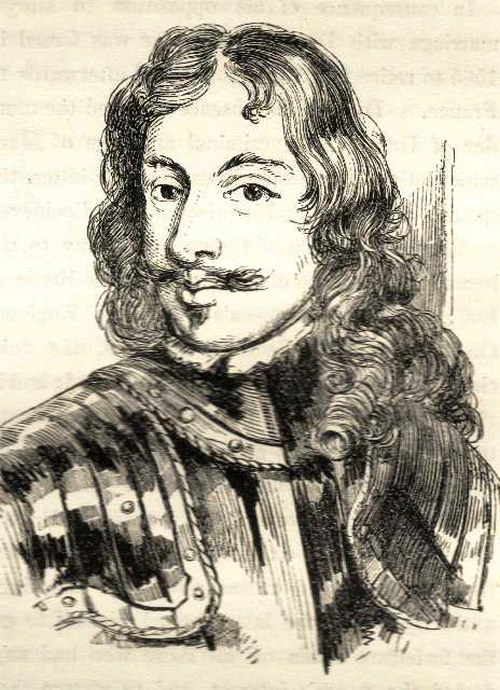
[portrait of James Second Earl of Arran]
In 1548 a new treaty was entered into with France, by which
the young queen was betrothed to the dauphin, and when she was
scarcely six years of age, she was sent to that country for her
education; and on February 8th, the regent was created by
the French king duke of Chatelherault, in the province of Poitou.
Owing, however, to the intrigues of the queen-mother, Mary of Guise,
and the unceasing exertions of his enemies, a strong party was
formed in Scotland against his authority; and after many delays the
duke resigned the regency in a parliament which met April 10, 1554,
when the queen-mother was immediately raised to that high office,
which had so long been the object of her ambition. On this occasion
Arran received from France the confirmation of his French title,
with a considerable pension, as well as from the Scottish parliament
a formal recognition of his right of succession to the crown, and a
public ratification of his conduct during his regency. The duke of
Chatelherault afterwards joined the lords of the congregation, and
employed all his power and influence in support of the reformed
faith, which, after the death of the queen regent, was, by the
parliament that met August 1, 1560, recognised as the established
religion of the Scottish nation.
In consequence of his opposition to Mary’s marriage with
Darnley, the duke was forced in 1565 to retire first to England, and
afterwards to France. During his absence occurred the murder of
Darnley, the criminal marriage of Mary with Bothwell, the speedy
exile of the latter, the queen’s deposition and imprisonment in
Lochleven castle, the elevation of the earl of Moray to the regency,
the escape of Queen Mary, the battle of Langside, and the queen’s
flight into England. On his return to Scotland in 1569, the duke
claimed the regency as his by right of blood; and in virtue of a
commission from Queen Mary, constituting him lieutenant-general of
the kingdom, he began to assemble his friends and raise forces. At a
meeting, however, which afterwards took place between the duke and
the earl of Moray, the former agreed to acknowledge the king’s
authority, while the latter bound himself to get the forfeiture
taken off all those who had supported the queen’s interest, and to
restore their estates. Soon after Moray, under pretence that they
were plotting in behalf of Queen Mary, ordered his guards to seize
the duke and Lord Herries, and committed them prisoners to the
castle of Edinburgh, where they remained till the murder of the
regent by Hamilton of Bothwellhaugh, in the succeeding January, when
they were set at liberty. The earl of Lennox, on being chosen
regent, proclaimed the duke of Chatelherault, the earls of Huntly
and Argyle, and the other leaders of the queen’s party, traitors and
enemies to their country, and in 1571 shamefully beheaded the duke’s
brother, the archbishop of St. Andrews. For two years after this the
country was desolated with the civil war which raged between the
regent’s party and the Hamiltons, or the “king’s men” and “queen’s
men,” as the two factions were called; but after the earl of
Morton’s elevation to the regency, a treaty was concluded at Perth
with the duke and the earl of Huntly, by which the establishment of
the reformed religion and the king’s authority were secured, and the
duke and the queen’s friends were relieved of the act of attainder
which had been passed against them. The duke spent the remainder of
his days on his estates, and died at Hamilton palace, January 22,
1575.
HAMILTON, JOHN, Archbishop of St. Andrews,
was the natural son of James, first earl of Arran. Mackenzie says
that he studied the belles lettres and philosophy at the university
of Glasgow, and theology in France, where he entered into holy
orders, and that he was nominated, in 1541, abbot of Paisley; but
Crawford states that he attained to this dignity in 1525. On his
return to Scotland from France in 1543, one of his first measures
was to effect a reconciliation between his brother the regent and
Cardinal Bethune, who had till then been Arran’s determined enemy.
He now joined the cardinal in his opposition to the proposed
matrimonial treaty with England, and prevailed on the regent to
renounce the friendship of Henry the Eighth, and to renew the
alliance with France. In January 1543 he was appointed keeper of the
privy seal, and he held that situation till August 1546. In the
former year he also succeeded Kirkaldy of Grange as treasurer of the
kingdom, an office which he retained till the resignation of the
regency by his brother in 1554. In June 1545 he obtained a
legitimation under the great seal, and shortly after he was created
bishop of Dunkeld. On the assassination of Cardinal Bethune in May
1546, he became archbishop of St. Andrews; and under his primacy,
Adam Wallace, and Walter Mill, an aged preacher of the Reformed
doctrines, were burnt at the stake for heresy.
In 1551, when the archbishop was confined to his bed, by a
dangerous and lingering malady, advantage was taken of his illness
by the queen-mother, Mary of Guise, to endeavour to get the regency
into her own hands; and she was so far successful in her design,
that the earl of Arran was induced to enter into a negotiation on
the subject, with the view of resigning to her his authority. But no
sooner was the primate, by the aid of the celebrated Cardan,
restored to health, than he used all his influence with his brother
to break off the negotiation; and Arran, in consequence, retained
possession of the regency for three years more, and only resigned it
at last on receiving a parliamentary acknowledgment of his right of
succession to the throne. The archbishop subsequently endeavoured in
vain to obstruct the progress of the Reformation in Scotland; and in
1563, three years after the new religion had obtained the sanction
of the legislature, he was committed to the castle of Edinburgh for
having celebrated mass contrary to law. He was soon, however,
liberated, on the intercession of Queen Mary, at whose request he
baptized, in 1566, the infant prince James, with the ceremonies of
the Church of Rome. The queen having soon after restored him to his
consistorial jurisdiction, he granted a commission to judges, who
pronounced sentence of divorce between the earl of Bothwell and his
wife, the Lady Jean Gordon. He adhered faithfully to the queen
throughout her subsequent misfortunes in Scotland, and after the
battle of Langside, he was among those of the name of Hamilton who
were proscribed and attainted by parliament. On the capture of the
castle of Dumbarton, April 2, 1571, the archbishop, who had found a
temporary refuge there, was taken prisoner, and carried under a
strong guard to Stirling, where an attempt was made to convict him
of the murder of the king (Lord Darnley) and the regent (the earl of
Murray), but these accusations could not be substantiated. He was,
however, condemned to death by the regent Lennox, in terms of the
act of forfaulture already passed against him, and was accordingly
hanged in his pontifical robes on the common gibbet of Stirling,
April 5, 1571, being the first bishop in Scotland who had died by
the hands of the executioner, and the last Scottish primate of the
Roman Catholic church. By his mistress, Grizzel Semple, widow of
James Hamilton of Stanehouse, he had two sons and one daughter. The
elder son, was William Hamilton of Blair near Culross, whose
grandson, Peter Hamilton, was first episcopal minister at Cramond,
afterwards at Leith, and subdean of the chapel-royal. By Charles the
Second he was promoted to be bishop of Dunkeld, and died after the
Revolution, without issue. Crawford describes him as “a pleasant
facetious gentleman, and an excellent companion over a bottle.”
HAMILTON, JOHN,
a factious and turbulent secular priest, who, in the sixteenth
century, rendered himself conspicuous by his furious zeal in behalf
of the Church of Rome, was the second son of Thomas Hamilton of
Orchartfield, grandfather of the first earl of Haddington. He left
Scotland on account of his religion, and fixing his residence at
Paris in 1573, was soon after appointed professor of philosophy in
the college of Navarre. In 1576 he became tutor to the cardinal de
Bourbon, and in 1578 to Francis de Joyeuse, afterwards a cardinal.
In October 1584 Hamilton was chosen rector of the university
of Paris, and in the following year was presented, by the students
forming the German nation of that university, to the cure of the
parishes of St. Cosmus and Damian. He was a zealous partisan of the
Catholic league of 1586; and in 1590, when Henry IV. Besieged Paris,
he collected the ecclesiastics of the capital, and marshaling them
in battle order, advanced at their head against the forces of the
heretics. In 1591 he was one of the “‘Couseil des Seize Quartiers,”
who offered the crown of France to Philip II. Of Spain, when, among
other atrocities, that society of bigots decreed the death of
Brisson, president of the parliament of Paris, and of L’Archer and
Tardif, two of the councillors. Hamilton carried his violence so far
as to drag Tardif from a bed of sickness to the scaffold. In 1594,
on the very day that Henry IV. Entered Paris, he and some other
fanatics like himself, distrusting that monarch’s recent conversion
to the Catholic faith, endeavoured to expel the king by force of
arms. The attempt, however, failed, and Hamilton was arrested, but
soon after received permission to the depart out of France, on which
he retired to Brussels. In his absence the parliament condemned him
to be broken on the wheel for the murder of Tardif, and the sentence
was duly executed on his effigy.
In 1601, after an absence of nearly thirty years, he ventured
to return to Scotland, where he was joined by Edmond Hay, the
Jesuit. No sooner was their arrival known, than the king issued a
proclamation ordering their instant departure from the kingdom, on
pain of treason, and prohibiting any one from harbouring them.
Hamilton found a temporary asylum at the castle of Airlie, in
Forfarshire, belonging to Lord Ogilvie; but in 1609 he was
apprehended by a party of life-guards, sent by the Scottish privy
council, and confined in the Tower of London, where he died.
He was the author of:
Ane Catholick and Facile Traictaise drawin out of the Halie
Scriptures, treulie exponit be the Ancient Doctrines, to confirm the
Reall and Corporell Praesence of Christis Pretious Bodie and Blude
in the Sacrament of the altar. Dedicated to His Soveraine, Marie,
the Queenis Majestie of Scotland. Paris, 1581, 16mo. Appended to
this curious production were twenty-four Orthodox and Catholic
conclusions dedicated to James VI., containing ‘Certain Questions to
the quhilks we desire the Ministers mak resolute answer at the next
General Assemblie.’ Running title: Of ye Lordis Supper. There is
another edition entitle, “ Facile Traictise; contenand first, and
infallible Reul to discerne trew from fals Religion; nixt, a
declaration of the nature, number, verteu, and effects of the
Sacraments, &c. Lovan, 1600, 8vo.
HAMILTON, JAMES,
third marquis and first duke of Hamilton, elder son of James, second
marquis, who in 1619 was created by James the First of England earl
of Cambridge in the English peerage, was born in Hamilton palace,
June 19, 1606. He received the early part of his education in
Scotland, and completed it at Oxford. On the death of his father in
1625, he succeeded to the family titles and estates; and at the
coronation of Charles the First in that year, he carried the sword
of state in the procession. He afterwards lived in retirement,
chiefly at Brodick castle, island of Arran, till the end of 1628,
when, having been pressingly invited by the king, he went to court,
and was created master of the horse, gentleman of the king’s
bedchamber, and privy councillor in both kingdoms. At the baptism of
Prince Charles in 1630, he represented the king of Bohemia, as one
of the sponsors, when the order of the Garter was conferred on him,
together with a grant of the office of chief steward of the house
and manor of Hampton Court.
The same year, having been empowered by the king to raise
troops in his own name, he joined the famous Gustavus Adolphus, king
of Sweden, with 6,000 men, to assist Charles’ brother-in-law, the
elector palatine, in his attempt to recover his lost hereditary
dominions. On disembarking his troops near the mouth of the Oder, he
received from his Swedish majesty a general’s commission, and
immediately proceeded into Silesia, where he besieged and took
several fortified places, distinguishing himself by his bravery on
all occasions. The severity of the service, combined with the
ravages of the plague, in a short time reduced his army to two
incomplete regiments, and, finding himself treated with neglect by
the king of Sweden, he returned to England in September 1632. The
following year he attended King Charles to Scotland, and assisted at
his coronation there, but took no farther part in public affairs for
several years.
In 1638 the marquis of Hamilton was appointed his majesty’s
commissioner to the famous General Assembly, which met at Glasgow,
and the proceedings of that body being in opposition to the views of
the king, the marquis had recourse to a dissolution of the court.
But as, of course, the Assembly could not recognise this exercise of
authority, they continued their sittings as usual, went on
subscribing the Covenant, and formally abolished Episcopacy in
Scotland. The king hereupon authorised the marquis to treat with
them, and endeavour to get the Covenant recalled, but they plainly
told him “that they would sooner renounce their baptism.” This year
he published a ‘Declaration and Vindication of himself,’ in 4to.
In 1639, when the Scots nation were compelled to defend by
arms their civil and religious liberties, the marquis was sent to
Scotland with a well equipped fleet and a force of 5,000 men, while
the king, at the head of 25,000 foot and 3,000 horse, advanced by
land. The treaty of Berwick, however, concluded July 18, prevented
hostilities for that time. In October 1641 a plot was formed, by the
marquis of Montrose and the earl of Crawford, against the marquis,
his brother, the earl of Lanark, and the marquis of Argyle, on which
he retired with these two noblemen to the house of Kinniel, in
Linlithgowshire, till the affair was investigated; and at the end of
a few days they resumed their attendance in parliament. This event
is styled in history “The Incident.”
In 1643, as a reward for his services to the king, the marquis
was created duke of Hamilton, and marquis of Clydesdale, &c. About
the end of the same year, the duke and his brother went to Oxford,
to clear themselves from some misrepresentations of their conduct
which had been made by their enemies to the king, but were debarred
access to his majesty, who ordered them into confinement. The earl
of Lanark, as previously mentioned, made his escape, but the duke
was sent prisoner to Pendennis castle, in Cornwall, and afterwards
was removed to St. Michael’s Mount, at the Land’s End, where he
remained till the end of April 1646, when the castle being captured
by the parliamentary forces, he was set at liberty.
After Charles had thrown himself into the hands of the
Scottish army, the duke went to Newcastle, and again offered his
services to the king. On August 10, 1646, he had a grant from his
majesty of the office of hereditary keeper of the palace of Holyrood.
In 1648 the duke promoted, with all his power, “the Engagement”
entered into by the Scots parliament, to raise an army for the
relief of the king. Of the force which was hastily collected
together, amounting to about 10,000 foot and 4,000 cavalry, the duke
was appointed general, the earl of Callendar lieutenant-general, and
Middleton and Baillie major-generals. With these troops, which were
very indifferently appointed and disciplined, and but imperfectly
armed, and without artillery, the duke marched into England, where
he was joined by Sir Marmaduke Langdale, with a body of English
forces, and by Sir George Monro with 2,000 foot and 1,000 horse.
After compelling Lambert, the parliamentary general, to retire with
precipitation, they passed through Carlisle, and advanced by Penrith,
Appleby, and Kendal, driving the enemy before them to Preston, where
the retreating force of Lambert was met by Cromwell at the head of a
strong reinforcement. A battle ensued on August 17, in which the
Royalists were defeated, and great part of their army dispersed. The
remainder, with the duke, proceeded on to Uttoxeter, in
Staffordshire, where, having only a few of the cavalry left, he
capitulated with General Lambert, on assurances of safety to himself
and his followers. The duke was carried to Derby, and from thence to
Ashby-de-la-Zouche, where he continued till the beginning of
December, when he was brought to Windsor castle, and confined under
a strong guard. On the 21st of that month, when the king
was carried through Windsor on his way to his trial at London, the
duke prevailed upon his keepers to permit him to see his majesty;
and, as he passed, he fell on his knees, and passionately exclaimed,
“My dear master!” The king, lifting him up, embraced him, and said,
“I have been so, indeed, to you.” No further discourse was allowed
between them, and Charles was instantly hurried away.
Subjoined is a portrait of his grace from a painting by
Vandyck:
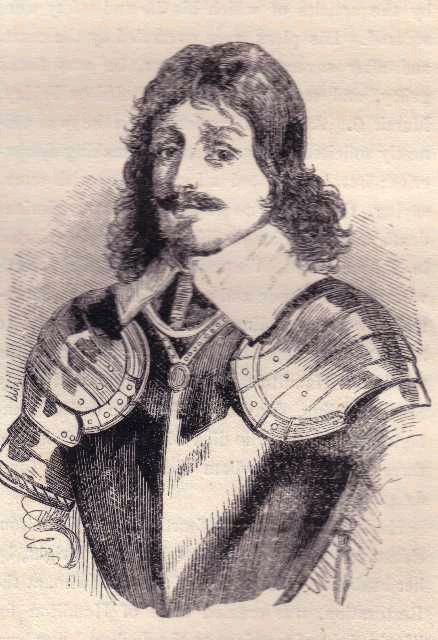
[portrait of James first duke of Hamilton]
After the king’s execution, his grace, apprehensive of his own
fate, resolved on making his escape, and by the help of his equery,
he succeeded in getting away from Windsor, under night, and reached
the neighbourhood of London undiscovered; but entering the city
about four o’clock in the morning, contrary to the directions he had
received, he was apprehended by a patrol of cavalry, and carried to
St. James’, where he was lodged in the same room with the earl of
Norwich, Lord Capel, and Sir John Owen, also prisoners, who
afterwards suffered with him. He was brought to trial February 6,
1649, being indicted as earl of Cambridge, and a natural-born
English subject, for having levied war and committed treason against
the kingdom and people of England. He pleaded that he had acted by
command of the Estates and supreme authority of Scotland, which were
altogether independent of England; that he was a native of Scotland,
and consequently an alien, and not amendable to English
jurisdiction; and, finally, that he had surrendered himself a
prisoner of war on capitulation, by the articles of which his life
and safety were secured. His pleas were overruled by the court, and
after several adjournments, he was found guilty, and sentenced to be
beheaded on Friday, March 9. After his condemnation he was earnestly
solicited to save himself by making discoveries; but he rejected all
such offers with scorn, saying, there was no choice betwixt a
glorious death and an infamous life. He was decapitated in Palace
Yard, Westminster, suffering death with great fortitude and
magnanimity, and his remains were, according to his desire, conveyed
to Scotland, and deposited in the burial-place of the family at
Hamilton. His grace married Lady Mary Fielding, daughter of William
earl of Denbigh, and by her, who died May 10, 1638, he had three
sons, all of whom died young, and three daughters.
HAMILTON, JAMES,
fourth duke of Hamilton, eldest son of Anne, duchess in her own
right, by her husband, William earl of Selkirk (who, at the
Restoration, was created duke of Hamilton for life, in right of
marriage to the duchess), was born April 11, `658, and was at first
styled earl of Arran. He was educated principally at the university
of Glasgow, after which he passed some time on the Continent. On his
return he was appointed, January 17, 1679, one of the gentlemen of
the king’s bedchamber. He had not long been at court before an
affair of gallantry involved him in a quarrel with Lord Mordaunt,
afterwards the celebrated earl of Peterborough and Monmouth, which
led to a duel betwixt the parties in Greenwich Park. Lord Arran
fired first, and narrowly missed Lord Mordaunt, who discharged his
pistol in the air. They then engaged with swords, when Lord Mordaunt
was wounded in the groin, but running his antagonist into the thigh,
his sword broke, so that his life was at the mercy of the earl of
Arran, who honourably put an end to the contest, and they parted
good friends.
In December 1683, Charles II. Nominated Lord Arran ambassador
extraordinary to France, to congratulate Louis XIV. On the birth of
a grandson. He served two campaigns under the French king as his
aide-de-camp, the dauphin and his lordship being sworn into that
office on the same day. On the accession of James the Second and
Seventh, his lordship returned to England, and was appointed master
of the wardrobe to the new king, who, in the succeeding July,
conferred on him the command of the first or royal regiment of
horse.
On the revival of the order of the Thistle in 1687, the earl
of Arran was nominated one of the knights companions thereof. He
adhered firmly to King James in his declining fortunes, and was one
of the four lords who accompanied him to Rochester on his
embarkation for the Continent, December 22, 1688. At the meeting of
the Scottish nobility and gentry in London, assembled by the prince
of Orange, January 7, 1689, of which his father, the duke of
Hamilton, was president, Lord Arran made the following speech: “I
have all the honour and deference for the prince of Orange
imaginable. I think him a brave prince, and that we owe him great
obligations in contributing so much to our delivery from popery;
but, while I pay these praises, I cannot violate my duty to my
master. I can distinguish betwixt his popery and his person; I
dislike the one, but have sworn, and do owe, allegiance to the
other, which makes it impossible for me to sign away that which I
cannot forbear believing is the king my master’s fight; for his
present absence in France can no more affect my duty, than his
longer absence from us has done all the while; and the prince,
desiring our advice, mine is, that we should move his majesty to
return and call a free parliament for the securing our religion and
property, which, in my humble opinion, will at last be found to be
the best way to heal all our breaches.” This proposal received no
support from any one. In the subsequent August, being suspected of
having a share in Sir James Montgomery’s plot for the restoration of
King James, and also of corresponding with the abdicated monarch, he
was twice committed prisoner to the Tower of London, where he
remained several months, but was at length discharged without
prosecution. On his release he returned to Scotland, where he lived
in retirement for some years. His father’s death, in 1694, brought
no accession of honours or estate, both being hereditary in the
duchess, but in July 1698 her grace resigned her titles into the
hands of King William, in favour of her eldest son; when the earl of
Arran was accordingly created duke of Hamilton, with the original
precedency.
The failure of the Darien expedition having excited much
popular ferment in Scotland, the duke of Hamilton took an active
part in support of the claims of the African Company, and headed a
strong party, which stood firm to the interests of the country, and
uniformly asserted the independence of the nation. He took the oaths
and his seat in parliament May 21, 1700, and distinguished himself
on all occasions by his opposition to the measures of King William’s
government.
On the accession of Queen Anne, March 8, 1702, his grace, with
other influential persons, went to London, to endeavour to prevail
on her majesty to call a new parliament; but she did not think
proper to comply with their advice. On the opening of the Convention
parliament, on June 9, his grace entered a protestation against the
legality of the meeting, and, with seventy-nine members, withdrew
from its sittings, amid the acclamations of the people. In the
parliament of 1703 he exerted his utmost influence to obtain for his
countrymen an equality of commercial privileges with England, and in
all the discussions of that period he took a prominent part as
leader of the country party. In August 1704 was passed the famous
act of security, which provided for the succession to the crown, and
for the maintenance of the liberties and independence of the
Scottish nation. In this, the concluding parliament of Scotland, the
duke’s conduct had an important influence on all the measures
proposed for the settlement of the affairs of the kingdom. In the
last session, which met October 3, 1706, the treaty of Union
received the determined opposition of his grace, who voted against
every article of that treaty, excepting the first clause of the
fifteenth article relating to the equivalent, and adhered to every
protest against it. In the debate respecting the first article,
November 2d, he said, “What! Shall we, in half an hour, yield what
our forefathers maintained with their lives and fortunes for many
ages! Are none of the descendants here of those worthy patriots who
defended the liberty of their country against all invaders – who
assisted the great King Robert Bruce to restore the constitution,
and avenge the falsehood of England and usurpation of Baliol? Where
are the Douglases and the Campbells? Where are the peers? Where are
the barons, once the bulwarks of the nation? Shall we yield up the
sovereignty and independency of Scotland, when we are commanded by
those we represent to preserve the same, and assured of their
assistance to support us?” Some of the more violent of the
opposition had planned a general insurrection against the progress
of this obnoxious treaty, and had appointed a body of 7,000 men to
rendezvous at Hamilton on a certain day, but the duke’s prudence
prevented him from entering heartily into the design, and, by
sending messengers to countermand the contemplated rising in the
west country, he had the merit of saving the country from being
involved in civil war.
In 1707, when a visit from the Pretender was expected in
Scotland, the duke, to avert suspicion from himself of favouring the
project, retired to his seat in Staffordshire. In 1708, when the
French fleet appeared off the coast, his grace was taken into
custody and removed to London, but soon obtained his liberty. In
June of that year his grace was elected one of the sixteen
representative peers, and was rechosen at the next general election
in 1710. On the overthrow of the Whig ministry, October 1, 1710, he
was appointed lord-lieutenant of the county palatine of Lancaster,
ranger of the queen’s forests therein, admiral of the sea-coasts of
that county, and admitted a privy councillor.
In September 1711 his grace was created a peer of Great
Britain by the title of Baron Dutton, in Cheshire, and duke of
Brandon, in Suffolk, On taking his seat in the subsequent December,
several interesting debates took place in the House of Lords, as to
his right to sit as a British peer while he continued a
representative peer of Scotland, and their decision being
unfavourable to his claim, the Scottish peers withdrew from the
House. A motion for taking the option of the twelve judges on the
point was negatived. In consequence of a message from the queen, who
was much interested in behalf of the duke, the question was again
taken into consideration on January 25, 1712, when the Scottish
peers were so far appeased, that they resumed their attendance in
the House of Lords. The point, however, was not completely set at
rest till 1782, when, in the case of Douglas, the eighth duke of
Hamilton and fifth duke of Brandon the judges gave an unanimous
opinion in favour of the eligibility of Scottish peers to be
admitted to the full privileges of peers of Great Britain.
On the death of Earl Rivers, the duke was, September 5, 1712,
appointed master-general of the ordnance; and, on October 26, was
installed a knight of the order of the Garter. A few days
thereafter, he was appointed ambassador extraordinary to France,
upon the conclusion of the treaty of Utrecht; but while splendid
preparations were making for that embassy, his grace was slain in a
duel, fought in Hyde Park, with Lord Mohun, who was also killed on
the spot, on Saturday, November 15, 1712. His grace and Lord Mohun
had married two nieces of Charles, earl of Macclesfield, and for
several years had been engaged in a chancery suit for part of his
estate, which created much animosity, inflamed by their espousing
different sides in parliament. The immediate cause of the duel was
some high words which passed between them, at a meeting in the
chambers of a master in chancery, three days before. Parnell, in his
verses ‘On the Peace of 1712,’ notices the duke’s fate in very
pathetic terms. At the time of his tragical death he was in his 55th
year. He was twice married: first to Lady Anne Spenser, eldest
daughter of Robert 2d earl of Sunderland, by whom he had 2
daughters, who died young; and, 2dly, to Elizabeth, only child of
Lord Gerard of Bromley, by whom he had 7 children. He was succeeded
by his eldest son James. (See previous article)
HAMILTON LORD CLAUD,
fourth son of James, second earl of Arran and first duke of
Chatelherault, by his wife, Lady Margaret Douglas, eldest daughter
of James, third earl of Morton, was born either in 1539, or,
according to Keith [Catalogue of Bishops, page 253], in 1543.
His father, the duke of Chatelherault, being acknowledged by act of
parliament next heir to the crown of Scotland after Queen Mary, and
having been appointed regent of Scotland in 1543 during her
minority, Lord Claud was, at a very early age (in 1553), appointed
to the opulent post of commendator of the abbey of Paisley, under
the confirmation of a papal bull fro Pope Julius III. In the bull
his age is given as fourteen years old. During the civil discords
that prevailed in Scotland in the reign of Queen Mary, he, with his
father and the other members of the house of Hamilton, warmly
espoused her interests, and was one of the principal commanders in
her army at the battle of Langside. May 13, 1568, the loss of which
was the cause of her flight into England. Immediately after the
battle, Lord Claud, with many others, was summoned to attend a
parliament called by the Regent Moray, and upon his refusal to
appear, was outlawed, and his estate forfeited. During the regency
of the earl of Mar, Lord Claud’s lands were bestowed on Lord Semple,
who kept a strong garrison in his castle, and exercised on all
around a severe military discipline. At the head of his faithful
tenants, Lord Claud besieged the castle, and compelled Lord Semple
to surrender at discretion. His forfeiture was repealed by the act
of parliament which confirmed the pacification of Perth in 1573.
In the year 1579, King James, having it insinuated to him that
the Hamiltons, as declared heirs to the crown, had espoused the
queen’s cause in that hearty manner, with the view of destroying
him, who stood in their way, resolved to apprehend the Lords John
and Claud Hamilton, at that time in Edinburgh, under sanction of the
articles of agreement ratified the year before. They however made
their escape. Lord John fled in a seaman’s habit to England, and
went thence to France. Lord Claud was in hiding for some time on the
borders of Scotland, but ultimately retired into England, and lived
for a time at Widdrington, with a relation of the earl of
Northumberland. During the year that he remained in exile he was
constantly engaged in the various attempts made to restore Queen
Mary to liberty, and seems to have been regarded by her at that
time, as appears from the numerous letters now extant in the State
paper office, as the person in whose assistance she had the greatest
hope and confidence. Amongst many letters of interest relating to
him, is one from the unfortunate queen, during her imprisonment at
Chartley, dated 20th May 1586, to Sir Charles Paget, who
was one of her principal means of communication there with her
friends, in which she says –
“I wold then in the meane tyme yow shold write to the Lord
Claude, letting him understande how that the k. of Spayne is to sett
on this countrye, and desireth to have the assistance of the
Catholikes of Scotlande for to stoppe at the least, that from theme
the queen of Englande have no soccours, and to that effect yow shall
pray the sayd Lord Claude to sownde and grope the mindes hereunto of
the principall of the Catholike hobilitye in Scotlande and others
hereof, under pretextes he might bringe to other; moreover that he
declare particularly unto yow the names of those that are to enter
in this bande, and what forces they are able to make together, and
to the ende they may be the more encouraged herein yow may write
playnelye to the Lord Claude that yow have charge, of me, to treate
with him in this matter. Buy by yowr first letter I am not of
opinion that yow discover yowr selfe further to him nor to other at
all, untill yow have received answer of the k. of spayne, which
being conform to this desseignment, then may yow open more to the
Lord Claude, shewing him that to assure himself of my sonne, and to
the end (if it be possible) that things be past and done under his
name and authoritye, it shall be nedefull to sease his person, in
case that willinglye he cannot be browght to this enterprise; yea
and that the surest way were to deliver him into the k. of spayne
his hands, or the Pope’s, as shall be thowght best; and that in his
absence he depute the L. Claude his lieutenant-general and regent in
the government of Scotland, which yow are assured I may be easelye
persuaded to confirme and approve. For if it be possible I will not,
for divers respects, be named herein untill the extremitye. To
persuade hereunto the sayd L. Claude, it shall be good that yow
assure him to travell to abolish all remembrance or grefe of his
brother the Lord of Arbroth (Lord John Hamilton) his procedings;
that idurectly yow put him in hope that I shall make him be declared
lawfull heyre to the crowne of Scotland, my sonne fayling without
children, and that there unto I shall make the catholike princes of
christendome condescende to mayntayne him in that respect. I can
write nothing presentyle to the L. Claude him selfe, for want of an
alphabete between me and him, which now I send yow herewith
enclosed, that yow may send it unto him.”
Another letter, to Lord Claud himself, from Chartley, July
1586, is in these terms –
“Right trusty and well-beloved cousin, – Being as yet not very
sure of this new way, I will not content my self hereby only to
testifie unto youe how much liking and contentment I have had of
that which the English lordes brother (Sir Charles Paget) and
Fontenay did write unto me in your name, before your return to
Scotlande. Youe are now in place, and have meanes to correspond
effectually to the expectation which I and all myne have conceaved
of youe, wherein I assure youe that I shall not fayle youe in any
thing consisting in my owne power, or that I may obtayne by my
credit of all Christian princes. Wherefore I praye youe uppon that
which I committed last to be imparted unto youe by the said English
(desiring youe to credit him as my self) to let me know particularly
your own resolution and the inclination of others my good and
faithfull subjectes, to the end that according thereunto I may
proceede with my principal frendes. This last ligue of my sonnes
with the queene of England hath much offended them; labor to make me
understand the perticuarities thereof, and whether if there be any
thing passed in the same concerning my perticular, either in the
publicque treatie or in any secreat articles. For I have been
advertised that that unhappy master of Gray hath not desisted to
labour with all extremity against me, which moveth me not to feare a
litle that so ong as he shall remaine neere my sonne, we are not
like (I and my sonne) ever to have much good intelligence together;
and therefore I pray youe so earnestly as I can to find the meanes
to shift him forth of the roome, having behaved himself so
traiterously toward me, as that there is no punishment but he hath
deserved therefore. The delivirer hereof did serve me very
faithfully so long as he was in this contry, and I trust he will do
the lyke in all you will employ him there for my service, especially
for the sure convoy of your letters and myne by this way. God
almighty have youe, cousin, in his holly protection. Your right
loving cousingnes and good friend,
Marie R.”
Lord Claud, with his brother Lord John, returned to Scotland
in 1585, and was well received by the king. All their estates and
honours were restored to them, and in consideration of the constant
loyalty, and great losses and sufferings of Lord Claud on behalf of
the king’s mother, all the lordship and barony of Paisley, with the
pertainments of the abbacy and monastery of Paisley, and their
extensive lordships and estates, comprising lands in Renfrewshire
and nine other counties, and the patronage of twenty-eight churches,
were bestowed on him by charter in 1585, and, July 29, 1587, were
erected into a temporal lordship, for him and his heirs male, under
the title of Baron of Paisley. His eldest son also, James, was,
during his lifetime, in 1606, created earl of Abercorn, and
additional estates were granted to him in Linlithgowshire and
elsewhere. Lord Claud died in 1622, aged 78, and was buried in the
abbey of Paisley. He was the ancestor of the marquis of Abercorn,
and also of the Counts Hamilton of Sweden. He married Margaret, only
daughter of George, sixth Lord Set on, and with a daughter,
Margaret, wife of William, first marquis of Douglas, had four sons.
1. James, first earl of Abercorn; 2. Hon. Sir Claud Hamilton, a
gentleman of the king’s privy chamber, and by privy seal, dated
October 6, 1618, appointed constable of the castle of Toome, county
Antrim, Ireland, for life; 3. Hon. Sir George Hamilton of Greenlaw
and Roscrea, county Tipperary, who behaved with great bravery in the
service of Charles I. His daughter, Margaret, married, in 1622, Sir
Archibald Acheson of Gosford, East Lothian, baronet, a lord of
session and secretary of state for Scotland, ancestor of the earls
of Gosford in the peerage of Ireland. 4. Hon. Sir Frederick
Hamilton, whose youngest son, Gustavus, lieutenant-general in the
army, was by George I., on October 9, 1714, created Baron Hamilton
of Stackallan, and in August 1717, advanced to the dignity of
Viscount Boyne, in the Irish peerage.
HAMILTON, JAMES,
first earl of Abercorn, eldest son of the preceding, a nobleman of
much ability, and in great favour with King James VI., was one of
the lords of his privy council, and a gentleman of the bedchamber.
By a charter, dated in 1600, the king gave the office of high
sheriff of the county of Linlithgow, to him and his heirs male
whatever; and by another charter in 1601, he got the lands of
Abercorn, Braidmeadows, &c. He was created a peer, by the title of
Baron Abercorn, April 5, 1603, and in 1604 he was appointed one of
the commissioners, on the part of Scotland, to treat of a union with
England, which did not take place. On July 10, 1606, he was advanced
to the dignity of earl of Abercorn, baron of Paisley, Hamilton,
Mountcastle, and Kilpatrick, by patent to him and his heirs male
whatever. King James, after his accession to the crown of England,
having founded the plantations of Ulster in the north of Ireland,
and wishing to have eminent persons on whom he could depend in
connexion with them, granted the earl of Abercorn the same
precedence, as an earl, in the Irish parliament and at the
council-table, as he held in Scotland, and in 1615 he had a grant of
a vast estate out of the escheated lands in the barony of Strabane,
on which he built a castle, a schoolhouse, and a church.
The earl of Abercorn, who usually resided at the Place of
Paisley, had the honour of receiving there in 1597 the consort of
King James VI.; and again the king himself, who, in his progress
through Scotland, after a fourteen years’ absence, tarried at
Paisley in 1617, where “a welcome in the earl of Abercorn his great
hall was verie graciously delivered by a prettie boy of nine years
of age, son of Sir James Semple of Belltries.” The earl died in the
lifetime of his father, March 16, 1618, and was buried in the abbey
of Paisley. He married Marion, eldest daughter of Thomas, fifth Lord
Boyd, and with three daughters, had five sons. 1. James, 2d earl of
Abercorn. On the death of William, second duke of Hamilton, of his
wounds at the battle of Worcester, September 11, 11651, the second
earl of Abercorn became male representative of the family of
Hamilton; but the estates and titles of that house devolved on the
duke’s niece, Anne, duchess of Hamilton. 2. Claud, Lord Strabane in
Ireland, so created Aug. 14, 1634, on his brother’s resignation of
that title to him. The male line having failed in the eldest branch
on the death of George, 3d earl of Abercorn, the descent devolved on
Claud, grandson of Lord Strabane, who was 5th baron of
Strabane and 4th earl of Abercorn. 3. Hon. Sir William
Hamilton, who was long a resident at Rome, from Henrietta Maria,
queen dowager of England. 4. Hon. Sir George Hamilton, of Donalong,
county Tyrone, and Nenagh, Tipperary, created a baronet of Ireland
in 1660. His eldest son, Colonel James Hamilton, who died June 6,
1673, of a wound received in a naval battle against the Dutch, and
was buried in Westminster Abbey, was the father of James, 6th
earl of Abercorn. Sir George’s third son was the celebrated Count
Anthony Hamilton, of whom a memoir is given below. 5. Hon. Sir
Alexander Hamilton of Holborn, from whom the Counts Hamilton of
Germany are directly descended. He settled first at the court of
Philip William, elector palatine, by whom he was sent envoy
extraordinary to King James II. Of England. He accompanied to Vienna
the elector’s daughter Eleonora Magdalena, who was married to the
Emperor Leopold, and was created a count of the empire, with a grant
of the county of Neuberg, near Passau, and other estates in Moravia
and Hungary.
HAMILTON, JAMES,
eighth earl of Abercorn, a nobleman who possessed singular vigour of
mind, integrity of conduct, and patriotic views, was born October
22, 1712. He was summoned by writ to the House of Peers in Ireland
as Baron Mountcastle, March 23, 1736, and succeeded his father in
1744, as earl of Abercorn and Viscount Strabane. In 1745, he
purchased from Archibald, duke of Argyle, the barony of Duddingston,
Mid Lothian, where he built an elegant mansion, and made it his
favourite residence. In the imperial parliament he was one of the
peers who, on March 11, 1766, voted against the act to repeal the
American stamp act, and joined in the protests against the second
and third reading of the bill. He also voted for rejecting Fox’s
India bill, December 17, 1783. He was created a peer of Great
Britain, August 8, 1786, by the title of viscount Hamilton, with
remainder to his nephew, John James.
He was among the first who, in the middle of the eighteenth
century, laid the foundation of that improved system of agriculture
and rural economy for which Scotland has now become so remarkable.
To him also is due, in great measure, the advancement of the
important manufacturing town of Paisley, which a century ago was but
an inconsiderable place, until what is now known as “the new town”
was laid out and built by the earl on his patrimonial estate. This
has been the means of increasing the trade and importance of
Paisley, and giving it its present position among the manufacturing
towns of the kingdom. On his estate in Ireland he built a
magnificent house at Baron’s Court, near Strabane. At his seat,
Witham, in Essex, Queen Charlotte slept September 7, 1761, on her
journey from Harwich to London. The earl sat as a representative
peer of Scotland for twenty-three years, from 1761 to 1784, He died
unmarried, October 9, 1789, and was buried in the abbey of Paisley.
His lordship, as heir male of the second earl of Arran and first
duke of Chatelherault, claimed the title of duke of Chatelherault in
France, a claim afterwards renewed on the part of the second marquis
of Abercorn. He was succeeded by his nephew, John James, ninth earl
and first marquis of Abercorn.
HAMILTON, COUNT ANTHONY,
author of the ‘Memories du Comte de Grammont,’ third son of Sir
George Hamilton, fourth son of first earl of Abercorn, and
great-grandson of first duke of Chatelherault, was born in Ireland
in 1646. During the protectorate of Cromwell he passed most of his
time in France, having, with all his father’s family, accompanied
Charles II. In his exile. He returned to England at the restoration.
In 1687, he was a lieutenant-colonel, with the pay of £200 a-year,
and although a Roman Catholic, had the command of a regiment of
infantry in Ireland, and was governor of Limerick. At the revolution
he followed James VII. Into France, and became a lieutenant-general
in the French service, as did also his brother Richard.
In his ‘Memories de Grammont,’ with a pen full of easy and
exquisite point, he has portrayed the character of the beauties and
wits of the court of Charles II., and detailed the intrigues in
which he was himself a considerable actor. He was also the author of
‘Count Hamilton’s Tales,’ and other works, in the French language,
to which Voltaire gives high praise, and which he says have all the
humour without the burlesque of Scarron. His ‘Epistle to the Count
de Grammont’ was much read. He may be styled the father of the
natural romance or novel. His works were published collectively in
1749, in 6 vols. 12mo, and are all in French. Count Anthony Hamilton
died at St. Germains, April 21, 1720, aged 74 years. His elder
brother, James, father of the sixth earl of Abercorn, was in great
favour with Charles II. After his restoration. The latter made a
grant to him, for his and his children’s lives, of Hyde Park in
London, which grant was, however, afterwards commuted, for a charge
of nine hundred pounds per annum, on the first-fruits and tenths of
the dioceses of St. David’s, Hereford, Oxford, and Worcester.
HAMILTON, ELIZABETH,
countess de Grammont, popularly known as “La belle Hamilton” at the
court of Charles II., and of whom numerous portraits are extant at
Hampton Court Palace and elsewhere, was the eldest daughter of Sir
George Hamilton, fourth son of the first earl of Abercorn, and the
sister of Count Anthony Hamilton. Mill Hamilton was one of the few
ladies attached to the court of Charles II. Who appear to have
preserved a reputation, in spite of acknowledged beauty, untainted
by suspicion. In the brilliant pages of the ‘Memoires de Grammont,’
she is styled “the chief ornament of the court, worthy of the most
ardent and sincere affection, – nobody could boast a nobler birth,
nothing could be more charming than her person.” She had many noble
offers of marriage, and after refusing the duke of Richmond, Jermyn,
nephew of the earl of St. Albans, and Henry Howard, afterwards duke
of Norfolk, she married Philibert, count de Grammont, brother of the
duke of that name, and hero of the ‘Memoires de Grammont.’ charles
II., in a letter to his sister, the duchess of Orleans, dated 24th
October 1669, bears this testimony to her merits: – “I writt to you
yestarday by the compte de Grammont, but I beleeve this letter will
come sooner to your handes, for he goes by the way of Diep with his
wife and family; and now that I have named her, I cannot chuse but
again desire you to be kinde to her, for besides the meritt her
family has on both sides, she is as good a creature as ever lived. I
beleeve she will passe for a handsome woman in France, though she
has not yett, since her lying in, recovered that good shape she had
before, and I am affraide never will.” [Dalrymple’s Memoirs, vol. ii. p. 26.]
After her marriage to the comte de Grammont, she was appointed
dame du Palais to Maria Theresa of Austria, queen of Louis XIV. Her
husband died at Paris, January 30, 1707, aged 86. She died January
3, 1708, aged 67. They had two daughters, Claude Charlotte de
Grammont, who married Henry Howard, earl of Stafford, and Marie
Elizabeth de Grammont, abbess de St. Marie de Poussay in Lorraine,
who died in 1706.
HAMILTON, SIR Robert, Bart.,
of Preston, commander of the Covenanters’ army (see previous
article).
HAMILTON, SIR THOMAS,
first earl of Haddingto, an eminent judge and statesman, eldest son
of Sir Thomas Hamilton of Priestfield, (a lord of session 1607-08),
by his wife, Elizabeth, daughter of James Heriot of Trabrown, was
born in 1563. According to Scott of Scotstarvet, his grandfather was
a merchant in the West Bow of Edinburgh. He was, however, Thomas
Hamilton of Orchartfield, Bathgate, and Ballencrieff, and was killed
at the battle of Pinkie, September 10, 1547, leaving two sons, Sir
Thomas, his successor, father of the subject of this notice, and
John, a secular priest, whose life is given at a previous article.
Thomas Hamilton of Orchartfield’s father, the great-grandfather of
the first earl of Haddington, was also named Thomas Hamilton of
Orchartfield, and was the second son of Hugh Hamilton of Innerwick,
Haddingtonshire, sprung from John de Hamilton, second son of Sir
Walter FitzGilbert de Hamilton, dominus de Cadzow.
The subject of this notice was educated at the High School of
Edinburgh, but pursued his university and legal studies for six
years in France. After his return to Scotland, he was, on 1st
November 1587, admitted advocate, and soon distinguished himself by
his talents and learning. As he resided in the Cowgate of Edinburgh,
in the 16th century a street of greater consideration
than it is now, he acquired from James the Sixth the ludicrous
byname of Tam o’ the Cowgate. In 1592 he was appointed a lord of
session, when he took the title of Lord Drumcairn. The same year he
was nominated one of the commissioners for printing the acts of
parliament. On 13th January 1595-6, he was constituted
one of the eight persons, called from their number Octavians, to
whom King James committed the charge of all the state patronage and
finances, and in the distribution of offices made by them among
themselves, he secured that of king’s advocate, although there were
already two persons in possession of that office. The Octavians,
from the invidious nature of their functions and their possession of
all the patronage of the kingdom, were an unpopular body, and
Hamilton is particular, from his being suspected of a leaning to
popery, was so obnoxious to the people, that his life was in extreme
danger during the tumult which took place in Edinburgh on 17th
December 1596. In the presbytery of Edinburgh, it was even proposed
that he and the president of the court of session, Set on,
afterwards earl of Dunfermline, should be excommunicated. In the
famous anonymous letter delivered to the king’s porter on the night
of 10th January 1597, and by him given to the king, he is
described as “Mr. Thomas Hamilton, brought up in Paris, with that
apostate Mr. John Hamilton, and men say the dregs of stinking Roman
profession sticke fast in his ribbes.” [Calderwood’s Hist. vol. v. p. 549.] On 22d February 1597, an act of sederunt of the
court of session was passed, stating that people murmured at his
sitting as a judge in the cases in which he was pursuer for the
king’s interest, and declaring that in such cases he was not to be
considered as a party. Being afterwards knighted, he was designed
Sir Thomas Hamilton of Monkland. In 1604, he was named one of the
Scots commissioners for the union then projected with England, and
in 1606 he attended the celebrated conference at Hampton Court. In
1597 he had begun the purchase of land, particularly church lands,
and in the course of thirty years he had acquired about twenty large
estates, besides all the vast territories and jurisdictions which
had once belonged to the knights of St. John, the successors of the
Templars. On 4th April 1607, he obtained a charter of the
office of master of the metals, with a lease of all the metals and
minerals in Scotland, upon payment of one-tenth of the produce to
the king. The same year he discovered a silver mine within his lands
near Linlithgow, and it is stated that, after having worked it till
the vein was exhausted, he sold it to King James for five thousand
pounds! “The king,” says honest Calderwood, “sent certan English and
Scottish men, to bring a great quantity of the ore to Londoun, to be
melted and tryed. How it proved, it is not weill knowne to manie;
but after that the myne was closed till his majestie advised
farther.”
On 15th May 1612, Sir Thomas was appointed lord
clerk register, but soon after he exchanged this office with Sir
Alexander Hay for that of secretary of state. At that time the
salary attached to the latter place was only one hundred pounds. In
1613 he was raised to the peerage by the title of Lord Binning and
Byres, and on 15th June 1616 he succeeded Preston of
Fentonbarns as lord-president of the court of session. Mr. Tytler,
in his Life of
Sir Thomas Craig, speaking of Lord Binning, says, “For many years he
conjoined, with apparent ease to himself and acknowledged advantage
to the country, the occupations of these high offices. Nor was this
all: he was a friend and patron of learned men; he was deeply read,
not only in civil law, but in matters of state policy and in general
history. To those who, ignorant of its proper distribution, complain
of the want of time, it may form a useful lesson to regard the
multitudinous labours of this remarkable man. According to our
modern notions of intellectual labour, the various notes and
observations collected by him in the course of his studies, and the
marginal references yet seen upon his books, would rather appear the
relics of a life wholly devoted to literary labour, than the fruits
of those scattered hours which must have been stolen from the duties
of the bench, the severer labours of the council-board, or the
pleasures and intrigues of a court.”
In 1617 Lord Binning was one of the royal commissioners to the
General Assembly at Perth, in which the well-known six articles
savouring of episcopacy were passed, to the great delight of James
and dismay of the Presbyterians. On 20th March 1619 he
was created by patent earl of Melrose, being then in possession of
the lands of that abbacy. After the death of Sir John Ramsay,
viscount of Haddington, eight years afterwards, he exchanged his
title of Melrose for that of Haddington, judging it more honourable
to take his style from a county than from an abbey, the patent of
his new creation being dated at Bagshot, August 27, 1627. From his
great wealth, being reputed the richest man in Scotland of his time,
he was believed to be in possession of the fabulous philosopher’s
stone; but as he informed King James on his visit to Edinburgh in
1617, his whole secret lay in never putting off till tomorrow what
can be done today, nor ever trusting to another’s hand what his own
could execute.
He resigned the offices of secretary of state and president of
the court of session on 15th February 1626, when he was
appointed lord privy seal. He died May 29, 1637, in his 74th
year. His valuable collection of manuscripts and charters are
preserved in the Advocates’ Library. Of his shrewdness as a judge,
it is related by Forbes, that “in an improbation of a writ, which
the lords were convinced was forged, but puzzled for want of clear
proof, Lord Binning taking up the writ in his hand, and holding it
betwixt him and the light, discovered the forgery by the stamp of
the paper, the first paper of such a stamp being posterior to the
date of the writ quarrelled, “that is, challenged. On another
occasion a Highland witness, in a cause in which he had been cited
to give evidence for his chief, thus described him to a clansman. “I
began, and was going to tell my own way, when an awful man that sits
in the middle broke in upon me with such a multitude of
interrogatories, as they call them, that he quite dumbfoundered me,
and then I lay at his mercy, and he whirled the truth out of me as
easy as ye would wind the thread off a pirn.”
HAMILTON, GEORGE,
first Earl of Orkney. See ORKNEY, Earls of.
HAMILTON, Charles, Lord Binning,
an ingenious poet, eldest son of Thomas, sixth earl of Haddington,
was born in 1697. He served as a volunteer with his father at the
battle of Sheriffmuir, 13th November, 1715, and behaved
gallantly against the rebels. A song in praise of Æmilius, supposed
to be written by him while a youth, in his own commendation,
contains a jocular allusion to his father’s terror during that
conflict, in which, on the contrary, his father’s courage was
particularly conspicuous. In 1722, he was elected member of
parliament for St. Germains in Cornwall, and appointed knight
marischal of Scotland. He was also a commissioner of trade. Being
attacked with the symptoms of a consumption, in the hope of deriving
benefit from a change of climate, he went, with some of his
relations, to Naples, where he died, in the lifetime of his father,
January 13, 1733, aged 36. He was the author of a pleasing pastoral
entitled ‘Ungrateful Nanny,’ originally printed in the Gentleman’s
Magazine for 1741, and republished by Ritson. Another ballad of
inferior merit, written in the character of colonel Charteris,
entitled ‘The Duke of Argyle’s Levee,’ published in the Gentleman’s
Magazine for 1740, has been erroneously ascribed to his lordship.
From a letter on the subject, believed to be by Lord Hailes, in the
Edinburgh Magazine for April 1786, the following paragraph may be
quoted: “That Lord
Binning was the author of that satirical ballad is reported on no
better authority than a vague popular rumour. To this, I oppose,
first, the mild character of that young nobleman, who was a wit,
indeed, but without malice. Secondly, the assertion of his brother,
who told me, that Lord Binning, before he went to Naples, where he
died, solemnly declared, that it was not he, but one Mitchell, the
author of a book of poems, who wrote that ballad.” The person here
mentioned is Joseph Mitchell, the dramatist, a memoir of whom is
given in a subsequent part of this work. Lord Binning, indeed, seems
to have been as much beloved for his amiable disposition, as admired
for his lyrical genius. He married Rachel, youngest daughter, and at
length sole heiress of George Baillie of Jerviswood and Lady Grizzel
Baillie, and by her he had five sons and three daughters. The eldest
son, Thomas Hamilton, succeeded his grandfather in 1735, as seventh
earl of Haddington.
A portrait of Lord Binning is subjoined from a rare engraving
by A. V. Haccken.
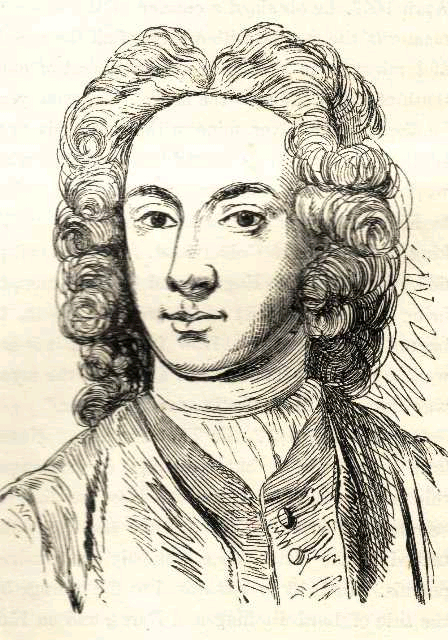
[portrait of Lord Binning]
HAMILTON, WILLIAM,
of Gilbert field, Lanarkshire, a poet of some merit, the friend and
correspondent of Allan Ramsay, was the second son of Captain William
Hamilton of Lady land, Ayrshire, and is supposed to have been born
before 1670. The family to which he belonged, proprietors of Ardoch,
in the latter county, was a branch of the Hamiltons of Torrance,
Lanarkshire, descended from Thomas Hamilton of Darngaber, third son
of Sir John Hamilton, lord of Cadyow, ancestor of the ducal family
of Hamilton. His father, the second son of William Hamilton of
Ardoch, acquired the estate of Lady land about the middle of the
seventeenth century, and succeeded his brother in the lands of
Ardoch. For refusing to take the test and for nonconformity, he was
disarmed in 1684, and severely dealt with by the commissioners for
the western shires. In 1686 he was one of the commissioners of
supply for the county of Ayr. He was killed in battle against the
French during the wars of King William. He had married in 1662,
Janet, daughter of John Brisbane of Brisbane, and had two sons,
John, his heir, and William the poet. The latter entered the army
early in life, and after considerable service abroad, he returned to
Scotland, on half pay, with only the rank of a lieutenant. Gilbert
field, where he went to reside, seems to have been only rented by
him, though designed of that place to distinguish him from Hamilton
of Bangour, a contemporary poet. “His time,” says a writer in the
Lives of Eminent Scotsmen, London, 1822, 18mo, “was now divided
between the sports of the field, the cultivation of several valued
friendships with men of genius and taste, and the occasional
production of some effusions of his own, in which the gentleman and
the poet were alike conspicuous.” In familiar Scottish poetry he
excelled. His principal productions were inserted in a work, the
first of its kind in Scotland, entitled ‘A Choice Collection of
Scots Poems,’ by James Watson, published at Edinburgh in 1706, 8vo,
with two additional parts in 1709 and 1711. In 1719 Hamilton
addressed from Gilbert field an Epistle in Scottish verse to Allan
Ramsay, designating himself “Wanton Willie,” which led to a rhyming
correspondence between them. Three of Hamilton’s epistles, with his
own replies, and another, on receiving from the lieutenant the
compliment of a barrel of Loch fyne herrings, are inserted in the
common editions of Ramsay’s works. Ramsay says of him that he “held
his commission honourably in my Lord Hyndford’s regiment.” His
elegies ‘on Bonny Heck,’ a dog, and ‘on Habby Simpson, Piper of
Kilbarchan,’ with his familiar epistles and other poems, are
remarkable for their easy versification and vein of humour, and it
is thought that both Ramsay and Burns, particularly the latter,
formed their own manner on some of Hamilton’s compositions, in some
of their most celebrated pieces in the same measure. In 1722 he
published at Glasgow, by subscription, an abridgment in modern
Scottish, of Henry the Minstrel’s Life of Sir William Wallace, which
Dr. Irving styles “an injudicious and useless work.” It has been
often reprinted. Towards the close of his life Hamilton resided at
Letterick in Lanarkshire, where he died at an advanced age, May 24,
1751. He married a lady of his own name, supposed to be a relation
of his own, by whom he had a daughter, Anna. The property of Lady
land was, about 1712, sold to his brother to the ninth earl of
Eglinton, who disposed of it to William Cochrane of Edge. The
brother, John Hamilton, went to the north of Ireland, where he had
purchased an estate. His son and successor, William Hamilton, having
disposed of the Irish property, returned to Scotland in 1744, and
bought the lands of Craighlaw in Wigtonshire from a family of the
name of Gordon.
HAMILTON, WILLIAM,
of Bangour, a pleasing and accomplished poet, was born in 1704. He
was descended from the ancient family of Little Earnock, ayrshire,
and was the second son of James Hamilton of Bangour, Linlithgowshire,
advocate, by Elisabeth, daughter of John Hamilton of Muirhouse, or
Murrays. His father’s uncle, Sir William Hamilton of Whitelaw, was
one of the lords of session, and appointed in 1608 lord justice
clerk, The subject of this notice received a liberal education, and
began in early life to cultivate a taste for poetry. He was long an
ornament of the fashionable circles of Edinburgh. When the rebellion
of 1745 broke out he joined the cause of the Pretender, and
celebrated his first success at Prestonpans, in the well-known
Jacobite ode of “Gladsmuir,” which was set to music by MacGibbon.
After the battle of Culloden, which terminated for ever the hopes of
the Stuarts, he took refuge in the Highlands, where he endured many
perils and privations, but at last succeeded in escaping into
France. Through the intercession of his friends at home his pardon
was soon procured from government, on which he returned to Scotland.
In 1750, on the death, without issue, of his elder brother,
John, who married Elizabeth Dalrymple, a descendant of the family of
Stair, the poet succeeded to the estate of Bangour. His health,
however, which was originally delicate, had been injured by the
hardships to which he had been exposed, and required the benefit of
a warmer climate. He, therefore, returned to the continent, and took
up his residence at Lyons, where he died of a lingering consumption,
March 25, 1754. A volume of his poems, without his consent or name,
appeared at Glasgow in 1748; but the first genuine and correct
edition of his works was published by his friends at Edinburgh in
1760, with a head by Strange, from which the subjoined woodcut is
taken:
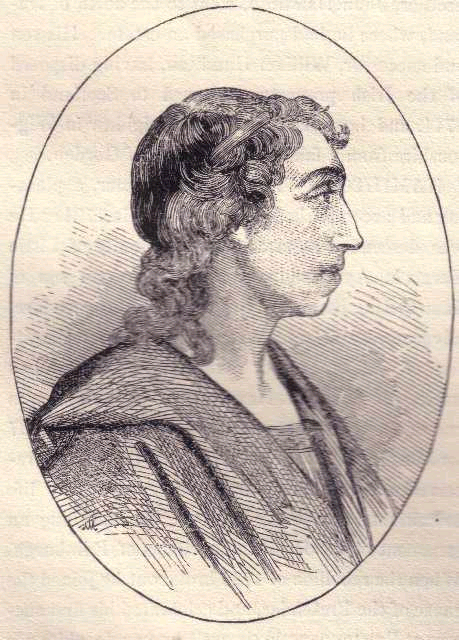
[woodcut of William Hamilton]
A discriminating criticism by Professor Richardson of Glasgow,
in the Lounger, first drew the public attention to his poems, the
chief characteristics of which are liveliness of imagination and
delicacy of sentiment. “Mr. Hamilton’s mind,” says Lord Woodhouselee,
in his life of Lord Kaimes, “is pictured in his verses. They are the
easy and careless effusions of an elegant fancy and a chastened
taste; and the sentiments they convey are the genuine feelings of a
tender and susceptible heart, which perpetually owned the dominion
of some favourite mistress, but whose passion generally evaporated
in song, and made no serious or permanent impression.” Had he never
written anything but the “Braes of Yarrow,’ that ballad, one of the
finest in the language, would have been sufficient to have
immortalized his name. He married Miss Hall, of the family of
Dunglass, and had issue one son, James, who succeeded him.
HAMILTON, GAVIN,
a distinguished painter, a descendant of the family of Murdieston,
was born at Lanark some time in the first half of the eighteenth
century, and being sent to Rome while very young, became a scholar
of Augustine Mossuchi. After several years’ absence he returned to
Scotland, and, with the exception of a few portraits, he devoted
himself entirely to historic composition. Two full lengths of the
duke and duchess of Hamilton are spoken of as his best efforts in
the department of portrait painting. Returning in the course of a
short time to Rome, he made that city his residence for the
remainder of his life. From his classical taste and superior style
he soon acquired a high reputation as an artist, and was one of the
three celebrated painters employed by the Prince Borghese to
embellish the saloons of the Villa Borghese. The subject,
represented by Hamilton, is the story of Paris, painted in different
compartments, and is described as being one of the finest specimens
of modern art to be found in Italy. His greatest work, however, was
his Homer, consisting of a series of pictures representing scenes in
the Iliad. One of these, the parting of Hector and Andromache, was
in the possession of the duke of Hamilton; another, the Death of
Lucretia, was in that of the earl of Hopetoun; and a third, Achilles
dragging the body of Hector round the walls of Troy, was painted for
the duke of Bedford. The whole series can now only been seen
continuously in the excellent engravings made of them by Cunego.
In 1773 Mr. Hamilton published at Rome a folio volume,
entitled ‘Schola Picturae Italiae,’ or “The Italian School of
Painting,’ consisting of a number of fine engravings by Cunego, all
the drawings for which were made by Mr. Hamilton himself, forming
part of the collection of Piraneisi. He died at Rome about 1775.
HAMILTON, RIGHT HON. SIR WILLIAM, K.B.,
an eminent virtuoso, celebrated for his works on the Volcanic
Phenomena, and Antiquaries of the Kingdom of the Two Sicilies, as
born December 13, 1730. He was the youngest son of Lord Archibald
Hamilton of Riccartoun and Pardovan, Linlithgowshire, a son of the
duke of Hamilton, by Lady Jane Hamilton, daughter of 6th
earl of Abercorn. In his youth Mr. Hamilton held a commission in the
third regiment of foot guards, and before his accession to the
throne, George III. Made him his equery. In 1758, he married the
only daughter of Hugh Barlow of Lawrenny-Hall, Pembrokeshire, with
whom he got an estate worth £5,000 a-year. In 1761 he was elected
member of parliament for Midhurst; and in 1764 was appointed
ambassador to the court of Naples, where he resided for 36 years.
Having abundance of leisure, the volcanic eruptions of the
neighbourhood early engaged his attention, and before the middle of
1767 he had visited Vesuvius no less than 22 times; also Mount Etna
and the Eolian Islands. His researches he detailed in several
letters to the Royal Society, inserted in the Philosophical
Transactions, and published separately in 1770; also in his splendid
work, ‘Campi Phlegraei.’ 2 vols. Folio, published at Naples in
1776-7; a Supplement to which appeared in 1779, containing an
account of the great eruption of Vesuvius in August of that year.
Always indefatigable in bringing to light the buried treasures
of antiquity, he promoted the publication of the magnificent account
of Herculaneum, and drew up a description of the discoveries made in
Pompeii, which was printed in the fourth volume of the “Archaeologia.’
He also collected a Cabinet of Greek and Etruscan vases and other
antiquities, of which an account was edited by D’Hancarville, and
published in 4 volumes, under the title of ‘Antiquities Etrusques,
Grecques, et Romaines, tirees du Cabinet de M. Hamilton.’ In 1766 he
was elected a Fellow of the Royal Society; and January 3, 1772, he
was created a knight of the Bath. About 1775 he lost his only
daughter, and in 1782 he was deprived by death of his lady. In
February 1783 he undertook a journey through Calabria, to observe
the effects produced by the dreadful earthquakes which had just
before desolated that beautiful province, and transmitted the result
of his investigations to the Royal Society. His portrait is
subjoined:
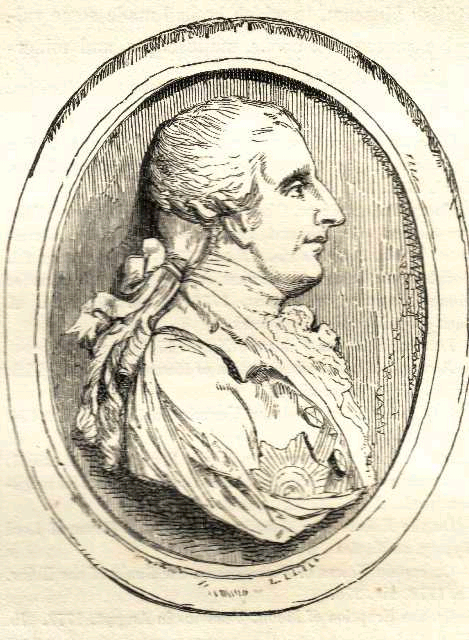
[portrait of Sir William Hamilton]
In 17911791 Sir William was sworn a privy councillor; and the
same year he married a second time Emma Harte, originally a servant
in a low tavern, afterwards the goddess Hygeia of the eccentric Dr.
Graham [see GRAHAM, JAMES], better known as the fascinating and
licentious Lady Hamilton, celebrated for her connexion with Lord
Nelson. In December 1798, when the French invaded the kingdom of
Naples, Sir William accompanied his Sicilian majesty to Palermo. His
connexion with the stirring events of that period belong to history.
By his exertions in getting the English fleet refitted at Palermo,
Lord Nelson was speedily enabled to pursue the French, and achieve
the glorious victory of Aboukir. The English nobility and gentry who
visited Naples expressed the warmest acknowledgments for the
splendid hospitality he exercised towards them. He was recalled in
1800, when he returned to England, and died in London, April 8,
1803, in his 73d year. He bequeathed what property remained to him
to his nephew, the Hon. C. F. Greville, son of the earl of Brooke
and Warwick. It was in trying to save this nephew from the wiles of
Emma Harte, that Sir William himself fell a victim to her arts.
After his death, his collection of Antique Vases was purchased by
parliament for the British Museum, to which he had made some
valuable presents of books, manuscripts, and mineralogical
curiosities.
His works are:
Observations on Mount Vesuvius, Mount Etna, and other
Volcanoes of the two Sicilies; with explanatory Notes. Lond. 1772,
1774, 8vo.
Campi Phlegraei; or, Observations on the Volcanoes of the two
Sicilies. English and French; with 54 plates, illuminated by Mr.
Peter Fabris. Napl. 1776-7, 2 vols. Atlas fol. Supplement: being an
Account of the great Eruption of Mount Vesuvius, in August, 1779.
Napl. 1779. Fol. A most splendid and curious work.
Lettersa sul Monte Volture. Napol. 1780, 8vo.
Account of the last Eruption of Mount Vesuvius, Phil. Trans.
1767. Abr. xii. 417.
On the Eruption of Mount Vesuvius in 1767. Ib. et 494. 1769,
592.
An Account of a Journey to Mount Etna, Ib. 1770, xiii. 1.
Remarks on the Nature of the ?Soil of Naples, and its
neighbourhood. Ib. 1771. 92.
On the Effects of a Thunder Storm on the House of Lord Tylney,
at Naples. Ib. 1773. 453.
On certain Traces of Volcanoes on the Banks of the Rhine. Ib.
1778. 618.
On the Eruption of Mount Vesuvius in August, 1779. Ib. 1780.
618.
Of the Earthquakes which happened in Italy, from February to
May, 1783. Ib. 1783, xv. 373.
Some particulars of the Present State of Mount Vesuvius; with
the Account of a Journey into the province of Abruzzo, and a Voyage
to the Island of Ponzo. Ib. 1786, xvi. 131.
Account of the late Eruption of Mount Vesuvius. Ib. 1795,
xvii. 492.
Account of the Discoveries at Pompeii. Archaeol. iv. p. 160.
1777.
Antiquites Etrusques, Grecques, et Romaines, tirees du Cabinet
de Mr. Hamilton; with Introductory Dissertations in English and
French, by M. D’Hancarville. Napl. 1765, 2 vols. Large fol. To which
two other volumes were added. Napl. 1775. The figures are
beautifully coloured after the vases from which they were copied.
The two first volumes of this scientific and magnificent work were
reduced to a smaller size by M. David, and published at Paris, 1787.
HAMILTON, ALEXANDER, M.D.,
an eminent physician and professor of midwifery in the university of
Edinburgh, was born in 1739 at Fourdoun, in Kincardineshire, where
his father, who had been a surgeon in the army, was established as a
medical practitioner. In 1758 he was appointed assistant to Mr. John
Straiton, a surgeon in Edinburgh, and on that gentleman’s death in
1762, having been induced to remain in that city, he was admitted,
on application, a member of the College of Surgeons, and commenced
practice for himself. He afterwards obtained a medical degree, and
was admitted a licentiate of the Royal College of Physicians, being,
at a suitable interval, chosen a fellow of the college. In 1780 he
was appointed joint professor of midwifery in the university of
Edinburgh with Dr. Thomas Young, o whose death in 1783, he became
sole professor. He resigned his professorship on the 26th
March 1800, and on the 9th April, his son, who had been
his assistant for two years, was elected his successor. Dr. Hamilton
was a fellow of the Royal Society of Edinburgh. He died on 23d May
1802. His works are:
Elements of the Practice of Midwifery. Lond. 1775, 8vo.
A treatise of Midwifery; comprehending the whole management of
Female complaints, and the treatment of Children in early infancy.
Edin. 1780, 8vo. Translated into German by J. P. Ebeling.
Outlines of the Theory and Practice of Midwifery. Edin. 1784,
8vo.
In 1786 he brought out a new and corrected edition of Dr.
William Smellie’s Anatomical Tables, with Explanations, and an
Abridgment of the Practice of Midwifery.
Letters to Dr. William Osborne, on certain Doctrines contained
in his Essays on the Practice of Midwifery. Edin. 1792, 8vo.
Case of an Inverted Uterus; with Practical Remarks on its
Reduction. Med. Com. xvi. 315. 1791.
HAMILTON, Robert, LL.D.,
an eminent mathematician and political economist, was the eighth son
of Gavin Hamilton, bookseller, Edinburgh, and grandson of Dr.
William Hamilton, professor of divinity, and afterwards principal of
Edinburgh college. He was born June 11, 1743, and studied at the
university of his native city. Though in early life subject to
constitutional weakness of health, he displayed remarkable
proficiency in mathematics, and a singular application in the
acquisition of knowledge. After leaving college, being intended for
a commercial profession, he spent some time in the banking
establishment of Messrs. William Hogg and Son, where he obtained
that practical information on money matters which afterwards enabled
him to expose, with so much effect, the ruinous nature of the then
financial system of the country. In 1766, when only twenty-three
years of age, he was induced, by the advice of his friends, to offer
himself as a candidate for the mathematical chair in Marischal
college, Aberdeen, then vacant by the death of Professor John
Stuart. Though unsuccessful in his application, Dr. Trail being the
fortunate competitor, he left a very high impression of his
abilities on the minds of the examinators. Thereafter he became
partner in a paper-mill, established by his father, but which he
relinquished in 1769, on being appointed rector of the academy at
Perth. In 1771 he married Miss Anne Mitchell of Ladath, who died
seven years afterwards.
In 1779 Dr. Hamilton was presented by the Crown to the chair
of natural philosophy in Marischal college, Aberdeen, which, in the
subsequent year, he exchanged with Dr. Copland for the mathematical
professorship, as being better suited to his inclination and
ability. It was not, however, till 1814 that he was formally
appointed to the mathematical chair in the same university.
In 1782 Dr. Hamilton married a second time Jane, daughter of
James Morison, Esq. of Elsick, and sister of the Rev. Dr. Morison,
minister of Banchory-Devenick.
Dr. Hamilton’s principal work, the ‘Inquiry concerning the
Rise and Progress, the Redemption and Present State of Management of
the National Debt of Great Britain,’ was published at Edinburgh in
1813, when he had passed his seventieth year. The greater part of
this celebrated Treatise is devoted to the consideration of the
various measures which had heretofore been adopted for reducing the
national debt. In opposition to the views advocated by Dr. Price in
his treatise ‘Of Reversionary Annuities,’ published in 1771, Dr.
Hamilton proves the utter uselessness of a borrowed sinking fund,
like that of Mr. Pitt, and the fallacy, as well as folly, of
continuing its operations during war, or when the expenditure of the
country overbalances the revenue. His arguments are supported and
illustrated by tables of practical calculation; and he
satisfactorily shows that the excess of revenue above expenditure is
the only real method by which the national debt, or any other debt,
can be discharged. His principles have not only been sanctioned by
the most eminent political economists, but have gradually been
adopted by the government.
In 1814 Dr. Hamilton’s increasing infirmities rendering it
necessary that he should have an assistant in the duties of his
chair, Dr. John Cruickshank was appointed to that office, and became
his successor. He died, July 14, 1829, at the advanced age of
eighty-six. By his first wife he had three daughters, of whom, the
second, Helen, was married to the late Mr. Thomson of Banchory, and
the youngest, Marion, to the Rev. Robert Swan of Abercrombie, in
Fife. By his second wife, who died in 1825, he had no family.
His works are:
Introduction to Merchandise; containing a complete system of
Arithmetic, a system of Algebra, Book-keeping in various forms, an
account of the Trade of Great Britain, and the Laws and Practices
which Merchants are chiefly interested in. Edin. 1777-9, 2 vols.
8vo.
System of Arithmetic and Book-keeping. Lond. 1778, 12mo.
Several editions.
Essay on Peace and War. 1790. This essay, published
anonymously, was written with the benevolent view of inculcating
doctrines favourable to universal peace. Having become scarce, it
was reprinted in 1831, by his family, along with a small pamphlet on
the Poor Laws, first published in 1822; and to these were added an
unfinished fragment of an Essay on Government, written during the
progress of the French Revolution.
A set of Mathematical Tables, for the use of his pupils, first
printed in 1790, reprinted with great accuracy and care in 1807.
Heads of a Course of Mathematics. An elementary work intended
for the use of his Students. 1800.
Inquiry into the Rise and Progress, the Redemption and Present
State of Management of the National Debt of Great Britain. Edin.
1813, 8vo.
HAMILTON, WILLIAM,
an eminent historical painter, the son of a Scotch gentleman, who
resided many years at Chelsea, was born in 1750. He was sent to
Italy when very young, and studied under Zucchi, the painter of
arabesque ornaments at Rome. On his return to England he became a
pupil in the Royal Academy, and acquired considerable employment. He
was engaged by Alderman Boydell for his Shakspeare, and by Macklin
for his edition of the Bible and of the Poets. One of his best works
was a picture of the ‘Queen of Sheba entertained at a Banquet by
Solomon,’ a design for a window in Arundel castle. He was elected
associate of the Royal Academy November 8, 1784, and a Royal
Academician February 10, 1789. He died December 2, 1801.
HAMILTON, WILLIAM, D.D.,
an eminent minister of the church of Scotland, the son of a farmer,
was born in 1780, at Longridge, parish of Stonehouse, Lanarkshire.
He was early sent to the parish school, and in Nov. 1796 was
enrolled a student in the university of Edinburgh. In addition to
his ordinary studies, he attended also the classes of anatomy,
chemistry, and materia medica.
In the summer of 1802 Mr. Hamilton went to reside, as
chaplain, in the family of Mr. Colquhoun of Killermont, lord
register of Scotland, and in Dec. 1804 he was licensed to preach the
gospel by the presbytery of Hamilton. Shortly after he became
assistant to the minister of Broughton, in Tweeddale, where he
laboured for about 16 months. By the influence of the lord register
he subsequently obtained the appointment of assistant and successor
to the Rev. Mr. Maconochie, minister of Crawford, which, however, he
was induced to relinquish in favour of another, and accepted the
office of assistant to Mr. Sym at New Kilpatrick. He officiated at
the latter place for a year and a half, when he was chosen minister
of St Andrew’s chapel, Dundee, to which charge he was ordained Dec.
23, 1807. After he had been about 20 months in that town, his
friend, Mr. Colquhoun, procured for him the presentation to the
parish of Strathblane, Stirlingshire, to which he was inducted
September 14, 1809. He died April 16, 1835. He was the author of the
following works:
Treatise on Assurance.
Young Communicant’s Remembrancer.
Mourner in Zion Comforted.
He wrote also a most excellent and edifying autobiography,
published with his ‘Life and Remains,’ edited by his son, the Rev.
James Hamilton, D.D., minister of the Scottish National church,
London.
HAMILTON, SIR WILLIAM, Baronet,
one of the greatest metaphysicians of modern times, was born in
Glasgow in March 1788. His grandfather, Thomas Hamilton, professor
of Anatomy in the university of that city (who died in 1781) by his
wife, Isabella, daughter of Dr. William Anderson, had a son, William
(who died in 1793), the father of the subject of this notice. His
mother was Elizabeth, second daughter of William Stirling, Esq.,
heir male of the ancient family of Calder. Sir William was the elder
of two sons. His brother, Thomas Hamilton, Esq., at one time an
officer in the army, was the author of ‘The Youth and Manhood of
Cyril Thornton,’ a novel, published in 1827, one of the most
vigorously written fictious of its day; ‘Men and Manners in
America,’ published in 1833; ‘Annals of the Peninsular Campaigns,’
and other popular works.
After his father’s death, he was boarded for some time with
Rev. Dr. Summers at Mid Calder, and at the age of 12, entered the
university of Glasgow. He was afterwards sent to a school at
Bromley, and returned to Glasgow College. Having obtained one of the
Snell exhibitions, he went, in 1809, to Baliol College, Oxford,
where he took first-class honours. The profession which he made, it
is stated, on going in for his degree, was unprecedented for its
extent. It embraced all the classics of mark, and under the head of
science, it took in the whole of Plato, the whole of Aristotle, with
his early commentators, the Neo-Platonists, and the fragments of the
earlier and later Greek schools. His examination in philosophy
lasted two days, and two hours each day, and he came forth from it,
showing that his knowledge was both accurate and extensive.
In 1812 he went to Edinburgh, and having devoted himself to
the study of the law, he passed advocate at the Scottish bar in
1813. The representation of the family of Hamilton of Preston, East
Lothian, and Fingalton, Renfrewshire, the oldest branch of the noble
house of Hamilton, having in 1799 devolved upon him, he took the
necessary steps to have his right acknowledged, and on July 24,
1816, was by a most respectable jury, before the Sheriff of
Mid-Lothian, served heir male in general to Sir Robert Hamilton, the
second baronet of the family, who died, unmarried, October 20, 1701,
and proved himself to be of the house of Preston and Fingalton, the
twenty-fourth in lineal male descent from Sir John Fitz Gilbert de
Hamilton, of Rossaven and Fingalton, who lived about 1330, and was
the second son of Sir Gilbert, the founder of the house of Hamilton
in Scotland. The lands of Rossaven, here mentioned, are in
Lanarkshire, and afforded an occasional title to the heir apparent
of the family. Ross, in the Gaelic, signifies a promontory or
peninsula. Rossaven, therefore, is the promontory or peninsula
formed by the confluence of the Aven and the Clyde, near the town of
Hamilton. Sir William was, also, of the family of Airdrie, the
twelfth male representative.
In 1821, Sir William was elected by the Faculty of Advocates
and the Town council, with whom the patronage then lay, to the chair
of Universal History in the University of Edinburgh. He first
distinguished himself by a remarkable series of contributions to the
Edinburgh Review, extending from 1826 to 1839. From 1826 to
1828 he wrote elaborate papers against Phrenology and George Combe
and Dr. Spurzheim, and in preparing for them he dissected several
hundred different brains. In 1829, he wrote his famous article on
Cousin and the Philosophy and Literature, Education and University
Reform.’ By these he became known, on their appearance in the Review,
to philosophers on the Continent, and his fame abroad at
the time was higher than even in his own country. These essays are,
in an especial degree, distinguished for vigour and originality of
thought, not less than for vast and varied learning, and on their
publication a collected form, the work was translated into French.
In 1836, on the death of Dr. David Ritchie, one of the
ministers of St. Andrew’s church, Edinburgh, professor of logic in
the university of that city, Sir William was appointed by the Town
Council, the then patrons, his successor in the chair. For this
professorship, more than for any other, he was particularly
qualified, and he attained in it a reputation equal to that of any
of the deepest thinkers yet known. Under him, the class, which had
long been a mere appendage to the theological course, assumed a new
importance, and Scotland as a school of metaphysics, regained the
renown it had enjoyed in the days of Dugald Stewart. Having begun to
prelect on Dr. Thomas Reid in his class, he was led to prepare an
edition of Reid’s works, which, with selections from his unpublished
letters, was published in 1846.
Sir William also held the office of her majesty’s solicitor of
teinds for Scotland. He was a corresponding member of the Institute
of France; honorary member of the American Academy of Arts and
Sciences, and of the Latin Society of Jena, and a doctor in
philosophy. Previous to his death he was engaged upon the works of
Dugald Stewart. His Lectures, edited by Professor Mansel, Oxford,
and Professor Veitch, St. Andrews, were also published after his
decease. For a number of years previous to his death he was
oppressed with infirmities, and obliged to employ an assistant, and
it was characteristic of him that he was in the habit of selecting
for the office some one of those who had been his more distinguished
students.
Sir William Hamilton has been described as “the most learned
of all the Scottish metaphysicians.” “When he was alive,” says one
who knew him, “he could always be pointed to as redeeming Scotland
from the reproach of being without high scholarship. Oxford had no
man to put on the same level. Germany had not a profounder scholar,
or one whose judgment, in a disputed point, could be relied on.”
Unlike Brown, who, notwithstanding his wide reputation and many
admirers, founded no school, Hamilton has numerous professed
disciples, and is an established authority in metaphysics. “His
articles in the Edinburgh Review were above the comprehension,” says
a writer in the ‘North British Review’ for November, 1857, who
understood what he was writing about, “and still further above the
tastes of the great body even of metaphysical students in this
country when they appeared. But they were translated by M. Peisse
into the French language, and there were penetrating minds in
Britain, America, and the continent, which speedily discovered the
learning and capacity of one who could write such Dissertations. By
the force of his genius he raised up a body of pupils ready to
defend him and to propagate his influence. He has, at this present
time, a school and disciples, as the Greek philosophers had in
ancient times, and as such men as Descartes, Leibnitz, and Kant,
have had in modern times.
Sir William Hamilton died at Edinburgh May 6, 1856, of
congestion of the brain. He had married, in 1829, his cousin, the
daughter of Hubert Marshall, Esq., and had three sons, 1st
William, his successor in the baronetcy; 2d, Hubert, who in 1860
passed advocate at the Scottish bar; 3d, Thomas; and one daughter,
Elizabeth.
A memoir of Sir William Hamilton, by his pupil, thomas Spencer
Baynes, LL.B., is given in the “Edinburgh University Essays” for
1856, and in an ably written article on “Scottish Metaphysicians” in
the North British Review for November 1857, an account is given of
his system and philosophy. His works are:
Be not Schismatics. Be not Martyrs by Mistake. A pamphlet on
the Non-Intrusion Controversy. Edin., 1843.
Works of Thomas Reid, with Selections from his Unpublished
Letters. Preface, Notes, and Supplementary Discussion (unfinished).
1846.
Discussions on Philosophy and Literature, Education and
University Reform. London, 1852, 8vo.
Collected works of Dugald Stewart, 10 vols. 1854-60, 8vo, with
supplementary volume.
Lectures on Metaphysics and Logic, edited by the Rev. H. L.
Mansel, B.D., LL.D., Waynflete Professor of Moral and Metaphysical
Philosophy, Oxford, and John Veitch, M.A., Professor of Logic,
Rhetoric, and Metaphysics, St. Andrews, 4 vols., (Posthumous).
I would
like you to correct an “error” that I think really needs
to be addressed concerning John Hamilton, the 4th of
Cadyow. He did indeed marry Jacoba (Janet) Douglas but
his first son was not his son at all, despite what
history might say. I am involved in the Hamilton genetic
genealogy and we have now researched this to death and
there is no way John was the father of James.
I am also
working on the Wikitree Hamilton tree and have some
details up there as well. I am currently editing a book
on one branch of the family that ended up in Ireland and
have put the following in the book:
“Until a few years ago it
was thought that James Hamilton (the 5th of Cadzow) was
the son of John Hamilton the 4th of Cadzow but through
the marvels of genetic testing it is now quite clear
that this just cannot be. Who the actual father was is
still a mystery but his genetic “finger-print” is known
and the search goes on.
“Two papers have been
combined into one on the Internet and are highly
recommended for anyone interested in
exploring this mystery. One of the papers also gives
an excellent account of the politics of the time
providing an essential background to the emergence of
this branch of the family.
“Clearly James Hamilton was
not a Hamilton in terms of bloodline but then what is a
“Hamilton”. The first of the line to consistently use
the surname Hamilton was David Hamilton around 1381:
He was the first of the
family recorded as formally using the name Hamilton,
appearing in a writ of 1375 as "David de Hamylton, son
and heir of David fitz Walter", in 1378 he is styled as
David de Hamilton and in 1381 as David Hamilton, Lord of
Cadzow. (1).
“So there is the first
officially recorded Hamilton of the line in 1381, only a
short time before the birth of James. Prior to that
surnames thought to have been used by the male line of
the family include de Hamilton, fitz Walter, fitz
Gilbert, Beaumont, Audemar, Harcourt, Sachsen and even
Frithuwald. What is important is the blood-line because
at that time the legitimacy of the birth radically
affected the right and ability to inherit titles and
property so the subterfuge successfully conducted by
Janet and her entourage has had a long lasting effect on
the family and its fortunes.
“What the
genetics also tell us is that the father of James and
his step-father (John) shared a common ancestor possibly
2,000 years ago and he lived somewhere in what is now
North Western Germany.”
John
Hunter
James
Earl Hamilton Marsden



