HERIOT,
a surname derived from a legal term, hariot or heriot, being, under
the feudal system, a due belonging to a lord at the death of his
tenant, consisting of his best beast, either horse, ox, or cow. In
some manors, the best goods, piece of plate, &c., are called hariots.
The word heriot, in the Saxon, also meant a provider of furniture
for the army.
The name
is old in Scotland. According to Buchanan, in the time of Edward
Baliol’s brief usurpation, William, John, and Gilbert Heriot, safely
conducted Robert the Steward out of the reach of his enemies, when
eagerly sought after by the English. The lands of Trabrown in East
Lothian were granted by the earl of Douglas to John Heriot about
1423, and they continued in the possession of his descendants till
the end of the reign of Charles the First. Of this family was the
celebrated George Heriot, founder of Heriot’s Hospital, of whom a
memoir follows. The lands of Elphonston in East Lothian afterwards
came into their possession, and these they called Trabrown. The
Heriots of Niddrie-Marischal belonged to the same family.
HERIOT, GEORGE,
founder of a magnificent hospital at Edinburgh, was the son of a
goldsmith of high respectability in that city, a descendant, as
already stated, of the Heriots of Trabrown. He is supposed to have
been born in June 1563. Being bred to his father’s business, to
which in that age was usually added the occupation of a banker, he
was, May 28, 1588, admitted a member of the incorporation of
goldsmiths. At the age of twenty-three he married Christian,
daughter of Simon Marjoribanks, a substantial burgess of Edinburgh,
with whom he received a portion of 1,075 merks, but who appears to
have died a few years after, without children. In 1597 he was
appointed goldsmith to Queen Anne, consort of James VI., and soon
after he was constituted goldsmith and jeweller to the king.
On the
accession of James to the English throne, Heriot followed the court
to London, and, by diligent application to business, he amassed
considerable riches. Several of the accounts of jewels furnished by
him to the queen are given in constable’s Memoirs of Heriot,
published in 1822. He took for his second wife Alison, eldest
daughter of James Primrose, clerk to the Scottish privy council,
grandfather of the first earl of Rosebery. By this lady, who died
April 16, 1612, he had no issue. His own death took place at London,
February 12, 1624, and on the 20th of that month he was
buried at St. Martin’s in-the-field. By his will, dated January 20,
1623, he bequeathed the greater part of his wealth to the clergy,
magistrates, and town-council of Edinburgh, to found and endow an
hospital in that city for the maintenance and education of poor
fatherless sons of freemen. He also left legacies to all his
relations, and to two natural daughters, with remembrances to many
of his friends and servants.
The
magnificent Gothic structure of Heriot’s Hospital, from a design by
Inigo Jones, was begun July 1, 1628. The building was interrupted by
the troubles of the period, but was renewed in 1642, and finally
completed in 1650, at a cost of £30,000 sterling. It has long formed
one of the noblest public ornaments of the city of Edinburgh. After
the battle of Dunbar, Cromwell took possession of it as a military
hospital. In 1658 General Monk restored to the governors, and, April
30, 1659, thirty boys were admitted. The number afterwards regularly
increased, and in 1854 one hundred and eighty boys were maintained
and educated in the Hospital. By the will of the donor the governors
were directed to purchase lands in the vicinity of Edinburgh for the
benefit of the institution; and, from the great rise in the value of
such property in that neighbourhood, the revenues have very much
increased, particularly within the present century. In 1837 the
annual income amounted to £14,355, and the expenditure to £11,235.
The Governors having procured an act of parliament for the purpose,
applied the surplus to the erection of schools in various parts of
Edinburgh for the education of children of poor inhabitants of that
city, those of burgesses having the preference. Certain statutes for
the government of the Hospital were drawn up by Dr. Balcanquhal,
dean of Rochester. There is a statue of the founder in the court of
the institution, and a portrait of him in the Governor’s room. A
miniature statue of him by Salter was erected at the south-west
corner of the Scott monument, Princes Street, Edinburgh, in April
1854. Subjoined is Heriot’s portrait:
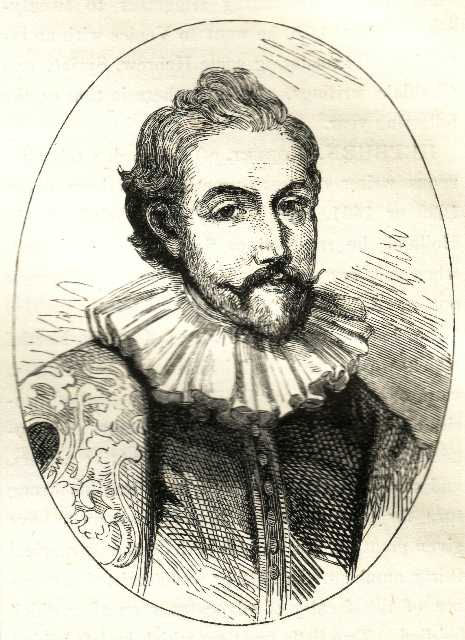
[portrait of George Heriot]
George Heriot was a great favourite with James the Sixth, wh
gave him the designation of ‘Jingling Geordie,’ under which name he
figures as a prominent character in Sir Walter Scott’s novel of ‘The
Fortunes of Nigel.’
HERIOT, JOHN,
a miscellaneous writer, was born at Haddington, April 22, 1760. His
father was the sheriff-clerk of the county of East Lothian. He
received the rudiments of his education at the schools of Dunse and
Coldstream, and in 1772 was sent to the High school of Edinburgh. He
subsequently became a student at the university of that city. In
1778 he proceeded to London, and, having entered the navy, saw a
good deal of service on board the Vengeance, 74, and the Elizabeth,
which formed one of the fleet under the command of Sir Hyde Parker.
In the battle of April 16, 1780, between the British and the French
fleets, the Elizabeth maintained for a considerable time an unequal
combat with two line of battle ships, and had nine men killed and
sixteen wounded, among the latter Mr. Heriot. He was also in the
action of May 19 of the same year. In the subsequent July he
exchanged into the Brune frigate of 32 guns, in which he continued
till she was paid off.
Having been promoted to a first lieutenancy, Mr. Heriot,
towards the end of 1782, embarked on board the Salisbury of 50 guns,
and subsequently joined the Alexander, 74; but at the general
reduction consequent upon the peace, in 1783, he was placed on the
half-pay list. To assist his parents he mortgaged his half-pay, a
step which was productive of much subsequent embarrassment to him.
The next few years of his life were passed in a mere struggle for
existence. He wrote two novels, which produced a small fund, on
which he lived for nearly two years. He was afterwards employed on
‘The Oracle,’ at the same time that Sir James Macintosh was retained
to translate the French journals for that paper. He subsequently
joined the ‘World,’ of which he was for a short time the sole
editor.
Having, by his writings, recommended himself to one of the
secretaries of the treasury, that gentleman proposed to him to
undertake the establishment of a daily paper. The funds were
supplied by two individuals connected with the government, but
wholly from their own resources. Mr. Heriot entered actively into
the project, and October 1, 1792, under his management, ‘The Sun’
evening newspaper appeared; and on January 1, 1793, he started also
‘The True Briton.’ With the assistance of able coadjutors, he
continued regularly his arduous task of editing two papers a-day,
until 1806, when he retired, on being appointed a commissioner of
the Lottery. In 1809 he was nominated deputy-paymaster to the forces
in the Windward and Leeward Islands. On his return to England in
1816 he was appointed comptroller of Chelsea Hospital, in which
situation he continued till his death, which happened July 29, 1833.
In 1798 he published an Account of the Battle of the Nile, drawn up
from the Minutes of an officer of rank in the squadron, which has
passed through several editions.
His works are:
The Sorrows of the Heart; a Novel. 1787, 2 vols.
The Half-Pay Officer; a Novel. 1788, 3 vols. 8vo.
Historical Sketch of Gibraltar; with an Account of the Siege
of the Fortress, by the combined Forces of France and Spain. Lond.
1792, 8vo.
Account of the Battle of the Nile. 1798.



