HOGG, WILLIAM,
an ingenious translator into Latin of English poems, lived in the
seventeenth century, and was a native of Gowrie, In Perthshire. To
better his condition he went to London, but being disappointed in
his views, he was reduced to great distress. Dr. Birch states that
he died of want in the streets. In 1690 he published at London
‘Paraphrasis Poetica in tria Johannis Miltonis viri clarissimi
Poemata, viz. Paradisum Amissum, Paradisum Recuperatum, et Samsonum
Agonistem,’ an edition of which was printed at Rotterdam in 1699. Of
this version of Milton the notorious Lauder made considerable use in
his dishonest attempt against the reputation of that great poet. The
other principal translations of Hogg are, ‘Liber Primus Principis
Arcturi,’ (a Rich. Blackmore, Esq. Aur.) Latine red. 1706;
‘Paraphrasis in Jobum Poetica,’ 1682; ‘Satyra Sacra, sive
Paraphrasis in Ecclesiasten Poetica.’ Part of his sacred poetry is
reprinted in the ‘Poetarum Scotorum Musae Sacrae.’
HOGG, JAMES,
the Ettrick Shepherd, one of the most remarkable of Scotland’s
self-taught poets, was born in a cottage on the banks of the
Ettrick, Selkirkshire, January 25, 1772, the anniversary of the
natal day of Burns. His progenitors were all shepherds, an
occupation which his father, like himself, followed for many years.
He received but a scanty education, and spent only about half a year
at school. At seven years of age he was sent to herd cows, and his
boyhood was devoted to keeping sheep upon the hills. Among the first
books that he read were ‘The Life of Wallace,’ and ‘The Gentle
Shepherd,’ which he was disappointed were not written in prose
instead of verse. He also read Bishop Burnet’s ‘Theory of the
Conflagration of the Earth,’ which he sates nearly “overturned his
brain.” His first attempts at versification were made in the spring
of 1796; and his first published song was ‘My name it is Donald
M’Donald,’ composed, in 1800, on the threatened invasion of
Bonaparte, which soon became very popular. In 1801, when attending
the sheep market at Edinburgh, he ventured to publish a small volume
of poems, which, however, was soon consigned to oblivion. The
attention of Sir Walter, then Mr. Scott, being drawn to the poetical
talent of Mr. Hogg, by his advice he published, in 1807, a volume of
ballads, under the title of the ‘Mountain Bard.’ These compositions,
emanating from a rough untutored mind, bore many latent indications
of that high poetical imagination which afterwards shone out so
brightly in ‘Kilmeny;’ and the work being successful, with its
profits and a premium which he gained from the Highland Society for
an ‘Essay on Sheep,’ published the same year, he was tempted to
embark in an agricultural speculation, which unfortunately proved a
failure.
Disappointed in
his views, he now determined upon settling in Edinburgh, and
following the precarious calling of an author. Accordingly he
arrived in that city in February 1810, and the same year he
published a volume of songs, called ‘The Forest Minstrel,’ from
which, however, he derived no pecuniary benefit. At this period,
when poverty was pressing hard upon him, he found kind and steady
friends in Messrs. Grieve and Scott, hatters, whose well-timed
benevolence, we are told, supplied all his wants. His next adventure
was a literary publication called ‘The Spy,’ chiefly devoted to
moral essays, tales, poetry, and sketches of life. But Hogg at this
time knew nothing of men and manners, and very little of
contemporaneous literature; and his periodical did not outlive the
year of its birth.
In the
spring of 1813 he produced his ‘Queen’s Wake,’ a legendary poem,
which consists mainly of a series of metrical tales written in
imitation of the old Scottish ballads, and connected and diversified
by a fiction of considerable ingenuity, in which the bards and
minstrels of Scotland are represented as contending for prizes
before Mary Queen of Scots and her court at Holyrood. Overlooking a
few defects of style, the ‘Queen’s Wake’ is undoubtedly one of the
finest poems in the language; and by far the best and most
imaginative piece in the volume is the beautiful episodical tale of
‘Kilmeny,’ which for sweetness and simplicity cannot be excelled. In
the course of a short time the ‘Queen’s Wake’ went through several
editions, and at once secured for the author a degree of popularity
and fame that has seldom fallen to the lot of a modern writer. His
portrait is subjoined.
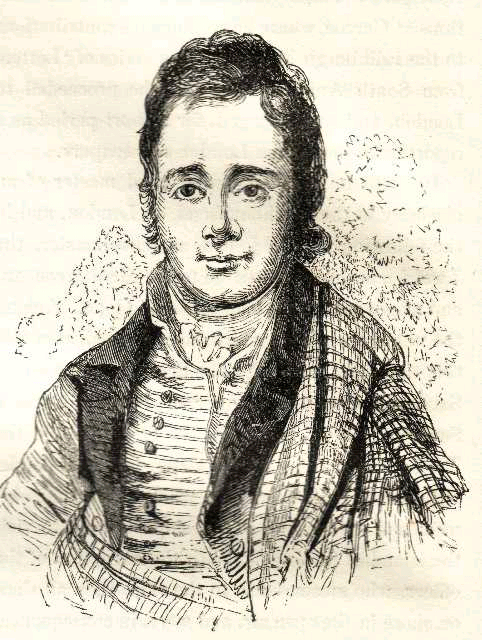
[portrait of James Hogg]
In 1815, Mr. Hogg published ‘The Pilgrims of the Sun,’ a poem
of unequal merit, although in some passages worthy of his now
established reputation. In 1816 appeared ‘Mador of the Moor,’ in the
Spenserian stanza, which is greatly inferior to its predecessor. The
Shepherd next applied himself to collect original pieces from the
principal living poets of Great Britain, but the refusal of Sir
Walter Scott to assist him in the project, with other untoward
circumstances, caused him to change his plan, and write imitations
of the whole himself. The ‘Poetic Mirror,’ published anonymously,
was the result of this bold attempt. It comprised many pieces of
great excellence, and soon passed into a second edition. It was
followed by ‘Dramatic Tales,’ in two volumes, a work which, with the
exception of ‘The Hunting of Badlewe,’ a tragedy previously printed
separately, contains little surpassing the ordinary standard. In
1818 he published ‘The Brownie of Bodsbeck, and other Tales in
Prose,’ 2 vols. In 1819 he brought out the first volume of the
‘Jacobite Relics,’ the second volume of which appeared in 1821. In
1820 ‘Winter Evening Tales, collected among the Cottagers in the
South of Scotland,’ made their appearance. This work was one of his
most successful publications. In 1822, when George IV. Visited
Scotland, Hogg welcomed his sovereign in ‘The Royal Jubilee, a
Scottish Masque,’ which took no permanent hold of public attention.
In 1814 the Shepherd had received, at a nominal rent, from the
duke of Buccleuch, the small farm of Altrive Lake, in the wilds of
Yarrow, which continued to be his residence till his death. After
his marriage, in 1820, he determined once more to farm on a large
scale, and accordingly took a lease for nine years of the adjoining
farm of Mount Benger. Having lost about £2,000 by his agricultural
speculations, to raise money, he wrote, in a few months, two
extravagant Border romances, each in three volumes, the one entitled
‘The Three Perils of Man,’ for which he received £150; and the other
‘The Three Perils of Woman,’ which produced the same sum. In 1824 he
published anonymously a book abounding in horrors, called
“Confessions of a Fanatic,’ which had a tolerable sale, though he
reaped no benefit from it. In 1825 he gave to the world ‘Queen Hynd,’
an epic poem, by no means one of his happiest efforts. About this
time he wrote, for Blackwood’s Magazine, a series of interesting
prose sketches under the title of ‘The Shepherd’s Calendar,’
published separately in two volumes in 1829.
In 1832, in which year appeared his ‘Queer Book,’ Mr. Hogg
visited London, and during his short sojourn in the metropolis, he
was “the observed of all observers,” and was honoured with a public
dinner. In 1834 he produced a volume of ‘Lay Sermons,’ and shortly
after ‘Domestic Manners of Sir Walter Scott.’ In the following year,
during the short period that the conservatives were in power, Sir
Robert Peel transmitted to him £100 as an earnest of an annual
pension to that amount, which he did not live to enjoy. His
constitution had been long sinking under the united effects of
pecuniary embarrassments and intense literary labour, and he died at
Altrive Lake, November 21, 1835. He had married, in 1820, Margaret,
youngest daughter of Mr. Phillips of Longbridgemoor, Annandale, who,
with five children, survived him. In 1854, his widow received a
pension from government of £50, in consideration of her husband’s
services to literature.
Hogg was fond of all athletic exercises and field sports, and
was long made to figure conspicuously in the ‘Noctes Ambrosianae’ of
Blackwood’s Magazine, which gave his name a celebrity beyond that
acquired by his own writings. He wrote two interesting
autobiographies of himself, which will be found published with his
works.
The Works of the Ettrick Shepherd
Tales and Sketches
Revised at the instance of the Author's Family by the Rev. Thomas
Thomson (1869)
PREFACE
Ox the Ettrick Shepherd and his Writings
much comment is no longer necessary: his name has become a household
word, and his works are known not only in his native Scotland, but
wherever the English language or the Scottish dialect is understood.
Next to Burns himself, who stands alone as our great national bard,
no poet has so nearly approached him in his own peculiar walk, or
won so high a reputation as James Hogg; while the merits of both are
enhanced by the original lowliness of their station, and the
difficulties that stood in their way to such high distinction. The
one was only a ploughman, and the other a shepherd. But from the
Thames to the Ganges, from the Clyde to the Nova, their songs are
sung as the commemorations of social and domestic worth, or the
incentives to patriotic and public nobleness; while prince and
peasant cordially unite in applauding their productions and
honouring their memory.
But while Burns stands so proudly alone, and Hogg occupies a
considerably lower pedestal, it must not be forgot, that the latter
possessed excellencies of his own which are wanting in the former.
If in deep emotion and correspondent power of language the songs of
Burns have hewn for themselves an indelible imprint into the living
rock of time—if in the vivid brilliancy with which, by a single
line, he could reveal an unnoticed sentiment as with a flash of
lightning, the Ettrick Shepherd cannot be compared with his great
prototype,—this deficiency in power is all but compensated by the
superior wideness of his range. His faculties expanded over a more
ample field than that of the Bard of Coila, and in this way
accomplished more than Burns could have effected. In the imaginative
of poetry, could the latter have pictured such a union of the
supernaturally bright and beautiful as that of Kilmeny? Could he
have sustained himself so long upon the wing as Hogg has done in his
larger productions! And in that inventiveness which is so essential
an attribute in poetry, could he have created so wide and so varied
a world of scenery and incident as has been done by the Ettrick
Shepherd!
But abandoning such questions, which may be deemed too captious, we
would now observe, that the fame of Hogg does not rest solely upon
his merits as a poet. He was also a prose writer; and in this
department the fervour of his imagination, and his originality, are
almost as conspicuous as in his poetry. While the force of
circumstances compelled him to adopt this course of authorship, the
same necessity obliged him to write upon those subjects with which
he was best acquainted, and which he had already so well illustrated
in his poems. And hence his Tales, his Essays, and Sketches were
conceived and expressed in the same poetical spirit, while they
chiefly touch upon the same subjects. The short and simple annals of
the poor—their social and domestic joys and sorrows—their daily
occupations and stated festivals—their wild and wondrous legends and
superstitions—their adventures as Scottish emigrants in search ol
wealth or occupation—these have all found in him an able, faithful,
and sympathizing recorder: his stories of mirth and glee describe
events in which he had been an actor; while his narratives of
fearful diablerie, or the mysteries of Fairyland, are told in the
con amove spirit of one who was more than half persuaded ol their
truth. Hence the freshness and air of sincerity with which they are
invested, and which impart to fiction the charms of reality. Even
had Hogg written nothing more than these, he would have been
entitled to a high place among the prose writers of our country.
It is gratifying to think that such genuine excellence has obtained
a correspondent ! recognition. The productions of the Ettrick
Shepherd, by their own intrinsic excellence, have won their way, and
secured their proper place among the lasting literary achievements
of our countrymen. While they excited the admiration of the bygone
period, and made the public to wonder that they could have been
written by any one under such adverse circumstances as his, their
popularity was not, like that of so many contemporaneous works,
confined to their own day. They have stood the severest ordeal of
criticism, and every year has only added to their reputation. Like
the national characteristics of Scotland, which they so well
illustrate, they have only been hardened into permanence by the
trial through which they have passed unscathed; and they bid fair to
endure as long as Scottish individuality continues to be prized and
cherished. And although the fashion of things may change with the
mutations of time, the Ettrick Shepherd’s writings, along with those
of Scott and of Burns, will still continue to be valued as the
faithful transcripts of an existence dear to memory, though its
forms have become obsolete, as well as of those more solid and
substantial national virtues which neither fashion can change nor
time eradicate.
This edition of The Ettrick Shepherd’s Works is. in some respects, a
reproduction, in a cheaper and more popular form, of the collection
of his writings in poetry and prose, partly prepared by the Author
himself, issued by the publishers in eleven volumes, foolscap 8vo. A
new Life of the Shepherd has been supplied, in addition to the
former Autobiography, and a fresh arrangement has been made of the
larger Poems, while the smaller have been classed into distinct and
appropriate groups. Hogg’s own contributions to the Forest Minstrel,
many of which were omitted in the earlier edition of his works, are
now restored, so that the present issue will be, more than any
other, full and complete. To each of the larger poems a brief
critical, explanatory, or analytical notice has been prefixed. While
these re-arrangements and additions have been made in the Poetical
works, those in Prose have been carefully revised, but chiefly for
the purposes of a slight occasional pruning and verbal emendation,
such as the Author, had he lived, would himself most probably have
made.
In the work of revision, and in the preparation of the Memoir. the
Editor has enjoyed the advantage of the co-operation of the Author’s
widow, and the surviving members of his family. The Memoir and
Autobiography accompany the volume containing the Poems.
Edinburgh, November. 1865.
Download
The Works of the Ettrick Shepherd here
Tales and Sketches of the Ettrick
Shepherd
Including several pieces not before printed with Illustrative
engravings from real scenes by D.O. Hill in six volumes
Vol. 1
| Vol. 2 |
Vol. 3. |
Vol. 4. |
Vol. 5 |
Vol. 6



