|
RAMSAY, a surname
derived from Ramsey or Ramsea, the island of rams. Lower, in his ‘Essays
on English Surnames,’ says that the abbot of Ramsay bore on his seal a
ram in the sea. Simundus de Ramsay, the ancestor of the Dalhousie
family, the first of the name in Scotland, came from the county of
Huntingdon, in England, where the name of Ramsay is a local appellation,
and received a grant of lands in Mid Lothian from David I. (see
DALHOUSIE). We learn from Douglas (Peerage, Wood’s edit. Vol. i. p.
401,) that he was a witness in a charter of Archbishop Thurston to the
monks of Holyrood in 1140, and also in one, in the reign of Malcolm IV.,
wherein William de Morville, constable of Scotland, granted the lands of
Gilmerton, near Edinburgh, to Eudulph, the son of Uchtred. William de
Ramsay is witness to a charter to the church of Coldingham, in the reign
of King William the Lion, before 1198. Patrick de Ramsay is witness to a
charter of King Alexander II., to the abbacy of Dunfermline in 1227.
Another William de Ramsay was of the council of King Alexander III. in
1255, in the minority of that monarch. He witnessed a charter of Duncan
de Lascels in 1260, also a donation of Symon de Kyner or Kinneir, to the
monks of Balmorine, in Fife, 1st September 1261, and another, signed in
presence of King Alexander III., in the castle of Edinburgh, in May
1278. He is said to have had three sons; William, his successor;
Malcolm, witness to a charter of William de Valloniis in 1284; and John,
witness to the same and to another charter in 1278.
William de Ramsay, the
eldest son, swore fealty to Edward I. of England, for his lands of
Dalwolsie or Dalhousie, in the county of Edinburgh, and of Foulden,
Berwickshire, in 1296, and again in 1304. He joined King Robert the Brus,
and was one of the patriot barons who signed the letter to the pope,
asserting the independence of Scotland, 6th April 1320.
Sir Alexander de Ramsay
of Dalhousie, supposed to be his son (referred to in the article
DALHOUSIE, earl and marquis of), distinguished himself by his valour and
daring in the reign of David II., and was one of the most conspicuous of
the Scottish leaders against the English at that period. In August 1335,
when Edward III. invaded Scotland, and a considerable body of foreign
troops, under the command of Guy count of Namur, had landed to his
assistance, the latter were encountered and defeated on the Boroughmuir
of Edinburgh by the regent Randolph, earl of Moray, the earl of March,
and Sir Alexander Ramsay. Collecting together a band of adventurous
young men, the latter took shelter in the caves of Hawthornden near
Roslin, and in the adjacent caves of Gorton, and continually harassed
the English by his sallies against them. He relieved the castle of
Dunbar, when besieged by the earl of Salisbury in 1338. He even extended
his inroads across the border, and, on one occasion, returning from
Northumberland with much booty, he was encountered by Robert Manners
near Wark castle. Pretending to fly, he led the party into an ambuscade,
when he attacked and totally defeated them, making their leader
prisoner. He took the strong fortress of Roxburgh by storm from the
English, 20th March 1342. As William Douglas, the knight of Liddesdale
had previously failed in an attempt on the same fortress, David II.
conferred his office of sheriff of Teviotdale on Ramsay. This roused the
resentment of Douglas, formerly his friend and companion in arms, and
while Ramsay was holding a court in the church of Hawick, 20th June
1342, he came with an armed retinue, and dragging him from the
judgment-seat, conveyed him to his castle of Hermitage, where he shut
him up in a dungeon, and left him to perish of hunger. It is related
that above the place of his confinement there was a granary, and that
with some grains of corn which dropped down through the crevices of the
roof, Ramsay protracted a miserable existence for seventeen days.
Sir William Ramsay of
Dalhousie, said to be his son, conducted a body of men across the
border, in August 1355, and pillaged the country about Norham, six miles
above Berwick. Sir Thomas Grey of Chillinghame, the governor of Norham
castle, attacked him on his return, but was drawn into an ambush and
taken prisoner. Sir William’s elder son, Sir Patrick Ramsay of
Dalhousie, had a charter from David II. of the lands of Kerrington, in
Mid Lothian, and died in 1377. His son, Alexander, designed of Carnock,
having predeceased him, he was succeeded by his grandson, Sir Alexander
Ramsay, the son of the latter. This baron defended Dalhousie castle,
when attacked by the English under Henry IV., so stoutly that the king
was compelled to retreat from before it. Sir Alexander was slain at the
battle of Homildon, 14th September 1402.
Sir Alexander Ramsay, the
next feudal baron of Dalhousie, obtained a letter of safe-conduct to go
to England in 1423, to accompany James I. to Scotland, on his return
from his long captivity, and was knighted at his coronation the
following year. At the conflict at Pipeden, 30th September 1435, when
the English were defeated, he was one of the principal commanders. He
died before 19th March 1465. He had four sons. Alexander, the eldest,
predeceased his father, leaving a son of the same name. Robert, the
second son, is supposed to have been the ancestor of the Ramsays of
Cockpen. The Ramsays of Whitehill, in the county of Edinburgh, descended
from a second son of Cockpen, had the title of baronet. The family
terminated in an heiress, who married Balfour of Balbirnie. The two
younger sons were George Ramsay of Hallhouse and Lekbernard, Mid
Lothian, and William Ramsay. Sir Alexander made an entail of his estate,
by charter, dated 3d April 1456, in favour of his grandson, Alexander,
and the heirs male of his body, which failing, to his remaining sons in
their order, and the heirs male of their bodies respectively.
The grandson, Sir
Alexander Ramsay of Dalhousie, was a minor at the death of his
grandfather. The baronies of Foulden and Dalhousie were confirmed to him
by James III., 22d March, 1473. He was slain at Flodden in September
1513. His son, Nicol, who succeeded him, had a commission of justiciary
on Dalhousie, Kerrington, and Foulden, 2d May 1542, and died in 1554.
Nicol’s son, George
Ramsay of Dalhousie, signed the bond of association in 1567 for the
defence of James VI., but on the escape of Queen Mary from Lochleven
castle, he joined her party, and entered into the hand at Hamilton to
support her cause, 8th May 1568. He died in December 1579. In Carr’s
History of Coldingham Priory, under the head of Foulden, it is stated
that he was the last of the family, probably meaning that possessed
Foulden, and that he died 4th January 1592, aged 74. He was buried in
the churchyard of Foulden, where a tombstone bearing the latter date,
with a quaint inscription, marks his dust. His eldest son, John Ramsay
of Dalhousie, who succeeded him, died in 1592, without issue. His next
brother, James, predeceased him, but left two sons, George, first Lord
Ramsay, and John, viscount of Haddington and earl of Holderness. The
latter, when Sir John Ramsay, was the chief instrument in saving the
life of James VI., when attack in Gowrie house in 1600 (see HADDINGTON,
viscount of).
George Ramsay of
Dalhousie, the elder son, had the barony of Dalhousie, on his own
resignation, and the lordship of Melrose on the resignation of his
brother John, viscount of Haddington, erected into the free barony of
Melrose, to himself and his heirs male of entail, with the title of Lord
Ramsay of Melrose, by charter, dated 25th August 1618. He afterwards
obtained a letter from King James Vi., dated at Whitehall 5th January
1619, changing the title to Lord Ramsay of Dalhousie. He died in 1629.
He married, first, Margaret, daughter and heiress of Sir George Douglas
of Helenhill, brother of William, earl of Morton, and had, with two
daughters, a son, William, second Lord Ramsay of Dalhousie, and first
earl of Dalhousie. By a second marriage he had two sons, the Hon. John
Ramsay and the Hon. James Ramsay.
_____
A baronetcy of Nova
Scotia was conferred, 3d September 1625, on Gilbert Ramsay of Balmain
and Fasque in Kincardineshire, grandson of Sir John Ramsay, knight, the
page of James III., and the only one of his favourites not put to death
at Lauder Bridge, who was created by that monarch Lord Bothwell (see
BOTHWELL, Lord). Sir Alexander, the sixth baronet of this family, died
11th February 1806, without issue, when his kinsman and heir-at-law, Sir
Thomas Ramsay, colonel East India Company’s service, became seventh
baronet. Sir Thomas died in 1830, without issue, when the title became
extinct.
Sir Alexander, the sixth
baronet, had bequeathed the estates to his nephew, Alexander Burnet,
Esq., second son of Sir Thomas Burnet of Leys, baronet, by Catherine
Ramsay, his sister. Mr. Burnet, in consequence, assumed by sign manual
the surname and arms of Ramsay, and was created a baronet in May 1806,
by the designation of Sir Alexander Ramsay of Balmain. He died 17th May
1810. By his wife, Elizabeth, daughter and coheir of Sir Alexander
Bannerman of Elsick, baronet, he had eight sons and three daughters. The
four eldest sons were, Sir Alexander, second baronet; Thomas, a captain
in the 47th regiment, who was twice married, with issue; and the Very
Rev. Edward Ramsay, dean of Edinburgh, in the Scots Episcopal church,
married. The eldest son, Sir Alexander, third baronet, born 14th
February 1785, was twice married, and had issue by both marriages. His
2d wife was Elizabeth, 2d daughter of the 1st Lord Panmure. Sir
Alexander died April 26, 1852.
Sir Alexander, the eldest
son, 3d baronet, born May 26, 1813, married Dec. 29, 1835, Ellen
Matilda, eldest daughter of John Entwisle, Esq. of Foxholes, county of
Lancaster, issue, 4 sons and a daughter. The eldest son, Alexander
Entwisle, was born January 13, 1837.
_____
A baronetcy of Nova
Scotia is also possessed by the family of Ramsay of Bamff, Perthshire,
conferred in 1666, on Sir Gilbert Ramsay, knight, grandson of George
Ramsay of Bamff, descended from Adam de Ramsay of Bamff, one of the
Scottish barons who swore fealty to Edward I. of England in 1296, and
the father of Alexander Ramsay, physician to King James and Charles I.
Sir Gilbert’s son, Sir
James, second baronet, died in 1730, when his eldest son, Sir John,
became third baronet. He was succeeded in 1738 by his eldest son, Sir
James, whose eldest son, Sir John, fifth baronet, advocate and sheriff
of Kincardineshire, died without issue. The title then devolved upon his
brother, Sir George, the sixth baronet, who fell in a duel with Captain
James Macrae of Holmains in April 1790. The dispute between them arose
out of some insolent behaviour which one of Lady Ramsay’s footmen had
offered to Captain Macrae at the Edinburgh theatre, for which that
gentleman beat him severely on the spot. This was on the evening of the
7th April. The footman, James Merry, having on the 12th raised an action
against him, the captain wrote to Sir George, insisting on the
prosecution being stopped or that the footman should be instantly
dismissed. Sir George declined to interfere, and a duel was the
consequence. On the 14th the parties met at Musselburgh, when sir George
received a wound of which he died on the 16th. Captain Macrae took
refuge in France.
Leaving no issue, Sir
George was succeeded by his brother, Sir William, 7th baronet, who died
in 1807. The latter had 3 sons; James; George; and William, professor of
humanity in the university of Glasgow, appointed in 1831, who married
Catherine, daughter of Professor Davidson, of the same university,
issue, one daughter.
Sir James, M.A., baronet,
born Sep. 26, 1797, married in 1828, Jane, only child and heiress of
John Hope Oliphant, Esq., first in council of Prince of Wales Island. He
died without issue, Jan. 1, 1839.
His brother, Sir George,
born March 19, 1800, succeeded as 9th bart. He married in 1830
Emily-Eugenie, daughter of Henry Lennox, Esq., county Westmeath, issue,
3 sons.
_____
In the reign of David
II., families of the name of Ramsay acquired lands in various parts of
the kingdom. In Fife there were the Ramsays of Northbarnes, the Ramsays
of Lumquhat, and the Ramsays of Balbartan; in Forfarshire, the Ramsays
of Mains; and in Kincardineshire the Ramsays of Cracknestown.
One-third of the lordship of Leuchars, in Fife, that to which the castle
was attached, was conferred by Robert II. on Sir Alexander Ramsay, and
to distinguish it from the other two-thirds it was subsequently
designated Leuchars-Ramsay. Sir Alexander Ramsay dying without male
issue, his only daughter married Eustachius de Monypenny, who thus
acquired the lands of Leuchars-Ramsay, and their successor leaving only
a daughter, who married Ramsay of Colluthis, this portion of the lands
came to that family.
About 1356 Sir William
Ramsay of Colluthie married Isabel, countess of Fife, daughter of
Duncan, the last earl of Fife on the ancient race of Macduff, in
consequence of which he was invested with the earldom, says Sir James
Balfour, by David II., by the cincture of the belt and sword, as the
custom then was, (Nisbet’s Heraldry, vol. i. p. 23). Sibbald says that
in a charter to the Scringeours, he is placed before the earl of March,
from which he concludes that he had probably some right to the title by
blood. There is no reason to believe, however, that he had any other
right than was derived from the investiture of the crown, in consequence
of his marriage with the heiress. He accompanied the earl of Douglas to
France in 1356, probably previous to his marriage with the countess of
Fife, and was present at the battle of Poictiers, 19th September of that
year, when Archibald de Douglas, brother of the knight of Liddesdale,
was made prisoner by the English, but effected his escape through the
presence of mind of Sir William Ramsay. The circumstances are related at
vol. ii. p. 43. Sir William Ramsay, earl of Fife, died without issue,
when the investiture reverted to the crown; and his own estate to his
heirs, whose successors long possessed Colluthie.
Elizabeth Ramsay, the
daughter and heiress of the last male heir of the family, William Ramsay
of Colluthie, married David Carnegie of Panbride, who received with her
the lands of Leuchars-Ramsay and Colluthie. Two of the sons of this
David Carnegie, by a second wife, were, after his death, raised to the
peerage, his eldest son being created earl of Southesk, and his second
son, earl of Northesk. See those titles.
_____
A baronetcy was possessed
by a family of the name of Ramsay, proprietors for a time of the lands
of Abbotshall, in Fife. They were purchased from the Scotts of Balvearie
by Sir Andrew Ramsay, styled of Waughton, who was created a baronet in
1669, and was son of Andrew Ramsay, a rector of the college of
Edinburgh, and minister of the Greyfriars church there. He obtained the
latter estate by his marriage with the heiress of Hepburn of Waughton,
Haddingtonshire. Sir Andrew Ramsay was bred a merchant, and elected lord
provost of Edinburgh in 1654, and for the three succeeding years. He
gained the favour of the duke of Lauderdale by prevailing on the town
council to give that unprincipled statesman £5,000 sterling for the
superiority of Leith, and under his auspices he was re-elected lord
provost of Edinburgh in 1662, and kept that office for twelve successive
years, in spite of all the attempts of the council to remove him. In
1671 he was nominated a privy councilor and admitted an ordinary lord of
session. He was also commissioner to parliament for Edinburgh. From the
various offices which he held he was extremely useful to Lauderdale, and
necessarily obnoxious to his opponents. It was, therefore, resolved to
get quit of him by impeachment, and accordingly articles were given in
by the earl of Eglinton bearing that, “albeit by the act against
billeting it was declared a crime in any man to endeavour to thrust any
of his majesty’s subjects out of their employment without a formal and
legal sentence, yet he, the said Sir Andrew, had procured a letter from
his majesty to thrust Mr. Rockhead out of his employment as town clerk
of Edinburgh, and albeit the making lies betwixt the king and his people
was punishable by death, he had represented to his majesty that the town
had risen in a tumult against the king, and had thereupon procured
another letter commanding the privy council to proceed against the chief
citizens as malefactors.” This struck at Lauderdale himself as the
procurer of these letters, and he therefore prevailed on Sir Andrew to
escape from the impeachment by resigning his situation both as a
magistrate and as a lord of session in 1673. Sir Andrew died in 1680,
and was succeeded by his son, Sir Andrew Ramsay of Abbotshall and
Waughton. He was named a commissioner of trade in 1685, and died in
1709, without issue, when he was succeeded by his nephew, Mr. Andrew
Ramsay, a grandson of the laird of Whitston in the Mearns. The baronetcy
has long been extinct.
RAMSAY, ANDREW MICHAEL, better known as the Chevalier de Ramsay,
was born at Ayr, June 9, 1686. He was the son of a baker, in good
circumstances, and received a liberal education, first at the school of
his native place, and afterwards at the university of Edinburgh. He was
subsequently appointed tutor to the two sons of the earl of Wemyss.
Becoming unsettled in his religious principles, he repaired to the
Continent, and at the university of Leyden he made the acquaintance of
M. Poiret, a mystic divine, who induced him to adopt the doctrines of
that system of theology. In 1710 he visited the celebrated Fenelon,
archbishop of Cambray, who had imbibed the fundamental principles of
Mysticism; and by that amiable prelate he was persuaded to become a
Roman Catholic. Fenelon’s influence procured him the appointment of
preceptor to the duke de Chateau-Thierry and the prince de Turenne, when
he was made a knight of the order of St. Lazarus. He was subsequently
engaged by the Pretender to superintend the education of his two sons,
Prince Charles Edward and Henry, afterwards cardinal de York; and for
this purpose he removed to Rome in 1724; but on his arrival there, he
found so many intrigues and dissensions that he soon requested leave to
return to Paris. Some time after he visited Scotland, and was kindly
received by the duke of Argyle and Greenwich, in whose family he resided
some years, and employed his leisure in writing several of his works. In
1730 the university of Oxford conferred on him the degree of LL.D.,
having been admitted for this purpose of St. Mary’s Hall in April of
that year. While in his native country he offered to settle an annuity
on his relations, but they indignantly refused to accept it, on the
ground of his having renounced the Protestant religion. After his return
to France he resided some time at Pontoise, a seat of the prince de
Turenne, duke de Bouillon, in whose family he continued in the capacity
of intendant till his death, which happened at St. Germain-en-Laye, May
6, 1743. He was the author of the following works:
Discours sur le Poëme
Epique, prefixed to the latter editions of Telemachus.
La Vie de M. Fenelon, of which there is an English translation.
Essai sur le Gouvernement Civil. In English. London, 1769, 8vo.
Le Psychometre, on Reflexions sur les differens Characteres de l’Esprit,
par un Milord Anglois. These are Remarks upon Lord Shaftesbury’s
Characteristics.
Les Voyages de Cyrus, avec un Discours sur la Mythologie des Payens.
Paris, 1727, 12mo. Lond. 1728, 2 vols. 8vo. Et avec Additions, &c. Lond.
1730, 1733, 4to. In English, Lond. 1730, 4to. 1739, 12mo. With
Additions. Glasgow, 1755, 2 vols. 12mo. This is the only Work by which
he is much known in this country. It is written in imitation of
Telemachus.
Poems. Edin. 1728, 4to.
Plan of Education for a Young Prince. Lond. 1732, 8vo.
L’Historie de M. Turenne. Par. 1735, 2 tom. 4to. Haye, 1736, 4 tom.
12mo. In English. Lond. 1735, 2 vols, 8vo.
Philosophical Principles of Natural and Revealed Religion, explained and
unfolded, in a geometrical order. Glasgow, 1749, 2 vols. 4to.
(posthumous).
Two Letters in French to M. Racine, upon the True Sentiments of Mr. Pope
in his Essay on Man. Printed in Les Oeuvres de M. Racine le Fils, tom.
Ii. 1747.
Poëma Sacra. Lond. 1753, 8vo.
RAMSAY, ALLAN, next to Burns the most distinguished of the
national poets of Scotland, was born October 15, 1686, at Leadhills, in
the parish of Crawfordmuir, in Lanarkshire. He was great-grandson of
Captain John Ramsay, a son of Ramsay of Cockpen, a branch of the family
of Ramsay of Dalhousie. His grandfather, Robert Ramsay, a writer in
Edinburgh, and after him, his father, also named Robert Ramsay, was
superintendent of Lord Hopetoun’s lead mines at Lead-hills, and his
mother, Alice Bower, was the daughter of a gentleman of Derbyshire. His
grandmother, Janet Douglas, was a daughter of Douglas of Muthil. All the
education which he ever received was obtained at the parish school. He
lost his father at the early age of twenty-five, and his mother soon
after married Mr. Crichton, a small landholder of Lanarkshire, by whom
she had several children. In 1700 his mother died, and in the following
year his stepfather took him into Edinburgh, and bound him apprentice to
a periwigmaker, an occupation which most of his biographers are very
anxious to distinguish from that of a barber. In those days, however,
from the prevalent fashion of wearing periwigs, wig-making was a very
lucrative and highly respectable profession. Allan himself, it would
seem was not ashamed of his trade, but continued at it long after his
apprenticeship had terminated. The earliest of his poems which can now
be traced is an epistle addressed, in 1712, ‘To the most happy members
of the Easy club,’ a convivial society which, in 1715, appointed him
their poet laureate; but it was soon after broken up by the Rebellion.
In 1716, while still a wig-maker, Ramsay published an edition of James
the First’s poem of ‘Christ’s Kirk on the Green,’ with a second canto by
himself, to which, two years after, he added a third. From the imprint
of this latter edition, it appears that he had shortly before abandoned
his original occupation, and commenced the more congenial business of a
bookseller. His first shop was “at the sign of the Mercury, opposite to
Niddry’s Wynd.” In 1721 he published a collection of his poems, in one
volume 4to, which was so liberally subscribed for, that he is said to
have cleared four hundred guineas by it. The greater part of the pieces
in this volume had previously appeared at different times in the
detached form of sheets or half-sheets, at one penny each, and so
popular had his name become, that it was quite customary for the
citizens of Edinburgh to send their children, with a penny, for “Allan
Ramsay’s last piece.” In 1724 he published the first volume of ‘The
Tea-Table Miscellany,’ a collection of songs, Scottish and English,
which was speedily followed by a second; a third volume appeared in
1727, and a fourth after another interval. This publication went through
no less than twelve editions in a few years. The rapid sale of the first
volume induced him in the same year (1724) to bring out ‘The Evergreen,
being a Collection of Scots Poems, wrote by the Ingenious before 1600.’
It professed to be chiefly selected from the Bannatyne MS., and was
equally successful. Ramsay, who was a Jacobite in principle, inserted in
this publication a poem of affected antiquity, under an assumed name,
entitled ‘The Vision,’ having reference to the Pretender.
His next publication at
once established his fame upon a permanent foundation. In 1725 appeared
‘The Gentle Shepherd,’ a pastoral comedy, in five acts – the best poem
of its kind, perhaps, in any language. In 1721 he had published an
eclogue, under the title of ‘Patie and Roger,’ and in 1723 a sequel
under that of ‘Jenny and Maggie.’ The public approbation of these
detached scenes encouraged him to make them the groundwork of the
complete drama called ‘The Gentle Shepherd,’ the success of which was
instantaneous and unprecedented. Edition rapidly followed edition, and
in a few years it was known to every admirer of poetry in the three
kingdoms, and had secured a welcome place in almost every cottage in
Scotland. The great popularity of Gay’s ‘Beggar’s Opera,’ not long
after, induced Ramsay to print a new edition of ‘The Gentle Shepherd,’
with song abundantly interspersed, adapted to popular Scottish airs, and
these it has ever since retained.
In 1726 he removed to a
house at the east end of the Luckenbooths, afterwards occupied by Creech
the bookseller, and instead of Mercury, adopted for his sign the heads
of Ben Jonson and Drummond of Hawthornden. Ramsay is said to have been
the first who established a circulating library in Scotland. After his
death, it passed into the hands of Mr. Sibbald, and subsequently into
those of Mr. Mackay, by whose respective additions it was rendered the
most extensive establishment of the kind, perhaps, in Britain.
In 1728 a second quarto
volume of his poems appeared, and was reprinted in 8vo during the same
year. In 1730 he published his ‘Thirty Fables,’ undoubtedly the best of
his minor productions. Among them is ‘The Monk and the Miller’s Wife,’ a
story which, though previously told by Dunbar, “would of itself,” as a
competent critic has remarked, “be Ramsay’s passport to immortality as a
poet.” With these he seems to have concluded his poetic labours. “I e’en
gave over in good time,” he says in a letter to Smibert, the painter,
“before the coolness of fancy that attends advanced years should make me
risk the reputation I have acquired.” His fame had now extended beyond
the limits of his native country. An edition of his poems was published
by the London booksellers in 1731, and another appeared at Dublin in
1833. His acquaintance was courted by the rich and the noble, and his
shop was the usual resort of the literary characters and wits of
Edinburgh. His intercourse with contemporary poets was pretty extensive.
Hamilton of Bangour, Hamilton of Gilbertfield, Gay, and others, were
among the number of his friends, and he addressed verses to Pope and
Somerville, author of ‘The Chase,’ the latter of whom returned his
poetical greetings in two epistles.
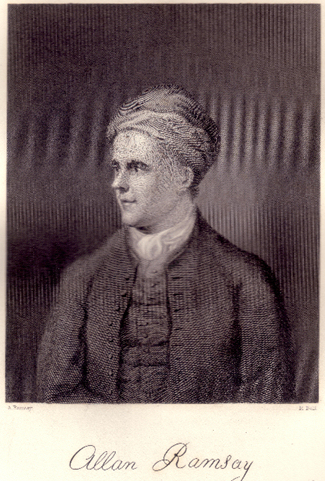
[portrait of Allan Ramsay]
In 1736 his passion for
the drama and enterprising spirit prompted him to erect a new theatre in
Carrubber’s Close; but in the ensuing year the act for licensing the
stage was passed, and the magistrates ordered the house to be shut up.
By this speculation he lost a good deal of money; and it is remarked by
his biographers, that this was, perhaps, the only unfortunate project in
which he ever engaged. In 1743 he lost his wife, Christian Ross,
daughter of a writer in Edinburgh, whom he had married in 1712, and who
left him a son and three grown-up daughters, out of seven children she
had borne to him. Soon after her death, with the view of spending his
days in dignified retirement, he erected a house on the north side of
the Castlehill, commanding a magnificent view, though now intercepted by
the houses of the New Town of Edinburgh. The mansion itself, however, is
built in rather a whimsical style of architecture. Here he spent the
last twelve years of his life, although he did not give up his shop
until 1755, three years before his decease. He died January 7, 1758,
aged 72, and was buried in the Greyfriars’ churchyard, where a monument
was, after the lapse of more than half a century, erected to his memory.
Allan Ramsay’s works are:
Christ’s Kirk on the Green. With a second Canto by Ramsay. Edin. 1716,
8vo. In 3 Cantos, the third also by Ramsay. Edin. 1718, Fifth edition,
1722.
Scots Songs, Edin. 1718, 8vo. Second edition, 1719.
Elegies on Maggie Johnston, John Cowper, and Lucky Wood. Edin. 1718,
8vo.
Many of his Poems were originally published at Edinburgh in separate
forms. They were afterwards collected and printed in one volume, with a
portrait of the author by Smibert. Edin. 1721, 4to.
Tartana; or the Plaid. Edin. 1721, 8vo.
Fables and Tales. Edin. 1722.
Tale of three Bonnets. Edin. 1722.
Fair Assembly. Edin. 1723.
Health; a Poem. Edin. 1724.
The Tea Table Miscellany; a collection of the most Choice Songs,
Scottish and English. Edinburgh, 1724, 24mo. The 2d volume appeared soon
after; the 3d volume in 1727, and the 4th at London in 1740. A pirated
edition of the three volumes then ready was published at Dublin in 1729,
3 vols. In one, 12mo. Pp. 334, printed for E. Smith. On the publication
of the 9th edition in 1732, Ramsay, as we learn from a contribution of
Mr. Peter Cunningham to the Gentleman’s Magazine for April 1853,
addressed a letter, dated 13th July of that year, to Mr. Andrew Millar,
the London publisher, in which he granted him permission to print the
three volumes of the Tea Table Miscellany then published, in what form
he pleased, on payment to him of five pounds sterling at Martinmas
following. He also empowered Mr. Millar to take up for him five guineas
from the printers of his poems, the unpaid moiety as agreed on between
them and Mr. M’Ewen, who had instructions from him to transact with
them, and to whom they paid the first moiety. The letter was taken by
his son, Mr. Allan Ramsay, the celebrated painter, and he added in a
postscript: “My son brings you this, if he approves of it. If we agree,
I desire that you send none to this country – it is scarce worth your
while.” This, says Mr. Cunningham, relates to the ninth edition of the
first collected edition of the Tea Table Miscellany, that in three thin
duodecimo volumes, printed for Andrew Millar in 1733, and called “the
ninth edition, being the compleatest and most correct of any yet
published by Allan Ramsay.” The tenth edition appeared in 1740, with the
addition of 150 songs. The eleventh edition was published at London,
four volumes in one, 12mo, 1750. The 18th at Edinburgh in 1792.
The Evergreen; being a Collection of Scots Poems wrote by the Ingenious
before 1600. Edin. 1724, 2 vols. 12mo. Edin. 1761, 2 vols, 12mo.
A Scots Ode to the British Antiquarians. Edin. 1726, 8vo.
The Gentle Shepherd; a Pastoral Comedy. Edin. 1725, 8vo. The same, with
a Glossary, published by David Allan, Glasgow, by Foulis, 1788, 4to.
Again, with Illustrations of the Scenery; an Appendix, containing
Memoirs of David Allan, the Scots Hogarth; besides original and other
Poems connected with the Illustrations; and a comprehensive Glossary. To
which are prefixed, an authentic Life of Allan Ramsay; and an Inquiry
into the Origin of Pastoral Poetry; the propriety of the Rules
prescribed for it; and the Practice of Ramsay. Edin. 1808, 2 vols. 8vo.
The editions which this admirable Pastoral has gone through are very
numerous, but the above are the best. It has been translated into
English by Cornelius Vanderstop. Lond. 1777, 8vo. By William Ward. Lond.
1785, 8vo. And by Margaret Turner. Lond. 1790, 8vo.
Collection of Scotch Proverbs, more correct and complete than any
hitherfore published; to which are added, the Tales of the Three
Bonnets. Edin. 1776, 1797, 12mo.
Poems, including the Gentle Shepherd. Edin. 1720, 1724, 2 vols, 12mo.
Poems (subscription edition). Edin. 1721, 1728, 2 vols. 4to, and many
subsequent editions. The following are the most valuable and perfect, --
Poems; to which are prefixed, a Life of the Author, from authentic
documents, and Remarks on his Poems, by George Chalmers, Esq., F.R.S.
Lond. 1800, 2 vols. 8vo. The works of Allan Ramsay, with Life of the
author, by George Chalmers; and an Essay on his genius and writings by
Lord Woodhouselee; an appendix and additional pieces, portrait, and
various illustrations. 3 vols. Edin. Fullarton & Co. 1848-18151.
RAMSAY, ALLAN, an eminent portrait painter, eldest son of the
preceding, was born at Edinburgh in 1713. Having shown an early
attachment to art, after receiving some instructions in London, he went
to Italy, where he studied under artists of great celebrity. On his
return he practiced for some time in Edinburgh, but afterwards resided
chiefly in London, where he acquired considerable reputation as a
portrait painter. By the interest of Lord Bute he was introduced to
George III., when prince of Wales, whose portrait he painted both in
whole length and in profile, the former being engraved by Ryland and the
latter by Woollett. Several mezzotinto prints were also published after
portraits by him, of several of the most distinguished of his own
countrymen. In March 1767 he was appointed principal painter to the
king; a situation which he retained till his death, though he retired
from practice about 1775, in consequence of having injured his arm by an
accident. He visited Rome at four different times, and on the last
occasion he spent several years in Italy. Finding his health decline he
returned to England, but died, a few days after landing, at Dover,
August 10, 1784. His portraits are celebrated for their resemblance to
nature, and their unstudied simplicity; and he himself is described as
having contributed to improve the style of portrait painting in Great
Britain.
Ramsay possessed
considerable literary taste, and was the founder of the “Select Society”
of Edinburgh in 1754, of which all the eminently learned men of that
capital were members. He was the author of some able pamphlets on
history, politics, and criticism, published at different times, but
afterwards collected into a volume, entitled ‘The Investigator.’ He also
wrote a pamphlet on the subject of Elizabeth Canning. He was an
excellent classical scholar; spoke the Italian and German languages
fluently, and, like Cato, learned Greek in his old age. He is frequently
mentioned by Boswell as being of Dr. Johnson’s parties. He married
Margaret, eldest daughter of Sir Alexander Lindsay of Evelick, baronet,
a niece of Lord Mansfield, by whom he had a son, John, who attained the
rank of major-general in the army, and two daughters, Amelia, married to
Sir Archibald Campbell of Inverness, and Charlotte, who became the wife
of Colonel Malcolm of Ford Farm, Surrey.
RAMSAY, JAMES, an eminent philanthropist, and one of the first
who wrote against the slave trade, was born at Fraserburgh,
Aberdeenshire, July 25, 1733. After receiving his grammatical education,
he was apprenticed to Dr. Findlay, a medical practitioner in his native
town, and in 1750 entered as a student of King’s college, Aberdeen,
where he obtained one of the principal bursaries. In 1755 he repaired to
London, and studied surgery and pharmacy under Dr. Macauly, in whose
family he lived for two years. He afterwards obtained an appointment as
surgeon in the royal navy, in which he served for several years. While
on board the Arundel he unfortunately fell on the deck and broke his
thigh-bone, by which he was confined for ten months, and rendered lame
for life. This accident determined him to quit the navy, and turn his
thoughts towards becoming a minister of the church of England.
Accordingly, while the Arundel lay at St. Christopher’s, he obtained,
from some of the principal inhabitants, strong recommendations to the
bishop of London, by whom, on his coming to England, he was admitted
into holy orders. Returning to St. Christopher’s, he was presented by
the governor to two rectories, valued at £700 a-year. In 1763 he married
Rebecca Akers, the daughter of a planter of high respectability.
On his first settlement
in the West Indies he made some public attempts to instruct the slaves;
which, however, were misunderstood and misrepresented; and, in addition
to his clerical duties, he took the charge of several plantations in the
capacity of medical adviser. In 1777 he returned to Britain, and visited
his native place. In the following year he was appointed chaplain to
Admiral Barrington, then about to proceed to the West Indies. He
resigned his pastoral charge in the island of St. Christopher’s, and
returned to England with his wife and family in the end of 1781. ON his
arrival he was, through the interest of his friend Admiral Sir Charles
Middleton, presented to the livings of Teston and Nettlestead in Kent.
In 1785 he published an ‘Essay on the Treatment and Conversion of
African Slaves in the British Sugar Colonies,’ which involved him in a
controversy on the slave tread that embittered his latter years. He died
at London, July 20, 1789, His works are:
Sermon on Deut. Xxxii. 29, 30. 1778, 4to.
Twelve Sermons for the use of the Royal Navy. 1782, 8vo.
An Essay on the Treatment and Conversion of African Slaves in the
British Sugar Colonies. London, 1785, 8vo.
A Manual for African Slaves. Lond. 1787, 12mo.
Essay on the Duty and Qualifications of a Sea-officer.
A Treatise on Signals.
Scotland and Scotsmen in the Eighteenth
Century
From the MSS of John Ramsay, Esq. of Ochiltyre edited by Alexander
Allardyce in two volumes in pdf format
Volume 1 |
Volume 2
INTRODUCTION
The Ochtertyre Manuscripts, from which the
present work lias been compiled, are comprised in ten bulky volumes,
written during the last quarter of the eighteenth century, with
occasional additions made until within a year or two of Mr Ramsay’s (the
author’s) death in 1814. Ml’ Ramsay had made very extensive notes of his
reading, recollections, and personal experiences, and had endeavoured to
group them together under distinct heads. His own division of his
manuscript is as follows :—
Language, Literature, and Biography (of Scotland). 3 vols.
Religion and Church Polity, and of their Influence on Society and the
State. 2 vols.
Government, Clanship, and Law. 1 vol.
Prospects of Private Life. 3 vols.
Tracts on Forestry, Female Education, Superstitions, &c. 1 vol.
When it seemed desirable to those who were acquainted with the
Ochtertyre MSS. that a work upon which so much care and pains had been
expended should be made available to the present generation, the form of
publication had to be considered. The bulk of the MSS. put the printing
of them as a whole out of the question. Several of the volumes,
moreover, overlapped one another; as, for instance, subjects which are
treated of under ‘Language, Literature, and Biography’ are dealt with in
the same language in the "Prospects of Private Life," and sections of
the "Prospects" are again repeated in the volume on £ Government,
Clanship, and Law.’ In these volumes also there are many chapters that
are mere digests of Mr Ramsay’s reading, often accompanied with
intelligent views and valuable comments, but of less importance than the
records of his own experiences and observations; and, in addition to
these considerations, a certain amount of prolixity and discursiveness
in Mr Ramsay’s style pointed to the propriety of a compilation from his
MSS. rather than to the publication of them in their entirety.
In adopting the former course two difficulties had to be encountered. Mr
Ramsay evidently desired his MSS., if published at all, to appear
exactly as he had written then, although he apparently attaches a more
particular value to some portions of his work than to others. Secondly,
he left a stringent prohibition against any attempt to alter or modify
his statements and views. In compiling the present work the Editor kept
these facts steadily before him, and while extracting from the MSS. such
sections as it seemed to him the author himself laid most stress upon,
the Editor has not in any way altered the language or even the spelling
of the original. The design of the Ramsay MSS. was to present to
posterity a picture of his country at the period of which he was a
contemporary, and of the persons with whom he had been brought directly
or indirectly into contact—in short, to afford a sketch of ‘ Scotland
and Scotsmen in the Eighteenth Century,’ as the Editor has ventured to
entitle the present work.
Engrossed in literary recreations and in the management of his property,
the life of John Ramsay of Ochtertyre offers few features of interest,
and until the publication of the present work he has only been
remembered as the friend of Sir Walter Scott and as a patron of Burns.
He was born in Edinburgh on the 26th August 1736, the son of a Writer to
the Signet, whose family had acquired the estate of Ochtertyre, in the
parish of Kincardine-in-Menteith, near Stirling, in 1591. The property
descended from father to son in regular succession until John Ramsay, at
his death, bequeathed it to his cousin-german, James Dundas, whose
grandson is the present proprietor. In 1749 he was sent to Dalkeith
school, to which the abilities of Mr Barclay, its master, had at that
time attracted a number of boarders. Mr Ramsay describes him as one of
the first schoolmasters in Scotland who sought to rule his pupils by
moral discipline rather than by corporal punishment. “He seldom
whipped,” he says, “but when in a passion, substituting different
degrees of shame according to the offence,—viz., setting them on the
floor with their breeches down; making them crawl round the school,
which he called licking the dust; or putting them naked to bed in a play
afternoon, and carrying off their clothes. This method soon rendered him
exceedingly popular, both with parents and children, and contributed not
a little to the flourishing of his school. He was indeed showy, and
carried on the boys fast by means of translations, which were then in
high request. His manners were very kind and pleasing, but he chiefly
excelled in a sort of intuition into the character and genius of boys,
in which he was seldom mistaken. His mode of punishing trespassers
proved, however, more beneficial to himself than to his pupils. Ere long
shame, which had at first wrought wonders, lost its terrors and became
matter of ridicule to the wilder lads, some of whom took a comfortable
nap on a play afternoon.”
In spite of the assistance of translations, Mr Ramsay became a good
classic. He attended classes in the University of Edinburgh, afterwards
studied law in his father’s office, and passed as an advocate. His
father’s death while he was still under age left him in possession of
the estate of Ochtertyre, and enabled him to gratify tastes which were
evidently alien to the active and bustling; life of the law courts. In
1760 he settled down at Ochtertyre and devoted himself to the duties of
his property, farming a portion of his own land. His experiences as a
landlord are recorded in one of the chapters that have been selected
from his manuscript. In case it may be imagined that he takes a somewhat
complacent view of his own success, it should be mentioned that his
enlightened efforts for the improvement of his estate and the welfare of
his tenantry are fully testified to by contemporary records. The
vicinity of Ochtertyre to Blair Drummond brought Mr Ramsay into great
intimacy with Lord Karnes, and made him to some extent a partaker in
schemes for improvements which were far in advance of the ideas of the
most of the Scottish landlords of the day. He was one of the first to
endeavour to give a practical application to the principles of
scientific forestry. He also set an early example of the reclamation of
moss lands, which was largely followed by other Menteith proprietors. As
a landlord and an agriculturist his views seem to have been greatly in
advance of his contemporaries, without partaking of the speculations in
which his more visionary neighbour, Lord Karnes, was wont to indulge,
and which Mr Ramsay sometimes treats with genial ridicule. His character
as a landlord is well summed up by the writer in the 'Statistical
Account of Scotland' “He was very indulgent to his tenants, was a kind
friend, an intelligent country gentleman, and was highly esteemed by all
classes of the community.”
Both by education and connections Mr Ramsay was possessed of advantages
enjoyed by few Scottish lairds of the same acreage. He was connected
with the Dundas family, then the ruling power in Edinburgh, his mother
having been a daughter of Ralph Dundas of Manour, near Stirling, and a
niece of Bishop Burnet. A sister of Mrs Ramsay was married to George
Abercromby of Tullibody, and became the mother of Sir Ralph Abercromby.
The salons and literary clubs of Edinburgh were thus open to him at the
time when the influences of English letters were stirring up a new
culture in Scotland, and laying the foundations of the Modern Athens. In
London, too, to which he paid several visits—the first in 1758—he was
fortunate enough to enjoy the acquaintance of Andrew Drummond, the
banker, whose intimacy with Walpole opened up to him the inner circles
of Whig society. But Mr Ramsay’s tastes were rural and retired, and
though a shrewd and dispassionate observer and a close critic, he seemed
always to have been glad to return to his books and his tenants, his
plans of improvements, and his studies of the social changes that were
going on around him. In politics he was a Whig, but a decided enemy of
faction, and free from the rancorous spirit that then embittered
Scottish polities. He had seen the last struggle for the Stuarts in
1745-46; but though a friend to King George and the Protestant
succession, his manuscripts are full of sympathy for the gentlemen who
had ruined themselves by their loyalty to a hopeless cause. In religion
he was a Presbyterian of a type very rare in his day, and he might with
little difficulty have passed for a Broad Churchman of the present
generation. Narrow and sectarian feelings meet with his emphatic
condemnation, and he records with pain the commencement of sceptical
opinions in Scotland and the toleration they met with in society. To us,
in the present day of all the “isms,” there is a quaintness, almost
amusing, in the language which he uses while speaking of the lively
apprehensions caused by a few contemporary doubters.
In Mr Ramsay’s time, Stirling was the centre of a little literary circle
of which he may be said to have been the chief. There was Dr Gleio-, the
Bishop of Brechin, an able and industrious worker for the ‘British
Critic’ and the first edition of the 'Encyclopaedia Britannica,’ who
was sometimes wont to have recourse to the assistance of Mr Ramsay’s
MSS. ; Dr Doig, the Rector of the Grammar School,1 a philologist of
great repute, and the orthodox antagonist of Lord Karnes; Dr Graham Moir,
of Leckie, a frequent visitor, and a man of high and varied
accomplishments; and Lord Karnes himself, whose controversy with Dr Doig
warmed into a ripe friendship. And there were others of less note who
afforded congenial society to the Laird of Ochtertyre, and who
encouraged him in his literary pursuits. To these Mr Ramsay’s MSS. were
well known and often read; but with their death they fell into oblivion
for more than half a century, until Commander Dundas, R.N., his present
representative, encouraged by the hope that they would now be of
interest, resolved to publish them.
In the autumn of 1787, Burns, fresh from the recognition of the
Edinburgh literati, visited Mr Ramsay at Ochtertyre, and was received
with great hospitality and kindness. Mr Ramsay’s tastes had been formed
on strictly classical models, and he gave Burns the somewhat doubtful
advice to cultivate the drama on the model of the “Gentle Shepherd” and
to write “Scottish Eclogues.” “But,” says Mr Ramsay, “to have executed
either plan, steadiness and abstraction from company Were Wanting.” He,
however, was more impressed with the force of Burns’s genius than any of
the distinguished critics the poet had met in Edinburgh, the young
Walter Scott, perhaps, alone excepted. “I have been in the company of
many men of genius,” Mr Ramsay writes, “some of them poets; but I never
witnessed such flashes of intellectual brightness as from him — the
impulse of the moment, sparks of celestial fire; I never was more
delighted, therefore, than with his company, two days, tete-d-tete. In a
mixed company I should have made little of him; for, to use a gamester’s
phrase, he did not always know when to play off and when to play on.
When I asked him whether the Edinburgh literati had mended his poems by
their criticisms— ‘See,’ said he, £ those gentlemen remind me of some
spinsters in my own country, who spin their thread so fine that it is
neither fit for weft nor woof.’ ”In October of the same year, Mr Ramsay
wrote a long letter to Burns, in which, among other topics, he gives him
the following earnest advice: “ If some intellectual pursuit be well
chosen and steadily pursued, it will be more lucrative than most farms
in this age of rapid improvement. Upon this subject, as your well-wisher
and admirer, permit me to go a step further. Let those bright talents
which the Almighty has bestowed on you be henceforth employed to the
noble purpose of supporting the cause of truth and virtue. An
imagination so varied and forcible as yours may do this in many
different modes; nor is it necessary to be always serious, which you
have been to good purpose; good morals may be recommended in a comedy,
or even in a song. Great allowances are due to the heat and inexperiences of youth,—and few poets can boast, like Thomson, of never
having written a line which, in dying, they would wish to blot. In
particular, I wish you to keep clear of the thorny walks of satire,
which make a man a hundred enemies for one friend, and are doubly
dangerous when one is supposed to extend the slips and weaknesses of
individuals to their sect and party. About modes of faith, serious and
excellent men have always differed; and there are certain curious
questions which may afford scope to men of metaphysical heads, but
seldom mend the heart or temper. Whilst these points are beyond human
ken, it is sufficient that all our sects concur in their views of
morals. You will forgive me for these hints.” The references to Burns
throughout the Ramsay MSS. show traces of disappointment that this sound
advice was not more steadily kept in view.
The year 1793 brought to Ochtertyre Walter Scott, then recently called
to the Bar, and he could scarcely have come to a better authority than
Mr Ramsay on Scottish traditions and memories of the “’Forty-five.” The
acquaintance thus begun was continued at a distance, until Mr Ramsay’s
death, the year when 1 Waverley ’ was published. A copy of the ‘Ballads
from Burger’ was sent to Ochtertyre in 1796, and Lockhart, in his ‘Life of Scott,’ prints Mr Ramsay’s letter acknowledging the gift, and
commending the translations. Lockhart remarks that Scott’s recollections
of John Ramsay of Ochtertyre had gone some way, together with those of
George Constable and Clerk of Eldin, to form the character of Jonathan
Oldbuck of Monkbarns. Mr Ramsay was an enthusiastic antiquary, and was
the means of recovering many prehistoric and Roman remains, as well as
antiquities belonging to the period of the War of Independence, in his
neighbourhood. An old ash near his house was garnished with an ancient
pair of jugs, and the collection of the Society of Antiquaries was made
richer by some of his discoveries.
Of those who were acquainted with Mr Ramsay, perhaps the only one
surviving is the venerable ex-Chaplain-General of the Forces, Dr G. R.
Gleig, the son of the Bishop of Brechin, above alluded to, who, though
now upwards of ninety years of age, still writes with the vigour of a
man at his prime, and with such powers of memory as not many can boast
of at even half his age. Dr Gleig has kindly furnished the Editor with
the following interesting reminiscences of Mr Ramsay : “I never heard
that he did much as a practising lawyer, but he took a good place among
the scholars of his generation, especially among antiquaries. He
certainly stood with George Constable as the model from which the
character of Monkbarns is painted. When I knew him he was an old man,
and having lived as he did a bachelor, he had fallen, when alone, into
slovenly habits of dress. When receiving company his appointments were
those of a gentleman of the old school—a coat, usually blue, with bright
metal buttons, a high collar, and lace frills at the wrist. I think he
wore hair-powder, but I am not quite sure, though of his carefully tied
queue or pigtail I have a clear remembrance. Breeches and blue
stockings, with silver buckles in his shoes, were also worn on those
occasions. At other times his legs would be encased in worsted
stockings, to which it appeared as if he sometimes forgot to append
garters.
I think of him as a man of middle stature, well made, and with an
intelligent expression of countenance. The MSS. which you are preparing
for the press had been his recreation for years, and he never failed to
read a portion of them to every visitor whom he could prevail upon to
listen. More than once, when certainly not more than twelve or fourteen
years of age, I was his audience.
“Ramsay had the credit, I don’t know how justly, of having been in his
youth and manhood a great admirer of the sex. When I knew him, so much
of the old Adam remained with him that he used to exact a kiss from each
of his young lady visitors, for which he rewarded her by a peach—his
well-walled and sheltered garden being renowned for the excellence of
the peaches it brought to maturity. Ramsay’s servant was a sort of
counterpart of his master —very little younger, and with the same
old-fashioned politeness of manner. His house was well kept, and his
garden always in first-rate order.” |



