|
IN the fifteenth and
sixteenth centuries— to go no further back—the importance attached in
Scotland to richness and elegance of attire is abundantly shown, not
only by portraits but by allusions in the poetry of the period and by a
great variety of documentary evidence. Thus, of the successful merchant
in "The Priests of Peebles "-
"Rich were his gowns, with
other garments gay,
For Sunday silk, for ilk day green and gray
His wife was comely clad in scarlet red,"
There is, indeed, every
probability that the Scots, in the centuries preceding the Reformation,
were more attentive to dress than the English. "They are," says the
Spanish Ambassador, at the Court of James IV., of the Scots ladies,
"very graceful and handsome women. They dress much better than here"
[England], and "especially as regards the head-dress, which is, I think,
the handsomest in the world." Again, of the young nobles and barons ''
There is much emulation among them as to who shall be best equipped, and
they are very ostentatious." Even when he did not enlist in foreign
service, the young Scots gentleman usually spent some years in foreign
travel— especially in France, Spain, and Italy—and his manners were, in
great part, modelled after those of the gayer south. Moreover, Scotland
had then a wide and good commercial intercourse, and imported large
quantities of silks and other braveries. Even of the country damsels,
who danced "full gay" at "Christis Kirk on the Green," you read that
''their shune were of the Straits." Nor must the French influence at the
Court of Mary of Guise, and her daughter, Nary Stuart, be left out of
account. "Sour John Knox" refers disdainfully to the "stinicin Pride of
the women," at the opening of Mary's Parliament in 1563, and states that
articles were in this "Parliament presented for order to be taken for
apparel, and for reformation of other enormities," but that all was "scripped
at." But from a letter to his sisters it would appear that his own
private opinion in regard to female adornment was not thus Puritanical
and grim. Although he ''cannot approve," he declines absolutely to
condemn "sic vain apparell as inaist commonlie now is usit among women";
he thought it "difficult and dangerous to appoint any certainty." The
"Monstrous Regiment of women" (female government), gave him real
concern; but in respect of dress he was disposed to make allowance for
natural vanity and unreasonableness; he deemed it at least better that
they should feed their minds upon the trifles of the toilet than meddle
with politics and public authority." He rallied the ladies of Mary's
Court on their love of finery with gentle mockery ; he did not directly
reprove. "O fair ladies,'' said he "how pleasing were this life of yours
if it should ever abide, and then in the end we might pass to heaven
with all this gay gear!" The Act of 1567 regarding ladies' apparel—"This
Act is verray guid"—was somewhat mild: "Item it be lauchfull to na women
to weir abone hair estait except howris." This peculiar conjunction of
"let" and ''hindrance" is a curious illustration of Scots pawkiness. No
penalty is prescribed. It is merely announced that to dress above their
station is a privilege henceforth reserved to "unfortunate persons." It
was not that the legislators loved prostitution more it was that
they wanted to impale the devotees of personal adornment on the horns of
a bad dilemma.
According to "The First
Book of Discipline," "excess in apparel" was one of the faults which
"properly appertained to the Church of God to punish"; and although
there seems to have been much liberty at first, yet gradually every kind
of personal adornment came to be regarded as more or less of "a snare."
In 1575 an Act was passed by the General Assembly of the Kirk anent "the
apparelling of the ministers." The Reformed clergy had rejected the
dress of the Catholic priesthood with the "disguised apparels" of the
several religious orders. They adopted civil dress; and the regulation
shows how very ornamental and elaborate it was, and what difficulty the
Kirk authorities had in subduing the love of the beautiful and becoming
in the "preachers of the Word." "Forasmuche," the Act proceeded "as a
comelie and decent apparrell is requisite in all, namelie ministers, and
such as beare function in the Kirk, first, we thinke all kinde of
browdering unseemlie; all begaires (slashes) of velvet in gowne, hose,
or coat, and all superfluous and vaine cutting out, stocking with silkes,
all kinde of costlie sewing on pasients, or sumptuous and large steeking
with silkes; all kinde of costlie sewing or variant hewes in clothing,
as reid, blew, yellow, and such like, which declare the lightnesse of
the minde all wearing of rings, bracelets, buttons of silver, gold
or other uettall; all kmde of superfluities of cloath in making of hose;
all using of plaids in the Kirk by readers or ministers; all kinde of
gowning, cutting, cloul)letting, or breekes of velvet, satiric, taffatie
or such like; and costlie giltings of whingers and knives and such like
all silk hatts, and hatts of diverse and light colours; but that their
whole habite be of grave colour, as blacke, russet, sad gray, sad browne;
or searges, woisett, chawlett, grogram, lylis worset, or such like; that
the good Word of God, by them and their immoderateness, be not
slandered. And the wives of the ministers to be subject to the same."
Although this order primarily affected the ministers and their families
alone, it necessarily influenced powerfully the whole community. "Sad
gray" and "sad brown" were now authoritatively recognised to best befit
the godly, and "variant hues," as red, blue, yellow, and such-like, were
declared to be more or less akin to wickedness. Moreover, since the
clergy avowedly adopted civil dress, they no doubt set the fashion among
the middle classes, at least in the case of those who desired to be of
pious repute.
In its efforts to
discountenance gay apparel the Kirk was greatly aided by Parliamentary
legislation. In 1581 an Act was passed against "the great abuse among
the common people, even of the meanest rank, in their presuming to
counterfeit the King and the nobility by their habit of wearing costly
clothing of silk." This was renewed in 1584, and subsequent enactments
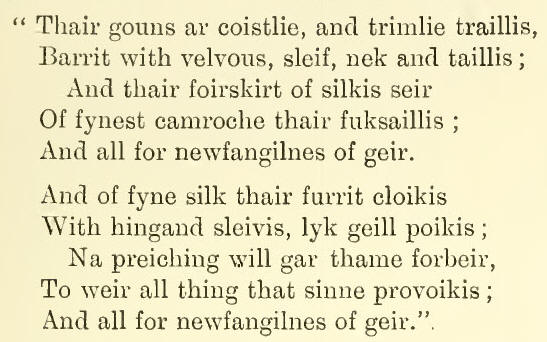
indicate the difficulty of breaking down the natural instinct. Sir
Richard Maitland's "Satire on the Toun Ladies" supplies evidence to the
same effect :-
It was one of the special
foibles of James VI. to prescribe appropriate dresses for the different
classes and functionaries. The dresses now worn by Scottish
officials—including judges, advocates, and magistrates —date from an Act
passed in 1610, and were personally determined by the King and this
enactment was supplemented by one of 1621 for the regulation of civil
attire. None but nobles were permitted to wear gold or silver lacing,
nor any velvet, satin, or silks. Lords of session, barons, magistrates,
professors at Universities and others were permitted to indulge in a
style of adornment something less gaudy; but all other persons were
prohibited from having pearls or lacings upon their ruffles, shirts,
napkins, or socks; as also from wearing "bushings of feathers," pearls
or precious stones. "Austere and Puritan self-denial in dress" was thus
rendered compulsory as regards the most. It was lauded by the Kirk as a
special token of grace, and the attitude of the Kirk was supported by
legislation reserving ornament to them that were favoured of the King,
if not of Heaven. And by this general prohibition of ornamentation the
standard of taste was lowered, until the nobles themselves lapsed into
the adoption of the sad and sombre style of the middle classes. No doubt
other influences—as the decay of feudalism and chivalry—were working
towards the same end. Nor did the case of Scotland essentially differ
from that of other countries; only the authority of Puritanism was there
more rampant, and to some extent antedated the period of change. |



