|
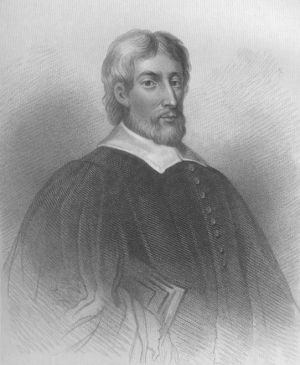 BOYD,
ROBERT, of Trochrig an eminent divine of the seventeenth century, was born
at Glasgow in 1578. He was the son of James Boyd, "Tulchan—archbishop"
of Glasgow, and Margaret, daughter of James Chalmers of Gaitgirth, chief
of that name. On the death of his father, which happened when he was only
three years old, his mother retired to the family residence in Ayrshire,
and Boyd, along with Thomas, his younger brother, was in due time sent to
the grammar school of the county town. From thence he was removed to the
university of Edinburgh, where he studied philosophy under Mr Charles
Ferme, (or Fairholm) one of the regents, and afterwards divinity under the
celebrated Robert Rollock. In compliance with the custom of the times, he
then went abroad for the purpose of pursuing his studies, and France was
destined to be the first sphere of his usefulness. He taught various
departments of literature in the schools of Tours and Montauban, at the
first of which places he became acquainted with the famous Dr Rivet. In
1601, he was ordained pastor of the church at Verteuil, and in 1606 he was
appointed one of the Professors in the university of Saumur, which had
been founded in 1593, by the amiable Philip de Mornay, better known by the
title of Du Plessis. Boyd also discharged the duties of a pastor in the
church at the same town, and, soon after, became Professor of Divinity. As
he had now the intention of remaining for some years abroad, he bethought
himself of entering into the married state, and having met with "an
honest virgin of the family of Malivern," says Wodrow, "he
sought her parents for their consent, who having received a satisfactory
testimonial of the nobility of his birth, and the competency of his
estate, they easily yielded, and so he took her to wife, with the good
liking of the church and the university, who hoped that by this means he
would be fixed among them, so as never to entertain thoughts of returning
to Scotland to settle there." But in this they were soon
disappointed, for king James having heard through several noblemen,
relations of Mr Boyd, of his worth and talents, offered him the
principalship of the university of Glasgow. BOYD,
ROBERT, of Trochrig an eminent divine of the seventeenth century, was born
at Glasgow in 1578. He was the son of James Boyd, "Tulchan—archbishop"
of Glasgow, and Margaret, daughter of James Chalmers of Gaitgirth, chief
of that name. On the death of his father, which happened when he was only
three years old, his mother retired to the family residence in Ayrshire,
and Boyd, along with Thomas, his younger brother, was in due time sent to
the grammar school of the county town. From thence he was removed to the
university of Edinburgh, where he studied philosophy under Mr Charles
Ferme, (or Fairholm) one of the regents, and afterwards divinity under the
celebrated Robert Rollock. In compliance with the custom of the times, he
then went abroad for the purpose of pursuing his studies, and France was
destined to be the first sphere of his usefulness. He taught various
departments of literature in the schools of Tours and Montauban, at the
first of which places he became acquainted with the famous Dr Rivet. In
1601, he was ordained pastor of the church at Verteuil, and in 1606 he was
appointed one of the Professors in the university of Saumur, which had
been founded in 1593, by the amiable Philip de Mornay, better known by the
title of Du Plessis. Boyd also discharged the duties of a pastor in the
church at the same town, and, soon after, became Professor of Divinity. As
he had now the intention of remaining for some years abroad, he bethought
himself of entering into the married state, and having met with "an
honest virgin of the family of Malivern," says Wodrow, "he
sought her parents for their consent, who having received a satisfactory
testimonial of the nobility of his birth, and the competency of his
estate, they easily yielded, and so he took her to wife, with the good
liking of the church and the university, who hoped that by this means he
would be fixed among them, so as never to entertain thoughts of returning
to Scotland to settle there." But in this they were soon
disappointed, for king James having heard through several noblemen,
relations of Mr Boyd, of his worth and talents, offered him the
principalship of the university of Glasgow.
The duties of principal in
that college were, by the charter of this monarch, not confined even to
those connected with that institution. He was required to teach theology
on one day, and Hebrew and Syriac the next, alternately; but this was not
all. The temporalities of the rectory and vicarage of Govan had been
annexed to it, under the condition that the principal should preach on
Sunday in the church of that parish. Under these circumstances, it could
not be expected that Mr Boyd could have much leisure to premeditate his
lectures. Wodrow informs us, that he did not read them, "but uttered
all in a continued discourse, without any hesitation, and with as much
ease and freedom of speech, as the most eloquent divine is wont to deliver
his sermons in his mother tongue." It will be remembered, that the
prelections were then delivered in Latin, and Principal Baillie, who
studied under Mr Boyd, mentions that, at a distance of thirty years, the
tears, the solemn vows, and the ardour of the desires produced by the
Principal’s Latin prayers, were still fresh in his memory. [Bodii
Praelections in Epist. Ad Ephes. Praefat, ad Lectorem.]
From the assimilation which
was then rapidly taking place to the episcopalian form of church
government, Mr Boyd felt his situation peculiarly unpleasant. He could not
acquiesce in the decisions of the Perth assembly, and it could not be
expected that he would be allowed to retain his office under any other
condition than that of compliance. He therefore preferred voluntarily
resigning his office, and retiring to his country residence. Soon after
this period, he was appointed Principal of the university of Edinburgh,
and one of the ministers of that city; but there he was not long allowed
to remain. His majesty insisted upon his compliance with the Perth
articles, and an intimation to that effect having been made to him, he
refused, and, to use the quaint expression of the historian, "swa
took his leave of them." He was now ordered to confine himself within
the bounds of Carrick. His last appointment was to Paisley, but a quarrel
soon occurred with the widow of the Earl of Abercorn, who had lately
turned papist, and this was a source of new distress to him. Naturally of
a weakly constitution, and worn down by a series of misfortunes, he now
laboured under a complication of diseases, which led to his death at
Edinburgh, whither he had gone to consult the physicians, on the 5th of
January, 1627, in the 49th year of his age.
Of his works, few of which
are printed, the largest and best known is his "Praelectiones in
Epistolam ad Ephesios." From the circumstances which occurred in the
latter part of his life, he was prevented getting it printed as he
intended. After his death, a copy of the MS. was sent to Dr Rivet, who
agreed with Chouet of Geneva for the printing, but when returning to that
place with the MS. in his possession, the ship was taken by the Dunkirkers,
and the work was seized by some Jesuits, who would part with it " nec
prece nec pretio." Fortunately the original still remained, and it
was, after many delays, printed "Impensis Socielatis Stationariorum,"
in 1652, folio. To the work is prefixed a memoir of the author, by Dr
Rivet; but as their acquaintance did not commence till l598 or 1599, there
are several errors in his account of the earlier part of Boyd’s life,
all of which Wodrow has with great industry and accuracy corrected. The
only other prose work of Mr Boyd, ever published, is his "Monita de
filii sui primogeniti Institutione, ex Authoris MSS. autographis per
R(obertum) S(ibbald), M. D. edita," 8vo, 1701. The style of this
work, according to Wodrow, is pure, the system perspicuous; and prudence,
observation, and piety, appear throughout. Besides these, the "Hecatombe
ad Christum," the ode to Dr Sibbald, and the laudatory poem on king
James, are in print. The two first are printed in the "Deliciae
Poetarum Scotorum." The Hecatombe has been reprinted at Edinburgh in
1701, and subsequently in the "Poetarum Scotorum Musae Sacrae."
The verses to king James have been printed in Adamson’s "Muses’
Welcome;" and it is remarkable, that it seems to have been altogether
overlooked by Wodrow. All these poems justify the opinion, that had Boyd
devoted more of his attention to the composition of Latin poetry, he might
have excelled in that elegant accomplishment.
In the time of Wodrow, several MSS. still remained in the possession of
the family of Trochrig, consisting of Sermons in English and French, his
Philotheca, a kind of obituary, extracts from which have lately been
printed in the second part of the Miscellany of the Bannatyne Club. His
life has been written at great length by the venerable historian of the
sufferings of the Scottish church, already frequently quoted. Those who
wish to know more of this learned man, than the limits of our work will
permit, are referred to the very interesting series of the Wodrow
biographies in the library of the university of Glasgow – article Boyd.
|



