|
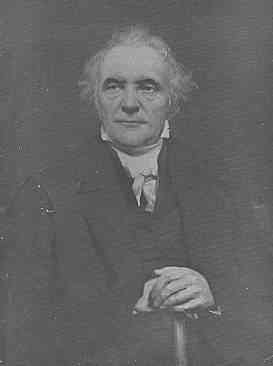 CHALMERS,
REV. THOMAS, D.D.—This eminent orator, philosopher, and divine, by
whom the highest interests of his country during the present century have
been so materially influenced, was born in the once important, but now
unnoticed town of Anstruther, on the south-east coast of Fife, on the 17th
March, 1780. He was the son of Mr. John Chalmers, a prosperous dyer,
ship-owner, and general merchant in Easter-Anstruther, and Elizabeth Hall,
the daughter of a wine-merchant of Crail, who, in the course of twenty-two
years, were the parents of nine sons and five daughters, of which numerous
family, Thomas, the subject of this memoir, was the sixth. After enduring
the tyranny of a severe nurse, he passed in his third year into the hands
of an equally severe schoolmaster, a worn-out parish teacher, whose only
remaining capacity for the instruction of the young consisted in an
incessant application of the rod. Thus early was Thomas Chalmers taught
the evils of injustice and oppression; but who can tell the number of
young minds that may have been crushed under a process by which his was
only invigorated! After having learned to read, and acquired as much Latin
as he could glean under such unpromising tuition, he was sent, at the age
of twelve, to the United College of St. Andrews. Even long before this
period he had studied with keen relish "Bunyan’s Pilgrim’s Progress," and
resolved to be a minister. It appears that, like too many youths at their
entrance into our Scottish universities, he had scarcely any classical
learning, and was unable to write even his own language according to the
rules of orthography and grammar. All these obstacles, however, only
called forth that indomitable perseverance by which his whole career in
life was distinguished; and in his third year’s course at college, when he
had reached the age of fifteen, he devoted himself with such ardour to the
study of mathematics, that he soon became distinguished by his proficiency
in the science, even among such class-fellows as Leslie, Ivory, and
Duncan. These abstract studies required some relief, and in the case of
Chalmers, they were alternated with ethics, politics, and political
economy. After the usual curriculum of four years he enrolled as a student
of theology, but with a heart so devoted to the abstractions of geometry,
that divinity occupied little of his thoughts; even when it was afterwards
admitted, it was more in the form of sentimental musings, than of patient
laborious inquiry for the purposes of public instruction. But he had so
successfully studied the principles of composition, and acquired such a
mastery of language, that even at the age of sixteen, many of his college
productions exhibited that rich and glowing eloquence which was to form
his distinguished characteristic in after years. He had also acquired that
occasional dreaminess of look and absence of manner which so often
characterizes deep thinkers, and especially mathematicians; and of this he
gave a curious illustration, when he had finished his seventh year at
college, and was about to enter a family as private tutor. His father’s
household had repaired to the door, to bid him farewell; and after this
was ended, Thomas mounted the horse that was to carry him to the Dundee
ferry. But in accomplishing this feat, he put his right foot (the wrong
one on this occasion) into the stirrup, and was in the saddle in a trice,
with his face to the horse’s tail! When ready to apply for license as a
preacher, an obstacle was in his way; for as yet he had not completed his
nineteenth year, while the rules of the Church required that no student
should be licensed before he had reached the age of twenty-one. This
difficulty, however, was overruled by an exceptional clause in favour of
those possessing "rare and singular qualities;" and it having been
represented by the member of presbytery who discovered this qualification
in the old statute, that Thomas Chalmers was a "lad o’ pregnant pairts,"
the young applicant, after the usual trials, was licensed as a preacher of
the gospel, on the 31st of July, 1799. CHALMERS,
REV. THOMAS, D.D.—This eminent orator, philosopher, and divine, by
whom the highest interests of his country during the present century have
been so materially influenced, was born in the once important, but now
unnoticed town of Anstruther, on the south-east coast of Fife, on the 17th
March, 1780. He was the son of Mr. John Chalmers, a prosperous dyer,
ship-owner, and general merchant in Easter-Anstruther, and Elizabeth Hall,
the daughter of a wine-merchant of Crail, who, in the course of twenty-two
years, were the parents of nine sons and five daughters, of which numerous
family, Thomas, the subject of this memoir, was the sixth. After enduring
the tyranny of a severe nurse, he passed in his third year into the hands
of an equally severe schoolmaster, a worn-out parish teacher, whose only
remaining capacity for the instruction of the young consisted in an
incessant application of the rod. Thus early was Thomas Chalmers taught
the evils of injustice and oppression; but who can tell the number of
young minds that may have been crushed under a process by which his was
only invigorated! After having learned to read, and acquired as much Latin
as he could glean under such unpromising tuition, he was sent, at the age
of twelve, to the United College of St. Andrews. Even long before this
period he had studied with keen relish "Bunyan’s Pilgrim’s Progress," and
resolved to be a minister. It appears that, like too many youths at their
entrance into our Scottish universities, he had scarcely any classical
learning, and was unable to write even his own language according to the
rules of orthography and grammar. All these obstacles, however, only
called forth that indomitable perseverance by which his whole career in
life was distinguished; and in his third year’s course at college, when he
had reached the age of fifteen, he devoted himself with such ardour to the
study of mathematics, that he soon became distinguished by his proficiency
in the science, even among such class-fellows as Leslie, Ivory, and
Duncan. These abstract studies required some relief, and in the case of
Chalmers, they were alternated with ethics, politics, and political
economy. After the usual curriculum of four years he enrolled as a student
of theology, but with a heart so devoted to the abstractions of geometry,
that divinity occupied little of his thoughts; even when it was afterwards
admitted, it was more in the form of sentimental musings, than of patient
laborious inquiry for the purposes of public instruction. But he had so
successfully studied the principles of composition, and acquired such a
mastery of language, that even at the age of sixteen, many of his college
productions exhibited that rich and glowing eloquence which was to form
his distinguished characteristic in after years. He had also acquired that
occasional dreaminess of look and absence of manner which so often
characterizes deep thinkers, and especially mathematicians; and of this he
gave a curious illustration, when he had finished his seventh year at
college, and was about to enter a family as private tutor. His father’s
household had repaired to the door, to bid him farewell; and after this
was ended, Thomas mounted the horse that was to carry him to the Dundee
ferry. But in accomplishing this feat, he put his right foot (the wrong
one on this occasion) into the stirrup, and was in the saddle in a trice,
with his face to the horse’s tail! When ready to apply for license as a
preacher, an obstacle was in his way; for as yet he had not completed his
nineteenth year, while the rules of the Church required that no student
should be licensed before he had reached the age of twenty-one. This
difficulty, however, was overruled by an exceptional clause in favour of
those possessing "rare and singular qualities;" and it having been
represented by the member of presbytery who discovered this qualification
in the old statute, that Thomas Chalmers was a "lad o’ pregnant pairts,"
the young applicant, after the usual trials, was licensed as a preacher of
the gospel, on the 31st of July, 1799.
On entering the sacred
office, Chalmers was in no haste to preach; on the contrary, he refused
the numerous demands that were made upon his clerical services, took up
his abode in Edinburgh during the winter of 1799-1800, for the purpose of
prosecuting his mathematical studies under Professor Playfair, and
deprecated the idea of even a church presentation itself, lest it should
prove an interruption to the progress of his beloved pursuits. The
following winter he also spent in Edinburgh, almost exclusively occupied
in the study of chemistry. As there was a prospect of the parish of
Kilmany soon becoming vacant, which was in the gift of the United College
of St. Andrews, and to which his nomination by the professors was certain,
Chalmers might now have awaited in tranquillity that happy destination for
life to which his studies hitherto had been ostensibly devoted. But
science and scientific distinction were still the great objects of his
ambition, and the mathematical assistantship of St. Andrews having become
vacant, he presented himself as a candidate for the charge, in the hope
that such an appointment would ultimately lead to the professorship,
without obliging him to forego the ministerial charge of Kilmany—for St.
Andrews was the head-quarters of ecclesiastical pluralities. In both
objects he was successful; and having lectured and taught mathematics at
college in the winter of 1802-3, on 12th May, 1803, he was inducted into
his expected parish. The ardour with which he threw himself into his
college prelections, and the unwonted eloquence with which he imbued a
science so usually delivered in the form of dry detail and demonstration,
constituted a novelty that astonished, while it delighted his pupils, and
their earnest application and rapid proficiency fully corresponded with
the efforts of their youthful teacher. At the close of the session,
however, a bitter disappointment awaited him; he was told by his employer
that his services as assistant teacher were no longer required, while
inefficiency for the office was stated as the cause of his dismissal. This
charge was not only most unjust in itself, but would have operated most
injuriously against Mr. Chalmers, by closing the entrance to any
scientific chair that might afterwards become vacant in our universities.
To refute this charge, therefore, as well as to silence his maligners, he
resolved to open on the following winter a class of his own in the town of
St. Andrews, and there show whether or not he was fitted to be a professor
of mathematics. He accordingly did so, and was so completely attended by
the pupils of his former class, that he felt no change, except in the mere
beauty. In taking this bold independent step, also, he was anxious to
repudiate those resentful or malignant motives to which it might have been
attributed. "My appearance in this place," he said, "may be ascribed to
the worst of passions; some may be disposed to ascribe it to the violence
of a revengeful temper—some to stigmatize me as a firebrand of turbulence
and mischief. These motives I disclaim. I disclaim them with the pride of
an indignant heart which feels its integrity. My only motive is, to
restore that academical reputation which I conceive to have been violated
by the aspersions of envy. It is this which has driven me from the
peaceful silence of the country—which has forced me to exchange my
domestic retirement for the whirl of contention." In spite of the
determined hostility of the professors, whose influence was all-prevalent
in the town, the three classes of mathematics which Chalmers opened were
so fully attended, that he opened a class of chemistry also, and in this
science, his eloquent expositions and successful experiments were so
popular that the whole county was stirred in his favour. His labours at
this youthful commencement of his public career could only have been
supported by an enthusiasm like his own; for, in addition to daily
attendance on his classes, and preparation of lectures, demonstrations,
and experiments, he fulfilled the duties of the pulpit, returning for that
purpose to Kilmany on the Saturday evenings, and setting out to St.
Andrews on Monday morning. Even his enemies thought this labour too much,
and resolved to lighten it, though with no benevolent feeling; and the
presbytery was moved, for the purpose of compelling him to reside
permanently at Kilmany, and attend exclusively to the duties of the
parish. It was not the evils of plurality and non-residence in the
abstract which they cared about, but that these should furnish an
opportunity for the lecturer to intrude into St. Andrew; and teach within
the very shadow of its university. Chalmers felt that this was their
motive, and wrote to the presbytery an eloquent defence of his conduct. On
the following session, he conceded so far as to discontinue his
mathematical classes, and only attend to that of chemistry, which had
become very popular in the county, and would require his attendance only
two or three days of each week. Even this did not satisfy the presbytery,
and one of its members requested it to be inserted in their minutes, that,
"in his opinion, Mr. Chalmers’ giving lectures in chemistry is improper,
and ought to be discontinued." This was done; upon which Chalmers, as a
member of the presbytery, begged that it should also be inserted in their
minutes, that "after the punctual discharge of his professional duties,
his time was his own; and he conceived that no man or no court had a right
to control him in the distribution of it."
An opportunity soon
occurred for which Chalmers had ardently longed. It was nothing less than
a vacancy in the professorship of Natural Philosophy in St. Andrews, and
he became one of three candidates for the chair. But the whole three were
set aside in favour of Mr. Jackson, rector of Ayr Academy.
In the following year
(1805) a similar vacancy occurred in the university of Edinburgh, by the
death of Dr. Robinson, and again Chalmers entered the lists; but here also
he was disappointed, with the consolation, however, that the successful
candidate was no other than the celebrated Leslie. This competition cabled
forth his first effort in authorship, in the form of a pamphlet, in
consequence of the assertion, that a ministerial charge and scientific
appointment combined in one person were incompatible—a pamphlet which, in
subsequent years, he laboured to suppress, and gladly would have forgot.
At present, however, his expressed opinion was, that "after the
satisfactory discharge of his parish duties, a minister may enjoy five
days in the week of uninterrupted leisure, for the prosecution of any
science in which his taste may dispose him to engage." This, alas! was too
true, if that "satisfactory discharge" of parochial duty involved nothing
more than the usual routine of a parish minister. Chalmers, therefore, had
to find some other outlet for his "uninterrupted leisure;" and after
having exhausted the field of St. Andrews, he resumed his lectureship on
chemistry in his little parish of Kilmany, and the county town of Cupar.
But even yet, something additional was needed, besides the delivery of
lectures formerly repeated, and experiments that had been twice tried; and
this was soon furnished by Napoleon’s menace of invasion. The hostile camp
of the modern Caesar at Boulogne, and the avowed purpose for which it had
been collected, roused the spirit of Britain, so that military
associations were formed, from the metropolis to the hamlet, in every part
of our island. This was more than enough for the ardent spirit of
Chalmers, and he enrolled himself in the St. Andrews corps of volunteers,
not only as chaplain, but lieutenant. It is well known how this threat of
an invasion of Britain was exchanged for an attack upon Austria, and how
suddenly the breaking up of the hostile encampment at Boulogne, dismissed
a million of armed Britons to their homes and workshops. On doffing his
military attire, the minister of Kilmany had other and more professional
occupation to attend to at the bed-side of a dying brother, who had
returned to his father’s home afflicted with consumption, under which he
died in a few months. During the last illness of the amiable sufferer, one
of the duties of Thomas Chalmers was to read to his brother portions of
those religious works which he had denounced from the pulpit as savouring
of fanaticism, and to hear the criticism pronounced upon them by the lips
of the dying man, as he fervently exclaimed, "I thank thee, O Father, Lord
of heaven and earth, that thou hast hid these things from the wise and
prudent, and revealed them unto babes." After this departure from life,
which was one of solemn and impressive resignation, Chalmers gave relief
to his thoughts, first by a journey to England, in which he visited
London, Cambridge, and Oxford, and afterwards by authorship. Independently
of mathematics, chemistry, and botany, which his ardent spirit of inquiry
had successively mastered, he had studied the science of political
economy; and now that Bonaparte had published his famous Berlin decree, by
which the mercantile and manufacturing community of Britain was
panic-struck, Chalmers produced his "Inquiry into the Extent and Stability
of National Resources," to show that this apprehension was groundless. The
analysis of this work can be best given in his own account of it. In a
letter to his brother he says, "The great burden of my argument is, that
the manufacturer who prepares an article for home consumption is the
servant of the inland consumer, labouring for his gratification, and
supported by the price which he pays for the article; that the
manufacturer of an article for exportation is no less the servant of the
inland consumer, because, though he does not labour immediately for his
gratification, he labours for a return from foreign countries. This return
comes in articles of luxury, which fetch a price from our inland
consumers. Hence, it is ultimately from the inland consumer that the
manufacturer of the exported article derives his maintenance. Suppose,
then, that trade and manufacture were destroyed, this does not affect the
ability of the inland consumer. The whole amount of the mischief is, that
he loses the luxuries which were before provided for him, but he still
retains the ability to give the same maintenance as before to the immense
population who are now discarded from their former employments. Suppose
this ability to be transferred to government in the form of a tax.
Government takes the discarded population into its service. They follow
their subsistence wherever it can be found; and thus, from the ruin of our
trading and manufacturing interest, government collects the means of
adding to the naval and military establishments of the country. I
therefore anticipate that Bonaparte, after he has succeeded in shutting up
the markets of the Continent against us, will be astonished—and that the
mercantile politicians of our own country will be no less astonished—to
find Britain as hale and vigorous as ever, and fitter than before for all
the purposes of defence, and security, and political independence." Such
was the theory of Chalmers, studied with much care, written with patriotic
enthusiasm, and published at Edinburgh in the spring of 1808. It was
perhaps as well that no opportunity occurred of testing its soundness,
owing to the remissness with which the Berlin decree was executed, so that
it gradually became a dead letter. Chalmers, however, was so impressed
with the urgency of the danger, and the efficacy of his plan to remove it,
that he was anxious to obtain a national publicity for his volume; and
with this view he had resolved to repair to the capital, and negotiate for
bringing out a new edition by the London publishers. But this event, which
might have altered the whole current of his life, and changed him into a
Malthus or Adam Smith, was prevented by a trying family dispensation, so
that instead of embarking in a Dundee smack as he had purposed, he was
obliged to attend the death-bed of one of his sisters. It is to be
observed, however, that his studies in political economy were not to be
without important results. In after years they were brought vigorously and
successfully to bear upon the management of towns and parishes, and the
cure of pauperism; and above all, in organizing the provision of a church,
that threw aside, and at once, the support and maintenance of the State,
when conscience demanded the sacrifice.
In this way, the first
twenty-nine years in the life of the subject of this memoir had passed.
But still, it gives little or no indication of that Dr. Chalmers who was
afterwards so widely renowned throughout the Christian world—of that very
Dr. Chalmers whom the present generation so fondly loved, and still so
vividly remembers. As yet, the record might serve for an amiable
enthusiastic savant of England, France, or Italy, rather than a
Scottish country minister intrusted with the care of souls, and preparing
his accounts for the close of such a solemn stewardship. But a series of
events occurred at this time by which the whole character of his mind and
ministry was to be changed. The first, and perhaps the most important of
these, was the death of his sister, an event to which we have already
alluded. She had departed amidst feelings of hope and joy that far
transcended the mere passive resignation of philosophy; and the
affectionate heart that pined within the lonely manse of Kilmany, while
remembering her worth, and lamenting her departure, had a subject of
anxious inquiry bequeathed to him, as to whence that hope and joy had
arisen. The first indication of this was given in a change that took place
in the course of his authorship. Previous to his sister’s decease, and
while the "Edinburgh Encyclopaedia" was in progress, he had been invited
by Dr. Brewster, the distinguished editor, to contribute to the work; and
this Chalmers had resolved to do, by writing the article "Trigonometry,"
for which purpose he had devoted himself to the study of Cagnoli’s "Trigonometria
Plana a Sferica," at that time the standard work upon the subject. But
after her death he changed his purpose, and earnestly requested that the
article "Christianity" should be committed to his management, offering, at
the same time, to live three or four months in St. Andrews, for the
purpose of collecting the necessary materials in the college library.
After his sister’s decease, the admonitory blow was repeated; this was the
death of Mr. Ballardie, a childless old officer of the navy, in whose
affection he had found a second father, and who was one evening discovered
dead upon his knees, having been called away into life eternal in the very
midst of prayer. These warnings were succeeded by a long and severe
illness, that reduced him to the helplessness of infancy, and threatened
to be fatal; and amidst the musings of a sick chamber, and unquiet
tossings upon what he believed to be a death-bed, the anxious mind of
Chalmers had full scope for those solemn investigations which the previous
calamities had awoke into action. But the trial ended; and after passing
through such a furnace, he emerged into life, and the full vigour of life,
a purified and altered man. His own account of the change and its process
is truly characteristic, and it will be seen from the following extract,
that a congenial spirit from the dwellings of the dead had hovered, as it
were, beside his pillow, and spoken to him the words of counsel and
encouragement. "My confinement," he wrote to a friend, "has fixed on my
heart a very strong impression of the insignificance of time—an impression
which, I trust, will not abandon me though I again reach the hey-day of
health and vigour. This should be the first step to another impression
still more salutary—the magnitude of eternity. Strip human life of its
connection with a higher scene of existence, and it is the illusion of an
instant, an unmeaning farce, a series of visions, and projects, and
convulsive efforts, which terminate in nothing. I have been reading
Pascal’s "Thoughts on Religion;" you know his history—a man of the richest
endowments, and whose youth was signalized by his profound and original
speculations in mathematical science, but who could stop short in the
brilliant career of discovery, who could resign all the splendours of
literary reputation, who could renounce without a sigh all the
distinctions which are conferred upon genius, and resolve to devote every
talent and every hour to the defence and illustration of the gospel. This,
my dear sir, is superior to all Greek, and to all Roman fame."
This change which had taken
place in the man, was soon manifested in the minister, and the pulpit of
Kilmany no longer gave forth an uncertain sound. Hitherto, Chalmers had
advocated virtuous feeling and a virtuous life as the head and front of
Christianity, to which the righteousness and death of our blessed Saviour
were make-weights and nothing more. And yet, even how that little was
supplemented, and what was its mode of agency, he could not conjecture.
"In what particular manner," he thus preached, "the death of our Redeemer
effected the remission of our sins, or rather, why that death was made a
condition of this remission, seems to be an unrevealed point in the
Scriptures. Perhaps the God of nature meant to illustrate the purity of
his perfection to the children of men; perhaps it was efficacious in
promoting the improvement, and confirming the virtue of other orders of
being. The tenets of those whose gloomy and unenlarged minds are apt to
imagine that the Author of nature required the death of Jesus merely for
the reparation of violated justice, are rejected by all free and rational
inquirers." In this manner he groped his way in utter uncertainty—a blind
leader of the blind, upon a path where to stumble may be to fall for ever.
But a year had elapsed, a new sun had arisen, and his eyes were opened. "I
am now most thoroughly of opinion," he writes, "and it is an opinion
founded on experience, that on the system of ‘Do this and live,’ no peace,
and even no true and worthy obedience, can ever be attained. It is,
‘Believe in the Lord Jesus Christ, and thou shalt be saved.’ When
this belief enters the heart, joy and confidence enter along with it. The
righteousness which we try to work out for ourselves eludes our impotent
grasp, and never can a soul arrive at true or permanent rest in the
pursuit of this object. The righteousness which by faith we put on,
secures our acceptance with God, and secures our interest in his promises,
and gives us a part in those sanctifying influences by which we are
enabled to do with aid from on high what we never can do without it. We
look to God in a new light—we see Him as a reconciled Father; that love to
him which terror scares away, re-enters the heart, and with a new
principle and a new power, we become new creatures in Jesus Christ our
Lord." Not only the change in the spirit of his pulpit ministrations was
now remarkable, but the manner in which they were prepared. Of this we
have a striking proof in the following incident. Mr. John Bonthron, a near
neighbour and intimate acquaintance, one day remarked to Mr. Chalmers,
before his illness had commenced: "I find you aye busy, sir, with one
thing or another, but come when I may, I never find you at your studies
for the Sabbath." "Oh, an hour or two on the Saturday evening is quite
enough for that," replied the minister. After the change, the visitor
found that, call when he might, he found Mr. Chalmers employed in the
study of the Scriptures, and could not help expressing his wonderment: "I
never come in now, sir, but I find you aye at your Bible." "All too
little, John, all too little," was the altered minister’s reply.
Two years had passed onward
in this state, during which the changed condition of the church of Kilmany
and its talented minister had been a subject of speculation throughout the
whole county. It was not that he had abandoned scientific pursuits, for he
still cultivated these as ardently as ever; nor relinquished his
devotedness to literature, for he was more eager for the labours and
enjoyments of authorship than before. But all these were kept in
subserviency to a more important principle of existence, and consecrated
to a higher aim. He had now reached the matured age of thirty-two, a
period of life at which the most active may well wish for a partner in
their labours, and the most recluse and studious a companion of their
thoughts. He had also been the occupant of a lonely manse during nine long
years, but was still as ignorant of the management and details of
housekeeping as when he first entered that dwelling, and sat down to
resume his college problems. His heart, too, had been lately opened and
expanded by the glorious truths of the gospel—and how earnestly does it
then seek a congenial heart into which it may utter its emotions, a
kindred soul with whom it may worship and adore! And such a one was
already provided; one who through life was to soothe his cares, animate
his labours, console him in his disappointments, and finally to rejoin him
in a happier world than that he had left, after a brief separation. This
was Miss Grace Pratt, second daughter of Captain Pratt, of the 1st Royal
Veteran Battalion. Mr. Chalmers, indeed, on account of the smallness of
his stipend, had previously resolved never to marry; but when this amiable
lady appeared for a short time in his neighbourhood, the resolution was
somehow lost sight of, and when she was about to remove to her own home,
he felt that there was no further leisure for delay. He was accepted, and
they were married on the 4th August, 1812. The following picture of the
state of life into which he had entered, forms the beau ideal of a
happy country manse, and its newly-married inmates. Writing to his sister,
he says, "I have got a small library for her; and a public reading in the
afternoon, when we take our turns for an hour or so, is looked upon as one
of the most essential parts of our family management. It gives me the
greatest pleasure to inform you, that in my new connection, I have found a
coadjutor who holds up her face for all the proprieties of a clergyman’s
family, and even pleads for their extension beyond what I had originally
proposed. We have now family worship twice a-day; and though you are the
only being on earth to whom I would unveil the most secret arrangements of
our family, I cannot resist the pleasure of telling you, because I know
that it will give you the truest pleasure to understand, that in those
still more private and united acts of devotion which are so beautifully
described in the ‘Cottar’s Saturday Night,’ I feel a comfort, an
elevation, and a peace of mind of which I was never before conscious.’
Allusion has already been
made to the connection of Mr. Chalmers with the "Edinburgh Encyclopaedia,"
and the earnest desire he had expressed, so early as the year 1809, to
have the article "Christianity" intrusted to his management. This request
was complied with, and early in 1813, his treatise under that title
appeared in the 6th volume of the work. It consisted, as is well known, of
the evidences of the divine origin of Christianity, based, not upon the
internal excellence of its character, or the proofs of its heaven-derived
origin, as exhibited in the divine nature of its teaching, but simply upon
the historical proofs of its authenticity. No fact in the whole range of
history could be more certain than that Christ and his apostles had lived
at the period assigned to them, and that they had acted and taught
precisely according to the record which revelation has handed down to us.
This being satisfactorily ascertained, all cavil must be silenced, and all
hesitation abandoned: that teaching has been shown to be from God, and
nothing more remains for man but implicitly to receive, and humbly to obey
it. This was his line of argument, and it had been so early matured in his
mind, that he had developed the idea in one of his chemical lectures
delivered at St. Andrews. "The truth of Christianity," he said, "is
neither more nor less than the truth of certain facts that have been
handed down to us by the testimony of reporters." The originality of his
arguments, the force of his conclusions, and the eloquent, clear, and
vigorous style in which they were expressed, arrested the public
attention, and secured for the article such a favourable reception, that
for the purpose of diffusing its benefits more widely, the proprietors of
the "Encyclopaedia" caused it to be published as a separate work. Still,
however, there were not a few who complained that the base of Christian
evidence had been unnecessarily lessened by such an exclusive mode of
reasoning; and he was addressed on the subject, not only with private
remonstrance, but also with sharp criticisms through the press. The effect
of all this was, gradually to enlarge his conceptions upon the subject, so
that more than twenty years after, when the work reappeared in his
"Institutes of Theology," it was with the internal evidences added to the
external. In this way, he surrendered a long-cherished and beloved theory
to more matured convictions, and satisfied, while he answered, the
objections which the first appearance of his treatise had occasioned.
These were not the only
literary labours of Chalmers at this period. About the same time that his
article on Christian evidence appeared in the "Encyclopaedia," he
published a pamphlet, entitled, "The Influence of Bible Societies upon the
Temporal Necessities of the Poor." It had been alleged, that the parochial
associations formed in Scotland in aid of the Bible Society, would curtail
the voluntary parish funds that were raised for the relief of the poor.
This argument touched Chalmers very closely; for he was not only an
enthusiastic advocate for the relief of poverty by voluntary contribution
instead of compulsory poors’-rates, but also an active agent in the
multiplication of Bible-Society associations over the country. He
therefore endeavoured to show, that these different institutions, instead
of being hostile, would be of mutual aid to each other; and that Bible
Societies had a tendency not only to stimulate and enlarge Christian
liberality, but to lessen the amount of poverty, by introducing a more
industrious and independent spirit among the poor. This was speedily
followed by a review of "Cuvier’s Essay on the Theory of the Earth," which
was published in the "Christian Instructor," and in which Chalmers boldly
ventured to call in question the generally received chronology which
theologians have ventured to engraft upon the Mosaic account of the
creation. They had asserted hitherto that the world was not more than six
thousand years old, and adduced the sacred history as their warrant, while
the new discoveries in geology incontestibly proved that it must have had
a much earlier origin. Here, then, revelation and the facts of science
were supposed to be completely at variance, and infidelity revelled in the
contradiction. But Chalmers boldly cut the knot, not by questioning the
veracity of Moses, but the correctness of his interpreters; and he asked,
"Does Moses ever say that there was not an interval of many ages betwixt
the first act of creation, described in the first verse of the book of
Genesis, and said to have been performed at the beginning, and those more
detailed operations, the account of which commences at the second verse?
Or does he ever make us to understand, that the genealogies of man went
any further than to fix the antiquity of the species, and, of consequence,
that they left the antiquity of the globe a free subject for the
speculations of philosophers?" These questions, and the explanations with
which they were followed, were of weight, as coming not only from a
clergyman whose orthodoxy was now unimpeachable, but who had distinguished
himself so lately in the illustration of Christian evidence;—and, perhaps,
it is unnecessary to add, that the solution thus offered is the one now
generally adopted. The subject of "Missions" next occupied his pen, in
consequence of an article in the "Edinburgh Review," which, while giving a
notice of Lichtenstein’s "Travels in Southern Africa," took occasion, by
lauding the Moravian missionaries, to disparage other missions, as
beginning their instructions at the wrong end, while the Moravian brethren
had hit upon the true expedient of first civilizing savages, and
afterwards teaching them the doctrines of Christianity. Chalmers showed
that, in point of fact, this statement was untrue; and proved, from the
testimony of the brethren themselves, that the civilization of their
savage converts was the effect, and not the cause—the sequel rather than
the prelude of Christian teaching. They had first tried the civilizing
process, and most egregiously failed; they had afterwards, and at
hap-hazard, read to the obdurate savages the account of our Saviour’s
death from the Evangelists, by which they were arrested and moved in an
instant; and this process, which the Moravians had afterwards adopted, was
the secret of the wonderful success of their missions. These were subjects
into which his heart fully entered, as a Christian divine and a lover of
science, and therefore he brought to each of these productions his usual
careful research and persuasive eloquence. It is not, however, to be
thought that amidst such congenial occupations the intellectual labour
necessary for the duties of the pulpit was in any way remitted. On the
contrary, many of his sermons, prepared at this period for the simple
rustics of Kilmany, were afterwards preached before crowds of the most
accomplished of our island in Glasgow, Edinburgh, and London, and
afterwards committed to the press, almost without any alteration. The
highest eloquence is the utterance of a full heart that cannot be silent.
And such was the eloquence of Chalmers. During three years he had been
intensely occupied with the most important and soul-engrossing of all
themes: they brought to his awakened perceptions the charm of a new
existence; and these sermons were but the expressions of love, and wonder,
and delight, which every fresh discovery of that new existence evolved
from him. And where, in such a state, was the need of listening thousands,
or the deep-muttered thunder of popular applause? He must thus write
though no eye should peruse the writing, and give it utterance although it
were only to the trees or the winds. And when such productions are spoken
before living men, the orator, while his auditors appear before him in
glimpses and at intervals, does not pause to gauge their intellectuality,
their rank, or their numbers. He only feels that they are immortal beings,
and that he is commissioned to proclaim to them the tidings of eternity.
But the time had now
arrived when this training, in the course of Providence, was to be turned
to its proper account, and such powers to find their proper field of
action. His renown as a preacher, by which all Fifeshire was stirred, had
gone abroad, while his literary reputation and intellectual powers were
stamped by his published productions beyond the possibility of doubt or
cavil. In this case, too, as was most fitting, he did not seek, but was
sought. Dr. Macgill, minister of the Tron church, Glasgow, had been
translated to the divinity chair of the university of that city, and the
task of finding a successor to the vacant pulpit devolved upon the
town-council. The name of the minister of Kilmany was forthwith heard,
and, after due consideration, the usual overtures were made to him to
accept the charge of the Tron church. But tempting though such an offer
might be, the rural minister demurred and held back. He could not persuade
himself to abandon a people whom his lately-awakened spirit had inspired
with a kindred sympathy, and who were wont every Sabbath to throng their
long-deserted pews with such eager solicitude, and listen to his teaching
with such solemn interest. But, above all, the secularities of a great
city charge, and the inroads which it would make upon his time and
attention, filled him with alarm. "I know of instances," he wrote in
reply, "where a clergyman has been called from the country to town for his
talent at preaching; and when he got there, they so belaboured him with
the drudgery of their institutions, that they smothered and extinguished
the very talent for which they had adopted him. The purity and
independence of the clerical office are not sufficiently respected in
great towns. He comes among them a clergyman, and they make a mere
churchwarden of him." His objections were at length overruled, and on
being elected by a large majority of the town-council of Glasgow, he
signified his acceptance, and was inducted into his important charge on
the 21st July, 1815, when he had reached the matured and vigorous age of
thirty-five. It was a day of impatient expectation in our metropolis of
manufactures and commerce, as after his acceptance, and four months
previous to his admission, its citizens had enjoyed the opportunity of
hearing with their own ears a specimen of that eloquence which hitherto
they had known only by report. The occasion was the annual meeting of the
Society of the Sons of the Clergy, held at Glasgow, before which Chalmers
was appointed to preach; and the feeling of the vast multitude that sat
electrified beneath his wondrous power might have been expressed in the
language of the Queen of Sheba: They had heard of it only, and could not
believe; but now they found that half of the truth had not been told them.
As soon as he had got
fairly located in Glasgow, Chalmers found that, notwithstanding all his
previous stipulations to that effect, his time was no longer to be his
own. But still worse than this, he found that it was to be frittered away
in ten thousand frivolous occupations with which, he justly thought, his
sacred office had nothing to do. Three months had scarcely elapsed, when
we find him thus writing on the subject: "This, Sir, is a wonderful place;
and I am half-entertained, half-provoked by some of the peculiarities of
its people. The peculiarity which bears hardest upon me is, the incessant
demand they have upon all occasions for the personal attendance of the
ministers. They must have four to every funeral, or they do not think that
it has been genteelly gone through. They must have one or more to all the
committees of all the societies. They must fall in at every procession.
They must attend examinations innumerable, and eat of the dinners
consequent upon these examinations. They have a niche assigned them in
almost every public doing, and that niche must be filled up by them, or
the doing loses all its solemnity in the eyes of the public. There seems
to be a superstitious charm in the very sight of them; and such is the
manifold officiality with which they are covered, that they must be
paraded among all the meetings and all the institutions." It was not
without cause that he thus complained; for in coming to details, we find
him at one time obliged to sit in judgment as to whether such a gutter
should be bought up and covered over, or left alone as it stood; and
whether ox-head soup or pork broth was the fittest diet for a poor’s
house; alternated, on going home, with the necessity of endorsing
applications of persons wishing to follow the calling of spirit-sellers
and pedlars. This, indeed, was to have "greatness thrust upon him!" But
the evil had originated in Glasgow so early as the days of the covenant,
when every movement was more or less connected with religion; and it was
perpetuated and confirmed by the mercantile bustle that succeeded in later
periods, when every merchant or shopkeeper was eager to devolve upon the
minister those occupations that would have interfered with his own
professional pursuits. These difficulties Chalmers was obliged to wrestle
down as he best could, and at the risk of being complained of as an
innovator; but a persevering course of sturdy refusal at length reduced
the grievance to a manageable compass. When this was surmounted, there was
still another trial to be got rid of, that originated in his own daily
increasing popularity. He was now the great mark of admiration and esteem,
so that all were not only eager to visit him, but to have their visits
reciprocated. When these demands were also comprised within tolerable
limits, a third difficulty was to be confronted, that could not so easily
be overcome, as it arose from his own parish, of which he had the
oversight. That our ministers might be able, like the apostles of old, to
give themselves "continually to prayer and to the ministry of the Word,"
our church had wisely appointed not only deacons to take charge of the
temporalities of the congregation, but elders to assist the pastor in the
visitation of the sick, and all the outdoor duties of his ecclesiastical
charge. But while the work of the deaconship had become of late little
more than a dead letter, the duties of the eldership had diminished almost
entirely to the Sabbath collections in the church porch, and their
allocation to the poor of the parish. Most truly, therefore, did a certain
minister of Edinburgh, after a charity sermon, announce, in full
simplicity of heart, to those who might be disposed to contribute still
farther, that in going out, they would find standing at the door "the
church plates, and their concomitants the elders." Chalmers felt
that this worn-out machinery must be renewed, and restored to its former
efficiency; for otherwise, in a parish containing nearly twelve thousand
souls, he could be little more than its Sabbath preacher. To this
important task he therefore addressed himself, and the result of his
labours in the ecclesiastical organization of his parish, which were
followed by general imitation, proved how justly he had appreciated the
difficulties that beset a city minister, and the most effectual remedies
by which they are obviated.
While he was thus
contending with this "mortal coil" of secular occupation, and shuffling it
off as well as he might, the pulpit preparations of the new minister
evinced that it was not his own ease that he sought by this earnest desire
of silence and seclusion. For it was not by mere eloquence and originality
of style that his weekly sermons not only retained, but increased his
reputation and efficiency; on the contrary, their depth of thought and
originality of sentiment were more wonderful than their language, powerful
and startling though it was. His preaching was in some measure the
commencement of a new era in the history of the Scottish Church. To
understand this aright, we must keep in mind the two parties into which
the Church had been divided, and the solicitude they had manifested for
nearly a century, to avoid every meeting except a hostile collision. On
the one side was the Evangelical party, with whom the sympathies of the
people were enlisted, and on the other the Moderates, who generally
speaking, comprised the aristocracy, the philosophists, and the
politicians of the community, men who talked of the "march of mind," and
the "progress of improvement," and who thought that religion, as well as
everything else, should accommodate itself to that progress. With such men
the theology of our fathers was distasteful, because it was old-fashioned,
and their aim was to dilute it so effectually with modern liberalism as to
adapt it to the tastes and exigencies of the day. Hence the cautiousness
with which they were wont, in their sermons, to avoid all such topics as
election, regeneration, and the atonement, and the decided preference
which they showed for those moral duties upon which man can decide and act
for himself. In this way, they too often confined their teaching to those
virtues on which all creeds are more or less agreed, so that sometimes it
would have been difficult to divine, from the tenor of such discourses,
whether the speaker was Christian, Pagan, or Infidel. With the evangelical
party the case was wholly different. Eager to preach the paramount
importance of faith, they were too ready to lose sight of its fruits as
exemplified in action; while every mention of human virtue was apt to be
condemned as legalism, self-seeking, and reliance on the covenant of works
instead of the covenant of grace. That the heavenly and divine might be
everything, the human was reduced to nothing; and to exalt the all-in-all
sufficiency of redemption, man was to sit still, not only under its
present coming, but also its future influences. And to impress upon their
hearers more fully the necessity of this redemption, an odious picture was
generally drawn of human nature, in which all that is helpless, and
worthless, and villanous, was heaped together indiscriminately, and made
to constitute a picture of man in his original condition. In this way,
either party diverged from the other, the one towards Socinianism, and the
other to Antinomianism, so that it was sometimes hard to tell which of
these aberrations was the worst; while of their flocks it might too often
be said—
"The hungry sheep look’d up,
and were not fed."
It would be insulting to
ask which of these two parties Chalmers followed as a public spiritual
teacher. His was a mind not likely to be allured either by the shrivelled
philosophy of the one, or the caricatured Calvinism of the other. He
rejected both, and adopted for himself a course which was based upon the
fulness of revelation itself, instead of the exclusive one-sided nook of a
body of mere religionists; a course which reconciled and harmonized the
anomalies of every-day reality with the unerring declarations of
Scripture. Thus, he could not see that every man at his birth was
inevitably a liar, a murderer, and a villain. Instead of this, there was
such a thing as innate virtue; and men might be patriots, philanthropists,
and martyrs, even without being Christians. And here he drew such pictures
of the natural man in his free unconstrained nobleness—such delineations
of disinterestedness, humanity, integrity, and self-denial welling forth
from hearts that were still unrenewed, as Plato might have heard with
enthusiasm, and translated into his own richest Attic eloquence. And was
not all this true? Was it not daily exhibited, not only in our empire at
large, but even in the mercantile communities of that city in which his
lot had now been cast? But while the self-complacent legalist was thus
carried onward delighted, and regaled with such descriptions of the innate
nobleness of human character as his own teachers had never furnished, he
was suddenly brought to an awful pause by the same resistless eloquence.
The preacher proceeded to show that still these words were an
incontestable immutable verity, "There is none righteous, no not one." For
in spite of all this excellence, the unrenewed heart was still at enmity
with God, and in all its doings did nothing at his command or for his
sake. And therefore, however valuable this excellence might be for time
and the world, it was still worthless for eternity. It was of the earth,
earthy, and would pass away with the earth. It sought a requital short of
heaven, and even already had obtained its reward.
An event soon occurred
after the arrival of Mr., now Dr., Chalmers in Glasgow, by which his
reputation as a preacher was no longer to be confined to Scotland, but
diffused over the world, wherever the English language is known. We allude
to his well known "Astronomical Discourses," which, of all his writings,
will perhaps be the most cherished by posterity. It was the custom of the
city clergymen to preach every Thursday in rotation in the Tron church;
and as there were only eight ministers, the turn of each arrived after an
interval of two months. Dr. Chalmers took his share in this duty, for the
first time, on the 15th November, 1815, and commenced with the first
lecture of the astronomical series, which he followed up during his turn
in these week-day services, for the year 1816. To those who have only read
these discourses, it would be enough to say, in the words of AEschines,
"What would you have said if you had seen him discharge all this
thunder-storm of eloquence?" They were published at the commencement of
1817; and the avidity with which they were read is shown by the fact, that
6000 copies were disposed of in a month, and nearly 20,000 within the
course of the year. Nothing like it had occurred in the publication of
sermons either in England or Scotland; and while the most illiterate were
charmed with the production, the learned, the scientific, and the
critical, read, admired, and were convinced. London would not rest until
it had seen and heard the living man; and Dr. Chalmers was invited to
preach the anniversary sermon for the London Missionary Society. Thither
he accordingly went, and delivered a discourse in Surrey chapel, on the
14th May. The service was to commence at eleven, but so early as seven in
the morning that vast building of 3000 sittings was crowded, while
thousands of disappointed comers were obliged to go away. An account of
what followed, written home by Mr. Smith, one of his friends, who
accompanied him from Glasgow, is thus expressed: "I write under the
nervousness of having heard and witnessed the most astonishing display of
human talent that perhaps ever commanded sight or hearing. Dr. Chalmers
has just finished the discourse before the Missionary Society. All my
expectations were overwhelmed in the triumph of it. Nothing from the Tron
pulpit ever exceeded it, nor did he ever more arrest and wonder-work his
auditors. I had a full view of the whole place. The carrying forward of
minds never was so visible to me: a constant assent of the head from the
whole people accompanied all his paragraphs, and the breathlessness of
expectation permitted not the beating of a heart to agitate the
stillness." Other demands for sermons followed; for, in the words of
"Wilberforce’s Diary," "all the world was wild about Dr. Chalmers." Even
Canning, who was one of his hearers, and who was melted into tears by his
sermon for the Hibernian Society, declared that, "notwithstanding the
northern accent and unpolished manner of the speaker, he had never been so
arrested by any kind of oratory." "The tartan," he added, "beats us all."
But the best and most valuable testimony was that of the Rev. Robert Hall,
himself the Chalmers of England, whose generous heart rejoiced in the
eclipse which he had just sustained by the arrival of his northern
brother; and in writing to him, after his return to Glasgow, he says: "It
would be difficult not to congratulate you on the unrivalled and unbounded
popularity which attended you in the metropolis. . . .The attention which
your sermons have excited is probably unequalled in modern literature; and
it must be a delightful reflection, that you are advancing the cause of
religion in innumerable multitudes of your fellow-creatures, whose faces
you will never behold till the last day."
It is now time to turn from
Dr. Chalmers in his study and pulpit, to Dr. Chalmers in his hard-working
life of every-day usefulness. And here we shall find no dreaming theorist,
contented with fireside musing upon the best plans of ameliorating the
evils of society, or daunted midway by the difficulties of the attempt.
Considering what he had already done, there was none who could more justly
have claimed the full privileges of literary leisure and retirement. But
when he threw off the throng of extraneous occupation that surrounded him,
it was only that he might have room for equally arduous employment, in
which the "full proof of his ministry" more especially consisted. It was
not enough that he should see and address his congregation; he must visit
the houses, examine the families, and become acquainted with the
individuals of which that congregation was composed. He must also bring
himself in contact with those of his parish who belonged to no
congregation—the vicious, the reckless, the ignorant, and the poor—and
endeavour, by his favourite process of "excavation," to bring them out
from their murky concealments into the light of day, and the elevating
influence of gospel ordinances. Twelve thousand souls to be visited!—but
is not a soul worth looking after? To work therefore he went as soon as he
became minister of the Tron church parish, undergoing an amount of bodily
labour such as few would have cared to encounter, but resolute not to
abandon the task until it was completed. A few weeks thus employed enabled
him to ascertain what evils existed, as well as what remedies should be
applied. It was necessary that the destitute and the outcast of his parish
should be frequently visited, and for the performance of this duty he
infused his own active spirit into the eldership by which he was
surrounded. The fearful ignorance that was accumulating among the young of
the lower orders must be dispersed; and, for this purpose, he organized a
society among his congregation for the establishment of Sabbath-schools in
the parish. These schools became so numerous, and so well attended, that
in two years they numbered 1200 children, receiving regular religious
instruction. A single close furnished the necessary amount of pupils for a
school; and the teacher who visited its families for the purpose of
bringing them out, was taught to watch over that little locality as his
own especial parish.
This course of daily labour
and visitation had its prospective, as well as immediate benefits. Dr.
Chalmers had hitherto witnessed poverty and its results only upon a small
scale. It was here a family, and there an individual, over the extent of a
country parish; and for these cases, private benevolence and the
contributions at the church door had generally been found sufficient. But
now he was brought into close contact with poverty and destitution acting
upon society in thousands, and producing an aggravation of crime, as well
as misery, such as his rural experience had never witnessed. For all this,
however, he was not wholly unprepared. He had already studied the subject
in the abstract, and he found that now was the time, and here the field,
to bring his theories on the subject into full operation. His idea, from
all he witnessed, was but the more strongly confirmed, that the simple
parochial apparatus of Scotland, so effectual for the relief of a village
or country parish, would be equally efficacious for a populous city, and
that recourse to poors’-rates and compulsory charity would only foster the
evil which it aimed to cure. This conviction he now endeavoured to
impress, not only in conversation and by public speeches, but also by his
articles on "Pauperism" in the "Edinburgh Review," and a series of essays,
which he afterwards published, on the "Civic and Christian Economy of
Large Towns." But to go to the very source of poverty, and strike at once
at the root, was his chief aim; and this could only be accomplished by
indoctrinating the masses of a crowded city with the principles of
Christian industry, independence, and morality. Even this, too, the
parochial system had contemplated, by an adequate provision of church
accommodation and instruction; but, unfortunately, while the population of
the country had been nearly trebled, the church provision had remained
stationary. The consequence was, that even in his own parish of the Tron,
there were not a third who attended any church, notwithstanding the
additional accommodation which dissent had furnished. And such, or still
worse, was the state of matters over the whole of Glasgow. What he
therefore wanted was "twenty more churches, and twenty more ministers,"
for that city alone; and this desideratum he boldly announced in
his sermon on the death of the Princess Charlotte in 1817. Such a
conclusion was but the unavoidable result of a train of premises to which
all were ready to assent, while the demand itself, instead of being
extravagant, was considerably short of the emergency. And yet it was
clamoured at, and cried down in every form of argument and ridicule, as
the wildest of all benevolent extravagancies, and even the addition of a
single church, which the magistrates had decided a few months previous,
was thought too much. But strong in the confidence of truth, Dr. Chalmers
held fast to his much decried doctrine, until he had the satisfaction of
finding his church extension principle generally adopted, and not twenty,
but two hundred additional churches erected in our towns and cities, to
attest the soundness of his argument, and reward the zeal with which he
had urged it.
The one additional church
to which we have adverted, was that of St. John’s, of which he was elected
to be minister, with a new parish attached to it of ten thousand persons,
almost entirely operatives. It redounds to the honour of the magistrates
and town council of Glasgow to state, that this erection of a new parish
and church, was for the purpose of giving Dr. Chalmers full opportunity of
testing the parochial principle as applied to large towns; and that for
this purpose they freed him from those restrictions which had gathered
upon the old city charges, and conceded to him and his kirk session a
separate independent parochial jurisdiction. The building, being finished,
was opened on the 26th September, 1819, and crowded by its new
parishioners, who had now their own church and minister, while the latter
met them with equal ardour, and commenced at once the duties of his new
sphere. He was ably seconded by his elders, a numerous body of active,
intelligent, devoted men, and by the deacons, whose office was restored to
its original efficiency under his superintendence; and as each had his own
particular district to which his labours were confined, every family and
every individual in the new parish, containing a population of ten
thousand, had his own spiritual and temporal condition more or less
attended to. In addition to these aids, he was soon surrounded by eighty
Sabbath-school teachers, each superintending the religious education of
the children belonging to his own little locality. These labours were not
long continued until another great parochial want called forth the
attention of Dr. Chalmers. It was the state of secular education, which,
defective as it was throughout Glasgow in general, was peculiarly so in
the new parish, whose population chiefly consisted of weavers, labourers,
and factory-workers—persons who were unable to obtain a good education for
their children, notwithstanding its cheapness as compared with that of
England. On account of this, it was soon found in the Sabbath-schools that
many of the children could not read a single verse of Scripture without
such hammering as to make its meaning unintelligible. Something must be
done, and that instantly, to counteract the evil. But mere charity schools
and gratis education were an abomination to the doctor, who well knew that
that which is got for nothing is generally reckoned worth nothing, and
treated accordingly. The best education at the cheapest rate—the
independence of the poor secured, while their children were efficiently
taught—this was the happy medium which he sought, and which he found ready
to his hand in the plan of Scottish parochial education. Let such a salary
be secured for the teacher, that an active and accomplished man will find
it worth his while to devote himself to the work; but, at the same time,
let the small school-fees of the pupils be such as to secure the feeling
of personal independence, and make them value the instruction for which a
price is exacted. An "education committee" was therefore established for
St. John’s; subscriptions were set on foot for the erection and endowment
of schools; and when a sufficient sum was procured, a desirable site was
found for the building of the first school. The ground was the
property of the College, and Dr. Chalmers repaired to its head, the
venerable Principal Taylor, to obtain it upon such cheap terms as the case
justly demanded. "Ah!" said the Principal, shaking his head, "we have been
talking about establishing parochial schools in Glasgow for these twenty
years." "Yes," replied Dr. Chalmers, "but now we are going to do
the thing, not to talk about it; we are going to take the labour of
talking and planning completely off your hands." This good-humoured
application was successful; and by the middle of 1820 the school was
finished, and the work of teaching commenced, under two efficient
schoolmasters. Another school was soon erected by the same prompt
liberality that had supplied funds for the first, and conducted also by
two able masters. The four teachers had each a fixed salary of £25 per
annum, and a free house, in addition to the fees of 2s. per quarter for
reading, and 3s. for reading, writing, arithmetic, and book-keeping, while
the right of admission was limited to parishioners exclusively. There was
full need of this restriction, for so highly were the benefits of this
system of education appreciated, that the two schools had 419 pupils. Even
when the doctor left Glasgow, also, the work was still going on through
fresh contributions and erections, so that about 800 children belonging to
the parish were furnished with the means of a complete and liberal
education at a small expense. Such a heavy and complicated amount of toil
as all this organization involved, would have been impossible for any one
man, however energetic, and even Dr. Chalmers himself would have sunk
beneath the load before his four years’ experiment in St. John’s had
expired, had it not been for the efficient aid which he received from his
assistant, the Rev. Edward Irving. Contemplating the vast amount of work
which he had proposed to himself in his trial of the parochial system as
applied to large towns, it had been considerately resolved that a regular
assistant should be allowed him in the task; and by a train of fortuitous
circumstances, that office was devolved upon a congenial spirit—one to the
full as wonderful in his own way as Dr. Chalmers, but whose career was
afterwards to be so erratic, and finally so mournful and disastrous. At
present, however, the mind of Irving, although swelling with high
aspirations, was regulated, controlled, and directed by the higher
intellect and gentler spirit of his illustrious principal, so that his
vast powers, both physical and mental, were brought fully to bear upon
their proper work. Nothing, indeed, could be a more complete contrast than
the genuine simplicity and rustic bearing of Dr. Chalmers, compared with
the colossal form, Salvator Rosa countenance, and startling mode of
address that distinguished his gifted assistant. But different as they
were in external appearance and manner, their purpose and work were the
same, and both were indefatigable in advancing the intellectual and
spiritual interests of the parish of St. John’s. Little, indeed, could it
have been augured of these two remarkable men, that in a few years after
they would be the founders of two churches, and that these churches should
be so different in their doctrines, character, and bearings.
After having laboured four
years in the ministerial charge of St. John’s parish, a new change was to
take place in the life of Dr. Chalmers, by the fulfilment of one of his
earliest aspirations. It will be remembered, that in the period of his
youth, when he was about to commence his ministry in the parish of Kilmany,
his earnest wishes were directed towards a chair in the university of St.
Andrews; and now, after the lapse of more than twenty years, his desires
were to be gratified. The professorship of Moral Philosophy in that
university had become vacant, and it was felt by the professors that none
was so well fitted to occupy the charge, and increase the literary
reputation of the college, as Dr. Chalmers, their honoured
alumnus, whose reputation was now diffused over Europe: The offer,
also, which was neither of his own seeking nor expecting, was tendered in
the most respectful manner. Such an application from his alma mater,
with which his earliest and most affectionate remembrances were
connected, did not solicit him in vain; and after signifying his consent,
he was unanimously elected to the office on the 18th January, 1823. Six
different applications had previously been made to him from various
charges since his arrival in Glasgow, but these he had steadfastly
refused, for he felt that there he had a work to accomplish, to which
every temptation of ecclesiastical promotion or literary ease must be
postponed. But now the case was different. The machinery which he had set
in motion with such immense exertion, might now be carried on by an
ordinary amount of effort, and therefore could be intrusted to a meaner
hand. His own health had suffered by the labour, and needed both repose
and change. He felt, also, that a new career of usefulness in the cause of
religion might be opened up to him by the occupation of a university
chair, and the opportunities of literary leisure which it would afford
him. And no change of self-seeking, so liberally applied in cases of
clerical translation, could be urged in the present instance; as the
transition was from a large to a smaller income; and from a thronging
city, where he stood in the full blaze of his reputation, to a small and
remote county town, where the highest merit would be apt to sink into
obscurity. Much grumbling, indeed, there was throughout Glasgow at large,
and not a little disappointment expressed by the kirk session of St.
John’s, when the proposed movement was announced; but the above-mentioned
reasons had at last their proper weight, and the final parting was one of
mutual tenderness and esteem. The effect of his eight years’ labours in
that city is thus summed up by his eloquent biographer, the Rev. Dr.
Hanna:—"When Dr. Chalmers came to Glasgow, by the great body of the upper
classes of society evangelical doctrines were nauseated and despised; when
he left it, even by those who did not bow to their influence, these
doctrines were acknowledged to be indeed the very doctrines of the Bible.
When Dr. Chalmers came to Glasgow, in the eye of the multitude evangelism
stood confounded with a drivelling sanctimoniousness, or a sour-minded
ascetism; when he left it, from all such false associations the
Christianity of the New Testament stood clearly and nobly redeemed. When
Dr. Chalmers came to Glasgow, for nearly a century the magistrates and
town council had exercised the city patronage in a spirit determinately
anti-evangelical; when he left it, so complete was the revolution which
had been effected, that from that time forward none but evangelical
clergymen were appointed by the city patrons. When Dr. Chalmers came to
Glasgow, there and elsewhere over Scotland, there were many most devoted
clergymen of the Establishment who had given themselves up wholly to the
ministry of the Word and to prayer, but there was not one in whose faith
and practice week-day ministrations had the place or power which he
assigned to them; when he left it he had exhibited such a model of
fidelity, diligence, and activity in all departments of ministerial
labour, as told finally upon the spirit and practice of the whole ministry
of Scotland. When Dr. Chalmers came to Glasgow, unnoticed thousands of the
city population were sinking into ignorance, infidelity, and vice, and his
eye was the first in this country to foresee to what a fearful magnitude
that evil, if suffered to grow on unchecked, would rise; when he left it,
his ministry in that city remained behind him, a permanent warning to a
nation which has been but slow to learn that the greatest of all
questions, both for statesmen and for churchmen, is the condition of those
untaught and degraded thousands who swarm now around the base of the
social edifice, and whose brawny arms may yet grasp its pillars to shake
or to destroy. When Dr. Chalmers came to Glasgow, in the literary circles
of the Scottish metropolis a thinly disguised infidelity sat on the seats
of greatest influence, and smiled or scoffed at a vital energetic faith in
the great and distinctive truths of revelation, while widely over his
native land the spirit of a frigid indifference to religion prevailed;
when he left it, the current of public sentiment had begun to set in a
contrary direction; and although it took many years, and the labour of
many other hands, to carry that healthful change onward to maturity, yet I
believe it is not over-estimating it to say, that it was mainly by Dr.
Chalmers’ ministry in Glasgow—by his efforts at this period in the pulpit
and through the press—that the tide of national opinion and sentiment was
turned."
Dr. Chalmers delivered his
farewell sermon on November 9 (1823), and on this occasion such was the
crowding, not only of his affectionate flock, but admirers from every
quarter, that the church, which was built to accommodate 1700 hearers, on
this occasion contained twice that number. On the 11th, a farewell dinner
was given to him by 340 gentlemen; and at the close, when he rose to
retire, all the guests stood up at once to honour his departure.
"Gentlemen," said the doctor, overwhelmed by this last token, and turning
repeatedly to every quarter, "I cannot utter a hundredth part of what I
feel—but I will do better—I will bear it all away." He was gone, and all
felt as if the head of wisdom, and heart of cordial affection and
Christian love, and tongue of commanding and persuasive eloquence, that
hitherto had been the life and soul of Glasgow, had departed with him. If
anything could have consoled him after such a parting, it must have been
the reception that welcomed his arrival in St. Andrews, where he delivered
his introductory lecture seven days after, the signal that his new career
of action had begun.
So closely had Dr. Chalmers
adhered to his clerical duties in Glasgow to the last, that on his arrival
in St. Andrews, his whole stock for the commencement of the course of
Moral Philosophy consisted of only a few days’ lectures. But nothing can
more gratify an energetic mind that has fully tested its own powers, than
the luxury of such a difficulty. It is no wonder, therefore, to find him
thus writing in the latter part of the session: "I shall be lecturing for
six weeks yet, and am very nearly from hand-to-mouth with my preparations.
I have the prospect of winning the course, though it will be by no more
than the length of half-a-neck; but I like the employment vastly." Most of
these lectures were afterwards published as they were written, a sure
indication of the deeply-concentrated power and matchless diligence with
which he must have occupied the winter months. It was no mere student
auditory, also, for which he had exclusively to write during each day the
lecture of the morrow; for the benches of the classroom were crowded by
the intellectual from every quarter, who had repaired to St. Andrews to
hear the doctor’s eloquence upon a new theme. Even when the session was
over, it brought no such holiday season as might have been expected; for
he was obliged to prepare for the great controversy upon the plurality
question, which, after having undergone its course in Presbytery and
Synod, was finally to be settled in the General Assembly, the opening of
which was now at hand. The point at issue, upon which the merits of the
case now rested, was, whether in consistency with the laws of the Church,
Dr. Macfarlan could hold conjunctly the office of principal of the
university of Glasgow, and minister of the Inner High church in the same
city? On this occasion, Dr. Chalmers and Dr. Thomson spoke against the
connection of offices with their wonted eloquence; but the case was so
completely prejudged and settled, that no earthly eloquence could have
availed, and the question in favour of the double admission was carried by
a majority of twenty-six. In much of the proceedings of this Assembly Dr.
Chalmers took a part, among which was the proposal of electing a new
Gaelic church in Glasgow. This measure he ably and successfully advocated,
so that it passed by a large majority. Only a fortnight after the Assembly
had closed he was in Glasgow, and more busy there if possible than ever,
having engaged to preach for six consecutive Sabbaths in the chapel which,
at his instigation, had been erected as an auxiliary to the parish church
of St. John’s. Here, however, he was not to rest; for, while thus occupied
with his former flock, he received an urgent invitation to preach at
Stockport, for the benefit of the Sabbath-school established there—a very
different school from those of Scotland for the same purpose, being built
at a great expense, and capable of accommodating 4000 children. He
complied; but on reaching England he was mortified, and even disgusted to
find, that the whole service was to be one of those half-religious
half-theatrical exhibitions, so greatly in vogue in our own day, in which
the one-half of the service seems intended to mock the other. He was to
conduct the usual solemnities of prayer and preaching, and, so far, the
whole affair was to partake of the religious character; but, in addition
to himself as principal performer, a hundred instrumental and vocal
artistes were engaged for the occasion, who were to rush in at the close
of the pulpit ministrations with all the secularities of a concert or
oratorio. The doctor was indignant, and remonstrated with the managers of
the arrangement, but it was too late. All he could obtain was, that these
services should be kept apart from each other, instead of being blended
together, as had been originally intended. Accordingly, he entered the
pulpit, conducted the solemn services as he was wont, and preached to a
congregation of 3500 auditors, after which he retired, and left the
managers to their own devices; and before he had fairly escaped from the
building, a tremendous volley of bassoons, flutes, violins, bass viols,
and serpents, burst upon his ear, and accelerated the speed of his
departure. The collection upon this occasion amounted to £400,—but might
it not be said to have been won too dearly?
The course of next winter
at St. Andrews was commenced under the most favourable auspices, and more
than double the number of students attended the Moral Philosophy
class-room than had been wont in former sessions. Still true, moreover, to
his old intellectual predilections, he also opened a separate class for
Political Economy, which he found to be still more attractive to the
students than the science of Ethics. Nothing throughout could exceed the
enthusiasm of the pupils, and their affection for their amiable and
distinguished preceptor, who was frequently as ready to walk with them and
talk with them as to lecture to them. Thus the course of 1824-25 went
onward to its close, after which he again commenced his duties as a member
of the General Assembly, and entered with ardour into the subject of
church plurality, upon which he spoke sometimes during the course of
discussion. It was during this conflict that a frank generous avowal was
made by Dr. Chalmers that electrified the whole meeting. On the second day
of the debate, a member upon the opposite side quoted from an anonymous
pamphlet the declaration of its author’s experience, that "after the
satisfactory discharge of his parish duties, a minister may enjoy five
days in the week of uninterrupted leisure for the prosecution of any
science in which his taste may dispose him to engage." When this was read,
every eye was turned to Dr. Chalmers; it was the pamphlet he had published
twenty years ago, when the duties of the ministerial office appeared to
him in a very different light than they now did. He considered its
resurrection at such a period as a solemn call to humiliation and
confession, and from this unpalatable duty he did not for a moment shrink.
Rising in his place, he declared, that the production was his own. "I now
confess myself," he added, "to have been guilty of a heinous crime,
and I now stand a repentant culprit before the bar of this venerable
assembly." After stating the time and the occasion in which it originated,
he went on in the following words:—"I was at that time, Sir, more devoted
to mathematics than to the literature of my profession; and, feeling
grieved and indignant at what I conceived an undue reflection on the
abilities and education of our clergy, I came forward with that pamphlet,
to rescue them from what I deemed an unmerited reproach, by maintaining
that a devoted and exclusive attention to the study of mathematics was not
dissonant to the proper habits of a clergyman. Alas! Sir, so I thought in
my ignorance and pride. I have now no reserve in saying, that the
sentiment was wrong, and that, in the utterance of it, I penned what was
most outrageously wrong. Strangely blinded that I was! What, Sir, is the
object of mathematical science? Magnitude and the proportions of
magnitude. But then, Sir, I had forgotten two magnitudes —I
thought not of the littleness of time—I recklessly thought not of the
greatness of eternity."
Hitherto the course of Dr.
Chalmers at St. Andrews had been comfortable and tranquil; but this state
was to continue no longer. It would have been strange, indeed, if one who
so exclusively enjoyed the popularity of the town and its colleges, should
have been permitted to enjoy it without annoyance. In the first instance,
too, his grievances arose from that very evil of church plurality of which
he had at first been the tolerant advocate, and afterwards the
uncompromising antagonist. A vacancy having occurred in the city parish of
St. Leonards, the charge was bestowed, not upon a free unencumbered man,
but upon one of the professors, whose college labours were enough for all
his time and talent; and as he was unacceptable as a preacher, many of the
students, among whom an unwonted earnestness had of late been awakened
upon the important subject of religion, were desirous of enjoying a more
efficient ministry. But an old law of the college made it imperative that
they should give their Sabbath attendance at the church of St. Leonards;
and when they petitioned for liberty to select their own place for worship
and religious instruction, their application was refused, although it was
backed by that of their parents. It was natural that Dr. Chalmers should
become their advocate; and almost equally natural that in requital he
should be visited by the collective wrath of his brethren of the
Senatus. They had decerned that the request of the students was
unreasonable and mutinous; and turning upon the doctor himself, they
represented him as one given up to new-fangled ideas of Christian liberty,
and hostile to the interests of the Established Church. A still more
vexatious subject of discussion arose from the appropriation of the
college funds, the surplus of which, instead of being laid out to repair
the dilapidated buildings, as had been intended, was annually divided
among the professors after the current expenses of the classes had been
defrayed. Dr. Chalmers thought this proceeding not only an illegal stretch
of authority on the part of the professors, but also a perilous
temptation; and on finding that they would not share in his scruples, he
was obliged to adopt the only conscientious step that remained—he refused
his share of the spoil during the five years of his continuance at St.
Andrews. Thus the case continued until 1827, when the royal commission
that had been appointed for the examination of the Scottish universities
arrived at St. Andrews, and commenced their searching inquest. Dr.
Chalmers, who hoped on this occasion that the evils of which he complained
would be redressed, underwent in his turn a long course of examination, in
which he fearlessly laid open the whole subject, and proposed the obvious
remedy. But in this complaint he stood alone; the commissioners listened
to his suggestions, and left the case as they found it. Another department
of college reform, which had for some time been the object of his anxious
solicitude, was passed over in the same manner. It concerned the necessary
training of the pupils previous to their commencement of a college
education. At our Scottish universities the students were admitted at a
mere school-boy age, when they knew scarcely any Latin, and not a word of
Greek; and thus the classical education of our colleges was such as would
have been fitter for a mere whipping-school, in which these languages had
to be commenced ab initio, than seats of learning in which
such attainments were to be matured nnd perfected. To rectify this gross
defect, the proposal of Dr. Chalmers suggested the erection of gymnasia
attached to the colleges, where these youths should undergo a previous
complete training in the mere mechanical parts of classical learning, and
thus be fitted, on their entrance into college, for the highest
departments of Greek and Roman scholarship. But here, also, his appeals
were ineffectual; and at the present day, and in the country of Buchanan
and Melville, the university classes of Latin and Greek admit such pupils,
and exhibit such defects, as would excite the contempt of an Eton or
Westminster school-boy.
It was well for Dr.
Chalmers that amidst all this hostility and disappointment he had formed
for himself a satisfactory source of consolation. At his arrival in St.
Andrews, and even amidst the toil of preparation for the duties of his new
office, he had longed for the relief that would be afforded by the
communication of religious instruction; for in becoming a professor of
science, he had not ceased to be a minister of the gospel. As soon,
therefore, as the bustle of the first session was ended, he threw himself
with alacrity into the lowly office of a Sabbath-school teacher. He went
to work also in his own methodical fashion, by selecting a district of the
town to which his labours were to be confined, visiting its families one
by one, and inviting the children to join the class which he was about to
form for meeting at his own house on the Sabbath evenings. And there, in
the midst of these poor children, sat one of the most profound and
eloquent of men; one at whose feet the great, the wise, and the
accomplished had been proud to sit; while the striking picture is
heightened by the fact, that even for these humble prelections and
examinations, his questions were written out, and his explanations
prepared, as if he had been to confront the General Assembly, or the
British Senate. In the hands of a talented artist would not such a subject
furnish a true Christian counterpart to that of Marius sitting among the
ruins of Carthage? At the third session this duty was exchanged for one
equally congenial, and still more important, arising from the request of
some of the parents of his college pupils, that he would take charge of
the religious education of their sons, by receiving them into his house on
the evenings of the Sabbath. With a desire so closely connected with his
professional office through the week he gladly complied, after having
intrusted his Sabbath-school children to careful teachers, who laboured
under his direction. These student meetings, at first, were assembled
around his fireside, in the character of a little family circle, and as
such he wished it to continue; but so greatly was the privilege valued,
and so numerous were the applications for admission, that the circle
gradually expanded into a class, which his ample drawing-room could
scarcely contain. These examples were not long in producing their proper
fruits. The students of St. Andrews, animated by such a pattern, bestirred
themselves in the division of the town into districts, and the formation
of Sabbath-schools; and in the course of their explorations for the
purpose, they discovered, even in that ancient seat of learning and city
of colleges, an amount of ignorance and religious indifference such as
they had never suspected to be lying around them till now. Another and an
equally natural direction into which the impulse was turned, was that of
missionary exertion; and on Dr. Chalmers having accepted the office of
president of a missionary society, the students caught new ardour from the
addresses which he delivered, and the reports he read to them at the
meetings. The consequence was, that a missionary society was formed for
the students themselves, in which a third of those belonging to the united
colleges were speedily enrolled. It was a wonderful change in St. Andrews,
so long the very Lethe of religious indifference and unconcern, and among
its pupils, so famed among the other colleges of Scotland for riot,
recklessness, and dissipation. And the result showed that this was no
fever-fit of passing emotion, but a permanent and substantial reality. For
many of those students who most distinguished themselves by their zeal for
missions, were also distinguished as diligent talented scholars, and
attained the highest honours of the university. Not a few of them now
occupy our pulpits, and are among the most noted in the church for zeal,
eloquence, and ministerial diligence and fidelity. And more than all,
several of them were already in training for that high missionary office
whose claims they so earnestly advocated, and are now to be found
labouring in the good work in the four quarters of the world. Speaking of
Dr. Chalmers at this period, one of the most accomplished of his pupils,
and now the most distinguished of our missionaries, thus writes:--"Perhaps
the most noticeable peculiarity connected with the whole of this
transformative process, was the indirect, rather than the direct, mode in
which the effectuating influence was exerted. It did not result so much
from any direct and formal exhortation on the part of Dr. Chalmers, as
from the general awakening and suggestive power of his lectures, the naked
force of his own personal piety, and the spreading contagiousness of his
own personal example. He carried about with him a better than talismanic
virtue, by which all who came in contact with him were almost
unconsciously influenced, moulded, and impelled to imitate. He did not
formally assemble his students, and in so many set terms formally exhort
them to constitute themselves into missionary societies, open
Sabbath-schools, commence prayer-meetings, and such like. No; in the
course of his lectures, he communicated something of his own life and
warmth, and expounded principles of which objects like the preceding were
some of the natural exponents and developments. He then faithfully
exemplified the principles propounded in his own special actings and
general conduct. He was known to be a man of prayer; he was acknowledged
to be a man of active benevolence. He was observed to be going about from
house to house, exhorting adults on the concerns of their salvation, and
devoting his energies to the humble task of gathering around him a
Sabbath-school. He was seen to be the sole reviver of an all but defunct
missionary society. All these, and other such like traits of character and
conduct, being carefully noted, how could they who intensely admired,
revered, and loved the man, do less than endeavour, at however great a
distance, to tread in his footsteps, and imitate so noble a pattern?"
Such was the tenor of his
course in St. Andrews, until he was about to be transferred into another
and more important field. The first effort made for this removal was an
offer on the part of government of the charge of the parish of St.
Cuthbert’s, Edinburgh, which had now became vacant by the death of the
Rev. Sir Henry Moncrieff. To succeed such a man, and hold such a clerical
appointment, which was one of the best in Scotland, were no ordinary
temptations; but Dr. Chalmers was now fully persuaded that the highest,
most sacred, and most efficient office in the Church, consisted in the
training of a learned and pious ministry, and therefore he refused the
offer, notwithstanding the very inferior emoluments of his present charge,
and the annoyances with which it was surrounded. Another vacancy shortly
afterwards occurred that was more in coincidence with his principles. This
was the divinity chair of the university of Edinburgh, that had become
vacant by the resignation of Dr. Ritchie, and to this charge he was
unanimously elected by the magistrates and town council of Edinburgh, on
the 31st October, 1827. The appointment on this occasion was cordially
accepted, for it transferred him from the limited sphere of a county town
to the capital; and from a professorship of ethics, the mere handmaid of
theology, to that of theology itself. As he had not to commence his duties
until the beginning of the next year’s session, he had thus a considerable
interval for preparation, which he employed to the uttermost. The subjects
of lecturing, too, which comprised Natural Theology and the Evidences of
Christianity, had for years been his favourite study. His class-room, as
soon as the course commenced, was inundated, not merely with regular
students, but with clergymen of every church, and gentlemen of every
literary or scientific profession, all eager to hear systematic theology
propounded by such a teacher. All this was well; but when a similar
torrent attempted to burst into his domestic retirement, and sweep away
his opportunities of preparation, he was obliged to repel it with unwonted
bluntness. "I have now," he said, "a written paper in my lobby, shown by
my servant to all and sundry who are making mere calls of attention, which
is just telling them, in a civil way, to go about their business. If
anything will check intrusion this at length must." During this session,
also, Dr. Chalmers was not only fully occupied with his class, but also
with the great question of Catholic emancipation, which was now on the eve
of a final decision. A public meeting was held in Edinburgh, on the 14th
of March, to petition in favour of the measure; and it was there that he
advocated the bill in favour of emancipation, in one of the most eloquent
speeches he had ever uttered. The effect was tremendous, and at its close
the whole assembly started to their feet, waved their hats, and rent the
air with deafening shouts of applause for several minutes. Even the
masters and judges of eloquence who were present were similarly moved, and
Lord Jeffrey declared it as his opinion, that never had eloquence produced
a greater effect upon a popular assembly, and that he could not believe
more had ever been done by the oratory of Demosthenes, Cicero, Burke, or
Sheridan.
After the college session
had ended, Dr. Chalmers was not allowed to retire into his beloved
seclusion. Indeed, his opinions were now of such weight with the public
mind, and his services so valuable, that he was considered as a public
property, and used accordingly. It was for this cause that our statesmen
who advocated Catholic emancipation were so earnest that he should give
full publicity to his sentiments on the subject. When this duty was
discharged, another awaited him: it was to repair to London, and unfold
his views on pauperism before a committee of the House of Commons, with
reference to the proposal of introducing the English system of poor-laws
into Ireland. During this visit to London, he had the honour of being
appointed, without any solicitation on his part, one of the chaplains of
his Majesty for Scotland. On returning home another visit to London was
necessary, as one of the members of a deputation sent from the Church of
Scotland to congratulate William IV., on his accession to the throne. It
is seldom that our Scottish presbyters are to be found in kings’ palaces,
so that the ordeal of a royal presentation is generally sufficient to
puzzle their wisest. Thus felt Dr. Chalmers upon the occasion; and in the
amusing letters which he wrote home to his children, he describes with
full glee the difficulty he experienced from his cocked hat, and the
buttons of his court dress. The questions put to him at this presentation
were of solemn import, as issuing from kingly lips: "Do you reside
constantly in Edinburgh?" "How long do you remain in town?" He returned to
the labours of his class room, and the preparation of his elaborate work
on "Political Economy," which had employed his thoughts for years, and was
published at the beginning of 1832. This care of authorship in behalf of
principles which he knew to be generally unpalatable, was further
aggravated by the passing of the Reform Bill, to which he was decidedly
hostile. After his work on "Political Economy," which fared as he had
foreseen, being roughly handled by the principal critics of the day,
against whose favourite doctrines it militated, he published his
well-known Bridgewater Treatise, "On the Adaptation of External Nature to
the Moral and Intellectual Constitution of Man." At the same period the
cholera, which in its tremendous but erratic march had arrived in the
island, and commenced its havoc in Newcastle and Sunderland, proceeded
northward, and entered like a destroying angel within the gates of
Edinburgh, which it filled with confusion and dismay. As its ravages went
onward, the people became so maddened as to raise riots round the cholera
hospitals, and treat the physicians, who attended on the patients at the
risk of their own lives, with insult and violence. This exhibition was so
afflictive to Dr. Chalmers, that he expressed his feelings upon the
subject in the most impressive manner that a human being can possibly
adopt—this was in public prayer, upon the national fast in St. George’s
church, while he was earnestly beseeching that the plague might be stayed,
and the people spared. "We pray, O Lord, in a more especial manner," he
thus supplicated, "for those patriotic men whose duty calls them to a
personal encounter with this calamity, and who, braving all the hazards of
infection, may be said to stand between the living and the dead. Save them
from the attacks of disease; save them from the obloquies of misconception
and prejudice; and may they have the blessings and acknowledgments of a
grateful Community to encourage them in their labours." On the same
evening, a lord of session requested that this portion of the prayer
should be committed to writing, and made more public, in the hope of
arresting that insane popular odium which had risen against the medical
board. The prayer was soon printed, and circulated through the city.
In the year 1832, Dr.
Chalmers was raised to the highest honour which the Church of Scotland can
bestow, by being appointed moderator of the General Assembly. In this
office he had the courage to oppose, and the good fortune to remove, an
abuse that had grown upon the church until it had become a confirmed
practice. It was now the use and wont of every commissioner to give public
dinners, not only upon the week-days, but the Sabbaths of the Assembly’s
sitting, while the moderator sanctioned this practice by giving public
breakfasts on the same day. In the eyes of the doctor this was a
desecration of the sacred day, and he stated his feelings to Lord
Belhaven, the commissioner, on the subject. The appeal was so effectual
that the practice was discontinued, and has never since been resumed. At
this Assembly, also, a fearful note was sounded, predictive of a coming
contest. It was upon the obnoxious subject of patronage, against which the
popular voice of Scotland had protested so long and loudly, but in vain.
Overtures from eight Presbyteries and three Synods were sent up to this
Assembly, stating, "That whereas the practice of church courts for many
years had reduced the call to a mere formality; and whereas this practice
has a direct tendency to alienate the affections of the people of Scotland
from the Established Church; it is overtured, that such measures as may be
deemed necessary be adopted, in order to restore the call to its
constitutional efficiency." An animated debate was the consequence, and at
last the motion of Principal Macfarlan, "that the Assembly judge it,
unnecessary and inexpedient to adopt the measures recommended in the
overtures now before them," was carried by a majority of forty-two. From
the office which he held, Dr. Chalmers could only be a presiding onlooker
of the debate; but in the Assembly of next year, when the subject was
resumed, he had an open arena before him, which he was not slow to occupy.
On this occasion, the eleven overtures of the preceding year had swelled
into forty-five, a growth that indicated the public feeling with
unmistakable significance. The two principal speakers in the discussion
that followed were Dr. Chalmers and Dr. Cook, and each tendered his motion
before the Assembly. That of Dr. Chalmers was to the effect, that
efficiency should be given to the call, by declaring the dissent of a
majority of the male heads of families in a parish, with or without the
assignment of reasons, should be sufficient to set aside the presentee,
unless these reasons were founded in malicious combination, or manifestly
incorrect as to his ministerial gifts and qualifications. The
counter-motion of Dr. Cook was, that while it is competent for the heads
of families to give in to the Presbytery objections of whatever nature
against the presentee, the Presbytery shall consider these objections, and
if they find them unfounded, shall proceed to the settlement. This was
carried only by a majority of twelve, and mainly, also, by the strength of
the eldership, as a majority of twenty ministers was in favour of the
motion of Dr. Chalmers. It was easy to see, however, in what direction the
tide had set, and to what length and amount it would prevail. At the next
Assembly a full trial was to be made that should be conclusive upon the
point at issue. Dr. Chalmers on this occasion was not a member, but his
motion of the preceding year was again brought before the Assembly by Lord
Moncrieff, in the form of an "Overture and Interim Act on Calls," and
expressed as follows:—"The General Assembly declare, that it is a
fundamental law of the Church, that no pastor shall be intruded into any
congregation contrary to the will of the people; and, in order that the
principle may be carried into full effect, the General Assembly, with the
consent of a majority of the Presbyteries of this church, do declare,
enact, and ordain, that it shall be an instruction to Presbytaries that
if, at the moderating in a call to a vacant pastoral charge, the major
part of the male heads of families, members of the vacant congregation,
and in full communion with the church, shall disapprove of the person in
whose favour the call is proposed to be moderated in, such disapproval
shall be deemed sufficient ground for the Presbytery rejecting such
person, and that he shall be rejected accordingly, and due notice thereof
forthwith given to all concerned; but that if the major part of the said
heads of families shall not disapprove of such person to be their pastor,
the Presbytery shall proceed with the settlement according to the rules of
the church: And farther declare, that no person shall be held to be
entitled to disapprove as aforesaid, who shall refuse, if required,
solemnly to declare, in presence of the Presbytery, that he is actuated by
no factious or malicious motive, but solely by a conscientious regard to
the spiritual interests of himself or the congregation." Such was the
well-known measure called the Veto, which, being carried by a majority of
forty-six, became part of the law of the Church of Scotland. Considering
the previous domination of patronage, it was regarded with much
complacency, as a valuable boon to public feeling, and a great step in
advance towards a thorough reformation in the church. But, unfortunately,
it was only a compromise with an evil that should have been utterly
removed; a mere religious half-measure, that in the end was certain to
dwindle into a nullity; and Dr. Chalmers lived long enough to confess its
insufficiency and witness its downfall.
In the case of those
honoured individuals who have "greatness thrust upon them," the imposition
generally finds them at a season not only when they are least expectant of
such distinctions, but apparently the furthest removed from all chance of
obtaining them. Such all along had been the case with Chalmers. Fame had
found him in the obscure parish of Kilmany, and there proclaimed him one
of the foremost of pulpit orators. It had followed him into the murky
wynds and narrow closes of the Trongate and Saltmarket of Glasgow; and
there, while he was employed in devising means for the amelioration of
poverty through parochial agency, it had lauded him in the senate and
among statesmen as an able financier and political economist. Instead of
seeking, he had been sought, by that high reputation which seems to have
pursued him only the more intently by how much he endeavoured to escape
it. And now, after he had been so earnestly employed in endeavouring to
restore the old Scottish ecclesiastical regime and Puritan spirit
of the seventeenth century—so loathed by the learned, the fashionable, and
the free-thinking of the nineteenth—new honours, and these from the most
unlikely sources, were showered upon him in full profusion. In 1834, he
was elected a fellow of the Royal Society of Edinburgh, and in the year
following a vice-president. In the beginning of 1834, he was elected a
corresponding member of the Royal Institute of France; and in the year
1835, while upon a visit to Oxford for the recovery of his health,
impaired by the fatigues he had undergone in London in the discharge of
his public duties, the university of Oxford in full theatre invested him
with the degree of Doctor of Laws. The academy of Voltaire, and the
university of Laud, combining to do honour to a modern Scottish
Covenanter!—never before had such extremes met! Such a triumph, however,
needed a slave behind the chariot, and such a remembrancer was not wanting
to the occasion. During his stay in London, he had been negotiating for
the establishment of a permanent government salary to the chair of
Theology in the university of Edinburgh, for at his entrance in 1828, the
revenues of its professorship, in consequence of the abolition of
pluralities, amounted to not more than £196 per annum. It was impossible,
upon such a pittance, to maintain the proper dignity of the office, and
rear a numerous family; and, although the town council endeavoured to
supplement the defect by the establishment of fees to be paid by the
students, this remedy was found so scanty and precarious, that Dr.
Chalmers could not calculate upon more than £300 a-year, while the
necessary expenditure of such an office could not be comprised within
£800. But Government at the time was labouring under one of those
periodical fits of economy in which it generally looks to the pennies, in
the belief that the pounds can take care of themselves, and therefore the
earnest appeals of Dr. Chalmers upon the importance of such a
professorship, and the necessity of endowing it, were ineffectual. Little
salaries were to be cut down, and small applicants withheld, to convince
the sceptical public that its funds were managed with strict economy. To
his office of professor, indeed, that of one of the Scottish royal
chaplaincies had been added; but this was little more than an honorary
title, as its salary was only £50 per annum. Thus, at the very height of
his fame, Dr. Chalmers was obliged to bethink himself of such humble
subjects as weekly household bills, and the ways and means of meeting
them, and with the heavy pressure of duties that had gathered upon him to
take refuge in the resources of authorship. A new and cheap edition of his
works, in quarterly volumes, was therefore commenced in 1836. It was no
mere republication of old matter, however, which he thus presented to the
public, and this he was anxious should be generally understood. "It so
happens," he thus writes to the Rev. Mr. Cunningham of Harrow, "that the
great majority of my five first volumes will be altogether new; and that
of the two first already published, and which finishes my views on Natural
Theology, the "Bridgewater Treatise," is merely a fragment of the whole.
Now, my request is, that you will draw the attention of any of the London
reviewers to the new matter of my works." To such necessities the most
distinguished man in Scotland, and the holder of its most important
professorship, was reduced, because our Government would not endow his
office with a modicum of that liberality which it extended to a sinecure
forest-ranger, or even a captain of Beef-eaters.
These, however, were not
the greatest of Dr. Chalmers’ difficulties and cares. The important
subject of church extension, that most clamant of our country’s wants,
annihilated all those that were exclusively personal, and after years of
earnest advocacy, a bright prospect began to dawn that this want would be
fully satisfied. The King’s speech in 1835 recommended the measure; the
parliamentary leaders of the Conservative party were earnest in supporting
it; while the Earl of Aberdeen in the House of Lords, and Sir Robert Peel
in that of the Commons, were the most urgent advocates for the extension
of the Church in Scotland. But very different was the mood of the Whig
ministry, and the premier, Lord Melbourne, who succeeded, and all that
could be obtained from them was a commsssiou of inquiry. It was the vague
"I’ll see to it!" which in common life promises nothing, and
usually accomplishes as little. Thus at least felt Dr Chalmers,
notwithstanding the assurances of Lord John Russell that the commissioners
should be obliged to report progress from time to time, so that the House
might apply the remedy to each evil successively as it was
detected. It was no vague fear; for although the first report of the
commissioners was to be returned in six months, thrice that period elapsed
before the duty was implemented. This report, however, established a
momentous fact; it was, that nearly one-third of the whole population of
Edinburgh, to which their eighteen months’ inquiry had been exclusively
confined, were living in utter neglect of religious ordinances. To atone
for such delay, as well as to remedy such an evil, it was now full time
for the Parliament to be up and doing. But Parliament thought it was
better to wait—to wait until they got farther intelligence. This
intelligence at last came in two subsequent reports, by which it appeared
that the deficiency of church accommodation and church attendance was
still worse in Glasgow than in Edinburgh. And now, at least, was the time
for action after four years of protracted inquiry; but the remedy which
Parliament proposed consisted of little more than a few unmeaning words.
The Highlands and the country parishes were to be aided from sources that
were not available for the purpose, while the large towns were to be left
in their former condition. In short, the Church of Scotland was to wait,
and wait, and still to wait, while everything was to be expected, but
nothing definite insured. A deputation from the Church Extension Committee
was unavoidable under such circumstances of sickening procrastination and
heartless disappointment; but the government that had anticipated such an
advent, specified that Dr. Chalmers should not be one of the deputies. It
was not convenient that the rulers of the hour should encounter the
master-spirit of the age. Accordingly, the deputation of the Church of
Scotland, minus Dr. Chalmers, waited upon Lord Melbourne, and
represented what a dereliction the Government had committed in
abandoning.the religious provision of the large towns of Scotland, by
which the principle of religious establishment itself was virtually
abandoned. But they talked to a statesman whose only line of policy was to
remember nothing about the past, and fear nothing for the future. Britain
would last during his own day at least, and let all beyond encounter the
life-and-death scramble as it best could. When he was told, therefore,
that this abandonment of the Scottish cities was an abandonment of church
establishment, and would inflict a fatal wound upon the Church of
Scotland, this free-and-easy premier replied to the members of the
deputation: "That, gentlemen, is your inference: you may not be the better
for our plan; but, hang it! you surely cannot be worse;" and with this
elegant sentence they were bowed off from the ministerial audience. It was
well, however, that Dr. Chalmers, and those whom he influenced, had not
entirely leaned, in such a vital question, upon the reed of court favour
and government support. He had already learned, although with some
reluctance, that most necessary scriptural caveat for a minister of the
Church of Scotland, "Put not your trust in princes," so that from the
commencement of this treaty between the Church and the State, he had
turned his attention to the public at large as the source from which his
expectations were to be realized. He therefore obtained the sanction of
the General Assembly, in 1836, to form a sub-committee on church
extension, for the purpose of organizing a plan of meetings over the whole
country for the erection of new churches. It was thus applying to the
fountain-head, let the conduits be closed as they might, and the result
more than answered his expectations. In the year 1838, he was enabled to
state to the General Assembly, that these two years of organized labour,
combined with the two years of desultory effort that had preceded—four
years in all—had produced nearly £200,000, out of which nearly 200
churches had been erected. Well might he call this, in announcing the
fact, "an amount and continuance of pecuniary support altogether without a
precedent in the history of Christian beneficence in this part of the
British empire." To this he added a hope—but how differently fulfilled
from the way he expected! "At the glorious era of the Church’s
reformation," he said, "it was the unwearied support of the people which,
under God, finally brought her efforts to a triumphant issue. In this era
of her extension—an era as broadly marked and as emphatically presented to
the notice of the ecclesiastical historian as any which the Church is wont
to consider as instances of signal revival and divine interposition—the
support of the people will not be wanting, but by their devoted exertions,
and willing sacrifices, and ardent prayers, they will testify how much
they love the house where their fathers worshipped; how much they
reverence their Saviour’s command, that the very poorest of their brethren
shall have the gospel preached to them."
While the indifference of
Government upon the subject of church extension was thus felt in Scotland,
a calamity of a different character was equally impending over the
churches both of Scotland and England—a calamity that threatened nothing
less than to disestablish them, and throw them upon the voluntary support
of the public at large. Such was a part of the effects of the Reform Bill.
It brought forward the Dissenters into place and power, and gave them a
vantage ground for their hostility to all ecclesiastical establishments;
and so well did they use this opportunity, that the separation of Church
and State promised to be an event of no distant occurrence. Even
Wellington himself, whose practised eye saw the gathering for the
campaign, and whose stout heart was not apt to be alarmed at bugbears,
thus expressed his sentiments on the occasion: "People talk of the war in
Spain, and the Canada question, but all that is of little moment. The real
question is, Church or no Church; and the majority of the House of
Commons—a small majority, it is true, but still a majority—are practically
against it." This majority, too, had already commenced its operations with
the Church of Ireland, the number of whose bishops was reduced, and a
large amount of whose endowments it was proposed to alienate to other
purposes than the support of religion. Thus was that war begun which has
continued from year to year, growing at each step in violence and
pertinacity, and threatening the final eversion of the two religious
establishments of Great Britain. The friends of the Establishment
principle were equally alert in its defence; and among other institutions,
a Christian Influence Society was formed, to vindicate the necessity and
duty of State support to the national religion as embodied in the church
of the majority of the people. It occurred to this society that their
cause could be best supported by popular appeal on the part of a bold,
zealous, eloquent advocate —one who had already procured the right to
speak upon such a subject, and to whom all might gladly and confidently
listen. And where could they find such an advocate? All were at one in the
answer, and Dr. Chalmers was in consequence requested to give a course of
public lectures in London upon the subject of Church Establishments, to
which he assented. Thus mysteriously was he led by a way which he knew not
to a termination which he had not anticipated. He was to raise his
eloquent voice for the last time in behalf of a cause which he was soon
after to leave for ever—and to leave only because a higher, holier, and
more imperative duty commanded his departure.
This visit of Dr Chalmers
to London was made in the spring of 1838. He took with him a course of
lectures on which he had bestowed the utmost pains; and the first, which
he delivered on the 25th of April, was attended by the most distinguished
in rank and talent, who admired the lecturer, as well as sympathized in
his subject. The other discourses followed successively, and seldom has
great London been stirred from its mighty depths as upon these occasions.
Peers, prelates, statesmen, literati, the powerful, the noble, the rich,
the learned, all hurried pell-mell into the passages, or were crowded in
one living heap in the ample hall; and all eyes were turned upon the
homely-looking elderly man who sat at the head, before a little table, at
times looking as if buried in a dream, and at others, lifting up his eyes
at the gathering and advancing tide, composed of England’s noblest and
best, as if he wondered what this unwonted stir could mean. How had such a
man collected such a concourse? That was soon shown, when, after having
uttered a few sentences, with a pronunciation which even his own
countrymen deemed uncouth, he warmed with his subject, until his thoughts
seemed to be clothed with thunder, and starting to his feet, the whole
assembly rose with him as one man, passed into all his feelings, and moved
with his every impulse, as if for the time they had implicitly resigned
their identity into his hands, and were content to be but parts of that
wondrous individual in whose utterance they were so absorbed and swallowed
up. "The concluding lecture," says one writer, "was graced by the presence
of nine prelates of the Church of England. The tide that had been rising
and swelling each succeeding day, now burst all bounds. Carried away by
the impassioned utterance of the speaker, long ere the close of some of
his finest passages was reached, the voice of the lecturer was drowned in
the applause, the audience rising from their seats, waving their hats
above their heads, and breaking out into tumultuous approbation." "Nothing
was more striking, however," writes another, "amidst all this excitement,
than the child-like humility of the great man himself. All the flattery
seemed to produce no effect whatever on him; his mind was entirely
absorbed in his great object; and the same kind, playful, and truly
Christian spirit, that so endeared him to us all, was everywhere apparent
in his conduct. . . . I had heard Dr. Chalmers on many great occasions,
but probably his London lectures afforded the most remarkable
illustrations of his extraordinary power, and must be ranked amongst the
most signal triumphs of oratory in any age."
Having thus delivered such
a solemn and public testimony in behalf of Church Establishments,
Dr. Chalmers now resolved to visit France, a duty which he conceived he
owed to the country, as he had been elected a member of its far-famed
Royal Institute. He accordingly went from England to Paris in the earlier
part of June, 1838, accompanied by his wife and two daughters. From the
journal which he kept on the occasion, much interesting information may be
gleaned of his views on the state of France and French society, while
throughout, it is evident that he carried with him what our English
tourists too seldom transport.into that country—the willingness to
recognize and readiness to acknowledge whatever superiority it possesses
over our own. He thus found that Paris was something better than a city of
profligates, and France than a land of infidels. In that gay metropolis
his exclamation is, "How much more still and leisurely everything moves
here than in London!. . . .It is more a city of loungers; and life moves
on at a more rational pace." On another occasion he declared Paris "better
than London, in not being a place of extreme and high-pressure work in all
the departments of industry. More favourable to intellect, to man in his
loftier capacities, to all the better and higher purposes of our nature."
It was not wonderful, therefore, that with such frankness and warmth of
heart he was soon at one with the choicest of that literary and
intellectual society with which the city at all times abounds, and
delighted with its buildings, its public walks, and museums of science and
art. Dr. Chalmers made no pretension to taste in the fine arts, and its
critical phraseology he detested as cant and jargon; but it was well known
by his friends that he had a love of fine statues and pictures, and an
innate natural perception of their beauties, that might well have put
those who prate learnedly about Raffaele and Titian to the blush. This
will at once be apparent in his notices of the Louvre, where his remarks
are full of life and truthfulness: "Struck with the picture of one of
Bonaparte’s battles in his retreat from Moscow. The expression of Napoleon
very striking—as if solemnized by the greatness of the coming disaster,
yet with an air of full intelligence, and serenity, and majesty, and a
deep mournful expression withal. The long gallery of the Louvre superb;
impressed at once with the superiority of its pictures. Very much
interested in the Flemish pictures, of which there were some very
admirable ones by David Tethers. I am fond of Rembrandt’s portraits; and
was much pleased in recognizing the characteristics of Rubens, Poussin,
and Claude Lorrain. I also remarked that in most of the Italian schools,
with the exception of the Venetian, there was a total want of shading off;
yet the separate figures, though not harmonized with the back-ground, very
striking in themselves. The statuary of painting perhaps expresses the
style of the Roman and other such schools. There is a quadrangle recently
attached to the east end of the gallery, filled with the models of towns,
ships, and machinery; the towns very instructive. But the most interesting
part of this department is the Spanish pictures, in all of which the
strong emotions are most powerfully expressed. There is quite a stamp of
national peculiarity in these works. The walls which contain them seem all
alive with the passions and thoughts of living men." Thus far Dr. Chalmers
in a new character, as a critic in painting—not of the schools, however,
but of nature’s own teaching. After a short residence of three weeks in
Paris, during which he noticed everything with a benevolent and observant
eye, and read before the Institute a lecture of initiation, having for its
title, the "Distinction, both in Principle and Effect, between a Legal
Charity for the Relief of Indigence, and a Legal Charity for the Relief of
Disease," Dr. Chalmers set off on a short tour through some of the inland
provinces, which he was induced to make by the persuasion of his English
friends. On finishing it, he characterized it as a most interesting
journey, in which his hopes for the futurity of France had been materially
improved. He then returned to Edinburgh, where sterner events awaited his
arrival.
The first task of Dr.
Chalmers, on returning home, was the augmentation of the Church Extension
Fund. No hope was now to be derived from Government grants, and therefore,
while old age was stealing upon him, and the weariness of a life of toil
demanding cessation and repose, he felt as if the struggle had commenced
anew, and must be encountered over again. The Extension Scheme was his
favourite enterprise, in which all his energies for years had been
embarked; and could he leave it now in its hour of need, more especially
after such a hopeful commencement? He therefore began an arduous tour for
the purpose on the 18th of August, 1839. He commenced with the
south-western districts of Scotland, in the course of which he visited and
addressed ten presbyteries successively. And, be it observed, too, that
this prince of orators had a difficulty in his task to encounter which
only an orator can fully appreciate. Hitherto his addresses to public
meetings had been carefully studied and composed, so that to
extemporaneous haranguing on such occasions he had been an utter stranger.
But now that he must move rapidly from place to place, and adapt himself
to every kind of meeting, and be ready for every sudden emergency of
opposition or cavil, he felt that the aids of the study must be
abandoned—that he must be ready on every point, and at every moment--that,
in short, all his former habits of oratory must be abandoned, and a new
power acquired, and that too, at the age of sixty, when old habits are
confirmed, and the mind has lost its flexibility. But even this difficulty
he met and surmounted; his ardour in the work beat down every obstacle,
and bore him irresistibly onward. "It is true," he said, " that it were
better if we lived in times when a calm and sustained argumentation from
the press would have carried the influential minds of the community; but,
as it is, one must accommodate his doings to the circumstances of the
age." After the south-western districts had been visited, he made another
tour, in which he visited Dundee, Perth, Stirling, and Dunfermline; and a
third, that comprised the towns of Breehin, Montrose, Arbroath, and
Aberdeen. A fourth, which he called his great northern tour, led him
through a considerable part of the Highlands, where he addressed many
meetings, and endeavoured everywhere to stir up the people to a due sense
of the importance of religious ordinances. But it is melancholy to find
that labours so great ended, upon the whole, in disappointment. At the
commencement Dr. Chalmers had confidently expected to raise £100,000 for
the erection of a hundred new churches, and in this expectation he was
fully justified by the success of his previous efforts. But £40,000 was
the utmost that was realized by all this extraordinary toil and travel.
Still, however, much had been done during his seven years of labour in the
cause of church extension; for in 1841, when he demitted his office as
convener of the committee, 220 churches, at a cost of more than £300,000,
had been added to the Establishment. He had thus made an extensive trial
of Voluntaryism, and obtained full experience of its capabilities and
defects, of which the following was his recorded opinion:—"While he
rejoices in the experimental confirmation which the history of these few
years has afforded him of the resources and the capabilities of the
Voluntary system, to which, as hitherto unfostered by the paternal care of
Government, the scheme of church extension is indebted for all its
progress, it still remains his unshaken conviction of that system
notwithstanding, that it should only be resorted to as a supplement, and
never but in times when the powers of infidelity and intolerance are
linked together in hostile combination against the sacred prerogatives of
the church, should it once be thought of as a substitute for a national
establishment of Christianity. In days of darkness and disquietude it may
open a temporary resource, whether for a virtuous secession or an ejected
church to fall back upon; but a far more glorious consummation is, when
the State puts forth its hand to sustain but not to subjugate the Church,
and the two, bent on moral conquests alone, walk together as
fellow-helpers towards the achievement of that great pacific triumph—the
Christian education of the people."
The indifferent success
with which the latter part of the labours of Dr. Chalmers in behalf of
church extension was followed, could be but too easily explained. The
Church of Scotland had now entered the depths of her trial; and while the
issue was uncertain, the public mind was in that state of suspense under
which time seems to stand still, and all action is at a pause. The urgent
demand that was pressed upon society was for money to erect more places of
worship—but what the while did the State mean to do in this important
matter? Would it take the whole responsibility upon itself, or merely
supplement the liberality of the people? And if the latter, then, to what
amount would it give aid, and upon what terms? When a cautious benevolence
is thus posed, it too often ruminates, until the hour of action has
knelled its departure. Such was the condition to which Scotland was now
reduced. In tracing its causes, we must revert to the last five years of
our narrative, and those important ecclesiastical movements with which Dr.
Chalmers was so closely implicated.
In obtaining the veto law,
Dr. Chalmers was far from regarding it either as a satisfactory or a final
measure. Instead of being an ecclesiastical reform, it was but a half-way
concession, in which Church and State would be liable to much unpleasant
collision. This result must sooner or later be the case, and in such a
shock the weaker would be driven to the wall. This Dr. Chalmers foresaw,
and it required no extraordinary sagacity to foretell which of these
causes would prove the weaker. And yet the veto, like most great changes
however defective, worked well at the commencement. So remarkably had the
evangelistic spirit been revived by it, that in 1839 the revenue collected
for Christian enterprise was fourteen times greater than it had been five
years previous. Another significant fact of its usefulness was, that
notwithstanding the new power it conferred upon the people, that power had
been enjoyed with such moderation, that during these five years it had
been exercised only in ten eases out of one hundred and fifty clerical
settlements. All this, however, was of no avail to save it from ruin, and
even the beginning of its short-lived existence gave promise how soon and
how fatally it would terminate.
The first act of hostility
to the veto law occurred only a few months after it had passed. The parish
church of Auchterarder had become vacant, and the Earl of Kinnoul, who was
patron, made a presentation of the living in favour of Mr. Robert Young, a
licentiate. But the assent of the people was also necessary, and after Mr.
Young had preached two successive Sabbaths in the pulpit of Auchterarder,
that the parishioners might test his qualifications, a day was appointed
for their coming forward to moderate in the call, by signing their
acceptance. Not more, however, than two heads of families, and his
lordship’s factor, a non-resident, out of a parish of three thousand
souls, gave their subscription. As this was no call at all, it was
necessary to obtain a positive dissent, and on the opportunity being given
for the heads of families, being communicants, to sign their rejection,
two hundred and eighty-seven, out of three hundred members, subscribed
their refusal to have the presentee for their minister. Thus, Mr. Young
was clearly, and most expressly vetoed, and his presentation should,
according to the law, have been instantly cancelled; but, instead of
submitting, he appealed against the refusal of the parish, in the first
instance to the Presbytery, and afterwards to the Synod; and on his appeal
being rejected successively by both courts, he finally carried it, not to
the General Assembly, for ultimate adjudication, as he was bound to do,
but to the Court of Session, where it was to be reduced to a civil
question, and nothing more. In this way, admission to the holy office of
the ministry and the cure of souls was to be as secular a question as the
granting of a publican’s license or the establishment of a highway toll,
and to be settled by the same tribunal! After much fluctuation and delay
that occurred during the trial of this singular case, a final decision was
pronounced by the Court of Session in February, 1888, by which the
Presbytery of Auchterarder was declared to have acted illegally, and in
violation of their duty, in rejecting Mr. Young solely on account of the
dissent of the parish, without any reasons assigned for it. But what
should the Presbytery do or suffer in consequence? This was not declared;
for the Court, having advanced so far as to find the veto law illegal, did
not dare to issue a positive command to the Church to throw it aside, and
admit the presentee to the ministerial office. The utmost they could do
was to adjudge the temporalities of the benefice to Mr. Young, while the
Church might appoint to its spiritual duties whatever preacher was found
fittest for the purpose. Still, however, if not unchurched, she was
disestablished by such a decision; and, for the purpose of averting this
disastrous termination, the case was appealed from the Court of Session to
the House of Lords. But there the sentence of the Scottish tribunal,
instead of being repealed, was confirmed and established into law. Thus
patronage was replaced in all its authority, and the veto made a dead
letter. This judgment, so important to the future history of the Church of
Scotland, was delivered by the House of Lords on May 3, 1839. On the 16th
the General Assembly met, and Dr. Chalmers, who had hitherto seldom taken
a part in the proceedings of church courts, now made anxious preparation
for the important crisis. The veto, he saw, existed no longer; but was the
choice of the people to perish also? The important discussion commenced by
Dr. Cook presenting a motion, to the effect that the Assembly should hold
the veto law as abrogated, and proceed as if it never had passed. To this
Dr. Chalmers presented a counter-motion, consisting of three parts. The
first acknowledged the right of the civil authority over the temporalities
of the living of Auchterarder, and acquiesced in their loss; the second
expressed the resolution not to abandon the principle of non-intrusion;
and the third proposed the formation of a committee to confer with
Government, for the prevention of any further collision between the
ecclesiastical and civil authorities. A heart-stirring speech of three
hours followed, in which he advocated each point of his motion with such
irresistible eloquence, that it was carried by a majority of forty-nine.
In this speech, the following comparison between the two national churches
was not only fitted to send a patriotic thrill through every Scottish
heart, but to enlighten those English understandings that could not
comprehend the causes of a national commotion, in which they,
nevertheless, found themselves somehow most deeply implicated:— "Let me
now, instead of looking forward into consequences, give some idea to the
Assembly of the extent of that degradation and helplessness which, if we
do submit to this decision of the House of Lords, have been actually and
already inflicted upon us--a degradation to which the Church of England,
professing the king to be their head, never would submit; and to which the
Church of Scotland, professing the Lord Jesus Christ to be their head,
never can. You know that, by the practice of our church, the induction and
the ordination go together. We regard both as spiritual acts; but, by the
practice of the Church of England, the two are separated in point of time
from each other; and as they look only upon the ordination as spiritual,
this lays them open to such civil mandates and civil interdicts as we have
never been accustomed to receive in the questions which arise on the
subject of induction into parishes. But ask any English ecclesiastic
whether the bishop would receive an order, from any civil court whatever,
on the matter of ordination; and the instant, the universal reply is, that
he would not. In other words, we should be degraded far beneath the level
of the sister church if we remain in connection with the State, and submit
to this new ordinance, or, if you will, to this new interpretation of
their old ordinances." After quoting a case in point, in which a presentee
in the Church of England had appealed, but in vain, to the royal authority
against the prelate who refused to ordain him, Dr. Chalmers continued:—"To
what position, then, are we brought if we give in to the opposite motion,
and proceed in consequence to the ordination of Mr. Young? To such a
position as the bishops of England, with all the Erastianism which has
been charged, and to a great degree, I think, falsely charged, upon that
establishment, never, never would consent to occupy. Many of them would go
to the prison and the death rather than submit to such an invasion on the
functions of the sacred office. We read of an old imprisonment of bishops,
which led to the greatest and most glorious political emancipation that
ever took place in the history of England. Let us not be mistaken. Should
the emancipation of our church require it, there is the same strength of
high and holy determination in this our land. There are materials here,
too, for upholding the contest between principle and power, and enough of
the blood and spirit of the olden time for sustaining that holy warfare,
where, as in former days, the inflictions of the one party were met with a
patience and determination invincible in the sufferings of the other."
In consequence of the
recommendation embodied in his motion, a committee was appointed for
conferring with Government, of which Dr. Chalmers was convener. It was now
resolved that they should repair to London upon their important mission,
and thither he accompanied them in the beginning of July. After much
negotiation with the leaders of the different parties, the members of
committee returned to Edinburgh; and in the report which Dr. Chalmers gave
of their proceedings, he expressed his opinion that matters looked more
hopeful than ever. Important concessions were to be made to the church on
the part of Government, and a measure was to be devised and drawn up to
that effect. "With such helps and encouragements on our side," the report
concluded, "let but the adherents of this cause remain firm and united in
principle among themselves, and with the favour of an approving God, any
further contest will be given up as unavailing; when, let us fondly hope,
all the feelings of party, whether of triumph on one side, because of
victory, or of humiliation on the other side, because of defeat, shall be
merged and forgotten in the desires of a common patriotism, to the
reassurance of all who are the friends of our Establishment, to the utter
confusion of those enemies who watch for our halting, and would rejoice in
our overthrow."
It was indeed full time
that such a hope should dawn upon those who loved the real interests of
our church. For the case of Auchterarder did not stand alone; on the
contrary, it was only the first signal of a systematic warfare which
patronage was about to wage against the rights of the people; and the
example of appeal to the civil authority was but too readily followed in
those cases that succeeded. And first came that of Lethendy, and
afterwards of Marnoch, in which the civil authority was invoked by vetoed
presentees; while in the last of these conflicts the Presbytery of
Strathbogie, to which Marnoch belonged, complicated the difficulties of
the question by adopting the cause of the rejected licentiate, and setting
the authority of the church at defiance. The rebellious ministers were
suspended from office; and they, in turn, relying upon the protection of
the civil power, served an interdict upon those clergymen who, at the
appointment of the General Assembly, should attempt to officiate in their
pulpits, or even in their parishes. The Court of Session complied so far
as to exclude the Assembly’s ministers from preaching in the churches,
church-yards, and school-rooms of the suspended, so that they were obliged
to preach in barns or in the open air; but at last, when even this liberty
was complained of by the silenced recusants, the civil court agreed to the
whole amount of their petition. It was such a sentence, issuing from mere
jurisconsults and Edinburgh lawyers, as was sometimes hazarded in the most
tyrannical seasons of the dark ages, when a ghostly conclave of pope,
cardinals, and prince-prelates, laid a whole district under the ban of an
interdict for the offence of its ruler, and deprived its people of the
rites of the church until full atonement had been paid. Such was the state
of matters when the Assembly’s commission met on the 4th of March, and
resolved to resist this monstrous usurpation. On this occasion, Dr.
Chalmers spoke with his wonted energy; and after representing the enormity
of the offence, and the necessity of resisting it, he thus concluded:—"Be
it known, then, unto all men, that we shall not retract one single
footstep--we shall make no submission to the Court of Session—and that,
not because of the disgrace, but because of the gross and grievous
dereliction of principle that we should thereby incur. They may force the
ejection of us from our places: they shall never, never force us to the
surrender of our principles; and if that honourable court shall again so
far mistake their functions as to repeat or renew, the inroads they have
already made, we trust they will ever meet with the same reception they
have already gotten—to whom we shall give place by subjection, no, not for
an hour; no, not by an hair-breadth."
The only earthly hope of
the Church of Scotland was now invested in the Parliament. The former had
distinctly announced the terms on which it would maintain its connection
with the State, while the leading men of the latter had held out such
expectations of redress as filled the hearts of Dr. Chalmers and his
friends with confidence. It was now full time to make the trial. A
deputation was accordingly sent to London; but, after mountains of
promises and months of delay, by which expectation was alternately
elevated and crushed, nothing better was produced than Lord Aberdeen’s
bill. By this, a reclaiming parish were not only to state their
objections, but the grounds and reasons on which they were founded; while
the Presbytery, in taking cognizance of these objections, were to admit
them only when personal to the presentee, established on sufficient
grounds, and adequate for his rejection. Thus, a country parish—a rustic
congregation—were to analyze their religious impressions, embody them in
distinct form, and table them before a learned and formidable tribunal in
rejecting the minister imposed upon them; while, in weighing these nice
objections, and ascertaining their specific gravity, every country
minister was to be a Duns Scotus or Thomas Aquinas, if not a very Daniel
come to judgment. We suspect that the members of the learned House of
Lords, and even of the Commons to boot, would have been sorely puzzled had
such a case been their own, whether in the character or judges or
appellants. It was in vain that Dr. Chalmers remonstrated by letter
with the originator of this strange measure: the bill, the whole bill, and
nothing but the bill, was now the ultimatum; and, as might be
expected, it was rejected in the General Assembly by a majority of nearly
two to one. The unfortunate bill was in consequence withdrawn, while its
disappointed author characterized Dr. Chalmers, in the House of Lords, as
"a reverend gentleman, a great leader in the Assembly, who, having brought
the church into a state of jeopardy and peril, had left it to find its way
out of the difficulty as well as it could." This was not the only instance
in which the doctor and his coadjutors were thus calumniated from the same
quarter; so that he was obliged to publish a pamphlet on the principles of
the church question, and a reply to the charges with which its advocates
had been vilified. "It is as a blow struck," he wrote, "at the
corner-stone, when the moral integrity of clergymen is assailed; and when
not in any secret or obscure whispering-place, but on the very house-tops
of the nation, we behold, and without a single expression of remonstrance
or regret from the assembled peerage of the empire, one nobleman sending
forth his wrathful fulmination against the honesty and truth of ministers
of religion, and another laughing it off in his own characteristic way
with a good-natured jeer as a timing of nought—we cannot but lament the
accident by which a question of so grave a nature, and of such portentous
consequences to society as the character of its most sacred functionaries,
should have come even for a moment under the treatment of such hands."
Events had now ripened for
decisive action. The Church could not, and the State would not yield, and
those deeds successively and rapidly occurred that terminated in the
disruption. As these, however, were so open, and are so well known, a
brief recapitulation of the leading ones is all that is necessary. The
seven suspended ministers of Strathbogie, regardless of the sentence of
the Assembly, by which they were rendered incapable of officiating in
their ministerial character, resolved to ordain and admit Mr. Edwards, the
rejected presentee, to the pastoral charge of Marnoch, at the command and
by the authority of the Court of Session alone, which had by its sentence
commissioned them to that effect. This portentous deed was done on the
21st of January, 1841, and Scotland looked on with as much astonishment as
if the Stuarts had risen from the dead. "May Heaven at length open the
eyes of those infatuated men," exclaimed Dr. Chalmers, "who are now doing
so much to hasten on a crisis which they will be the first to deplore!"
For an act of daring rebellion, so unparalleled in the history of the
Church, it was necessary that its perpetrators should be deposed; and for
this Dr. Chalmers boldly moved at the next meeting of Assembly. The
question was no longer whether these men were animated by pure and
conscientious though mistaken motives, to act as they had done: of this
fact Dr. Chalmers declared that he knew nothing. "But I do know," he
added, "that when forbidden by their ecclesiastical superiors to proceed
any further with Mr. Edwards, they took him upon trials; and when
suspended from the functions of the sacred ministry by a commission of the
General Assembly, they continued to preach and to dispense the sacraments;
that they called in the aid of the civil power to back them in the
exclusion from their respective parishes of clergymen appointed by the
only competent court to fulfil the office which they were no longer
competent to discharge; and lastly, as if to crown and consummate this
whole disobedience—as if to place the topstone on the Babel of their proud
and rebellious defiance, I know that, to the scandal and astonishment of
all Scotland, and with a daring which I believe themselves would have
shrunk from at the outset of their headlong career, they put forth their
unlicensed hands on the dread work of ordination; and as if in solemn
mockery of the Church’s most venerable forms, asked of the unhappy man who
knelt before them, if he promised to submit himself humbly and willingly,
in the spirit of meekness, unto the admonitions of the brethren of the
Presbytery, and to be subject to them and all other Presbyteries and
superior judicatories of this Church; and got back from him an affirmative
response, along with the declaration that ‘zeal for the honour of God,
love to Jesus Christ, and desire of saving souls, were his great motives
and chief inducements to enter into the functions of the holy ministry,
and not worldly designs and interests.’" The proposal for their deposition
was carried by a majority of ninety-seven out of three hundred and
forty-seven members, notwithstanding the opposition of the moderate party,
and the sentence was pronounced accordingly. But only the day after the
Assembly was astounded by being served with an interdict, charging them to
desist from carrying their sentence into effect! After this deed of
hardihood, the deposed ministers retired to their parishes, and continued
their public duties in defiance of the Assembly’s award, while they were
encouraged in their contumacy by several of their moderate brethern, who
assisted them in the celebration of the Lord’s Supper. A resolution was
passed that these abettors of the deposed ministers should be censured;
but Dr. Cook and his party opposed the measure, on the plea that it would
perpetuate the divisions now prevalent in the Church. It was thus made a
question, not of the Church against the State for the aggressions of the
latter against the former, but merely of the evangelical party against the
moderates; and upon this footing the moderates were resolved to place it
before the legislature, and ascertain to which of the parties the
countenance and support of the State was to be given. In this form the
result would be certain, for the State would love its own. A disruption
was inevitable, and it was equally certain that the evangelical portion of
the Church would not be recognized by the State as the established Church
of Scotland, This was so distinctly foreseen, that meetings had already
been held to deliberate in what manner the Church was to be supported
after it should be disestablished. Upon this difficult question Dr.
Chalmers had already bestowed profound attention, and been rewarded with
the most animating hopes; so that in a letter to Sir George Sinclair he
thus writes: "I have been studying a good deal the economy of our non-Erastian
church when severed from the State and its endowments—an event which I
would do much to avert, but which, if inevitable, we ought to be prepared
for. I do not participate in your fears of an extinction even for our most
remote parishes. And the noble resolution of the town ministers, to share
equally with their country brethren, from a common fund raised for
the general behoof of the ejected ministers, has greatly brightened my
anticipations of a great and glorious result, should the Government cast
us off."
This casting-off became
every day more certain. The Court of Session was now the umpire in every
case of ecclesiastical rule; so that vetoed preachers and suspended
ministers could carry their case before the civil tribunal, with the
almost certain hope that the sentence of the church court would be
reversed. Thus it was in the case of Culsalmond, in the Presbytery of
Garioch. A preacher was presented whom the parishioners refused to receive
as their minister; but the Presbytery, animated by the example of their
brethren of Strathbogie, forthwith ordained him without waiting, as they
were bound, for the adjudication of the General Assembly; and when its
meeting of commission interposed, and arrested these proceedings, it was
served by the civil court with a suspension and interdict. Another case
was, if possible, still more flagrant. The minister of a parish had been
convicted of four separate acts of theft. The cases were of such a
contemptible kind of petty larceny, compared with the position of the
culprit and the consequences they involved, that it may be charitably
hoped they arose from that magpie monomania from which even lords and
high-titled ladies are not always exempt, under which they will sometimes
secrete a few inches of paltry lace, or pocket a silver spoon. But though
the cause of such perversity might be suited for a consultation of doctors
and a course of hellebore, the deeds themselves showed the unfitness of
the actor to be a minister. Yet he too applied for and obtained an
interdict against the sentence of deposition; so that he was enabled to
purloin eggs, handkerchiefs, and pieces of earthenware for a few years
longer. A third minister was accused of fraudulent dealings, and was about
to be tried by his Presbytery; but here, also, the civil court was
successfully invoked to the rescue, and an interdict was obtained to stop
the trial. A fourth case was that of a presentee who, in consequence of
repeated acts of drunkenness, was about to be deprived of his license; but
this offender was likewise saved by an interdict. And still the State
looked on, and would do nothing! The only alternative was for that party
to act by whom such proceedings could be conscientiously endured no
longer. They must dis-establish themselves by their own voluntary deed,
whether they constituted the majority of the church or otherwise. But how
many of their number were prepared to make the sacrifice? and in what
manner was it to be made? This could only be ascertained by a
convocation of the ministers from every part of Scotland; and the meeting
accordingly was appointed to be held in Edinburgh on the 17th of November,
1842. It was an awful crisis, and as such Dr. Chalmers felt it; so that,
having done all that man could do in the way of preparation, he threw
himself wholly upon Divine strength and counsel. His solemn petitions on
this occasion were: "Do thou guide, O Lord, the deliberations and measures
of that convocation of ministers now on the eve of assembling; and save
me, in particular, from all that is rash and unwarrantable when engaged
with the counsels or propositions that come before it. Let me not, O God,
be an instrument in any way of disappointing or misleading my brethren.
Let me not, in this crisis of our Church’s history, urge a sacrifice upon
others which I would not most cheerfully share with them." The convocation
assembled, and 450 ministers were present on the occasion. The
deliberations, which extended over several days, were conducted with a
harmony and unanimity seldom to be found in church courts; one common
principle, and that, too, of the highest and most sacred import, seemed to
animate every member; while in each movement a voice was heard to which
they were all ready to listen. The prayer of Dr. Chalmers was indeed
answered! It was resolved, that no measure could be submitted to, unless
it exempted them in all time to come from such a supremacy as the civil
courts had lately exercised. Should that not be obtained and guaranteed,
the next resolution was, that they should withdraw from a Church in which
they could no longer conscientiously remain and act under such secular
restrictions. It was probable, then, that they must withdraw, but what was
to follow? Even to the wisest of their number it seemed inevitable that
they must assume the character of mere individual missionaries each
labouring by himself in whatever sphere of usefulness he could find, and
trusting to the precarious good-will of Christian society for his support.
They could be an organized and united Church no longer; for had not such a
consequence followed the Bartholomew Act in England, and the Black Act in
Scotland, of whose victims they were about to become the willing followers
and successors. It was at this trying moment that Dr. Chalmers stepped
forward with an announcement that electrified the whole Assembly. He had
long contemplated, in common with his brethren, the probability of an
exodus such as was now resolved. But that which formed their ultimatum
was only his starting-point. In that very ejectment there was the
beginning of a new ecclesiastical history of Scotland; and out of these
fragments a Church was to be constituted with a more complete and perfect
organization than before. Such had been his hopes; and for their
realization he had been employed during twelve months in drawing out a
plan, by which this disestablished Church was to be supported as
systematically and effectually by a willing public, as it had been in its
highest ascendancy, when the State was its nursing-mother. Here, then, was
the remote mysterious end of all those laborious studies of former years
in legislation, political economy, and finance, at which the wisest of his
brethren had marvelled, and with which the more rigid had been offended!
He now unfolded the schedule of his carefully constructed and admirable
scheme; and the hearers were astonished to find that General Assemblies,
Synod, and Presbyteries,—that their institutions of missionary and
benevolent enterprise, with settled homes and a fitting provision for all
in their ministerial capacity, were still at hand, and ready for their
occupation, as before. In this way the dreaded disruption was to be
nothing more than a momentary shock. And now the ministers might return to
their manses, and gladden with these tidings their anxious families who
were preparing for a mournful departure. Even yet, however, they
trembled—it was a plan so new, so vast, so utterly beyond their sphere!
But they were still unshaken in their resolution, which they subscribed
with unfaltering hands; and when Dr. Chalmers heard that more than 300
names had been signed, he exclaimed, "Then we are more than Gideon’s
army—a most hopeful omen!" Their proposals were duly transmitted to Sir
Robert Peel, now at the head of Government, and the members, after six
days of solemn conference, retired to their homes.
The terms of the Church,
and the reasons on which these were founded, had thus been stated to
Government in the most unequivocal sentences, words, and syllables, so
that there could be no perversion of their construction, or mistake of
their meaning. The answer of the State was equally express, as embodied in
the words of Sir Robert Peel. And thus he uttered it in his place in the
House of Commons:—"If a church chooses to participate in the advantages
appertaining to an Establishment, that church, whether it be the Church of
England, the Church of Rome, or the Church of Scotland—that church must
conform itself to the law. It would be an anomaly, it would be an
absurdity, that a church should possess the privilege, and enjoy the
advantages of connection with the State, and, nevertheless, claim
exemption from the obligations which, wherever there is an authority, must
of necessity exist; and this House and the country never could lay it
down, that if a dispute should arise in respect of the statute law of the
land, such dispute should be referred to a tribunal not subject to an
appeal to the House of Lords." These were the conditions, and therefore
the Church of Scotland must succumb. Such treatment of land tenures and
offices, as that with which the Articles of Union insuring the
independence of the Scottish Kirk were thus treated, would have sufficed
to dispossess no small portion of the English nobility, and dry up
hundreds of title-deeds into blank parchment. But on this occasion the
dint of the argument fell not upon knights and nobles, whom it would have
been dangerous to disturb, but upon Scottish presbyters, of whom
sufferance had been the distinctive badge since the day that James VI.
entered England. The aggressors and the aggrieved were equally aware that
the days of Drumclog and Bothwell Bridge had passed away with the
buff-coats and partisans of the seventeenth century, and therefore, while
the one party assailed, the other were prepared to defend themselves,
according to peaceful modern usage. The war of argument and remonstrance
had ended, and the overpowered but not vanquished Church must rally and
intrench itself according to the plan laid down at the beginning of the
campaign. It was now, therefore, that Dr. Chalmers was doubly busy. When
he announced his financial plan at the convocation, by which the retiring
Church was to be supported in all its former integrity, his brethren had
demurred about the possibility of its accomplishment, and now held back
from the attempt. That plan was the organization of local associations, by
which not only every district, but every family should be accessible, so
that his vision, as they were ready to deem it, of £100,000 per annum for
the support of the ministry alone, might be accumulated in shillings and
pence. It was the trunk of the elephant handling every leaf, twig, and
branch of the tree which it was commissioned to uproot. Finding himself,
in the first instance, unable to convince by argument, he had recourse to
example, and for this purpose he immediately instituted an association of
his own in the parish of Morningside, the place of his residence. His
example was followed by others; and at last a provisional committee was
formed, having for its object the whole plan which he had originally
proposed. It consisted of three sections, the financial, the
architectural, and the statistical, of which the first was properly
intrusted to himself, and the result of this threefold action by
infinitesimal application quickly justified his theory. Local associations
over the whole extent of Scotland were formed by the hundred, and
contributions of money accumulated by the thousand, so that, let the
disruption occur as it might, the most despondent hearts were cheered and
prepared for the emergency.
The important period at
length arrived that was to set the seal upon all this preparation and
promise. The interval that had occurred was that awful pause of hope and
fear, with which friend and enemy await a deed of such moment, that they
cannot believe in its reality until it is accomplished. Would then a
disruption occur in very truth, and the Church of Scotland be rent
asunder? Or would Government interpose at the last hour and moment to
avert so fatal a necessity? Or might it not be, that when it came to the
trial, the hearts of the men who had spoken so bravely would fail them, so
that they would be ready to embrace any terms of accommodation, or even
surrender at discretion? But the days of martyrdom—the chivalry of the
Church—it was asserted had gone for ever; and therefore there were
thousands who proclaimed their conviction to the very last that not a
hundred would go out—not forty—perhaps not even one. On Thursday, the 18th
of May, 1843, the General Assembly was to be opened, and the question laid
to rest, while every district and nook of Scotland had poured its
representatives into Edinburgh to look on and judge. Nor was that day
commenced without a startling omen. The ministers of the Assembly had
repaired to the ancient palace of Holyrood, to pay dutiful homage to their
Sovereign, in the person of Lord Bute, her commissioner; and there also
were the protesting clergy, eager to show at that trying crisis, that let
the issue be what it might, they were, and still would continue to be, the
leal and loyal subjects of her Majesty. But as the crowded levee
approached his lordship, the picture of King William that hung upon the
wall—he who had restored that Presbyterian Church whose rights were now to
be vindicated—fell to the ground with a sullen clang, while a voice from
the crowd exclaimed, "There goes the revolution settlement?" The levee was
over in Holyrood; the devotional exercises had been finished in the
Cathedral of St. Giles; and the General Assembly were seated in St.
Andrew’s church, ready to commence the business of the day—but not the
wonted business. Dr. Welch, who, as moderator of the last Assembly,
occupied the chair of office, and opened the proceedings with prayer, had
another solemn duty to perform: it was, to announce the signal of
departure to those who must remain in the Church no longer; it was like
the "Let us go hence!" which was heard at midnight in the temple of
Jerusalem, when that glorious structure was about to pass away. Rising
from his chair, and addressing one of the densest crowds that ever filled
a place of worship, but all hushed in the death-like silence of
expectation, he announced that he could proceed with the Assembly no
further. Their privileges had been violated and their liberties subverted,
so that they could no longer act as a supreme court of the Church of
Scotland; and these reasons, set forth at full length in the document
which he held in his hand, he, with their permission, would now read to
them. He then read to them the well-known protest of the Free Church of
Scotland; and having ended, he bowed respectfully to the commissioner,
left his chair of office, and slowly passed to the door. Dr. Chalmers, who
stood beside him, like one absorbed in some recollection of the past, or
dream of the future, started, seized his hat, and hurried after the
retiring moderator, as if eager to be gone. A long stream followed; and as
bench after bench was emptied of those who thus sacrificed home, and
living, and station in society at the call of conscience, the onlookers
gazed as if all was an unreal phantasmagoria, or at least an
incomprehensible anomaly. But the hollow echoes of the building soon told
them that it was a stern reality which they had witnessed. More than four
hundred ministers, and a still greater number of elders, who but a few
moments ago occupied these places, had now departed, never to return.
In the meantime George
Street, one of the widest streets of Edinburgh, in which St Andrew’s
church is situated, was filled—nay, wedged—not with thousands, but myriads
of spectators, who waited impatiently for the result. Every eye was fixed
upon the building, and every tongue was impatient with the question, "Will
they come out?"—"When will they come out?" At length the foremost of the
retiring ministers appeared at the church porch, and onward came the long
procession, the multitudes dividing with difficulty before their advance,
and hardly giving them room to pass three abreast. Well, then, they had
indeed come out! and it was difficult to tell whether the applauding
shouts or sympathizing tears of that heaving sea of people predominated.
Onward slowly went that procession, extending nearly a quarter of a mile
in length, down towards Tanfield, where a place of meeting had been
prepared for them in anticipation of the event. It was a building
constructed on the model of a Moorish Hambra, such as might have loomed
over an orange-grove in Grenada during the days of the Zegris and
Abencerrages; but which now, strangely enough, was to receive a band of
Scottish ministers, and witness the work of constituting a Presbyterian
church. The hall, which could contain 3000 sitters, had been crowded from
an early hour with those who, in the faith that the ministers would redeem
their promises, had come to witness what would follow. This new General
Assembly Dr. Welch opened with prayer, even as he had, little more than an
hour previous, opened the old; after which, it was his office to propose
the moderator who should succeed him. And this he did by naming Dr.
Chalmers, amidst a tempest of approving acclamation. "Surely it is a good
omen," he added, "or, I should say, a token for good from the Great
Disposer of all events, that I can propose to hold this office an
individual who, by the efforts of his genius and his virtues, is destined
to hold so conspicuous a place in the eyes of all posterity. But this, I
feel, is taking but a low view of the subject. His genius has been devoted
to the service of his Heavenly Master, and his is the high honour promised
to those who, having laboured successfully in their Master’s cause, and
turned many to righteousness, are to ‘shine as the stars for ever and
ever.’" Dr. Chalmers took the chair accordingly; and who can guess the
feelings that may have animated him, or the thoughts that may have passed
through his mind, at such a moment? He had lived, he had wrought,
and this was the result! A man of peace, he had been thrown into
ecclesiastical controversy; a humble-minded minister, he had been borne
onward to the front of a great national movement, and been recognized as
its suggester and leader. And while he had toiled from year to year in
doubt and despondency, events had been so strangely overruled, that his
aims for the purification of the old Church had ended in the creation of a
new. And of that new Church the General Assembly was now met, while he was
to preside in it as moderator. That this, too, was really a national
Church, and not a mere sectarian offshoot, was attested by the fact of 470
ministers standing before him as its representatives; while the public
sympathy in its behalf was also represented by the crowded auditory who
looked on, and followed each successive movement with a solicitude far
deeper than mere transient excitement. All this was a mighty achievement—a
glorious victory, which posterity would be proud to chronicle. But in his
opening address he reminded them of the example given by the apostles of
our Lord; and by what followed, he showed the current into which his mind
had now subsided. "Let us not forget," he said, "in the midst of this
rejoicing, the deep humility that pervaded their songs of exultation; the
trembling which these holy men mixed with their mirth—trembling arising
from a sense of their own weakness; and then courage inspired by the
thought of that aid and strength which was to be obtained out of His
fulness who formed all their boasting and all their defence. Never in the
history of our Church were such feelings and such acknowledgments more
called for than now; and in the transition we are making, it becomes us to
reflect on such sentiments as these—‘Not I, but the grace of God in me;’
and, ‘Let him that thinketh he standeth take heed lest he fall.’"
Such was the formation and
such the commencement of the Free Church of Scotland. And now it might
have seemed that Dr. Chalmers should be permitted to retire to that
peaceful life of study and meditation in which he so longed that the
evening of his day should close. But the formation of the new Church,
instead of finishing his labours, was only to open up a new sphere of
trial and difficulty that imperiously demanded the uttermost of his
exertions, and which only promised to terminate when his own life had
ended. To him there was to be no repose, save in that place where the
"weary are at rest." But great though the sacrifice was, he did not shrink
from the obligation. The financial affairs of the church which he
had originated, and which were still in their new-born infancy, required
his fostering care; and therefore he undertook the charge of the
Sustentation Fund out of which the dispossessed ministers were to be
supported; and not only maintained a wide correspondence, but performed a
laborious tour in its behalf. And, truly, it was a difficult and trying
office, where money was to be raised on the one hand entirely from
voluntary benevolence, and distributed on the other among those who
outnumbered its amount, and whose share had to be apportioned accordingly.
All this, however, he endured till 1845, when, from very exhaustion, he
was, obliged to let the burden fall from his shoulders, and be taken up by
younger hands, with the declaration—"It is not a matter of choice, but of
physical necessity. I have neither the vigour nor the alertness of former
days; and the strength no longer remains with me, either for the debates
of the Assembly, or for the details of committees and their
correspondence." This, too, was not the only, or perhaps even the most
important task which the necessities of the disruption had devolved upon
him. A college must be established, and that forthwith, for the training
of an accomplished and efficient ministry; and here also Dr. Chalmers was
in requisition. His office of theological professor in the university of
Edinburgh was resigned as soon as his connection with the Established
Church had ceased; but this was followed by his appointment to the offices
of principal and primarius professor of divinity in the new institution
which the Free Church contemplated. Here, then, was a college to create,
as well as its duties to discharge; and how well these duties were
discharged till the last hour of his life, the present generation of
preachers and ministers who were his pupils can well and warmly attest. To
his capacious and active mind, the mere gin-horse routine into which such
professorial employments had too often degenerated, would have been not
only an absolute mockery, but a downright torture; and therefore he was
"in season out of season" in the subjects he taught, as well as his modes
of educational training, esteeming no labour too much that could either
impart new ideas or fresh enthusiasm to those whom he was rearing for the
most important of all occupations. And even independently of this impulse
which his labours thus communicated to the main-spring of action in the
mechanism of the Free Church, the fact of his merely holding office there
was of the highest importance to the college. No literary institution,
however lowly in aspect or poor in endowments, could be insignificant, or
even of a second-rate character, that had a man of such world-wide
reputation at its head. The college is now a stately edifice, while the
staff of theological professors with which it is supplied is the fullest
and most complete of all our similar British institutions.
But amidst all this
accumulated pressure of labour, under which even Dr. Chalmers had well
nigh sunk, and the fresh blaze of reputation that fell upon his decline of
life, making it brighter than his fullest noon-day—both alike the
consequences of that new position which he occupied—there was one
favourite duty of which he had never lost sight. It was the elevation of
the ground-story of human society from the mud in which it was
imbedded—the regeneration of our town pariahs into intelligent,
virtuous, and useful citizens, by the agency of intellectual and religious
education. This he had attempted in Glasgow, both in the Tron and St.
John’s parish; he had continued it, though with more limited means, and
upon a smaller scale, in St. Andrews; and but for his more onerous
avocations in Edinburgh, which had engrossed him without intermission
since his arrival in the northern capital, he would have made the attempt
there also. But still he felt as if he could not enjoy the brief term of
life that yet remained for him, or finally forego it with comfort, unless
he made one other attempt in behalf of an experiment from which he had
never ceased to hope for the most satisfactory results. Since the time
that he had commenced these labours in Glasgow, he had seen much of
society in its various phases, and largely amplified his experience of its
character and requirements; but all had only the more convinced him that
the lower orders, hitherto neglected, must be sought in their dens and
hovels—that they must be solicited into the light of day and the usages of
civilization—and that there the schoolmaster and the minister should be
ready to meet them more than half-way. Without this "aggressive system,"
this "excavating process," by which the deep recesses of a crowded city
were to be quarried, and its dark corners penetrated and pervaded, these
destitute localities might be studded with churches and schools to no
purpose. And the manner in which such a population were to be sought and
won, he had also fully and practically demonstrated by his former
experiments as a minister. Let but a district, however benighted, be
divided into sections, where each tenement or close could have its own
zealous, benevolent superintendent, and dull and obdurate indeed must the
inhabitants of that territory be, if they could long continue to resist
such solicitations. His first wish was, that the Free Church should have
embarked in such a hopeful enterprise; but its experience was as yet so
limited, and its difficulties so many, that it was not likely, during his
own life-time at least, that it could carry on a home mission upon so
extensive a scale. He therefore resolved to try the good work himself, and
leave the result as a sacred legacy, for the imitation of the Church and
posterity at large. "I have determined," he wrote to a friend in 1844, "to
assume a poor district of 2000 people, and superintend it myself, though
it be a work greatly too much for my declining strength and means. Yet
such do I hold to be the efficiency of the method, with the Divine
blessing, that, perhaps, as the concluding act of my public life, I shall
make the effort to exemplify what as yet I have only expounded." Only
expounded? This truly was humble language from one who had already
done so much!
The place selected for this
benevolent trial was the most unhopeful that could be found in Edinburgh.
It was the West Port, a district too well known in former years by the
murders of Burke and Hare, and to which such an infamy still attached,
that many of its inhabitants lived as if a good character were
unattainable, and therefore not worth striving for. Its population
consisted of about two thousand souls, the very sediment of the Edinburgh
lower orders, who seem to have sunk into this loathesome locality because
they could sink no farther. To cleanse, nay, even to enter this Augean
stable, required no ordinary firmness of senses as well as nerve, where
sight, touch, smell, and hearing were successively assailed to the
uttermost. Dr. Chalmers, undaunted by the result of a survey, mapped this
Alsatia into twenty districts, of about twenty families a-piece, over
which were appointed as many visitors—men animated with his spirit, and
imbued with his views, whose task was to visit every family once a-week,
engage with them in kindly conversation, present them with useful tracts,
and persuade them to join with them in the reading of Scripture and in
prayer. A school was also opened for the young in the very close of the
Burke and Hare murders but not a charity school; on the contrary the
feeling of independence, and the value of education, were to be impressed
upon this miserable population, by exacting a fee of 2d. per week from
each pupil—for Dr. Chalmers well knew, that even wiser people than those
of the West Port are apt to feel that what costs them nothing is worth
nothing. All this he explained to them at a full meeting in the old
deserted tannery, where the school was to be opened; and so touched were
the people with his kindness, as well as persuaded by his homely forcible
arguments, that on the 11th of November, 1844, the day on which the school
was opened, sixty-four day scholars and fifty-seven evening scholars were
entered, who in the course of a year increased to 250. And soon was the
excellence of this educational system evinced by the dirty becoming tidy,
and the unruly orderly; and children who seemed to have neither home nor
parent, and who, when grown up, would have been without a country and
without a God, were rescued from the prostitution, ruffianism, and beggary
which seemed to be their natural inheritance, and trained into the full
promise of becoming useful and virtuous members of society. Thus the
cleansing commenced at the bottom of the sink, where all the mephytic
vapours were engendered. But still this was not enough, as long as the
confirming power of religion was wanting, and therefore the church
followed close upon its able pioneer, the school. On the 22d of December,
the tan-loft was opened by Dr. Chalmers for public worship, at which no
more than a dozen of grown people, chiefly old women, at first attended.
But this handful gradually grew into a congregation under the labours of
Dr. Chalmers and his staff of district visitors, so that a minister and
regular edifice for worship were at last in demand. And never in the
stateliest metropolitan pulpit—no, not even when he lectured in London,
while prelate and prince held their breath to listen—had the heart of Dr.
Chalmers been more cordially or enthusiastically in his work, than when he
addressed his squalid auditory in that most sorry of upper rooms in the
West Port. And this, his prayers which he penned on the Sabbath evening in
his study at Morningside fully confirmed: "It is yet but the day of small
things with us; and I in all likelihood shall be taken off ere that much
greater progress is made in the advancement of the blessed gospel
throughout our land. But give me the foretaste and the confident foresight
of this great Christian and moral triumph ere I die. Let me at least, if
it be by Thy blessed will, see—though it be only in one or in a small
number of specimens—a people living in some district of aliens, as the
West Port, reclaimed at least into willing and obedient hearers,
afterwards in Thine own good time to become the doers of Thy word. Give
me, O Lord, a token for the larger accomplishment of this good ere I die!"
Such were his heavenward breathings and aspirations upon the great trial
that was at issue in the most hopeless of civic districts, upon the
overwhelming question of our day. Would it yet be shown in the example of
the West Port, that the means of regenerating the mass of society are so
simple, and withal so efficacious? The trial is still in progress, but
under the most hopeful auspices. Yet his many earnest prayers were
answered. Money was soon collected for the building of a commodious
school-room, and model-houses for workmen, and also for a territorial
church. The last of these buildings was finished, and opened by Dr.
Chalmers for public worship on the 19th of February, 1847; and on the 25th
of April he presided at its first celebration of the Lord’s Supper. When
this was ended, he said to the minister of the West Port church: "I have
got now the desire of my heart:—the church is finished, the schools are
flourishing, our ecclesiastical machinery is about complete, and all in
good working order. God has indeed heard my prayer, and I could now lay
down my head in peace and die."
As will be surmised from
the foregoing account, Dr. Chalmers, from almost the commencement of his
West Port operations, had a prophetic foreboding that this would prove the
last of his public labours. Such, indeed, was the result, only a few weeks
after this sacrament at the West Port, when, in full health, and with a
strength that promised an extreme old age, he passed away in silence, and
at midnight, and so instantaneously, that there seemed to have been not a
moment of interval between his ending of life in time, and beginning of
life in eternity. And this was at a season of triumph, when all was bright
and gladdening around him; for the Free Church, with which he was so
completely identified, had now 720 ministers, for whose congregations
churches had been erected, with nearly half a million of money voluntarily
contributed, besides a large amount for the building of manses; it had 600
schools, a college of nine professors, educating 340 students for the
ministry, and two extensive normal seminaries for the training of
teachers; while its missionaries were actively engaged in every quarter of
the earth. He had just visited London upon the important subject of a
national education; and after unfolding his views to some of our principal
statesmen, he returned by the way of Gloucestershire, where he had many
friends, with whom he enjoyed much delightful intercourse. He arrived at
his home in Morningside on Friday, the 28th of May, while the General
Assembly of the Free Church was sitting; and as he had a report to prepare
for it, he employed himself in the task in the forenoon of Saturday. On
the following day his conversation was animated with all its former
eloquence, and more than its wonted cheerfulness; and in the evening, as
he slowly paced through his garden, at the back of the house, the
ejaculations of "O Father, my heavenly Father!" were overheard issuing
from his lips, like the spontaneous utterances of an overflowing heart. He
retired to rest at his wonted hour, intending to rise early on the
following morning to finish his report: but when the hour of rising
elapsed he did not appear; and on knocking at the bed-room door, no answer
was returned. The apartment was entered, and Dr. Chalmers lay in bed as if
in tranquil repose, but it was that repose which only the last trump can
dispel. He had died, or rather he had passed away, about the hour of
midnight; but every feature was so tranquil, and every muscle so composed,
that it was evident he had died in an instant, without pain, and even
without consciousness.
Such was the end of Dr.
Chalmers on the night of the 30th of May, 1847, at the age of sixty-seven.
His character it would be superfluous to sketch: that is impressed too
indelibly and too plainly upon our country at large to require an
interpreter. Thus Scotland felt, when such multitudes followed his remains
to the grave as few kingly funerals have ever mustered. Nor will posterity
be at a loss to know what a man Dr. Chalmers was. He now constitutes to
all future time so essential a portion of Scottish history, that his name
will be forgot only when Scotland itself will cease to be remembered.
Here is a four volume
publications of "Memoirs of Thomas Chalmers" in pdf format
Volume 1 |
Volume 2 |
Volume 3 |
Volume 4
A book about him from the
Famous Scots series
There is also an
article about this publication from Tait's Edinburgh Magazine |



