|
From Dictionary of
National Biography, Vol.10, Chamber–Clarkson, Ed. Leslie Stephen,
(1887), London: Smith, Elder & Co, 15 Waterloo Place, pp.23–25, by
Francis Watt.
CHAMBERS, ROBERT (1802–1871), Edinburgh publisher, author of 'Vestiges
of Creation,' was born in Peebles 10 July 1802, of a family long settled
in that town. His father was connected with the cotton trade. His
mother, Jean Gibson, was also a native of Peebles. He has left some
graphic pictures, drawn from his own recollection, of the state of a
small Scottish burgh in the early years of the century, where nightly
readings of Josephus excited the keenest interest and 'the battle of
Corunna and other prevailing news was strangely mingled with the
disquisitions on the Jewish wars.' Here at the burgh and grammar schools
of the place he got for a few shillings a quarter's instruction in Latin
and the ordinary elements of an English education, as then understood. A
slight lameness (due to a badly performed surgical operation, but cured
in after life by skilful treatment) increased his inclination to study.
His father had a copy of the fourth edition of the 'Encyclopædia
Britannica' in a chest in the attic. Robert unearthed it, and it was to
him what the 'gift of a whole toy-shop would have been to most
children.' 'I plunged into it,' he says, 'I roamed through it like a
bee.' This was in his eleventh year. About this time the father fell
into increasing difficulties, and thought it advisable to leave Peebles
for Edinburgh, where he filled various small appointments. The
succeeding years were afterwards known in the family as the 'dark ages.'
Robert, who had been left at school in Peebles, soon joined the family
in Edinburgh. He had been destined for the church, and it was due to
this that he attended 'a noted classical academy' for some time, and
acquired a fair knowledge of Latin. At this period the family lived a
few miles out of town. Robert, who lodged in the West Port with his
elder brother William (1800-1883) [q.v.], found his chief amusement in
wandering through the narrow wynds and among the gloomy, but imposing,
houses of old Edinburgh.
In 1816 he left school, and, having taught a little in Portobello,
filled two situations as junior clerk. From both of these he was soon
discharged, and being now about sixteen, and without employment, his
brother suggested to him that he should begin as a bookseller,
furnishing a stall with his own school books, / p.24 / the old books in
the house, and a few cheap pocket bibles. Robert, taking this advice,
speedily started in the world in a small shop with space for a stall in
front in Leith Walk, opposite Pilrig Avenue. He prospered in this
business, and in 1822 moved to better premises in India Place, from
which he afterwards migrated to Hanover Street. He now made the
acquaintance of Scott and other eminent men of Edinburgh, and began to
engage extensively in literary work. He wrote 'Illustrations of the
Author of Waverley' (Edin. 1822) and 'Traditions of Edinburgh' (2 vols.
Edin. 1823, new edit. 1868). This latter work, based to a great extent
on traditions that were fast dying out, is valuable and interesting. It
delighted Scott, who wondered 'where the boy got all the information.'
Then followed the 'Fires which have occurred in Edinburgh since the
beginning of the Eighteenth Century' (Edin. 1824), Walks in Edinburgh' (Edin.
1825), 'Popular Rhymes of Scotland' (Edin. 1826) (one of several volumes
which he published on the songs of his country), 'Picture of Scotland'
(2 vols. Edin. 1826). The materials for this last work were gathered in
the course of successive tours made through the districts described. He
also wrote a variety of volumes for 'Constable's Miscellany.' The first
of these was 'History of the Rebellion of 1745' (1828, seventh edit.
1869). This was founded to a considerable extent on unpublished sources.
It is still the best known account of the rising. Other volumes were :
'History of the Rebellions in Scotland from 1638 to 1660' (1828),
'History of the Rebellions in Scotland in 1689 and 1715' (1829), 'Life
of James I' (1830). Other publications about this time were : Editions
of 'Scottish Ballads and Songs' (1829), of 'Scottish Jests and
Anecdotes,' of which the purpose was to prove that Scotchmen were 'a
witty and jocular' race; 'Biographical Dictionary of Eminent Scotsmen'
(4 vols. Glasgow, 1832-1834; there are various later editions), 'Jacobite
Memoirs of the Rebellion of 1745' (1834; this was edited from a
manuscript of Bishop Forbes). He also wrote (along with his brother) 'A
Gazetteer of Scotland,' Poems (1835), 'A Life of Scott' (new edition
with notes by R. Carruthers, ed. 1871), 'Land of Burns' (with Professor
Wilson, Glasgow, 1840), and a large number of magazine articles. During
the years thus occupied Robert's affairs had steadily grown more
prosperous. 'Chambers's Journal,' of which Robert was joint editor, had
been established in 1832. The undertaking was a great success, and had
led to the establishment of the firm of W. & R. Chambers. The business
management of what was soon a large publishing business fell on William
[see CHAMBERS, WILLIAM], and Robert was left to carry out his literary
projects undisturbed. In 1840 he was elected a member of the Royal
Society of Edinburgh, and having soon after removed to the comparative
quiet of St. Andrews, he laboured for two years at the production of
'Vestiges of the National History of Creation.' This well-known work is
a clear and able exposition of a theory of development. When published
in 1844 it excited great attention, and was bitterly attacked. The
author had foreseen this. He was anxious to escape strife, he did not
wish to risk a sound literary reputation honestly won in other fields,
or to bring his firm into discredit ; hence he published his book
anonymously. Extraordinary precautions were taken to avoid detection.
All the publishing arrangements were conducted through Mr. Alexander
Ireland of Manchester. He got the proofs, sent them under fresh covers
to Chambers, who returned them to Manchester, whence they were sent to
London. The authorship was attributed to many different hands—among them
were Sir Charles Lyell and Prince Albert—but people came generally to
believe that Chambers was the author. In the 'Athenæum' of 2 Dec. 1854
it was said that he 'has been generally credited with the work.' The
alleged heterodox opinions of the author were also used against him
when, in 1848, a proposal was brought forward to make him lord provost
of Edinburgh. The secret of authorship was not fully disclosed till
1884, when Mr. Ireland, the 'sole surviving depositary' of the secret,
edited a twelfth edition, in an introduction to which he gave full
details as to the authorship of the work. Although the book was
generally considered an attack on the then orthodox mode of conceiving
creation, and although Carl Vogt, the German translator, in his preface
(Braunschweig, 1851), expressly praises it on this account, yet
Chambers, a man of true, though unsectarian piety, did not himself so
regard it. He looked upon the question as one purely scientific and
non-theological. In 1845, after the fourth edition was published, he
issued a temperate reply to such criticism as seemed to him most
noteworthy, entitled 'Explanation ; a sequel to "Vestiges of the Natural
History of Creation," ' by the author of that work. Darwin (Historical
Introduction to Origin of Species) says that the work, from its
'powerful and brilliant style,' immediately had a very wide circulation.
'In my opinion it has done excellent service in this country in calling
attention to the subject, in removing / p.25 / prejudice, and in thus
preparing the ground for the reception of analogous views.'
When the ' Vestiges' were disposed of, Chambers returned to Edinburgh
and resumed the writing and edition of a number of useful works
published by his firm. For about twenty years he worked with
extraordinary activity. Besides occasional pieces and schoolbooks, such
as his 'History of the British Empire ' and ' History of the English
Language and Literature,' he produced with Robert Carruthers of
Inverness, his 'Cyclopædia of English Literature' (2 vols. 1844),
'Romantic Scotch Ballads,' with original airs (1844), 'Ancient Sea
Margins' (1848), 'History of Scotland' (new edit. 1849), 'Life and Works
of Robert Burns' (1851, 'aftger minute personal investigation '),
'Tracings of the North of Europe (1851), 'The Threiplands of Fingask'
(written in 1853, published 1880), 'Tracings in Iceland and the Faröe
Islands' (1856), 'Domestic Annals of Scotland' (3 vols. 1859-1861 ; this
work, based on original research, comprehends the period from the
Reformation to the rebellion of 1745), 'Memoirs of a Banking House'
(1860, by Sir William Forbes, edited by Chambers), 'Edinburgh Papers'
(1861, on miscellaneous subjects), 'Songs of Scotland prior to Burns'
(1862). Most of these went through several editions. In 1860 Chambers
paid a visit to the United States, and on his return removed to London
(March 1861), in order that he might consult authorities in the British
Museum for the 'Book of Days,' 'a miscellany of popular antiquities in
connection with the calendar, including anecdotes, biographies,
curiosities of literature, and oddities of human life and character' (2
vols. 1862-1864). During his residence in London the degree of LL.D. was
conferred upon him by the University of St. Andrews. He was also elected
a member of the Athenæum Club. These were probably the most pleasing to
him of the various honours which were now the reward of his labours.
When the 'Book of Days' was printed, Chambers returned to Scotland. The
production of the work had, however, injured his health to such an
extent that he never quite recovered. ' That book was my death-blow,' he
said. A brief ' Life of Smollett,' which appeared in 1867, was the last
of his printed productions. ' A Catechism for the Young' and 'The Life
and Preachings of Jesus Christ from the Evangelists' were left
unfinished. Among his unpublished works are numerous antiquarian papers,
and an extensive inquiry into spiritualistic and psychical research,
together with materials for another volume of the 'Domestic Annals of
Scotland.' Chambers died at St. Andrews, 17 March 1871, and was buried
in the old church of St. Regulus there. Chambers was of a fairish type,
with brown hair, which early became tinged with grey ; he was strongly
made, though somewhat under middle size. His opinions in politics and
religion were moderate and liberal. His disposition was genial,
hospitable, and kindly. When Leigh Hunt, in April 1834, started the
'London Journal,' which seemed likely at first to prove a rival to 'Chambers's
Journal,' Chambers, in a kindly letter, wished him all success as a
labourer in a common field. He gave all the profits of a cheap edition
of his 'Life and Work of Burns' for the benefit of Mrs. Begg, the poet's
sister. These are but two of many like instances. As a writer Chambers
is vigorous, instructive, and interesting. He knew a great deal of men
and books, and in communicating his knowledge he remembered his own
precept, that dulness is 'the last of literary sins.' Thus he was well
fitted to be a popular expounder of science and history. Occasional
touches of humour give his writing additional interest. In treating, as
he frequently did, of subjects illustrating Scottish character, he uses
the Scottish dialect with singular force and effect. Chambers was twice
married, but both his wives predeceased him. He was survived by three
sons and six daughters.
Electric Scotland Note:
It may be interesting to note that Chamber's
Domestic Annals of Scotland
are available on this site and that our Famous Scots are based on his
Biogra phical Dictionary of Eminent Scotsmen. We are now embarking
on his 2 volume work of Scottish Songs for which see below.
The
Scottish Songs
Collected and
Illustrated by Robert Chambers (1829)
Preface
This publication originated in a desire which seems
to have long been entertained by the public at large, that the Scottish
Songs should be put into a shape at once cheap and convenient, and which
should at the same time comprehend the important object, literary and
typographical correctness. Among the innumerable collections of Scottish
Song already in print, it will be readily allowed that there is not one
which combines all these advantages, or which is at all worthy of the
importance and interest of the subject Books of this sort are generally
crude and hasty compilations from the most obvious sources, got up
without the intervention of any responsible editor, and intended for
circulation only amongst the humbler orders of the people. Almost the
only exception of recent date exist* in the voluminous compilation of Mr
Allan Cunningham; but it is, on the other hand, so expensive,
that it can come into the possession of only a few. It appeared to the
editor of the present volumes, that if a collection could be made,
comprising all the really good songs, accompanied by all the information
respecting them which can now be recovered, and at once handsome in
appearance and cheap in price, the object would be still more decidedly
accomplished.
From these motives, and with these views, the:
present collection was undertaken. It will be found to contain all the
songs written in and regarding Scotland, which have either the merit of
being old and characteristic, or that of being new and popular.. No
original songs are admitted, as in most other collections; because it is
inconsistent with the idea of a collection of the best songs of a
country, that some should be accepted which have not yet endured the
ordeal of public taste. In an Introductory Essay, a view is given of all
the facts known with certainty regarding Scottish Song in general; and
to almost all the songs are appended notes, containing such anecdotes,
and other pieces of information, referring to. them individually, as the
editor considered necessary for their illustration, or at least
mentioning the earliest printed collection in which they are known to
have appeared. No tongs of an indecorous nature are introduced; while
from one or two others which are included) the objectionable passages
are silently omitted; the editor judging it better to fit his book, by
that very slight sacrifice, for the use of the tasteful, the fair, and
the young, than to consult the wishes of the antiquary; who, after all,
has but little reason to complain of such violations, seeing that the
songs are to be found, in all their native beauty, in the collections of
Ramsay and Herd*
Hanover Street,
Edinburgh;
April 27, 1829.
The following links are to pdf files.
Index
Pages 1 to 21
Pages 22 to 52
Pages 53 to 84
Pages 85 to 120
Pages 121 to 153
Pages 153 to 186
Pages 187 to 217
Pages 217 to 229
Pages 230 to 242
Pages 243 to 258
Pages 259 to 275
Pages 276 to 298
Pages 299 to 318
Pages 319 to 386
Pages 387 to 468
Pages 469 to 536
Pages 537 to 597
Pages 598 to 653
Pa ges 654 to 691
Songs
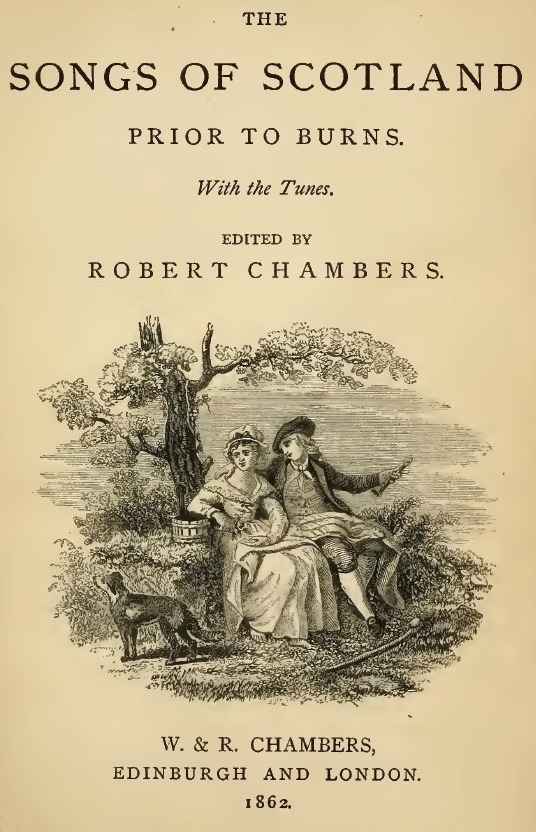
Of Scotland, Prior To Burns
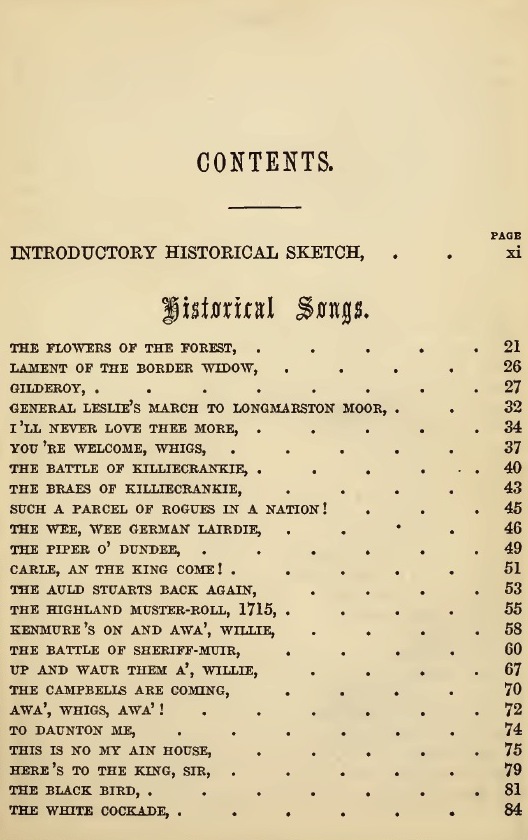
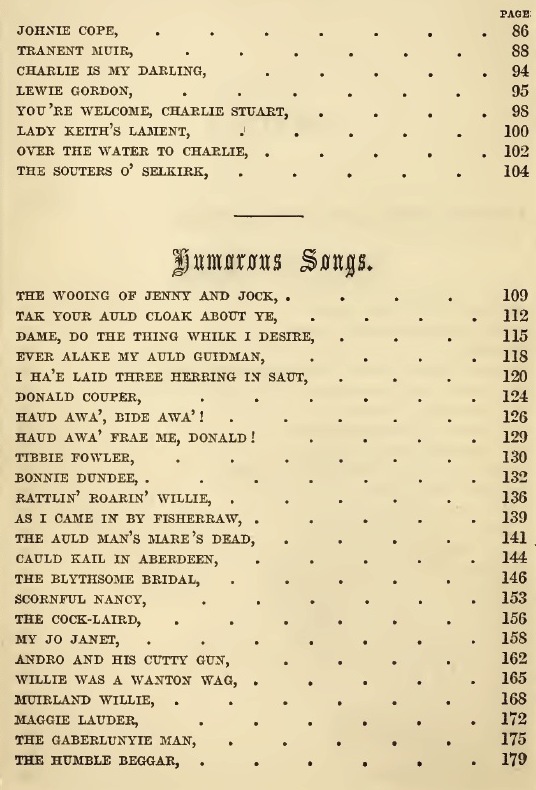
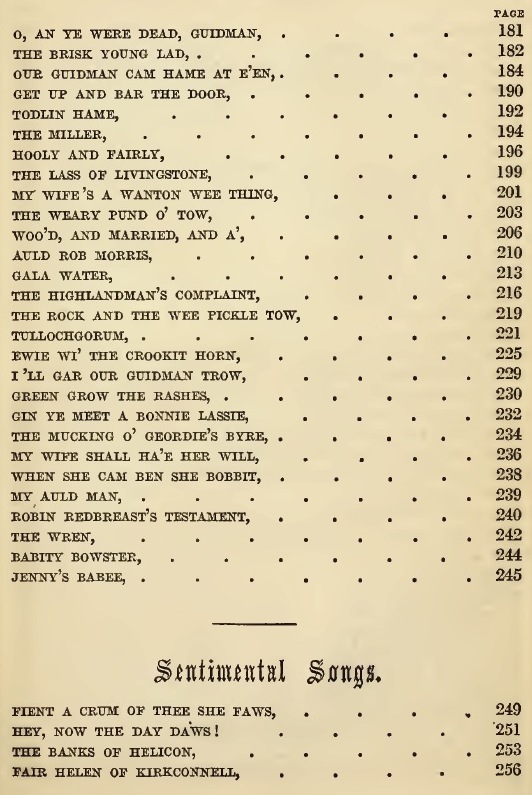
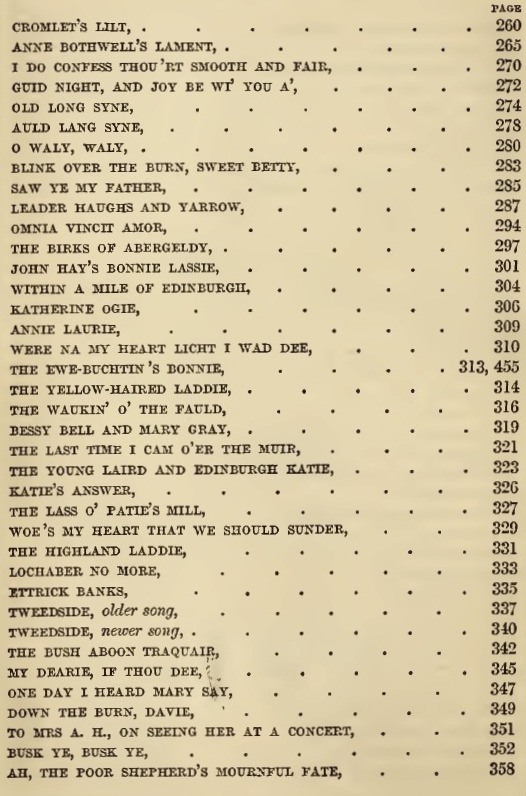
Introduction
The
Flowers of the Forrest
Lament of the Border Widow
Gilderoy
General Leslies
March to Longmarston Moor
Never Love Thee More
You're Welcome Whiggs
The Battle of and
Braes of Killicrankie
Such a Parcel of Rogues in
a Nation!
The Wee, Wee German Lairdie
The Piper O' Dundee
Carle, An The King Come!
The
Auld Stuarts Back Again
The Highland Muster Roll
Kenmures On and Awa Willie
Battle
of Sheriffmuir
Up And Waur Them A Wullie
The Campbells Are Coming
Awa Whigs Awa
To Daunton Me
This Is No My Ain House
Here's to
the King Sir
The Black Bird
The White Cockade
Johnie Cope
Tranent Muir
Charlie is my Darling
Lewis Gordon
You're Welcome Charlie Stuart
Lady Keith's Lament
Over the Water to Charlie
The
Souters of Selkirk
The Wooing of Jenny and Jock
Tak Your Auld Cloak About Ye
Dame Do The Thing Whilk I Desire
Ever Alack My Auld Gudeman
I Ha'e Laid Three Herrings
In Saut
Donald Couper
Haud Awa Bid Awa
Tibbie Fowler
Bonnie Dundee
Rattlin Roarin Willie
As I Came In By Fisherraw
The
Auld Man's Mare's Dead
Cauld Kail in Aberdeen
The Blythsome Bridal
Scornful
Nancy
The Cock-Laird
My Jo Janet
Andro
and his Cutty Gun
Willie was a Wanton Wag
Muirland Willie
Maggie Lauder
The Gaberlunyie Man
The Humble Beggar
An Ye
Were Dead Guidman
The Brisk Young Lad
Our Guidman Cam Hame At E'en
Get
Up And Bar The Door
Toddlin' Home
The Miller
Hooly and
Fairly
The Lass of Livingstone
My Wife's a Wonton Wee Thing
The Weary
Town O' Tow
Wood and Married and A'
Auld Rob Morris
Gala Water
The Highlandman's Complaint
The Rock and the Wee Pickle
Tow
Tullochgorum
Ewie Wi' The Crookit Horn
I'll Gar Our Guidman Trow
Green Grow The
Rashes
The Mucking O' Geordie's Byre
My Wife Shall Hae Her Will
When
She Cam Ben She Bobbit
My Auld Man
Robin Redbreast's testament
The Wren
Babity Bowster
Jenny's Babee
Fient A Crum Of Thee She Faws
Hey, Now The Day Dawns!
The Banks of Helicon
Fair
Helen of Kirkconnell
Cromlet's Lilt
Anne Bothwell's Lament
I Do Confess Thou'rt
Smooth and Fair
Guid Night, And Joy Be Wi You A'
Old Long Syne
Auld Lang Syne
O Waly, Waly
Blink Over The Burns, Sweet
Betty
Saw Ye My
Father
Leader Haughs and Yarrow
Omnia Vincit Amor
The
Birks of Abergeldy
John Hay's Bonnie Lassie
Within A Mile of Edinburgh
Katherine
Ogie
Annie Laurie
Were Na My Heart Licht I Wad
Dee
The
Ewe-Buchtin's Bonnie
The Yellow-Haired Laddie
The Waukin' O' The Fauld
Bessy
Bell and Mary Gray
The Last Time I Came O're The
Muir
The Young Laird and
Edinburgh Katie
Katie's Answer
The Lass O' Pattie's Mill
Woe's My Heart That We
Should Sunder
The
Highland Laddie
Lochaber No More
Ettrick Banks
Tweedside
The Bush Aboon Traquair
My Dearie, If Thou Dee
One Day
I Heard Mary Say
Down The Burn, Davie
To Mrs A. H. On Seeing Her At A Concert
Busk Ye, Busk
Ye
Ah, The Poor Shepherd's
Mournful Fate
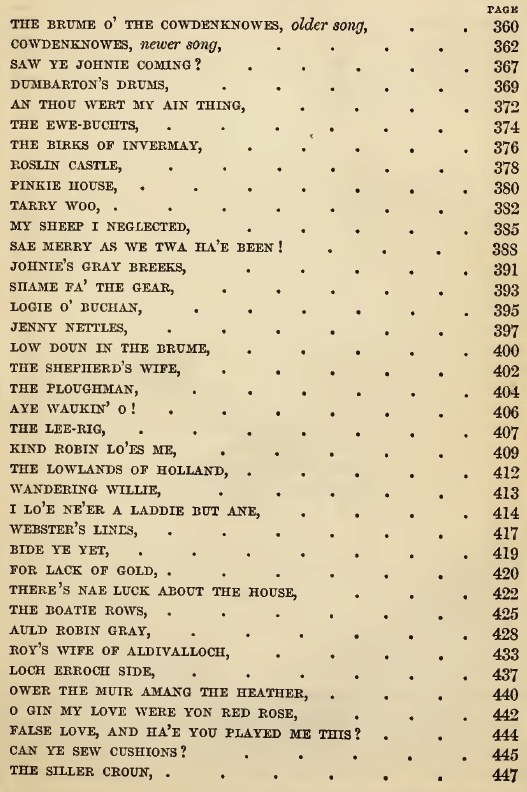
The Brume O' The Cowdenknowes
Saw Ye
Johnie Coming?
Dumbarton's Drums
An Thou Wert My Ain Thing
The Ewe-
Buchts
The Birks of Invermay
Roslin Castle
Pinkie House
Tarry Woo
My Sheep I Neglected
Sae
Merry As We Twa Ha'e Been!
Johnie's Gray Breeks
Shame Fa' The Gear
Logie O'
Buchan
Jenny Nettles
Low Doun In The Brume
The
Shepherd's Wife
The Ploughman
Aye Waukin' O!
The Lee-Rig
Kind Robin
Lo'es Me
The Lowlands of Holland
Wandering Willie
I Lo'e Ne'er A Laddie But Ane
Webster's
Lines
Bide Ye Yet
For Lack of Gold
There's Nae Luck About The
House
The Boatie
Rows
Auld Robin Gray
Roy's Wife of Aldivalloch
Loch Erroch
Side
Ower The Muir Amang The
Heather
O Gin My Love Were Yon Red
Rose
False Love, And Ha'e You
Played Me This?
Can Ye Sew Cushions?
The Siller Croun
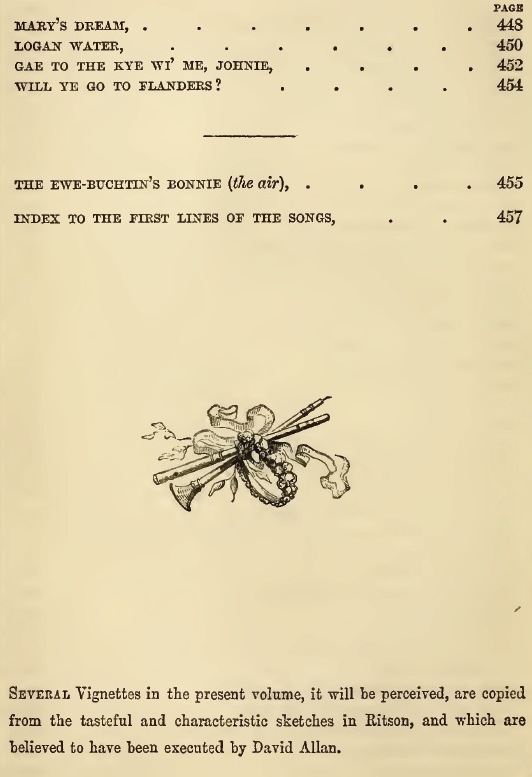
Mary's Dream
Logan Water
Gae To The Kye Wi' Me, Johnie
Will Ye
Go To Flanders?
Air Of The Ewe-Buchtin's
Bonnie
Select Writings of Robert
Chambers
Popular Rhymes of
Scotland (1847)
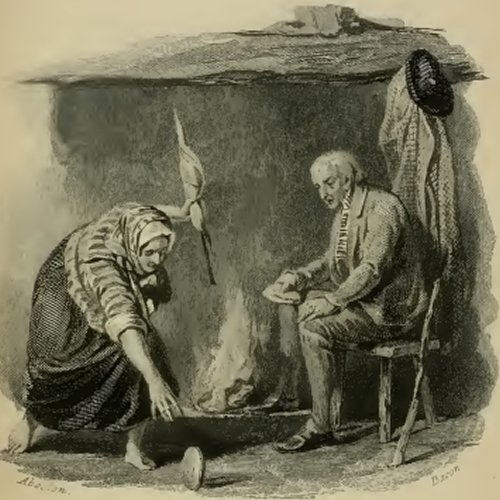
PREFACE
The purpose of this work is to supply a
presumed desideratum in popular antiquities. The various collections of
Percy, Evans, Scott, and others, have now probably given to the world
nearly all that is worth preserving of the songs and ballads of our
island; and this section of British traditionary poetry has been
received amongst the cultivated intellects of the country with a degree
of favour which could not have been dreamt of in the days of Milton and
Dryden. Careless unaffected graces, simple pathos and humour, the total
absence of all those marks of the chisel of the literary workman, and of
all those strainings after effect, which mar the merits of so much
elegant literature, have secured for these wildings of the national
intellect an affectionate admiration and regard, of which many modern
writers of native and acquired skill might well be envious.
Reared amidst friends to whom popular poetry furnished a daily
enjoyment, and led by a tendency of my own mind to delight in whatever
is quaint, whimsical, and old, I formed the wish, at an early period of
life, to complete, as I considered it, the collection of the
traditionary verse of Scotland, by gathering together and publishing all
that remained of a multitude of rhymes and short snatches of verse
applicable to places, families, natural objects, amusements, &c.
wherewith, not less than by song and ballad, the cottage fireside was
amused in days gone past, while yet printed books were only familiar to
comparatively few. This task was executed as well as circumstances would
permit, and a portion of the "Popular Rhymes of Scotland" was published
in 1826. Other objects have since occupied me, generally of a graver
kind; yet, amidst them all, I have never lost my wish to complete the
publication of these relics of the old natural literature of my native
country.
When now about to perfect this wish, I cannot help feeling anxious that
the articles collected may be viewed in a proper light. It is to be
observed, first of all, that they are, in most instances, the production
of rustic wits, in some the whimsies of mere children, and originally
were designed for no higher purpose than to convey the wisdom or the
humours of the cottage, to soothe the murmurs of the cradle, or enliven
the sports of the village green. The reader is therefore not to expect
here anything profound, or sublime, or elegant, or affecting. But if he
can so far upon occasion undo his mature man, as to enter again into the
almost meaningless frolics of children— if to him the absence of
high-wrought literary grace is compensated by a simplicity coming direct
from nature—if to him there he a poetry in the veiy consideration that
such a thing, though a trifle, was perhaps the same trifle to many human
beings like himself hundreds of years ago, and has, times without
number, been trolled or chanted by hearts light as his own, long since
resolved into dust—then it is possible that he may find something in
this volume which he will consider worthy of his attention.
In one respect only can the volume have the least claim upon a less
gentle class of readers. In some instances a remarkable resemblance is
made out between rhymes prevalent over Scotland and others which exist
in England and Germany; thus adding a curious illustration with regard
to the common origin of these nations, as well as showing at how early a
period the ideas of these rhymes had originated. In some instances more
direct proofs are adduced of the great antiquity of even the simplest
and most puerile of these popular verses. I greatly regret that it has
not been in my power to investigate the subject of kindred foreign
rhymes further; but it may be hoped that the present volume, showing
what are those which exist, or have recently existed, in Scotland, will
enable inquirers in France, Holland, Germany, and other countries
containing a Teutonic population, to make out such tallies as may exist
in those countries, and thus complete the investigation in a
satisfactory manner.
Edinburgh, November 24, 1841
CONTENTS
Rhymes on
Places
Characteristics of Places
and their Inhabitants
Popular Reproaches
Rhymes upon Families of
Distinction
Family Characteristics
Rhymes connected with
Superstitions
Slogans
Rhymes respecting Weather
Rhymes upon Natural Objects
Rhymes of the Nursery and Fireside Nursery Stories
Rhymes appropriate to Children's Amusements
Miscellaneous Purile Rhymes
Rhymes connected with New Year Observances
Miscellaneous Rhymes
Original Poems
Chambers's Journal
Nos. 1 To 25. January - June 1854 (pdf). See page 6, Maunderings by a
Scotchman. Also many other editions can be found on the
Internet Archive. |



