|
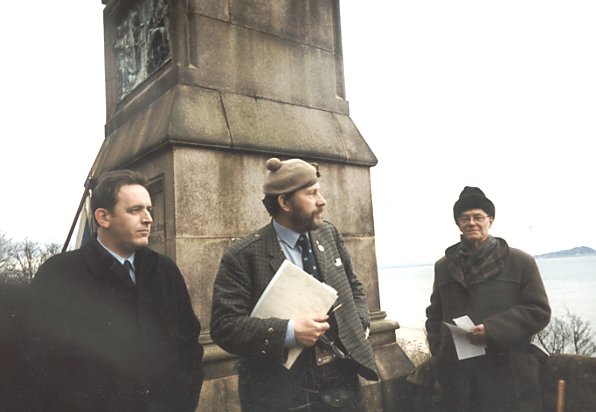
Left to right: Stewart Hosie, National Secretary, Scottish
National Party, Peter D Wright, Organiser Alexander III
Commemoration Committee and James Halliday, Historian and Author.
In Scotland the 19th of March 1286, after a stormy night, gave way to a Spring-like day with no sign of any further storm. At Dunbar Castle, Earl Patrick and his household dismissed the prophesy, made the previous evening by Thomas of Erchildoun, Thomas the Rhymer, that –
“Alas for the morrow, day of misery and calamity! Before the hour of noon there will assuredly be felt such a mighty storm in Scotland that its like has not been known for long ages past. The blast of it will cause nations to tremble, will make those who hear it dumb, and will humble the high, and lay the strong level with the ground.”
As noon approached Earl Patrick and his household, having watched the sky all morning for the prophesied storm, dismissed Thomas the Rhymer’s warning and went in to dinner. They had barely sat down as the clock pointed to noon when a messenger knocked on the Castle gate demanding entrance to see the Earl. He was admitted and gave his urgent news –
“News”, he said,” I have indeed, and evil news, which the whole realm of Scotland will mourn; for alas! its noble King ended his life yesternight at Kinghorn: and this I am come to tell you.”
The Earl Patrick rose and smote his breast, acknowledging that indeed Thomas of Erchildoun was all too true a prophet. Indeed as the messenger said all Scotland would mourn the loss of Alexander
III, whose death marked the end of the direct line of Scottish Kings descended from Kenneth MacAlpine. His death marked a turning point in Scottish History and his reign was to be seen by future generations, poets and historians, as ‘The Golden Age’.
Alexander III had succeeded his father, Alexander
II, in 1249 at the age of seven. At fifteen he took over the reins of government from his Regents and proved to be a wise and capable King. He acted, much in the way of a modern President or Prime Minister, in binding the Nation together, building upon the foundations laid by his father. He presided over a Scotland largely at peace, and with peace came prosperity and an expansion of the Burghs and trade. Indeed Berwick alone, the chief Scottish Burgh of Alexander’s day, had customs equal to a quarter of all the customs of England. The whole Nation prospered as never before.
No King of Scots, before or since, ever did more for the welfare of his realm. He was known as ‘The Peaceable’ because apart from freeing the Hebrides from Norse rule he led his people into no war. Thanks to Alexander peace with Scotland’s larger and more powerful neighbour England was maintained.
He firmly believed in the Independence of Scotland and of the Scots. He successfully withstood false claims of sovereignty by England, both by his father-in-law Henry
III and his brother-in-law Edward I.
The years of peace and rising prosperity gave Scotland, a foundation of unity, and a feeling of Scottishness and a spirit that she never had before. If after his untimely death, William Wallace and Andrew de Moray rallied a Nation against English oppressors, and Robert
I was able to regain Scottish Independence, it was Alexander III who had made that Nation and made his fellow Scots realise the need for a separate Scotland.
On the 18th of March 1286 that Independence was not threatened. Alexander was in good health and firmly in control. That fateful day he held council in Edinburgh Castle, debating a reply to an embassy from the English King Edward
I, a debate that went on until late in the afternoon. Alexander was said to be in good humour at the conclusion of the meeting and after eating he set off in the evening to return to Fife where his second wife, of six months, Yolande, awaited his return.
His nobles tried to persuade him to stay in Edinburgh, as it was an evening of stormy weather, bitterly cold with a strong wind from the north bearing rain and snow. But the King was determined to return to Kinghorn and rode to Queensferry. There the Ferryman tried to persuade him not to cross the gurlie waters of the Forth but to no avail. In an eight-oar ferry Alexander made a slow crossing of the Firth of Forth, as the oarsmen struggled against the elements. Eventually Alexander
III and three esquires arrived at the Fife Burgh of Inverkeithing.
In a pit-mirk night, which was so dark that the Inverkeithing Saltmaster only recognised his King by his voice, his pleas to travel no further were rejected by Alexander. The King was determined to finish his journey and asked for two guides. Off they rode but in the darkness the King and his companions were separated and as he pressed onwards alone, and almost at his destination, Alexander’s horse stumbled in the sand and threw him to his death.
His body was found in the morning and messengers dispatched with the sad news .His death was indeed mourned all over his Kingdom, as Alexander the Peaceable was held in such high esteem and love by his fellow Scots.
With the long and bloody Wars of Independence which followed his death, it is little wonder that Scots would look back on Alexander’s reign as ‘The Golden Age’ and remember the canto, by an unknown hand, recorded in Wynton’s Chronicle –
Quhen Alysandyr oure Kyng wes
dede,
That Scotland led in luve and le,
Away wes sons off ale and brede,
Off wyne and wax, off gamyn and gle;
Oure gold wes changyd in to
lede.
Cryst, borne in to Vyrgynyte,
Succoure Scotland and remede,
That stad [is in] perplexyte.
Seven hundred years on, Scots still look back for inspiration to Alexander’s Golden Age, when Scotland was Independent and prosperous, for as the Historian James Halliday has written “Scotland’s luck died with Alexander at Kinghorn and never the slightest whiff of good fortune was to come the way of the Scottish people for the next seven centuries.”
The Golden Age is still remembered. Every March Scots gather at the memorial to Alexander
III, which stands between Burntisland and Kinghorn in Fife, to pay tribute to his achievements.
This years commemoration will be held on
Sunday 17 march 2002 when the speakers will be Ian Hudghton MEP ( SNP
) and James Halliday, Historian and author. A wreath will be laid in
memory of The Golden Age by Mrs Llily Hudghton.
Peter D Wright
Organiser
Alexander III Commemorative Committee
For more details of the reign of Alexander
III visit ‘Scotland: A Concise History’ by James
Halliday.
|



