|
| |
Significant Scots
Robert Campbell |
| "Most Noble Duke Argyle" read the
inset stone just up from the left side of the doorway of the Campbell home in Omagh,
Northern Ireland. Young Robert Campbell stood at the front of the doorway looking
from one stone to the other one on the right of the door. It read, "Hugh
Campbell built this house in the year of our Lord 1786." In this year of 1812,
the young boy wondered about his life and the values for which his family stood. The
Argyle Clan had spread out across the low mountainous area just south of Londonderry in
the mid-seventeenth century. The terrain of this area was very similar to the
Scottish Highlands with its gently rounded hillsides, wide valleys, plateaus, and well
drained pastures. They prospered. His mother, a Buchannan, traced her linage
through Robert Stewart to Robert II, King of Scotland. With the death of his father
four years before, Robert's older brother Hugh led the family while their mother instilled
the principles of the Clan. "Vix ea nostra voco," she told the children
time after time-- "I scarcely call these things our own--" the principle of
stewardship. Robert knew he had much to live up to. A gift from his father was
to remind him of this all his own life -- the Argyle signet ring which had the buckle and
boar's head as its image.... By the
early 1820s, with life hard in Ireland and his brother's settling in the new world, Robert
knew that his destiny could be found in America. He knew that he had much to learn
and much to live up to. Robert believed he could do so -- afterall, the blood of
nobility coursed though his veins....
Robert worked his way west landing first in St. Louis,
Missouri an outpost on the great Mississippi River where it joined with the Missouri --
"the Gateway to the West."
Over the next decade, Robert entered into and reveled in the
life of the mountain man. He learned to trap the beaver, mink, otter, shoot the
buffalo, and keep his scalp when confronted by the Blackfeet or other Indians. He
also remembered his family and their legacy of honor. Robert believed in dealing
with others honestly and fairly -- Indian or white man. During the rest of his life,
Robert's adventures did credit to his family and he never forgot them. He:
- married and had thirteen children (ten of which died in
childhood);
- became a millionaire in the fur trade, railroad business, and
real-estate;
- served as a confident for six Missouri governors and three
United States Presidents;
- became a colonel in the Missouri Militia;
- advocated for and was one of the few white men ever trusted by
the Plains Indians (he became blood brother with a Flathead Indian)
- supported the Union during the Civil war, but also helped
captured Southern soldiers who were friends of the family;
- led the Missouri relief efforts during the Irish Potato
famine;
- became a leader in St. Louis society;
- was trusted by all who met him.
|
Robert Campbell's life still speaks
to the people of today. He stayed true to the Argyle heritage. Significantly,
one of the paintings in his home which today is a museum in St. Louis, is of a young
Scottish soldier, far from home who is dreaming of his wife and children.
This novel is the result of over six years of research by Stephen Huss who wrote his Ph.D.
dissertation on Robert Campbell. The material was converted to a novel to make it
more readable for the general public. Whenever possible, the words are actually from
one of the over 1,000 letters which are still in existence from Robert to Virginia, his
wife or others. It coveys the life of a remarkable man.
We regret to say that the web site address for this book is invalid and we
are trying to find contact details to trace this book. |
| Robert Campbell (Feb 12,
1804 - Oct 16, 1879) Born in Ireland
and of Scottish ancestry, Robert Campbell came to St. Louis, Missouri in 1822. Afflicted
with tuberculosis, the doctor advised clear mountain air.
Campbell did exactly that:
- In 1825 and 1826 trapped with Jedediah Smith in the Rocky
Mountains
- In 1827 led an expedition which resulted in a skirmish with
the Blackfeet
- In 1828 trapped in Crow territory
- In 1832 with William Sublette trapped the Rockies and
participated in the Pierre's Hole fight.
- In 1833 took supplies to the Green River and began trading
rather than trapping
Campbell attended the Fort Laramie Treaty, formed a regiment
during the Mexican War and became a successful merchant in St Louis, Missouri owning a
large amount of real estate.
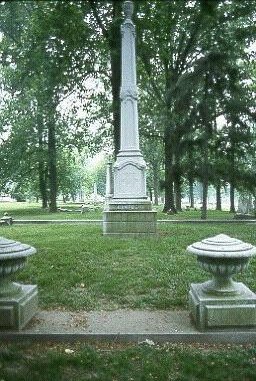
Robert Campbell is buried in the Bellefontaine Cemetery in
St. Louis, MO. |
 |
Return
to our Significant Scots Page |



