The ballad of The Douglas Tragedy is one of the few, to which popular tradition has ascribed complete locality.
The farm of Blackhouse, in Selkirkshire, is said to have been the scene of this melancholy event. There are the remains of a very ancient tower, adjacent to the farmhouse, in a wild and solitary glen, upon a torrent, named Douglas burn, which joins the Yarrow, after passing a craggy rock, called the Douglas craig. This wild scene, now a part of the Traquair estate, formed one of the most ancient possessions of the renowned family of Douglas; for Sir John Douglas, eldest son of William, the first Lord Douglas, is said to have sat, as baronial lord of Douglas burn, during his father's lifetime, in a parliament of Malcolm Canmore, held at Forfar. - GODSCROFT, vol. i. P. 20.
The tower appears to have been square, with a circular turret at one angle, for carrying up the staircase, and for flanking the entrance. It is said to have derived its name of Blackhouse from the complexion of the Lords of Douglas, whose swarthy hue was a family attribute. But, when the high mountains; by which it is enclosed, were covered with heather, which was the case till of late years, Blackhouse must also have merited its appellation from the appearance of the scenery.
From this ancient tower, Lady Margaret is said to have been carried by her lover. Seven large stones erected upon the neighboring heights of Blackhouse, are shown, as marking the spot where the seven brethren were slain; and the Douglas burn's averred to have been the stream, at which the lovers stopped to drink; so minute is tradition in ascertaining the scene of a tragical tale, which, considering the rude state of former times, had probably foundation in some real event.
Many copies of this ballad are current among the vulgar, but chiefly in a state of great corruption; especially such as have been committed to the press in the shape of penny pamphlets. One of these is now before me, which, among many others, has the ridiculous error of "blue gilded horn," for "bugelet horn." The copy, principally used in this edition of the ballad, was supplied by Mr. Sharpe. The three last verses are given from the printed copy and from tradition. The hackneyed verse, of the rose and the brier springing from the grave of the lovers, is common to most tragic ballads; but it is introduced into this with singular propriety, as the chapel of St. Mary, whose vestiges may be still traced upon the lake to which it has given name, is said to have been the burial-place of Lord William and Fair Margaret. The wrath of the Black Douglas, which vented itself upon the brier, far surpasses the usual stanza -
"At length came the clerk of the parish,
As you the truth shall hear,
And by mischance he cut them down,
Or else they had still been here." - *
*At the time when Sir Walter Scott was collecting the material for this work, the farm of Blackhouse was tenanted by the father of his attached friend, and in latter days factor, (or land-steward.) Mr. William Laidlaw. James Hogg was shepherd on the same farm, and in the course of one of his exploring rides up the glen of Yarrow, Sir Walter made acquaintance with young Laidlaw and the "Mountain Bard," who both thenceforth laboured with congenial zeal in behalf of his undertaking. - ED.
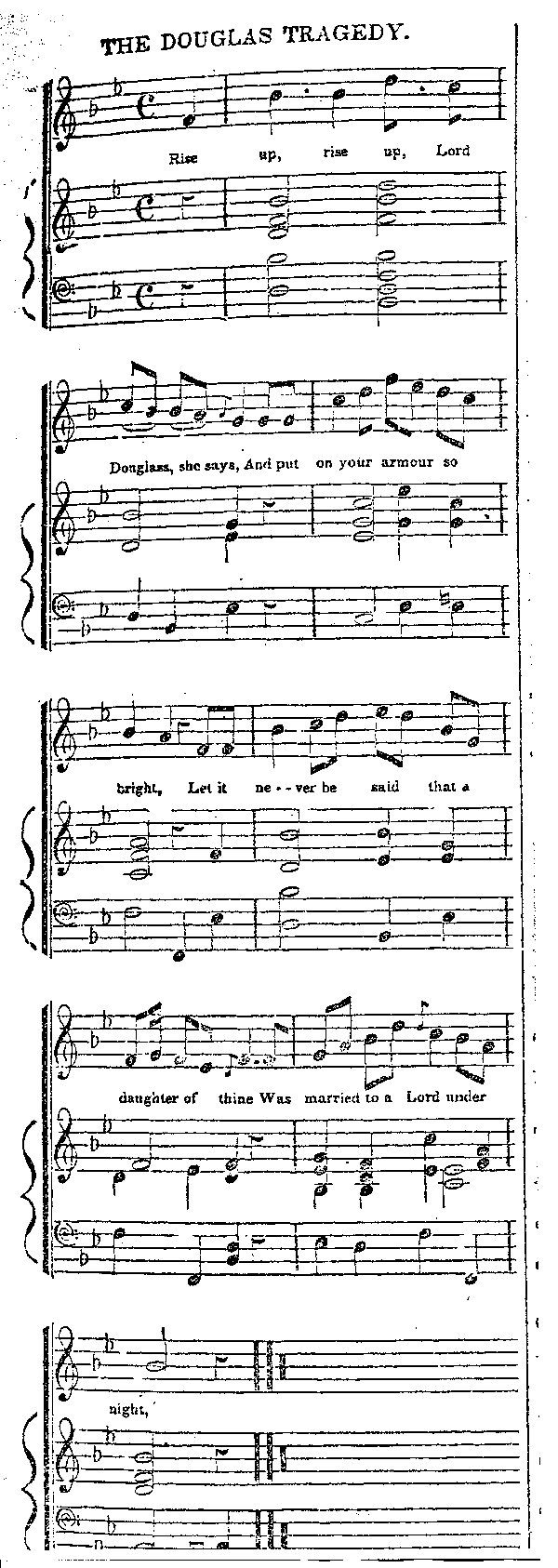
THE DOUGLAS TRAGEDY
 "Rise up, rise up, now, Lord Douglas," she says.
"And put on your armour so bright;
Let it never be said that a daughter of thine
Was married to a lord under night.
"Rise up, rise up, my seven bold sons,
And put on your armour so bright,
And take better care of your younger sister,
For your eldest's awa' the last night." -
He's mounted her on a milk-white steed,
And himself on a dapple grey,
With a bugelet horn hung down by his side,
And lightly they rode away.
Lord William lookit o'er his left shoulder,
To see what he could see,
And there he spy'd her seven brethren bold,
Come riding o'er the lee.
"Light down, light down, Lady Marg'ret," he said.
"And hold my steed in your hand,
Until that against your seven brethren bold,
And your father, I make a stand." -
She held his steed in her milk-white hand,
And never shed one tear,
Until that she saw her seven brethren fa'
And her father hard fighting, who lov'd her so dear.
"O hold your hand, Lord William!" she said,
"For your strokes they are wondrous sair;
True lovers I can get many a ane,
But a father I can never get mair." -
O, she's ta'en out her handkerchief,
It was o' the holland sae fine,
And aye she dighted her father's bloody wounds,
That were redder than the wine.
"O chuse, O chuse, Lady Marg'ret," he said,
"O whether will ye gang or bide?" -
"I'll gang, I'll gang, Lord William," she said,
"For you have left me no other guide."
He's lifted her on a milk-white steed,
And himself on a dapple grey,
With a bugelet horn hung down by his side,
And slowly they baith rade away.
O they rade on, and on they rade,
And a' by the light of the moon,
Until they came to yon wan water,
And there they lighted down.
They lighted down to tak a drink
Of the spring that ran sae clear;
And down the stream ran his gude heart's blood,
And sare she 'gan to fear.
"Hold up, hold up, Lord William," she says,
"For I fear that you are slain!" -
"'Tis naething but the shadow of my scarlet cloak,
That shines in the water sae plain." -
O they rade on, and on they rade,
And a' by the light of the moon,
Until they cam to his mother's ha' door,
And there they lighted down.
"Get up, get up, lady mother," he says,
"Get up, and let me in!" -
Get up, get up, lady mother," he says,
"For this night my fair lady I've win.
O mak my bed, lady mother," he says,
"O mak it braid and deep!
And lay Lady Marg'ret close at my back
And the sounder I will sleep." -
Lord William was dead lang ere midnight,
Lady Marg'ret lang ere day -
And all true lovers that go thegither,
May they have mair luck than they!
Lord William was buried in St. Marie's kirk,
Lady Marg-ret in Marie's quire;
Out o' the lady's grave grew a bonny red rose,
And out of the knight's a brier.
And they twa met, and they twa plat,
And fain they wad be near;
And a' the warld might ken right weel,
They were twa lovers dear.
But bye and rade the Black Douglas,
And vow but he was rough!
For he pull'd up the bonny brier,
And flang'd in St. Marie's Loch.
|