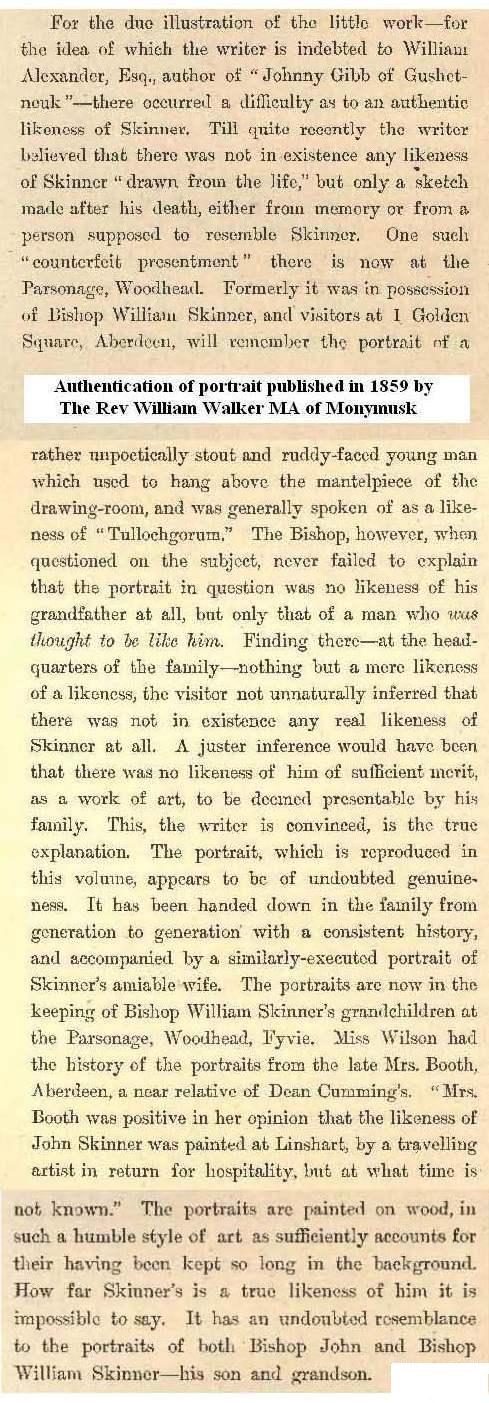
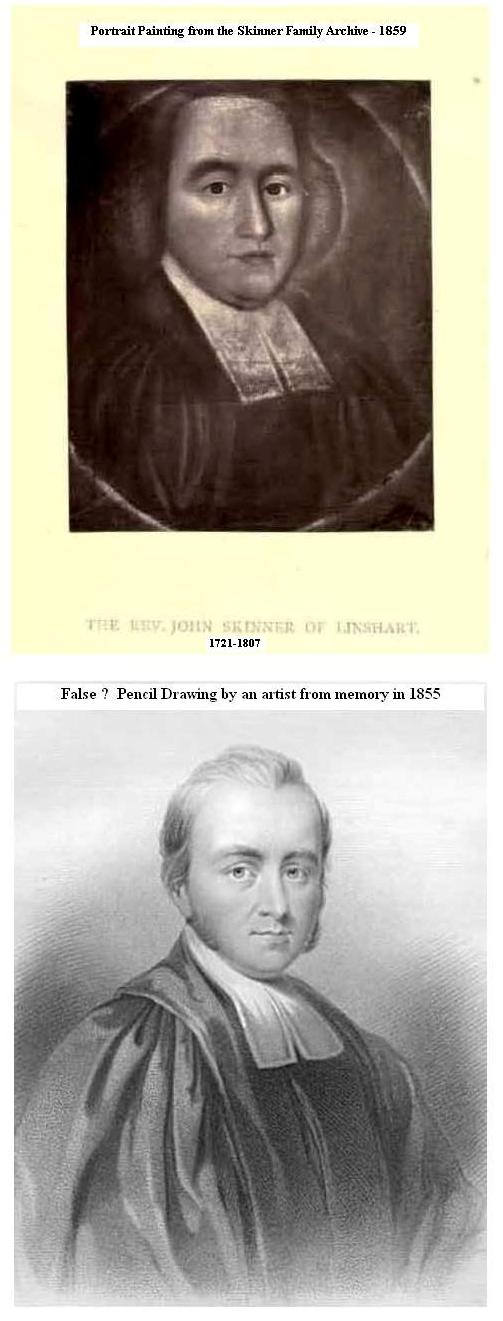
|
| |
Significant Scots
Rev John Skinner |
|
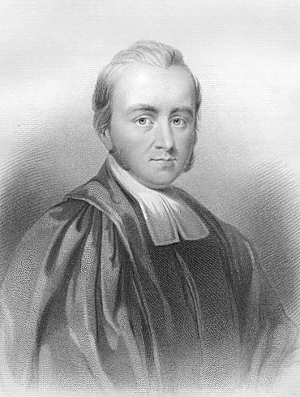 SKINNER,
(REV.) JOHN, the well known author of several popular poems, and of an
ecclesiastial history of Scotland, was born at Balfour, in the parish of
Birse, Aberdeenshire, October 3, 1721. His father was schoolmaster of that
parish, and his mother was the widow of Donald Farquharson, Esq. of Balfour.
Having in boyhood displayed many marks of talent, he was placed at thirteen
years of age in Marischal college, Aberdeen, where his superior scholarship
obtained for him a considerable bursary. After completing his academical
education, he became assistant to the schoolmaster of Kenmay, and
subsequently to the same official at Monymusk, where he was so fortunate as
to gain the friendship of the lady of Sir Archibald Grant. The library at
Monymusk house, consisting of several thousands of well-selected works, in
every department of literature, was placed by lady Grant at his command, and
afforded him better means of intellectual improvement, than he could have
hoped for in any other situation. He now found reason to forsake the
presbyterian establishment, in which he had been reared, and to adopt the
principles of the Scottish episcopal church, of which he was destined to be
so distinguished an ornament. After spending a short time in Shetland, as
tutor to the son of Mr Sinclair of Scolloway, and marrying the daughter of
Mr Hunter, the only episcopal clergyman in that remote region, he commenced
his studies for the church; and, having been ordained by bishop Dunbar of
Peterhead, was appointed, in November, 1742, to the charge of the
congregation at Longside, over which he presided for sixty-five years,
probably without a wish to "change his place." Of the severities with which
the episcopal clergy were visited after the rebellion of 1745, Mr Skinner
bore his full share. His chapel was one of those which were burnt by the
ruthless soldiers of Cumberland. After that period, in order to evade an
abominable statute, he officiated to his own family within his own house,
while the people stood without, and listened through the open windows.
Nevertheless, he fell under the ban of the government, for having officiated
to more than four persons, and was confined, for that offence, in Aberdeen
jail, from May 26th to November 26th, 1753. This was
the more hard, as Mr Skinner was by no means a partizan of the Stuart
family. SKINNER,
(REV.) JOHN, the well known author of several popular poems, and of an
ecclesiastial history of Scotland, was born at Balfour, in the parish of
Birse, Aberdeenshire, October 3, 1721. His father was schoolmaster of that
parish, and his mother was the widow of Donald Farquharson, Esq. of Balfour.
Having in boyhood displayed many marks of talent, he was placed at thirteen
years of age in Marischal college, Aberdeen, where his superior scholarship
obtained for him a considerable bursary. After completing his academical
education, he became assistant to the schoolmaster of Kenmay, and
subsequently to the same official at Monymusk, where he was so fortunate as
to gain the friendship of the lady of Sir Archibald Grant. The library at
Monymusk house, consisting of several thousands of well-selected works, in
every department of literature, was placed by lady Grant at his command, and
afforded him better means of intellectual improvement, than he could have
hoped for in any other situation. He now found reason to forsake the
presbyterian establishment, in which he had been reared, and to adopt the
principles of the Scottish episcopal church, of which he was destined to be
so distinguished an ornament. After spending a short time in Shetland, as
tutor to the son of Mr Sinclair of Scolloway, and marrying the daughter of
Mr Hunter, the only episcopal clergyman in that remote region, he commenced
his studies for the church; and, having been ordained by bishop Dunbar of
Peterhead, was appointed, in November, 1742, to the charge of the
congregation at Longside, over which he presided for sixty-five years,
probably without a wish to "change his place." Of the severities with which
the episcopal clergy were visited after the rebellion of 1745, Mr Skinner
bore his full share. His chapel was one of those which were burnt by the
ruthless soldiers of Cumberland. After that period, in order to evade an
abominable statute, he officiated to his own family within his own house,
while the people stood without, and listened through the open windows.
Nevertheless, he fell under the ban of the government, for having officiated
to more than four persons, and was confined, for that offence, in Aberdeen
jail, from May 26th to November 26th, 1753. This was
the more hard, as Mr Skinner was by no means a partizan of the Stuart
family.
Mr Skinner’s first publication was a pamphlet entitled,
"A Preservative against Presbytery," which he published in 1746, to
re-assure the minds of his people under the alarming apprehension of the
total extirpation of Scottish episcopacy. In 1757, he published at London, a
"Dissertation on Jocob’s Prophecy," which received the high approbation of
bishop Sherlock. In 1767, he published a pamphlet, vindicating his church
against the aspersions of Mr Sievewright, of Brechin. The life of this good
and ingenious man passed on in humble usefulness, cheered by study, and by
the cultivation of the domestic affections. His home was a small cottage at
Linshart, near Longside, consisting simply of a kitchen and parlour, the
whole appearance of which was, in the highest degree, primitive. Here, upon
an income resembling that of Goldsmith’s parson, he reared a large family,
the eldest of whom he had the satisfaction to see become his own bishop,
long before his decease. His profound biblical and theological knowledge is
evinced by his various works, as collected into two volumes, and published
by his family. The livelier graces of his genius are shown in his familiar
songs; " Tullochgorum;" "The Ewie wi’ the Crookit Horn;" "O why should old
age so much wound us, O?" &c. In 1788, he published his "Ecclesiastical
History of Scotland;" in which an ample account is given of the affairs of
the episcopal church, from the time of the Reformation, till its ministers
at length consented, on the death of Charles Stuart, to acknowledge the
existing dynasty. This work, consisting of two volumes octavo, is dedicated
in elegant Latin, "Ad Filium et Episcopum," to his son and bishop. It may be
remarked, that he wrote Latin, both in prose and verse, with remarkable
purity.
In 1799, Mr Skinner sustained a heavy
loss in the death of Mrs Skinner, who, for nearly fifty-eight years, had
been his affectionate partner in the world’s warfare. On this occasion, he
evinced the poignancy of his grief and the depth of the attachment with
which he clung to the remembrance of her, in some beautiful Latin lines,
both tenderly descriptive of the qualities which she possessed, and, at the
same time, mournfully expressive of the desolation which her departure had
caused. Till the year 1807, the even tenor of the old man’s course was
unbroken by any other event of importance. In the spring of that year,
however, the scarcely healed wound in his heart was opened by the death of
his daughter-in-law, who expired at Aberdeen, after a very short, but severe
illness. Each by a widowed hearth, the father and son were now mutually
anxious, that what remained of the days of the former should be spent
together. It was accordingly resolved, that he should remove from Linshart,
and take up his abode with the bishop, and his bereaved family. To meet him,
his grandson, the Rev. John Skinner, minister at Forfar, now dean of
Dunblane, repaired, with all his offspring, to Aberdeen. This was in unison
with a wish which himself had expressed. To use his own affecting language,
it was his desire to see once more his
children’s grand-children, and peace upon Israel.
On the 4th of June, he bade
adieu to Linshart for ever. We may easily conceive the profound sorrow
which, on either side, accompanied his separation from a flock among whom he
had ministered for sixty-five years. He had baptized them all; and there was
not one among them who did not look up to him as a father. After his arrival
in Aberdeen, he was, for a week or ten days, in the enjoyment of his usual
health. Surrounded by his numerous friends, he took a lively interest in the
common topics of conversation; sometimes amusing them with old stories, and
retailing to them anecdotes of men and things belonging to a past
generation. Twelve days after his arrival, he was taken ill at the
dinner-table, and almost immediately expired. He was buried in the
church-yard of Longside, where his congregation have erected a monument to
his memory. On a handsome tablet of statuary marble, is to be seen the
simple but faithful record of his talents, his acquirements, and his
virtues.
|
Return
to our Significant Scots page |