|
 STEWART,
(MAJOR-GENERAL) DAVID, author of the well-known "Sketches," of the
Highlanders and Highland Regiments, was the second son of Robert Stewart,
Esq. of Garth, in Perthshire, and was born in the year 1768. In the
seventeenth year of his age, he entered the 42nd regiment as an
ensign, and soon became distinguished for that steadiness and firmness of
conduct, joined in benignity of nature and amentity of manners, which marked
him through life. He served in the campaigns of the duke of York in
Flanders, and was present at the siege of Nieuport and the defence of
Nimeguen. In 1796, he accompanied the regiment, which formed part of the
expedition under Sir Ralph Abercromby, to the West Indies, and was for
several years actively employed in a variety of operations against the
enemy’s settlements in that quarter of the world; particularly in the
capture of St Lucia, and the harassing and desperate contest which was
carried on with the Caribbs in St Vincent and other islands. In the landing
near Pigeon Island, he was among the first who jumped ashore, under a heavy
fire of round and grape shot from a battery so posted as almost to sweep the
beach. "A cannon-ball," says he, in a letter addressed to Sir John Sinclair,
"passed lord Hopetoun’s left shoulder, and over my head. He observed that a
miss was as good as a mile, to which I cordially agreed; and added, that it
was fortunate for me that I was only five feet six inches; as if I were,
like him, six feet five inches, I would have been a head shorter." In the
year just mentioned, he was promoted to the rank of captain-lieutenant, and,
after serving in the West Indies for a year and a half, he returned to
England, but not to enjoy repose, for he was almost immediately ordered to
join the head-quarters of the regiment at Gibraltar, and the following year
accompanied it, when ordered to assist in the expedition against the island
of Minorca. He was afterwards taken prisoner at sea, and detained for five
months in Spain, when he had the fortune to be exchanged. STEWART,
(MAJOR-GENERAL) DAVID, author of the well-known "Sketches," of the
Highlanders and Highland Regiments, was the second son of Robert Stewart,
Esq. of Garth, in Perthshire, and was born in the year 1768. In the
seventeenth year of his age, he entered the 42nd regiment as an
ensign, and soon became distinguished for that steadiness and firmness of
conduct, joined in benignity of nature and amentity of manners, which marked
him through life. He served in the campaigns of the duke of York in
Flanders, and was present at the siege of Nieuport and the defence of
Nimeguen. In 1796, he accompanied the regiment, which formed part of the
expedition under Sir Ralph Abercromby, to the West Indies, and was for
several years actively employed in a variety of operations against the
enemy’s settlements in that quarter of the world; particularly in the
capture of St Lucia, and the harassing and desperate contest which was
carried on with the Caribbs in St Vincent and other islands. In the landing
near Pigeon Island, he was among the first who jumped ashore, under a heavy
fire of round and grape shot from a battery so posted as almost to sweep the
beach. "A cannon-ball," says he, in a letter addressed to Sir John Sinclair,
"passed lord Hopetoun’s left shoulder, and over my head. He observed that a
miss was as good as a mile, to which I cordially agreed; and added, that it
was fortunate for me that I was only five feet six inches; as if I were,
like him, six feet five inches, I would have been a head shorter." In the
year just mentioned, he was promoted to the rank of captain-lieutenant, and,
after serving in the West Indies for a year and a half, he returned to
England, but not to enjoy repose, for he was almost immediately ordered to
join the head-quarters of the regiment at Gibraltar, and the following year
accompanied it, when ordered to assist in the expedition against the island
of Minorca. He was afterwards taken prisoner at sea, and detained for five
months in Spain, when he had the fortune to be exchanged.
At the close of 1800, he was
promoted to the rank of captain; a step which like all others he
subsequently obtained, was given him for his services alone; and, in 1801,
his regiment received orders to join Sir Ralph Abercromby, in the memorable
expedition to Egypt. At the landing effected in the bay of Aboukir, in the
face of the enemy, on the morning of the 8th of March, and when
the four regiments destined for the attack of the enemy’s position on the
sand hills—the 40th, 23rd, 28th, and 42nd—had
formed, and received orders to charge up the hill and dislodge the enemy at
the point of the bayonet, the subject of this memoir, by his gallant
bearing, and knowledge of the capabilities of his countrymen, when properly
commanded, contributed essentially to the brilliant success which almost
immediately crowned this daring operation. In the celebrated action of the
21st, when the British army overthrew the French, but with the loss of their
commander-in-chief, the services of the 42nd were such as to secure for them
undying fame. On this occasion, captain Stewart, whose personal exertions
had been conspicuous in inspiring the men with a determination to conquer or
perish, received a severe wound, which prevented his taking almost any part
in the subsequent operations of the campaign.
Few officers have ever
possessed so powerful a command over the energies of their men as the
subject of these pages. He had studied the Highland character thoroughly;
had made himself the brother and confident of the men under him; and could,
with an art approaching to that of the poet, awaken those associations in
their bosoms which were calculated to elevate and nerve their minds for the
perilous tasks imposed upon them. The Highland soldier is not a mere
mercenary: he acts under impulses of an abstract kind, which none but one
perfectly skilled in his character, and who has local and family influences
over him, can take full advantage of. The usual principles of military
subordination fail in his case; while he will more than obey, if that be
possible, the officer who possesses the influences alluded to, and will use
them in kind and brotherly spirit. Captain Stewart appears to have enjoyed
and used these advantages in a remarkable degree, and to have possessed not
only the affections of his men, but of all connected with them in their own
country. Hence, when he had to recruit in 1804, for a majority, the stated
number of men, one hundred and twenty-five, came to his quarters at
Drumcharry House, in less than three weeks, after which between thirty and
forty arrived too late for admission into the corps, whose disappointment
and vexation at finding they could not serve under captain Stewart, no
language could describe. With this contingent he entered the 78th, with the
rank of major, and in 1805, trained his men at Hythe, under the immediate
direction of Sir John Moore. In June that year, he was selected with four
other officers to join the first battalion in India; but his parting with
his men was accompanied with such poignant regret, and so many marks of
reluctance on their part, that general Moore reported the case to the
commander-in-chief who, sensible of the value of a mutual esteem existing
between men and officers, countermanded his removal. In September, he
accompanied his regiment to Gibraltar, where it continued a perform garrison
duty until the month of May, 1806, when it embarked for Sicily, to join in
the descent which general Sir John Stuart was then meditating on Calabria.
Major Stewart accompanied the battalion on this occasion, and was present at
the battle of Maida, fought on the 4th of July, 1806, where he was again
severely wounded. Being obliged to return to Britain for his health, he was,
in April, 1808, promoted to the rank of lieutenant-colonel, with a
regimental appointment to the 3rd West India Rangers, then in Trinidad. But
the severity of the wounds he had received, and the effects of the hard
service he had encountered in various parts of the world, rendered it
impossible for him to avail himself of his good fortune, and he was obliged
to retire upon half-pay at a period when, had he been able to keep the
field, he would soon have found further promotion or a soldier’s grave.
Notwithstanding this circumstance, he was, in 1814, promoted to the rank of
colonel.
Colonel Stewart now for
several years employed his leisure in the composition of his work on the
Highlanders, which appeared in the year 1822, in two volumes, 8vo. [It was
entitled, "Sketches of the Character, Manners, and Present State of the
Highlanders of Scotland, with details of the Military services of the
Highland Regiments."] The earlier part of this work, which enters minutely
into the character of the Highlanders, and embodies a great quantity of
original anecdote and observation, is perhaps the most generally
interesting, though it does not aspire to the important quality of
historical accuracy: the most truly valuable part of the book is that which
details the services of the regiments which have been at various times
raised in the Highlands; a body of soldiers generally allowed to have
surpassed every other part of the British army, of the same extent in
numbers, at once in steady moral conduct and in military glory. The work
attained a popularity proportioned to its high merits, and will ever remain
as a memorial of its author, endearing his name to the bosoms of his
countrymen.
A few months after the
publication of his book, colonel Stewart succeeded to his paternal estate,
in consequence of the deaths of his father and elder brother, which occurred
in rapid succession. He is understood to have employed part of the year
1823, in collecting materials for a history of the Rebellion of 1745, a
desideratum in our literature which no hand was so well qualified to supply;
but, finding insuperable difficulties in the execution of the task, he was
reluctantly obliged to abandon it. In 1825, he was promoted to the rank of
major general, and he was soon after appointed governor of the island of St
Lucia. He proceeded to undertake this duty, with high hopes on his own part,
but the regrets and fears of his friends. Unfortunately, their anticipations
proved true. General Stewart died of fever, on the 18th of
December, 1829, in the midst of many improvements which his active mind had
originated in the island, and which, had he lived to complete them, would
have probably redounded to his honour as much as any transaction in his
useful and well-spent life.
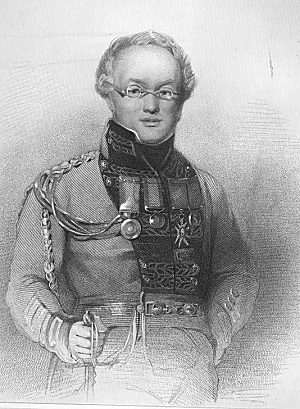
General Stewart was of the
middle stature, but originally of a robust frame, which was latterly
shattered considerably by wounds. His features, which spoke his character,
have been commemorated in a spirited engraving, representing him in the
Highland dress. Few individuals in recent times have secured so large a
share of the affections of all classes of the people of Scotland, as David
Stewart of Garth.
 |



