|
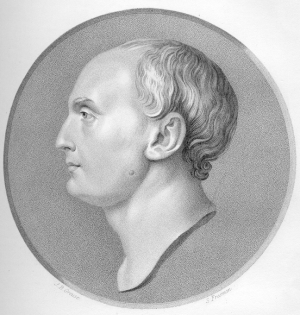 STRANGE,
(SIR) ROBERT, Knight, the father of the line manner of engraving in
Britain, was born in the island of Pomona, in Orkney, July 14, 1721. He was
lineally descended from Sir David Strange, or Strang, a younger son of the
family of Strang of Balcaskie, in Fife, who had settled in Orkney at the
time of the Reformation. He received a classical education at Kirkwall,
under the care of Mr Murdoch Mackenzie, teacher there, and who rendered some
estimable service to his country by accurate surveys of the Orkney islands,
and of the British and Irish coasts. STRANGE,
(SIR) ROBERT, Knight, the father of the line manner of engraving in
Britain, was born in the island of Pomona, in Orkney, July 14, 1721. He was
lineally descended from Sir David Strange, or Strang, a younger son of the
family of Strang of Balcaskie, in Fife, who had settled in Orkney at the
time of the Reformation. He received a classical education at Kirkwall,
under the care of Mr Murdoch Mackenzie, teacher there, and who rendered some
estimable service to his country by accurate surveys of the Orkney islands,
and of the British and Irish coasts.
The subject of this memoir
successively applied himself to the law and to the sea, before his talent
for sketching pointed out the propriety of his making art
his profession. Some sketches shown by a friend
to Mr Richard Cooper, an engraver of some eminence in Edinburgh, and
approved by him, led to Mr Strange being placed under that individual as an
apprentice; and the rapid progress he made in his new profession soon showed
that he had only now for the first time fallen into the line of life for
which he was destined by nature. He was practising his art in Edinburgh on
his own account, when, in September, 1745, the Highland army took possession
of the city. Mr Strange was not only himself well-inclined to this cause,
but he had formed an attachment to a Miss Lumisden, [Sister to Mr Andrew
Lumisden, a Jacobite partizan of some note, and who afterwards formed part
of the household of prince Charles Stuart at Rome, of the antiquities of
which city he published an account.] who had the same predilections. These
circumstances, which his local notoriety as an engraver, pointed him out as
a proper person to undertake a print of the young chevalier. While employed
on this work, his lodgings in Stewart’s Close were daily resorted to by the
chief officers and friends of the prince, together with many of the most
distinguished ladies attached to his cause. The portrait, when completed,
was looked upon as a wonder of art; and it is still entitled to considerable
praise. It was a half length in an oval frame on a stone pedestal, on which
is engraved "EVERSO MISSUS SUCCURRERE SECLO." As a reward for his
services, he was offered a place in the finance department of the prince’s
army, or, as another account states, in the troop of Life Guards; which
partly at the instigation of his mistress, who otherwise threatened to
withdraw her favour from him, he accepted. He therefore served throughout
the remainder of the campaign. Soon after the battle of Falkirk, while
riding along the shore, the sword which he carried in his hand was bent by a
ball from one of the king’s vessels stationed a little way out at sea.
Having surmounted all the perils of the enterprise, he had to sculk for his
life in the Highlands, where he endured many hardships. On the restoration
of quiet times, he ventured back to Edinburgh and supported himself for some
time by drawing portraits of the favourite Jacobite leaders, which were
disposed of to the friends of the cause at a guinea each. A few, also, which
he had destined for his mistress, and on that account adorned with the
utmost of his skill, were sold about this period with a heavy heart to the
earl of Wemyss, from whom, in better times, he vainly endeavoured to
purchase them back. In 1747, he proceeded to London, but not before he had
been rewarded for all his distresses by the fair hand of Miss Lumisden.
Without waiting long in the metropolis, he went to Rouen, where a number of
his companions in the late unfortunate war were living in exile, and where
he obtained an honorary prize given by the academy. He afterwards resided
for some time at Paris, where he studied with great assiduity under the
celebrated Le Bas, who taught him the use of the dry needle. In 1751, he
returned to London, and settled as an engraver, devoting himself chiefly to
historical subjects, which he handled in so masterly a manner that he soon
attracted considerable notice. In 1759, when he had resolved to visit Italy,
for his further improvement, Mr Allan Ramsay intimated to him that it would
be agreeable to the prince of Wales and the earl of Bute, if he would
undertake the engraving of two portraits which he had just painted for those
eminent personages. Mr Strange refused, on the plea of his visit to Italy,
which would thus be put off for a considerable time, and he is said to have
thus lost the favour of the royal preceptor, which was afterwards of
material disadvantage to him, although the king ultimately approved of his
conduct, on the ground that the portraits were not worthy, as works of art,
of being commemorated by him.
Mr Strange set out for Italy
in 1760, and in the course of his tour visited Naples, Florence, and other
distinguished seats of the arts. He was everywhere treated with the utmost
attention and respect by persons of every rank. He was made a member of the
academies of Rome, Florence, and Bologna, and professor of the royal
academy at Parma. His portrait was introduced by Roffanelli, amongst those
of other distinguished engravers, into a painting on the ceiling of that
room in the Vatican library where the engravings are kept. He had also the
distinguished honour of being permitted to erect a scaffold in one of the
rooms of that magnificent palace for the purpose of taking a drawing of the
Parnassus of Raphael; a favour not previously granted for many years to any
petitioning artist. And an apartment was assigned for his own abode, while
engaged in this employment. A similar honour was conferred upon him
at the palace of the king of Naples, where he wished to copy a celebrated
painting by Schidoni. Mr Strange’s drawings were in coloured crayons; an
invention of his own, and they were admired by all who saw them. He
subsequently engraved prints on a splendid scale from about fifty of the
paintings which he had thus copied in Italy. [The following are among the
principal engravings by Sir Robert Strange;—Two heads of himself, one an
etching, the other a finished proof; The Return from Market by Wouvermans;
Cupid by Vanloo; Mary Magdalen; Cleopatra; the Madonna; the Angel Gabriel;
the Vrgin with the child asleep; Liberality and Modesty, by Guido; Apollo
rewarding merit and punishing arrogance, by Andrea Sacchi; the Finding of
Romulus and Remus, by Pietro de Cortona; Caesar repudiating Pompeia, by the
same; Three children of Charles I., by Vandyke; Belisarius, by Salvator
Rosa; St Agnes, by Domenichino; the Judgment of Hercules, by Nicolas Poussin;
Venus attired by the Graces, by Guido; Justice and Meekness, by Raphael; the
Offspring of Love by Guido; Cupid Sleeping, by the same; Abraham giving up
the handmaid Hagar, by Guercino; Esther, a suppliant before Ahasuerus, by
the same; Joseph and Potiphar’s wife, by Guido; Venus, by the same; Danae,
by the same; Portrait of Charles I. by Vandyke; the Madonna, by Corregio; St
Cecilia, by Raphael; Mary Magdalen, by Guido; Our Saviour appearing to his
Mother after his resurrection, by Guercino; A Mother and Child by Parmegiano;
Cupid Meditating, by Schidoni; Laomedon, king of Troy, detected by Neptune
and Apollo, by Salvator Rosa. Sir Robert, near the close of his life, formed
about eighty reserved proof copies of his best prints into as many volumes,
to which he added a general title-page, and an introduction on the progress
of engraving.]
The subsequent part of the
life of Mr Strange was spent in London, where he did not acquire the favour
of the court till 1787, when he was knighted. A letter by him to lord Bute,
reflecting on some instances of persecution which he thought he traced to
that nobleman, appeared in 1775 and was subsequently prefixed to an "Inquiry
into the Rise and Establishment of the Royal Academy at London," which was
provoked from his pen by a law of that institution against the admission of
engravings into the exhibitions. After a life spent in the active exercise
of his professional talents, he died of an asthmatical complaint on the 5th
of July, 1792, leaving, besides his lady, a daughter and three sons. Sir
Robert has been described by his surviving friends, as one of the most
amiable and virtuous of men, as he was unquestionably among the most able in
his own peculiar walk. He was unassuming, benevolent, and liberal. His
industry was equally remarkable with his talent. In the coldest seasons,
when health permitted him, he went to work with the dawn, and the longest
day was too short to fatigue his hand. Even the most mechanical parts of his
labours he would generally perform himself, choosing rather to undergo a
drudgery so unsuitable to his talents than trust to others. His remains were
interred in Covent Garden church-yard.
Memoirs of Robert Strange
Memoirs of Sir Robert Strange, Knt., Engraver
And of his Brother-In-Law Andrew Lumisden, Private Secretary to the Stuart
Princes By James Dennistoun of Dennistoun in two volumes (1855)
Volume 1 |
Volume 2 |



