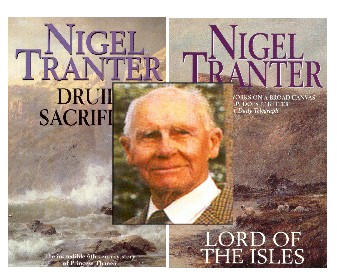
THE death in
January 2000 of Nigel Tranter, OBE, who, at 90, was one of Scotland's best-loved and most
prolific authors, deprives his family and his beloved country of one of the great masters
of historical reconstruction.
His more than 130 publications, which included the multi-million
selling Bruce trilogy and The Freebooters - a novel about the removal of the Stone of
Destiny from Westminster Abbey - brought Scotland's past to life for millions of people
around the world. They established him at the forefront of historical fiction.
He remained active until the last weeks of his life, and continued
to sketch the bare outlines of his books on a small clipboard while walking miles every
day along the southern shores of the Forth by Aberlady, east of Edinburgh.
He would return to his study to sew the sheaves of paper together
before typing his manuscript on a battered old typewriter. In November, he revealed that
he had seven more books in the pipeline.
Despite numerous requests from publishers to write his
autobiography, it was only recently that he allowed the publication of a "warts and
all" biography by retired diplomat Ray Bradfield, published to coincide with the
author's 90th birthday last November.
Mrs Bradfield, author of Nigel Tranter: Scotland's Storyteller,
explained last week why she felt so many people owed him a debt of gratitude: "The
great thing about Nigel was that he had this fantastic gift of a vivid visual imagination,
which lasted him right until the end.
"He had a gift for storytelling which was combined with this
really passionate love for Scotland, and all of that went into the service of the ordinary
people of Scotland - not the academics, not the intellectuals who can read the history for
themselves, but the ordinary people."
She added: "He gave ordinary people back their history and
their identity. They walked taller because of Nigel Tranter."
However, it was almost sheer happenstance that led the young Tranter
to publish his first book almost 65 years ago, his initial interest lying in architectural
restoration.
Born in 1909 in Glasgow, he moved to Edinburgh as a small boy and
attended George Heriot's School. Though he showed no particular interest in history, a
passion for architecture took him on cycling expeditions to the Borders, sketching
historic mansions with details of their background.
After school he went to work for Aldjo Jamieson Arnott, the
restoring architects in Edinburgh, but the early death of his father led to financial
stringencies, in turn forcing him to join the Scottish National Insurance Company, founded
by his uncle.
Nevertheless, books were already stirring inside him. At 25, he
produced the unlikely non-fiction title of The Fortalicles and Early Mansions of Southern
Scotland and, prompted by his wife May, whom he married in 1933, he produced his first
novel, Trespass - a romantic story set in the Highlands - in 1937.
Unfortunately his publisher, Moray Press, went bankrupt and he did
not receive a penny for it. But he persevered and by the time war broke out in 1939 he was
making £500 a year from writing, while still retaining his post in insurance.
By then, the Tranters had moved with their two children, Frances May
and Philip, to live at Aberlady, where he stayed until around a year ago. His war was
spent mostly in East Anglia, as a Royal Artillery officer, but there was still enough time
to write five novels.
Returning to Aberlady in 1946, and faced with having to support his
family, he became a full-time writer and wrote a number of children's books. After
cottoning on to the potential of the Western, he wrote 14 of them under the pen-name of
Nye Tredgold.
But he later realised that he needed to add another dimension to his
writing. In his researches for five non-fiction volumes of The Fortified House in
Scotland, he had amassed a great deal of material which led him, almost unwittingly, to
become a popular "teacher" of Scottish history, a role he accepted with the
utmost responsibility.
His public was worldwide, creating a fan mail which received his
personal attention. He held numerous honorary positions, including Honorary President of
the Saltire Society, President of the Scottish Castles Association, and BBC Radio Scot of
the Year in 1989.
A strong religious faith saw him through the worst experience of his
life, when his son, Philip, was killed in a car crash in France. He was only 27. Philip is
buried at Aberlady, beside his mother, May, who died in 1979.
In an interview with The Herald, Tranter was asked how he would like
to be remembered. "As a storyteller who tried to get people to appreciate Scotland's
story and to realise how exciting, colourful and dramatic it really is," he replied.
In late December, Tranter was invited to tour the Scottish
Parliament by SNP MSP Richard Lochhead.
Mr Lochhead said last week: "He was brimming with enthusiasm,
and eager to convey his thoughts to everyone whom he met that day.