|
ROADS.
Before the establishment of
turnpike duties for repairing high-ways (in 1714) the road in Penicuik
parish must have been in a deplorable condition. All over the county indeed
they were almost unfit, especially in wet weather, for anything in the shape
of carriage traffic. At the beginning of the present century only two
turnpike roads passed through the parish. One of these was from Edinburgh to
Dumfries and the west of England. Its course ran close to the base of the
hills all the way to Carlops, and part of it at Morton was on the direct
line of the old Roman road to Cramond. The other turnpike from the
metropolis passed through Auchendinny, on by the Pike, Howgate, Noblehouse,
and Broughton, to Dumfries. In connection with a portion of this latter road
one ancient and interesting historical fragment has been preserved, which
points out not only the bad condition of the highways, but also the
authorities who in those days were responsible for the mending of them. It
is an application from Thomas Vernour, the laird of Auchendinny, to the King
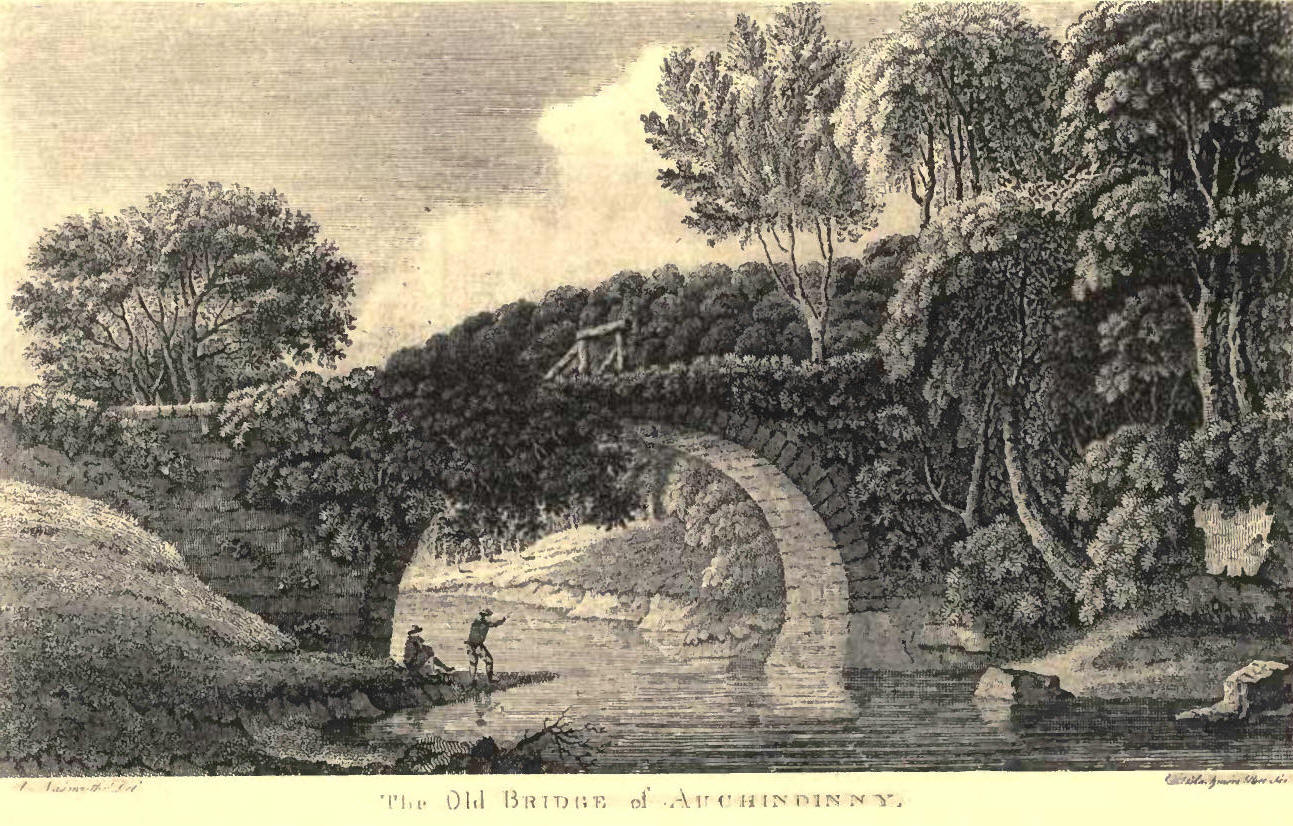
and Council, dated 1601, in which he petitions `That the bridges on the
water of the North Esk at Glencross, called Auchendinny Brigs, being the
only direct passages between Edinburgh and the south, are ruinous and
about fallen down, so that
pair cadgeris, travellers, and other passengers resortand, will be forcit to
their grait skaith to pass three or four miles about.' On this account the
lairds of Craigmillar, Pennycuke, and Hawthornden, the bailie of the barony
of Glencorse and Castlelaw, and the whole of the ministers of the Presbytery
of Peebles, have agreed that petitioner shall be commissioner for repair of
said bridges. He petitions for such commission accordingly to this effect,
that the King and Council give the petitioner power for two years to uplift
the following duties: For every horseman 2d.; every footman 1d.; every cow
or ox 2d. every 10 sheep 4d.; every cart 2s.; and every horse and pack 8d.
The allusion to the Presbytery of Peebles in the above, as one of the
authorities whose sanction has been obtained, is interesting, as showing
that the ecclesiastical courts had some jurisdiction in such matters in
those times.
In further illustration of
this, the following extracts from the Session minutes prove how, as a kind
of court of appeal, even in the question of rights of way, the Church had no
little influence in settling disputes.
The date of the first is
March 28th, 1675, and runs thus: William Steel of Newhall complains that the
ordinary and only way to the kirk was stopt between Ravenshauch and
Newbigging, and that therefore he could not come to church. The minister and
elder considering the stopping of that ordinary passage, which accommodates
all the tenants of Newhall, Marfield, Brunstane, and Ravenshaugh, to the
kirk, and that without that passage they could not he well accommodated with
any other way, and upon several other accounts declare that they think that
passage without publicity cannot be stopt, and seeing that the minister has
already dealt with the Laird of Pennycuke for opening that passage, resolve
to send two of their number, James Oswald of Spittal and David Hislopp of
Mosshouses, to deal with Pennycuke to that effect.'
The next is dated February
22d, 1676, and runs thus `Appeared Alexander Pennycook of Newhall, relating
to the Session by way of complaint that seeing the ordinary and old was' for
him and his tenants to the kirk was now shut up by a gate upon a straight
passage of the same by the directions of the Laird of Penycuke, and no new
sufficient way made in place thereof, according, to the law of the land, he
desired with his tenants to be excused if he did not come to the parish kirk
with them until this passage was made patent, to whom the minister and
elders unanimously replied that they were sorry that he had not an easy way
to kirk with his family and tenants, and that if in their power they would
help him to one; but forasmuch as they are not competent judges of highways,
that therefore he might make his address to the judge competent, who, they
doubted not, would provide him a good way according to Act of Parliament,
and the rather as they had used all their means with the Laird of Pennycuke
before now for continuing the old way.'
The road referred to in these
appeals would probably be upon much the sauce track as that which existed up
to near the middle of the present century, leading from the village up the
waterside to Brunstane, and from thence to Marfield, joining the old Biggar
road at Unthank. At the time when these complaints of the high-handed action
of the Penicuik laird were made, there can have been no path available but
one for foot-passengers or horsemen, for there were then no roads in the
parish suitable for carriage traffic. Sledges only could be used for time
transport of heavy material. Readers of The Gentle Shepherd may remember
Glaud's allusion to this fact when addressing Symon in Song viii., thus-
I'll yoke my sled and send to
the neist town,
And bring a draught of ale baith stout and brown.'
Writing in 1793, the Rev. Mr.
MCourty describes the two main turnpike roads as 'full of pulls and
extremely fatiguing and irksome to travellers.' In the good old clays of a
hundred years ago no improvement upon the ancient methods of road-making had
been introduced. The shortest cut was then the first consideration. Up ,hill
and down dale, no matter how high the ,gradient or how deep the slough at
the bottom, was the order of things. Mr. M`Courty mentions the fact that a
by-road had been recently made between the village and Howgate. No way of
reaching that hamlet, other than through the fields, formerly existed,
except the circuitous road by Kirkhill, Harpersbrae, and Maybank. The
reverend gentleman also says that a communication was being formed from the
Linton road across the hills, which would give access to the eastern parts
of the parish on the other side of the range, over which there had been
hitherto no easy passage. This would undoubtedly be the path now known as
the right of way which enters the Pentlands near Silverburn, proceeding by
the Wester Kip and Bavelaw, Redford and Balerno, a distance of twelve miles.
The present main road from Edinburgh to Penicuik was finished about 1812,
and proved an immense boon to the parishioners of that time as well as to
their successors in times more recent. Mr. James Niven of Penicuik, in his
pamphlet entitled Reflections on the Days of Youth, published in 1824,
alludes to the great improvement in the turnpike roads of the parish since
his school-days, when lie says they were so bad that the farmers sent all
their produce on horses' backs to Edinburgh. The village, he continues, `was
then a good distance from the turnpike, and a carriage, with the exception
of the laird's, was such a wonder to be seen, that all the inhabitants
turned out to craze, Wonder, and admire. Within a dozen years or so from the
time at which Mr. Niven wrote, a considerable development in roa(1-nlaking
took place within the parish, and, thanks to that intelligent Scotsman, Mr.
Macadam, the quality as well as the number of them was greatly improved.
Rev. Mr. Scott Moncrieff,
writing in 1836, alludes to the three great turnpikes traversing the parish
from north to south, viz., the old Dumfries road by Howgate, time new one by
Penicuik village, and a lately much improved line by Ninemileburn. There is,
he says, also another turnpike road recently opened connecting Penicuik with
West Linton, while a parallel line was being carried through between
Penicuik and Ninemileburn. This latter road is that which begins at the
finger-post on the Edinburgh road, continuing by Cornbank, Kersewell, and
Walston, on to Carlops. Prior to 1854 the only road to the west available
for carriage traffic went up past the Episcopal Chapel, through the high
park to the south of the present main entrance-gate to Penicuik House, on by
the Tipenny lodge, up through Lowrie's den to the old high road, which then
continued much in its present track until about 300 yards west of Silverburn,
where, clinging; close to the base of the hill, on past Walston stealing, it
finally joined the line of the present Carlops road, a little distance to
the north of that village. The other turnpike to Linton mentioned by Mr.
Moncrieff was formerly called Bolton's road, from the name of the contractor
who built it, and is now known as the Harlaw Muir road. There is at present
little traffic upon it, and a considerable portion of it is grass-grown.
The parish is indeed now
supplied with good roads in all directions. The control of them has been
vested by time Local Government (Scotland) Act of 1889 in the Midlothian
County Council, and it will be the duty of the representatives from the
burgh and parish of Penicuik to see that they are henceforward kept in a
creditable condition.
COACHES AND RAILWAYS.
The great development of our
turnpike system during the present century caused a proportionate increase
in the means of communication with other centres of population, as well as
an improvement in the kind and equipment of the conveyances used in the
transport of passengers.
Prior to the beginning of the
present century only one vehicle was available for the purpose of conveying
passengers from Penicuik to Edinburgh. This was the carrier's cart, which
travelled on Tuesdays and Saturdays to the metropolis, putting ulp at
Paterson's of the Candlemaker Row, and latterly at Eckford's in the
Grassmarket.
About the year 1803 another
primitive conveyance became available, to a limited extent, for travellers
from this district. This was a plain wooden vehicle placed upon two wheels
and without springs, called William Wilson's Caravan, which left Peebles at
eight o'clock in the morning, passing Maybank, and reaching Edinburgh at six
o'clock in the evening. This exceedingly slow coach was superseded about the
year 1806 by the Fly, an old-fashioned post-chaise, which held three inside
and one outside—the latter sitting upon an uneasy swinging seat beside the
driver. It was drawn by two horses, and, including a stoppage of an hour at
How gate, it made the journey from Peebles to Edinburgh in five hours, going
the one day and returning the next. It is worthy of remark, however, that at
this period a hackney coach could be hired in Edinburgh for a drive to
Penicuik for the modest sung of six shillings. Stage coaches now began to
run regularly between Edinburgh and Dumfries, passing through Auchendinny,
the Pike, and Howgate, on their way. The Carlisle coach also vent via
Maybank, Howgate, and Peebles, on by Innerleithen, Selkirk, and Hawick, to
its final destination.
Both these conveyances were
taken advantage of to it limited extent for local traffic. So also was the
Dumfries coach, which, about 1820, began to run by the new road from
Edinburgh through Penicuik, Noblehouse, and Blythe Bridge. Some years
afterwards, owing to the public spirit and enterprise of Mr. John Carstairs
of Springfield, an omnibus was started to carry passengers between
Wellington Inn and the metropolis, leaving the first-mentioned place in the
morning and returning in the afternoon. This he carried on for a
considerable time, greatly to the public advantage, after which it passed
into the hands of Messrs. Croall, Edinburgh. It is within the recollection
of residenters, yet comparatively young, how Croall's coach, as it was then
called, had finally to yield to the all-conquering power of steam, and
ceased to exist as a mediums of communication with the metropolis.
Long before that time,
however, the Peebles train, which then as now stopped at Pomathorn station,
was largely taken advantage of by Penicuik travellers, as well as by the
mill-owners for their heavy goods traffic. The bill giving powers to execute
this line was carried through Parliament without opposition on 8th July
1853. The Railway Company so constituted was empowered to raise a capital of
£70,000 in shares of £10, and to borrow in addition £23,000. In 1857 another
Act authorised the creation of new shares to the extent of £27,000 in £10
shares, guaranteeing a dividend of five per cent., making in all a capital
of £120,000.
The line was opened for
traffic on 4th July 1855, and in 1861 it was leased in perpetuity by the
Peebles Railway Company to the North British Railway Company, which now
works the traffic on terms mutually advantageous. The distance of this
railway from the valley of the Esk ultimately proved a source of
inconvenience to the papermakers on the tipper reaches of that river, and
they determined in consequence to lay down a line for goods and passenger
traffic nearer to their own works. The necessary powers were obtained; a sum
of over £6000 was paid to the proprietors of land for way-rights, and a
branch line from the Peebles railway at Hawthornden was laid right up to
Penicuik, at an additional cost of over £62,000. This was finished in the
year 1812. The North British Railway, who supplied the train service,
ultimately purchased the property and entered into possession in the month
of June 1877. |